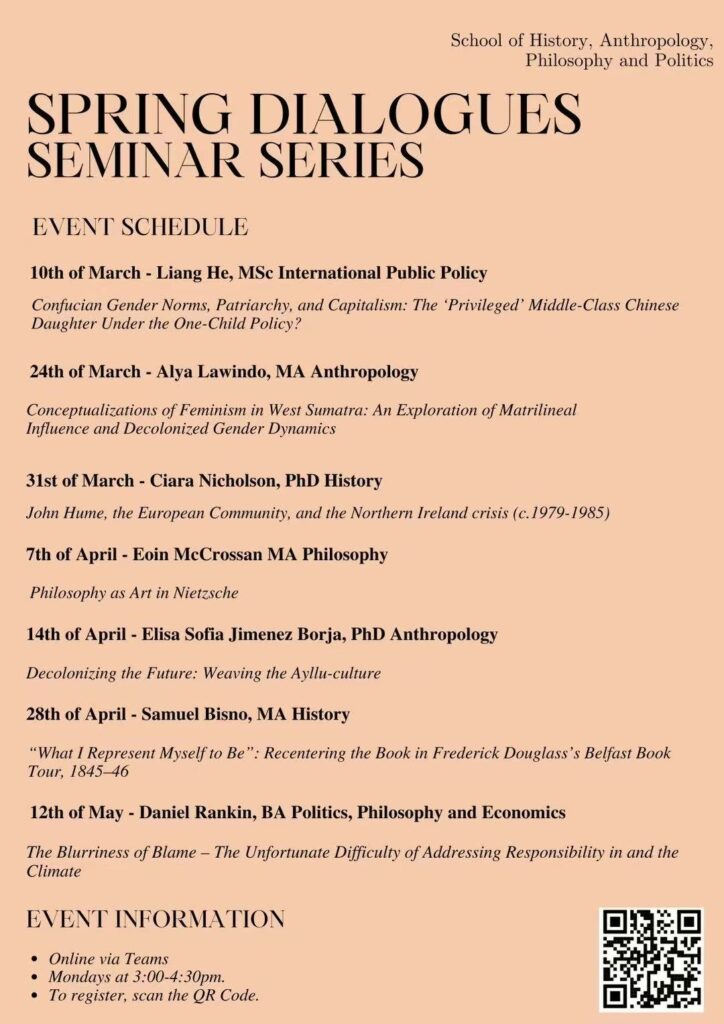
Happy Longtaitou Festival!
Longtaitou (龙抬头 Lóng tái tóu) Festival, also known as the Dragon-Head-Raising Festival, falls on the second day of the second lunar month each year and marks the traditional beginning of the spring farming season. This year, it falls on Friday 20 March.

Inspired by the symbolic “raising of the dragon’s head”, we are delighted to see a growing interest in Chinese language-related programmes and events. We warmly welcome more participants to join a variety of upcoming activities, as listed below.
Chinese Bridge Competition / Business Chinese Competition – Candidates
The “Chinese Bridge” Chinese Proficiency Competition is a large-scale international contest organised by the Centre for Language Education and Cooperation. Over the years, 24 UK national finals have been held, with outstanding winners invited to represent the UK at the global finals in China. Participants at this stage have the opportunity to compete for scholarships to further their Chinese-related studies at universities in China.
The Chinese Competition of Business Innovations & Charitable Projects for UK University Students (aka Business Chinese Competition), as a sister event to the Chinese Bridge Competition for UK University Students, is a well-known brand in Business Chinese education across the UK. It aims to promote the improvement and development of Business Chinese teaching in the UK universities, stimulate students’ potential for business innovation, and encourage awareness, participation, and responsibility in charitable projects initiatives. The competition also enables students studying Business Chinese to apply their knowledge in practice and achieve meaningful outcomes, nurturing talents who can contribute to China–UK trade exchange and cooperation.
The 2026 UK national finals will take place on Saturday 6 Friday 5 June in London, organised by the UK Organising Committee. Preliminary rounds will be held by each participating university in advance, with a deadline of Friday 24 April for completion.
Entry Requirements
Applicants must:
- Be a university student, aged 18-30
- Be of non-Chinese nationality
- Have been born and raised outside China
- Have a first language other than Chinese
- Not have taken part in the semi-final or final competition in China in previous years
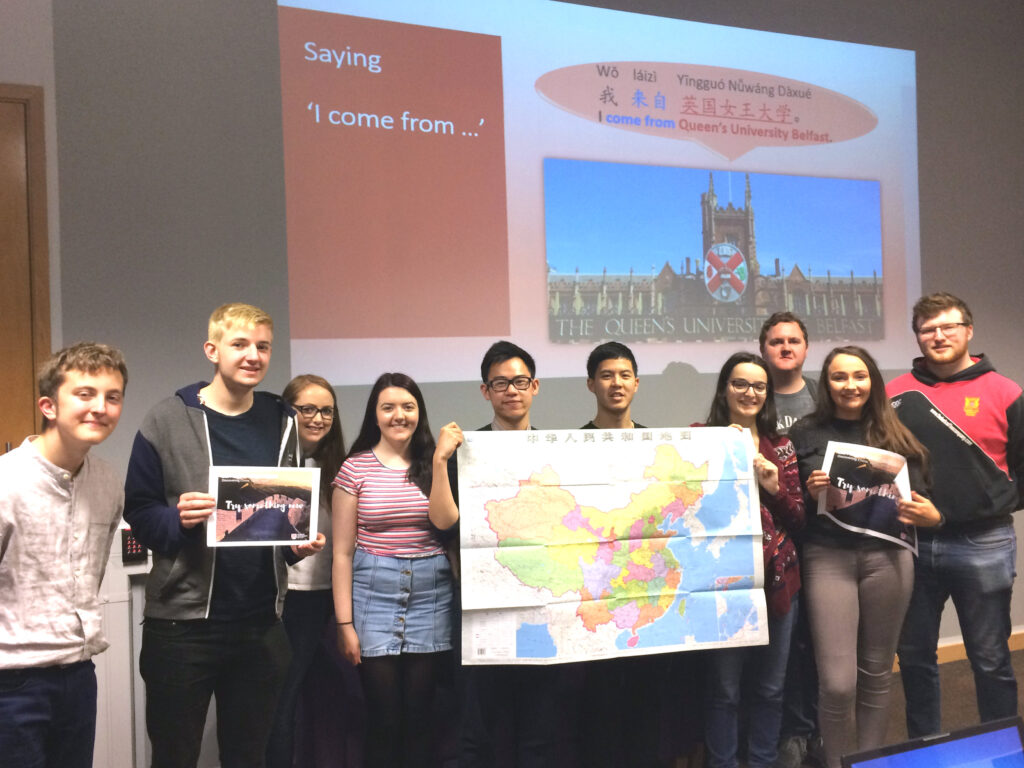
To know more details and to express your interest, please contact Liang.Wang[at]qub.ac.uk directly, with a brief self-introduction of your education background, including studying of Mandarin Chinese, by Thursday 2nd April.
Chinese School – Teachers/Teaching Assistants
The Chinese Language School Northern Ireland is currently seeking volunteers to support teaching and classroom activities during term time throughout the academic year. Volunteers are expected to commit to the school’s timetable during term time; however, some flexibility can be accommodated with advance notice.
Classes are held weekly on Sundays from 1:00 pm to 3:00 pm. Suitable candidates are preferably those with a strong background in Chinese language proficiency, along with relevant teaching experience or pedagogical knowledge.

To express your interest, please contact Chinese Language School NI via their WeChat account (ID: beiaizhongwenxuexiao) or email (Chinese.school.ni[at]gmail.com).
Success Chinese Lion Dance Society – Club Members
Success Chinese Lion Dance Society is currently seeking to recruit new members, particularly college and university students, to form the core team for campus-based performances.
Students from all linguistic and cultural backgrounds are warmly welcome. Members from QUB will have the opportunity to establish a student-led society registered with the Queen’s Students’ Union, organise regular training sessions, and participate in community activities under the guidance of the Society’s master.
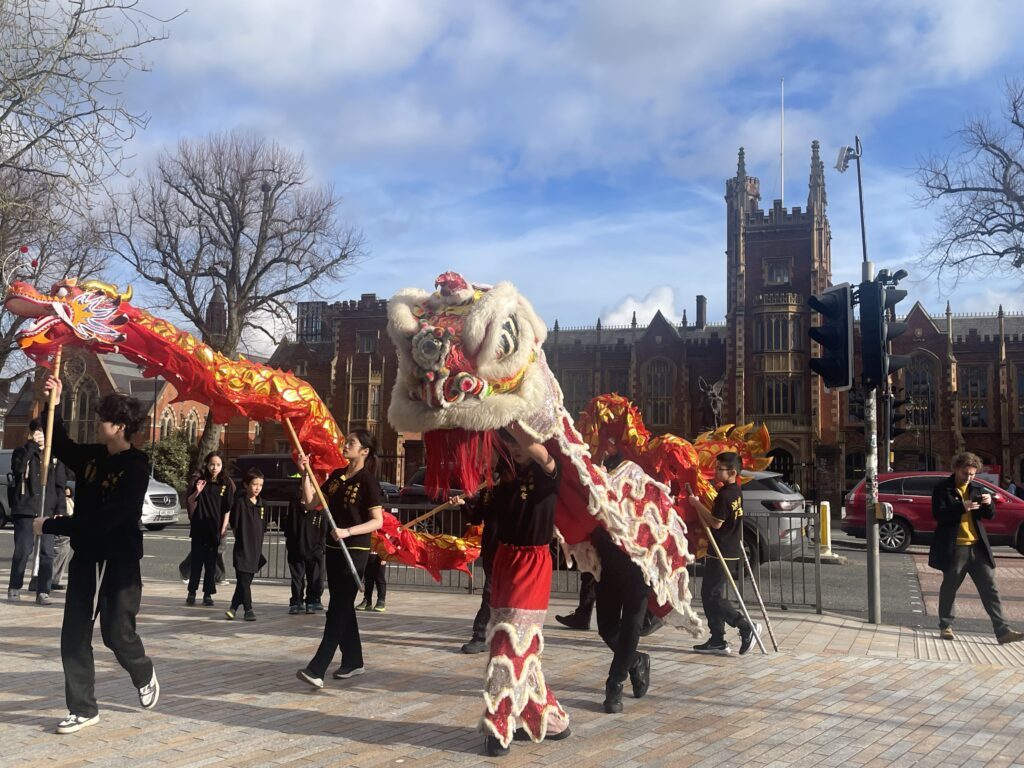
To express your interest, please contact sliondance[at]yahoo.co.uk
Chinese Culture Programme – Contributors
The Language Centre is looking for talented students and staff members to contribute to our Chinese Culture Programme at Queen’s. The engagement could be in the form of a variety of cultural performances, workshops or language/culture-related public talks and panels. The call is open to both Chinese-speaking and non-Chinese speaking volunteers.
We look forward to working with you in our future events.
Read the Chinese version here.
Learning Chinese language and culture at Queen’s
Finally, the third Semester Language Course registration is open and closes promptly at 17:00 on Thursday 16 April 2026. Classes are expected to be extremely popular and fill up quickly, so early registration is strongly recommended.
To register with a Mandarin Chinese course, please follow the course information page for more information with links to registrations.