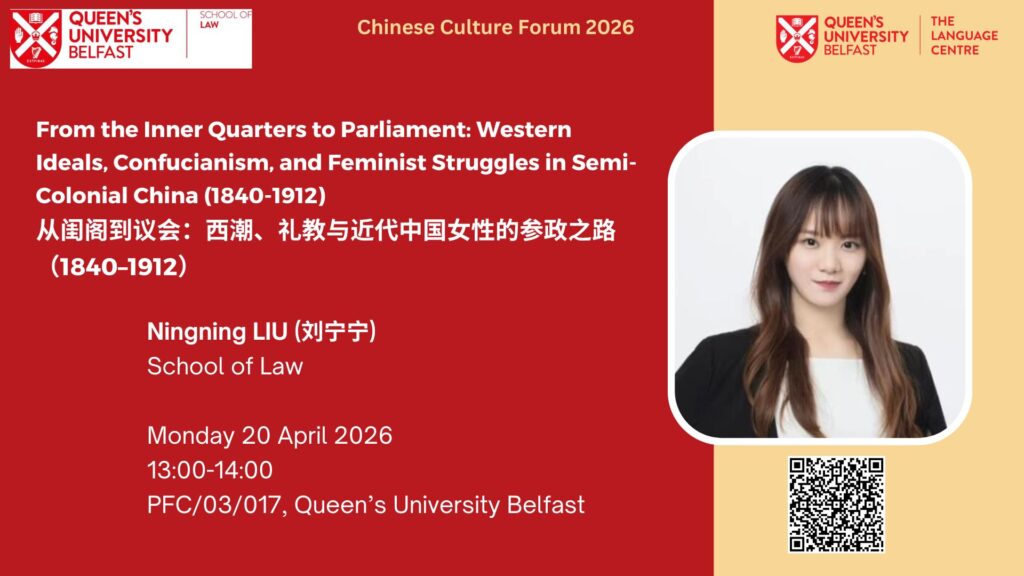
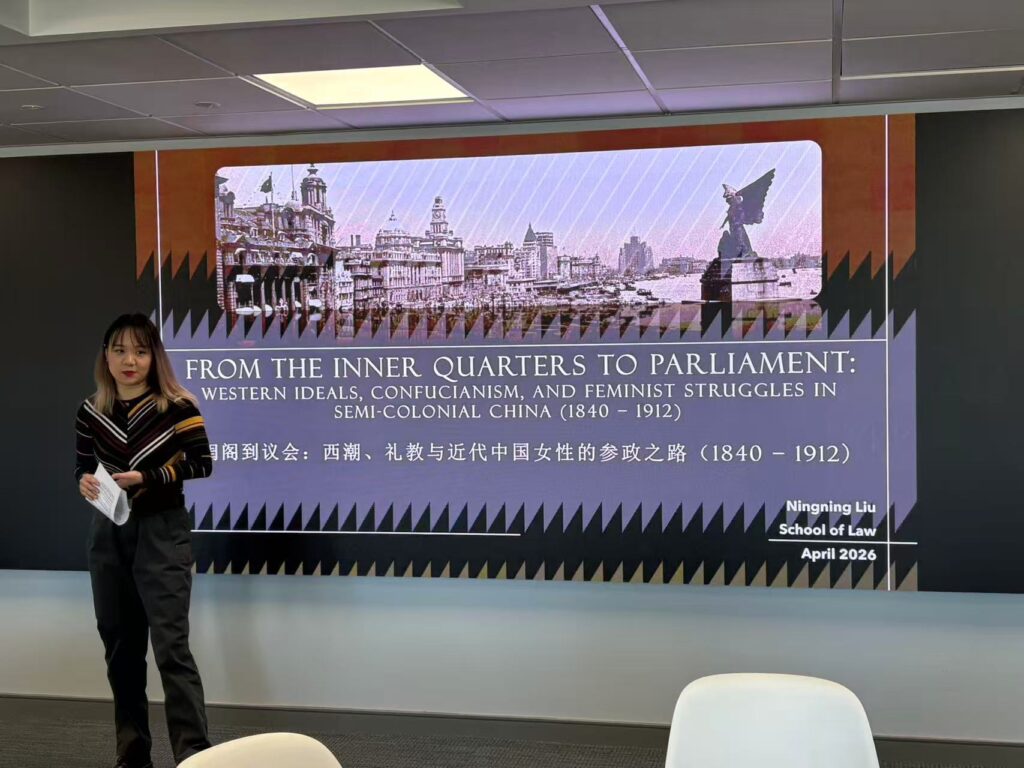
From the Inner Quarters to Parliament: Western Ideals, Confucianism, and Feminist Struggles in Semi-Colonial China (1840–1912)
从闺阁到议会:西潮、礼教与近代中国女性的参政之路(1840–1920)
Monday 20 April 2026
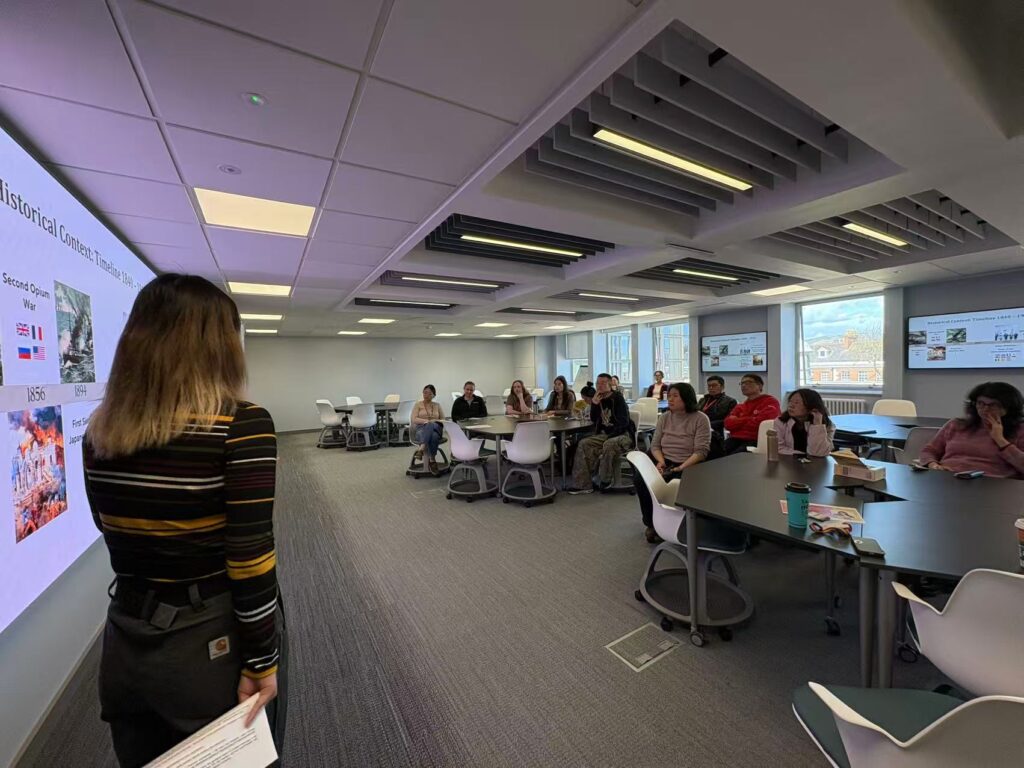
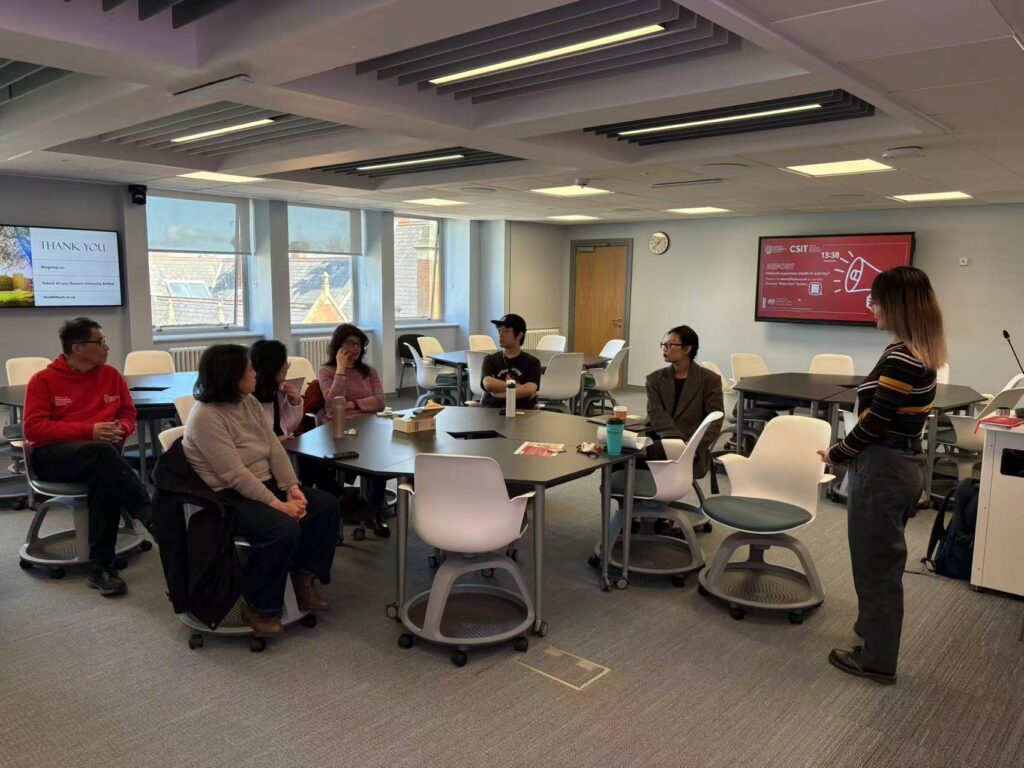
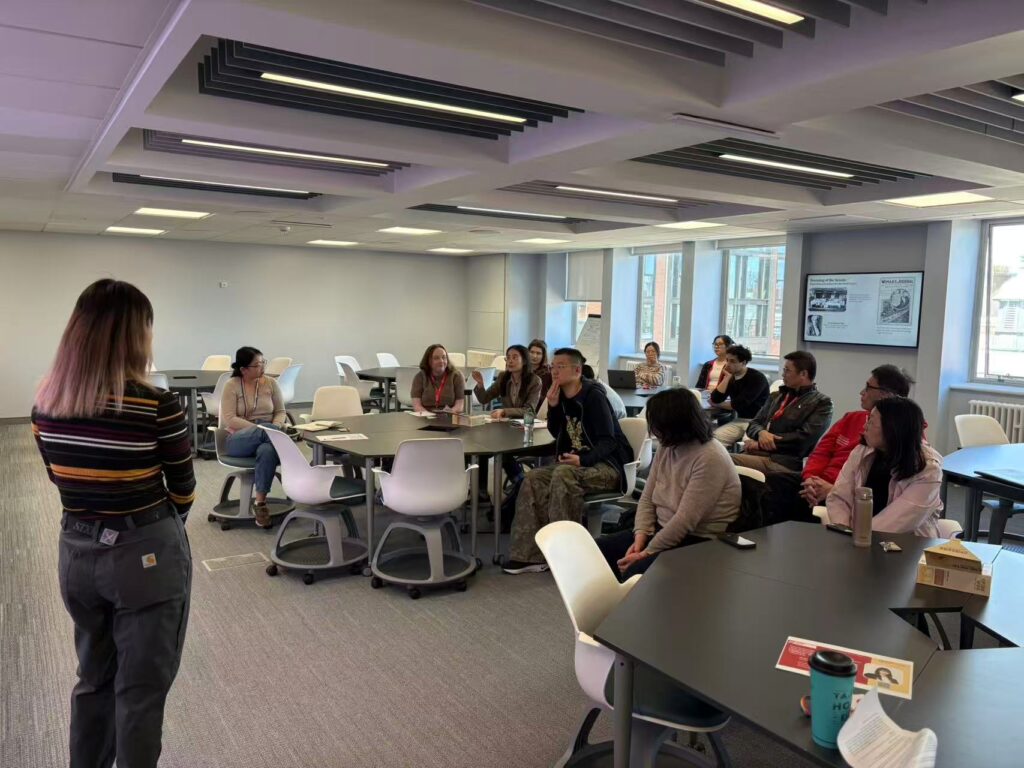
13:00-14:00 (*there will be a short celebration of UN Chinese Language Day after the talk)
PFC-03-017, Queen’s University Belfast
Speaker:
Ningning LIU is a PhD candidate in Law at Queen’s University Belfast. Her doctoral project, ‘Political Participation in Modern China – Shanghai (1840-1949): Lessons for Women’s Empowerment,’ funded by a Department for the Economy Scholarship, explores the evolution, challenges, and impact of women’s political participation in modern Chinese history. Ningning has published in peer-reviewed journals and has contributed to teaching at Queen’s. She holds a BA in German Language and Literature and a Juris Master’s degree, and received her legal training through a joint programme between Fudan University and the University of Cologne. Before her PhD, she practised as an international lawyer in Shanghai and served as a consultant at the OECD in Paris. Her work bridges feminist law, legal history, human rights, and advocacy for girls’ rights. She is currently co-authoring a legal literacy handbook for girls in partnership with an NGO ‘StandByHer’ in China.
Abstract:
This talk examines the early debates over women’s right to political participation in China between 1840 and 1912, a period marked by significant legal and political upheavals, foreign invasions, the collapse of China’s last imperial dynasty, semi-colonial exploitation, and intensive reformist experimentation. These challenges also gave rise to evolving discourses on human rights and women’s emancipation. Against the backdrop of national crises and exposure to Western liberal thought, reformers such as Kang Youwei, Liang Qichao, and Jin Tianhe began to link women’s liberation to national revitalisation. Yet their support was often instrumental and portrayed women primarily as mothers and moral guardians of citizens rather than political actors in their own right. At the same time, Chinese women themselves were not passive recipients: they articulated their own visions of political equality that went beyond reformist instrumentalism, from Lu Cui’s calls for female representation in government to the collective protests that culminated in the 1912 “storming of the Senate”.
Drawing on legal texts, reformist essays, feminist writings, and petitions, this talk employs socio-legal and gendered analysis to trace how rights language was reimagined and reinterpreted in early twentieth-century China and how reformist and feminist voices engaged with Western suffrage arguments within China’s shifting legal-political order. It examines both the anti-suffrage backlash and the feminist rebuttals and demonstrates how debates over citizenship, gender equality, and political inclusion were shaped by tensions between Confucian patriarchy, Western political thought, nationalist imperatives, and transnational suffrage discourses. By situating these perspectives within China’s modernisation efforts and broader global histories of rights and legal reform, this paper illustrates that gender was central to the making of modern legal subjecthood in China. It contributes to feminist legal historiography by recovering women’s agency in shaping political and legal modernity, while also challenging Euro-American centred accounts of international legal history. In doing so, it highlights the value of bringing diverse feminist struggles into view for rethinking the historical foundations of gender and international law.
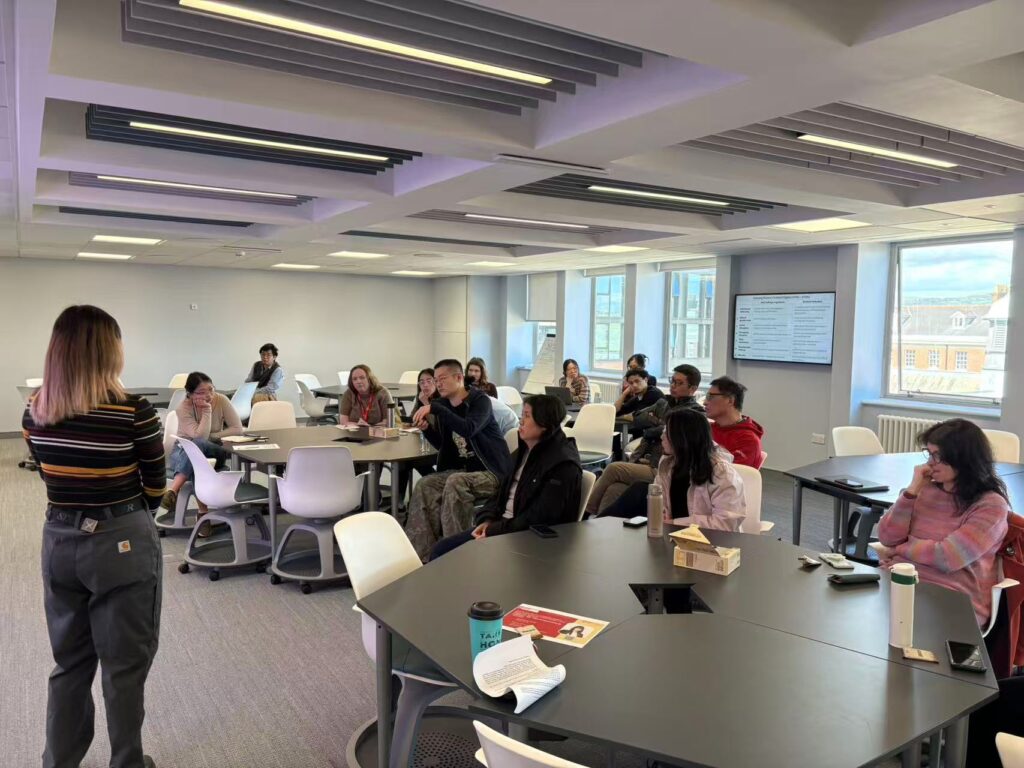
Photos:
Further reading
Ningning also has a strong interest in dance alongside her academic journey. If you would like to learn more about her academic and social life, feel free to read the blog posts she has shared with us below.