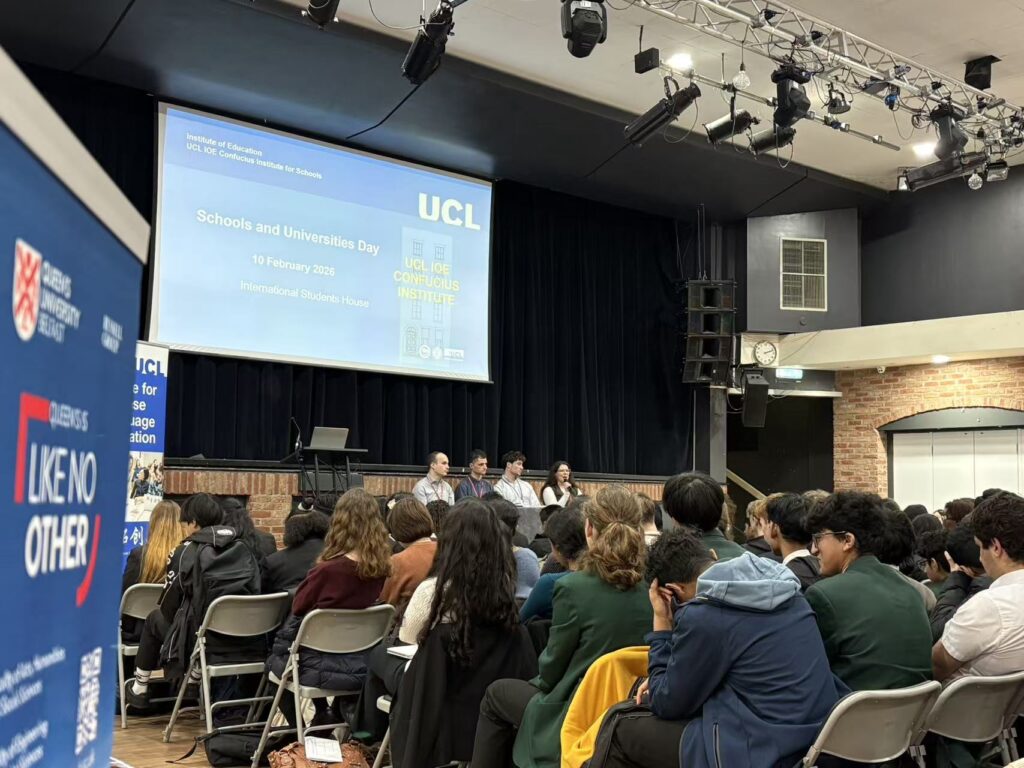
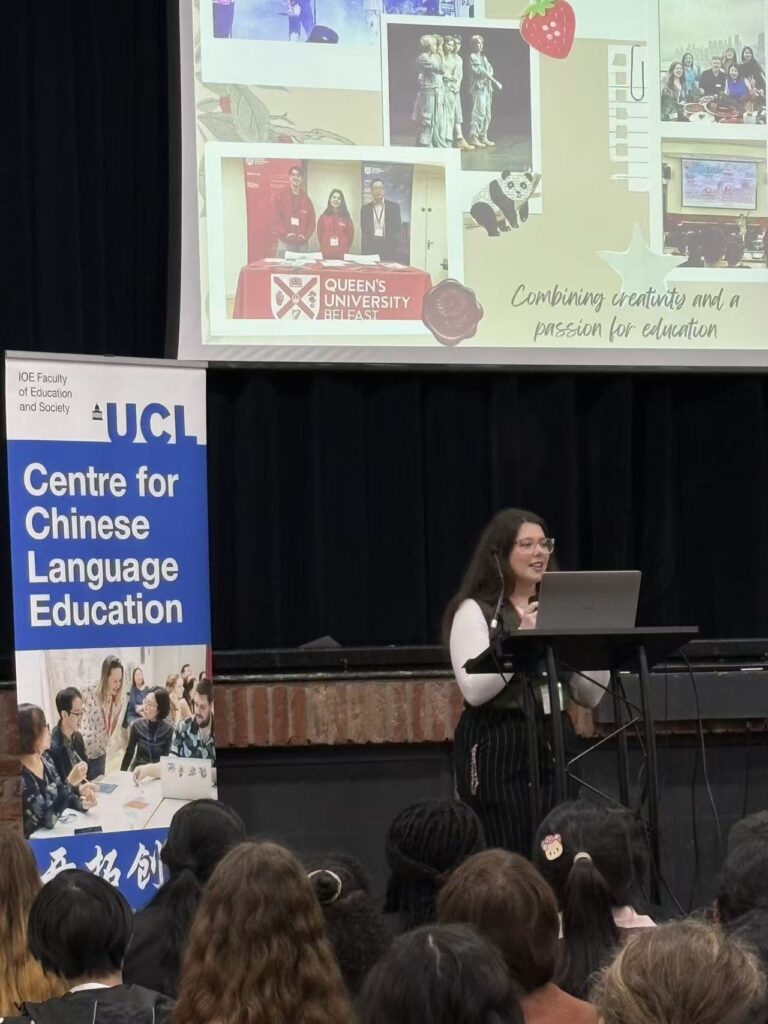
On Tuesday 10 February, Queen’s University Belfast took part in the 8th Schools and Universities Day – Chinese (and related) Learning Pathways, hosted by the UCL IOE Centre for Chinese Language Education. Bringing together 15 universities and over 400 school students and teachers from across England, the event was a vibrant space for sharing ideas, building connections, and inspiring the next generation of Chinese language learners.
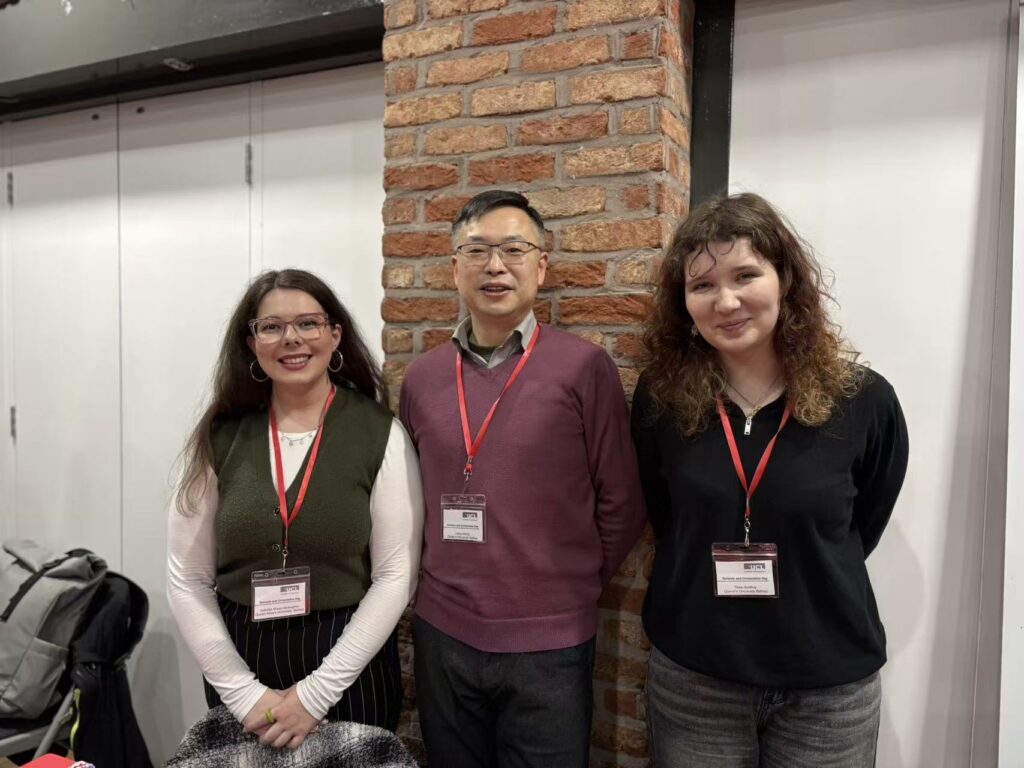
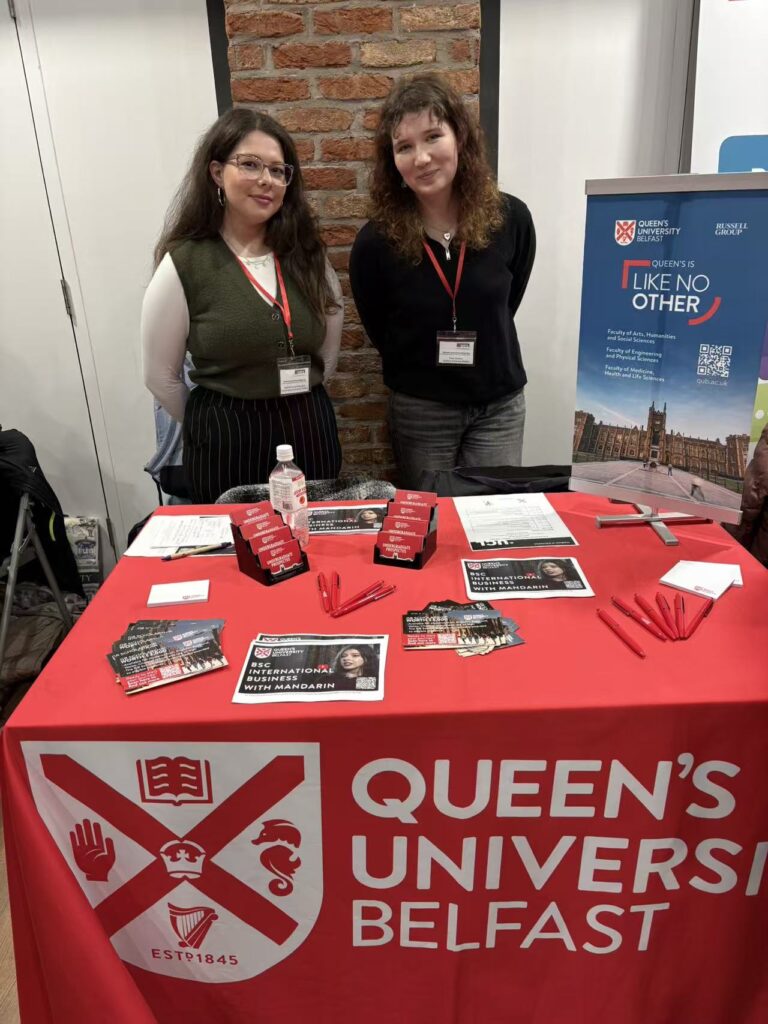
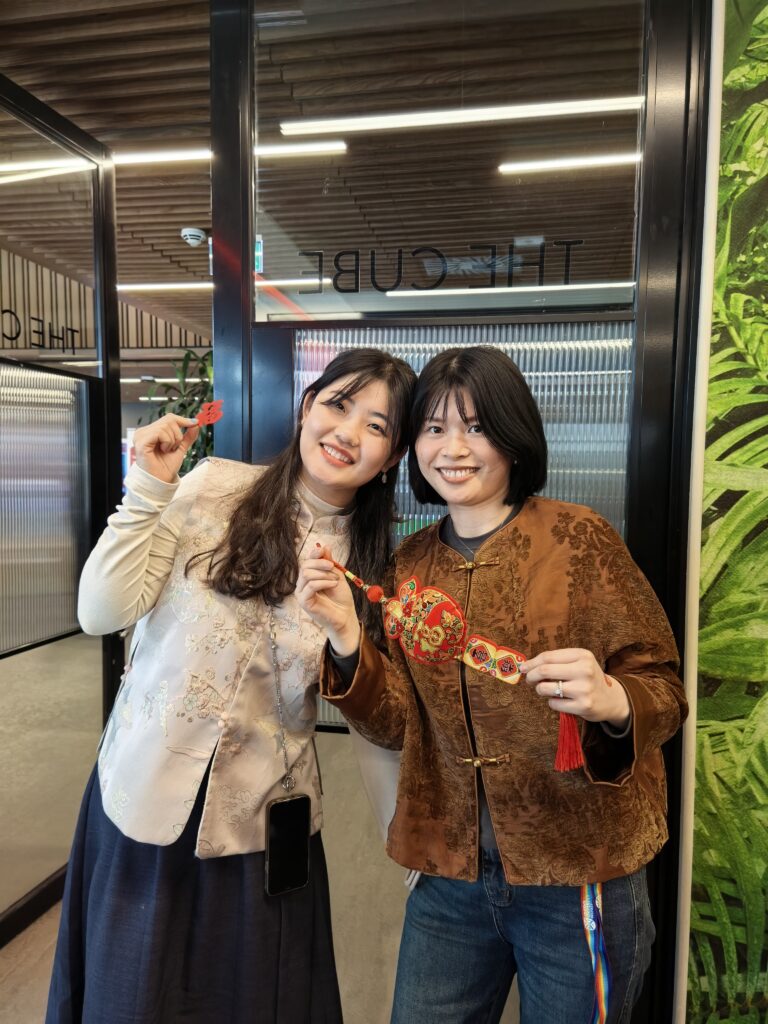
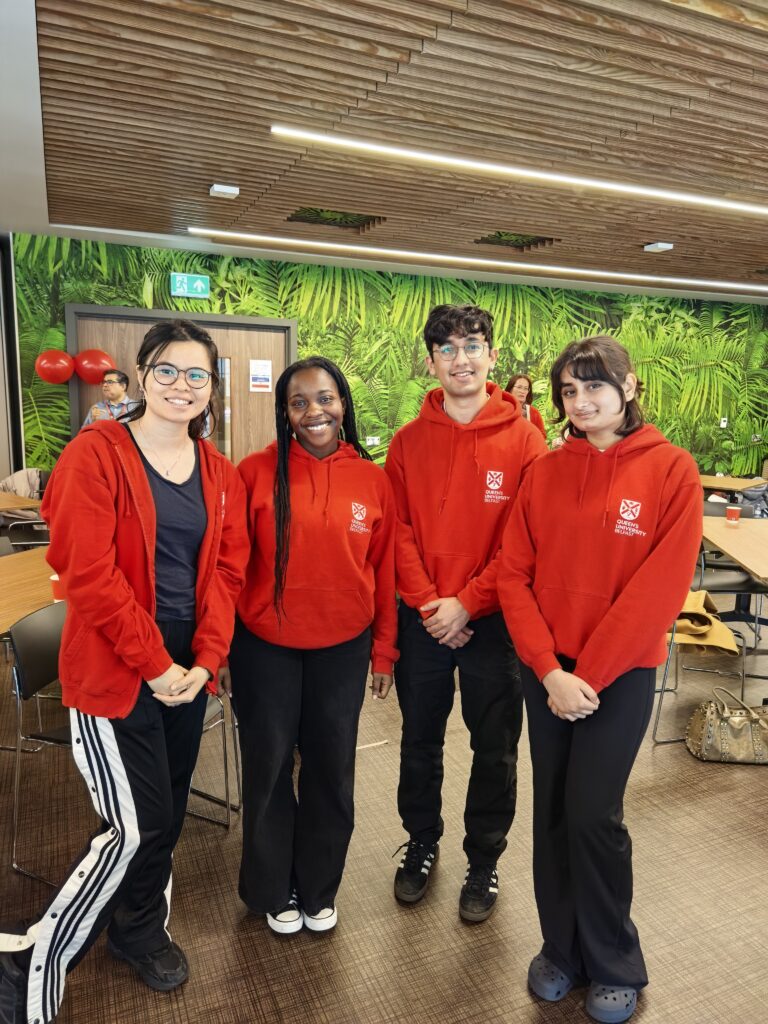
Isabella, Liang and Thea (left to right)
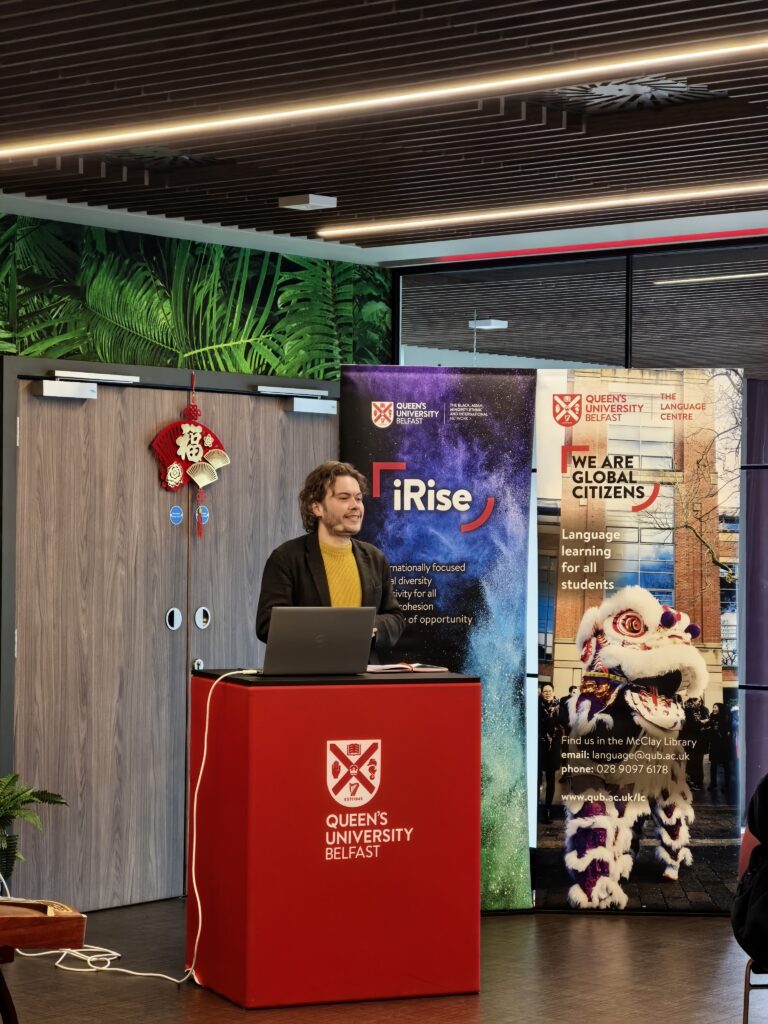
Dr Liang Wang (Queen’s Language Centre) was invited to a round-table discussion on developing “China-literate” talent, exploring how schools and universities can work together to strengthen progression pathways. He showcased Queen’s innovative approach to intercultural learning through communities of practice, including initiatives such as the Chinese Culture Forum and Tandem Language Exchange Programme.
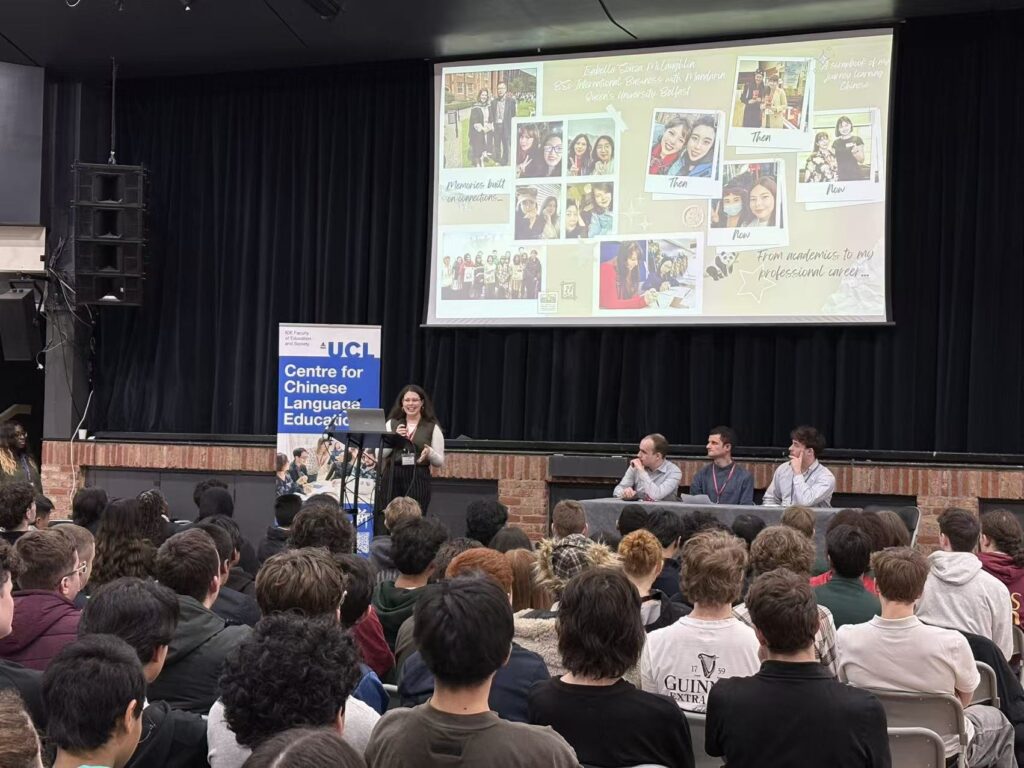
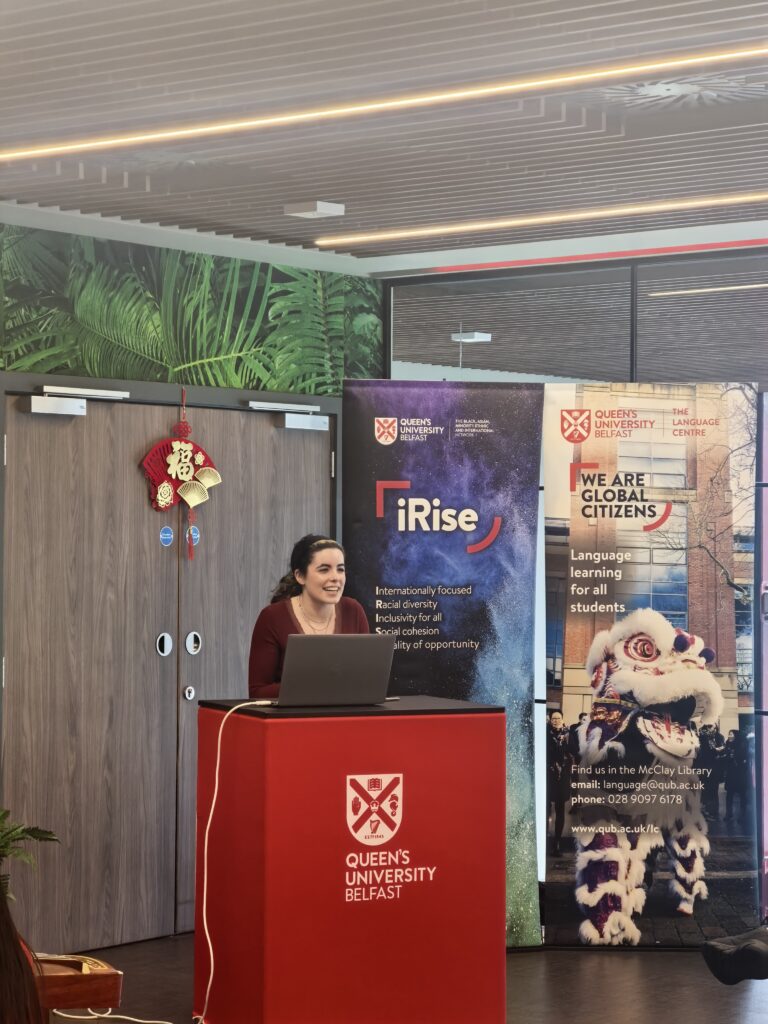
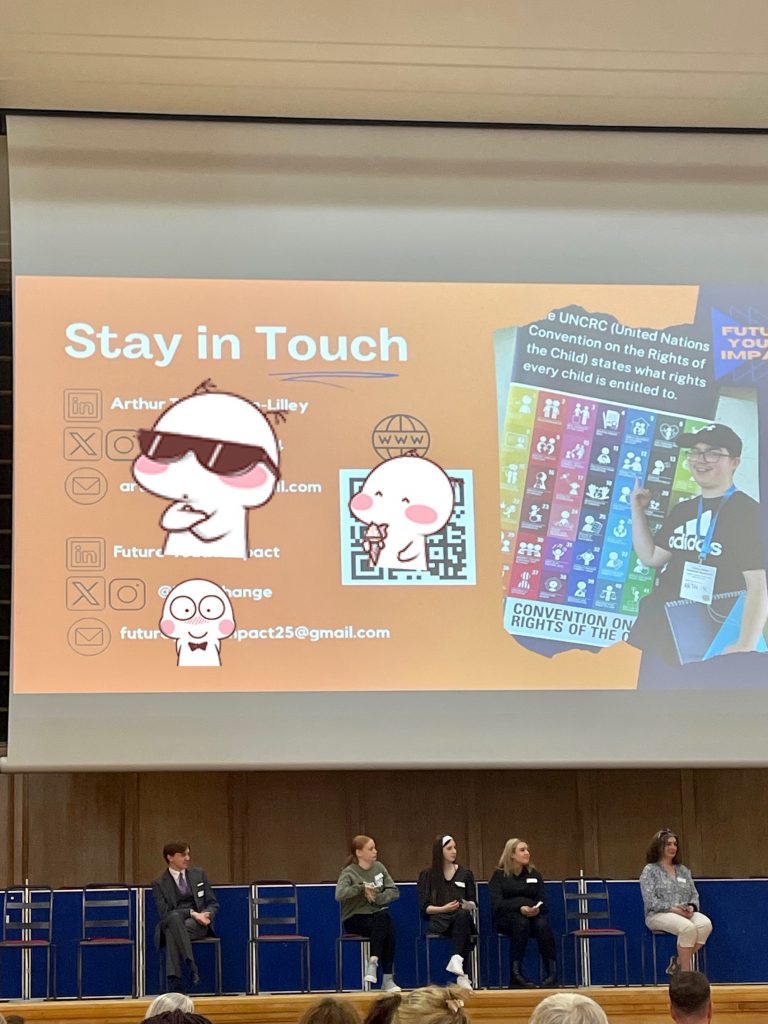
Alumna Isabella Souza McLaughlin (Global Student Recruitment) shared her journey of studying Mandarin Chinese as part of her International Business degree. Speaking on a university student and alumni panel, she emphasised the value of adaptability and openness in intercultural contexts, while reflecting on the challenges of completing her work placement during the pandemic. She also spoke about the rewarding experience of working with Chinese colleagues in both the UK and China in her role at Queen’s today.
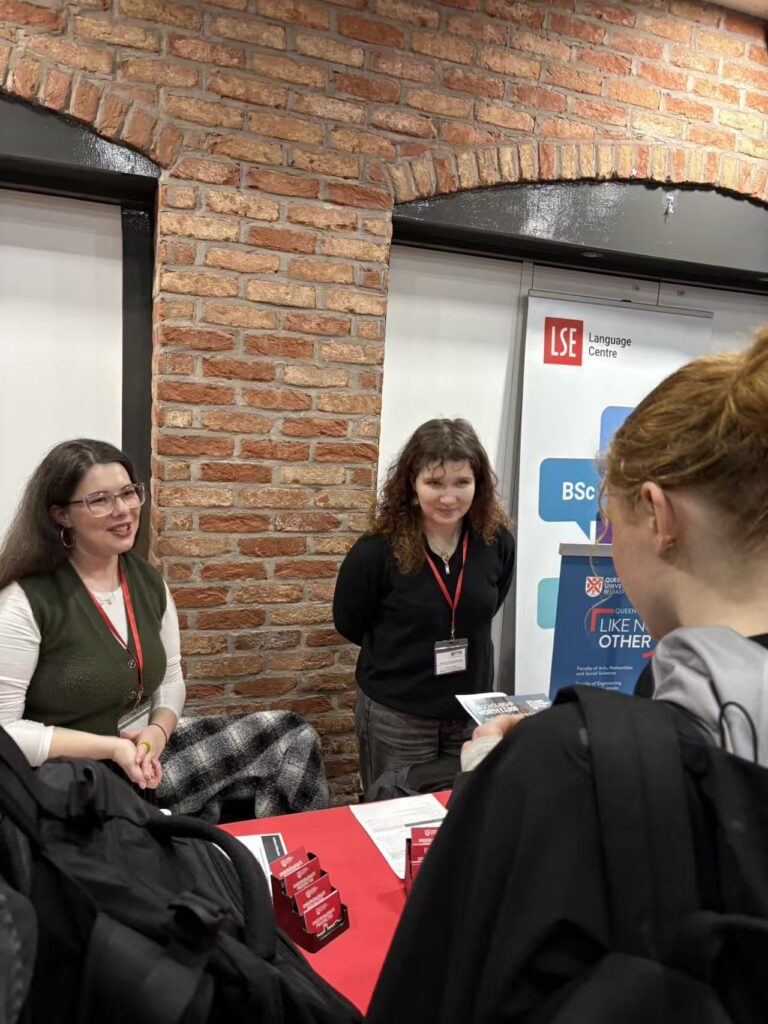
Supported by student ambassador Thea Godfrey, the team also hosted an information stand throughout the day, engaging with prospective students and teachers. From course details and scholarships to life in Belfast, Queen’s showcased the many opportunities available to students interested in combining Chinese with their degree and career ambitions.
The outreach and engagement provided an excellent opportunity to raise the profile of Queen’s and connect with the next generation of globally minded students in the UK.
About Schools and Universities Day (Click to expand)
This free event offers a unique opportunity for school teachers and secondary-school learners of Mandarin to meet departments from universities across the UK. Through these dialogues, learners can explore the range of opportunities and pathways for continuing Mandarin at university.
Since its inception, feedback on the day has been overwhelmingly positive. It creates space for informed discussions between students and university representatives and facilitates connections between teachers and universities.
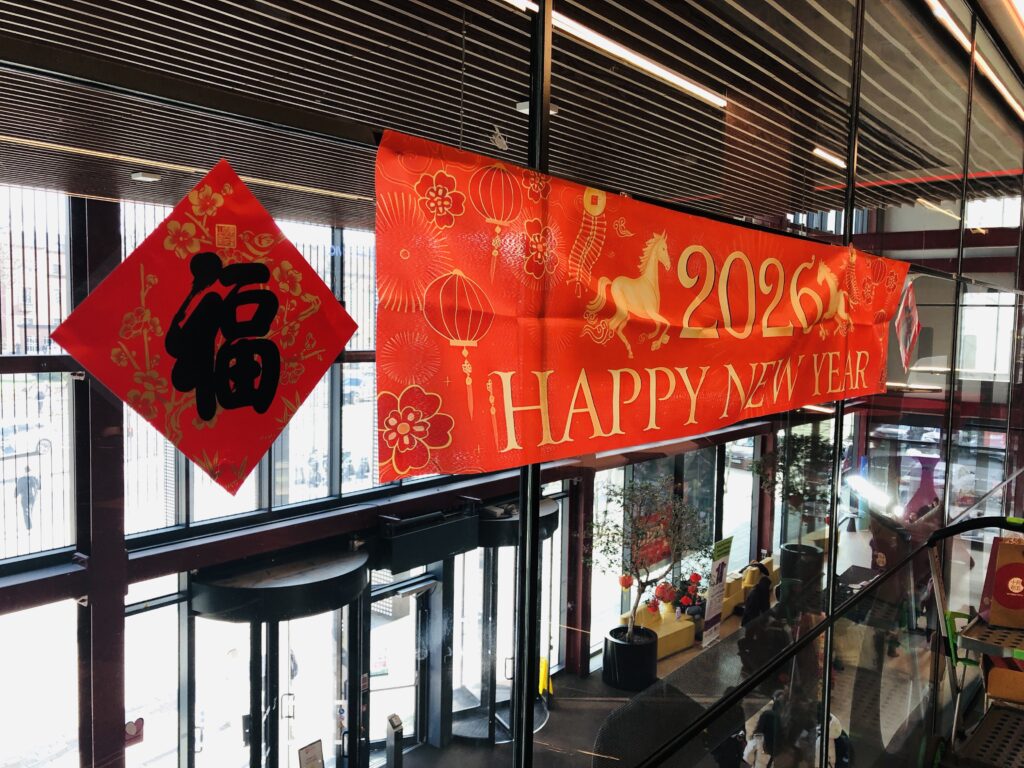
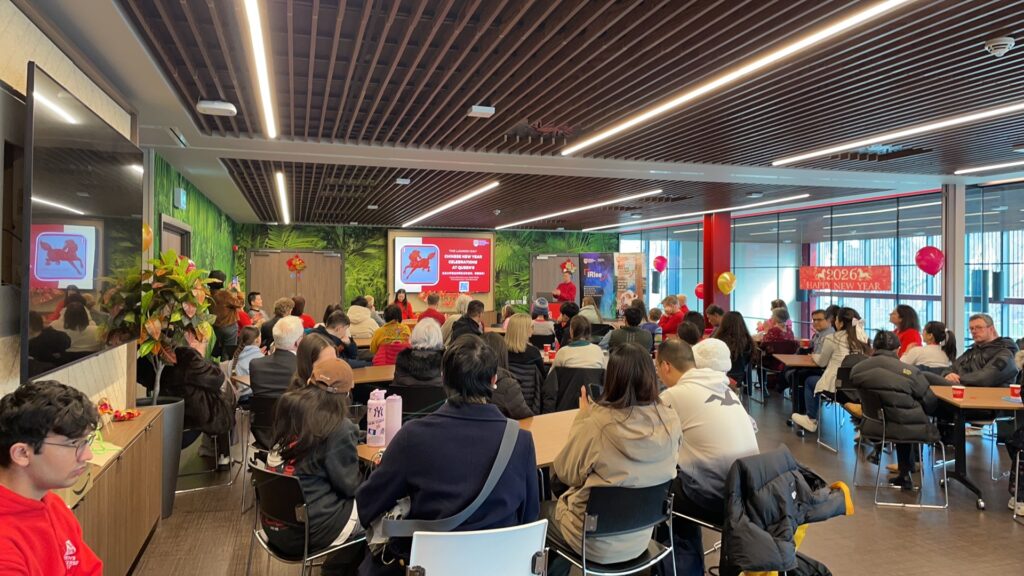
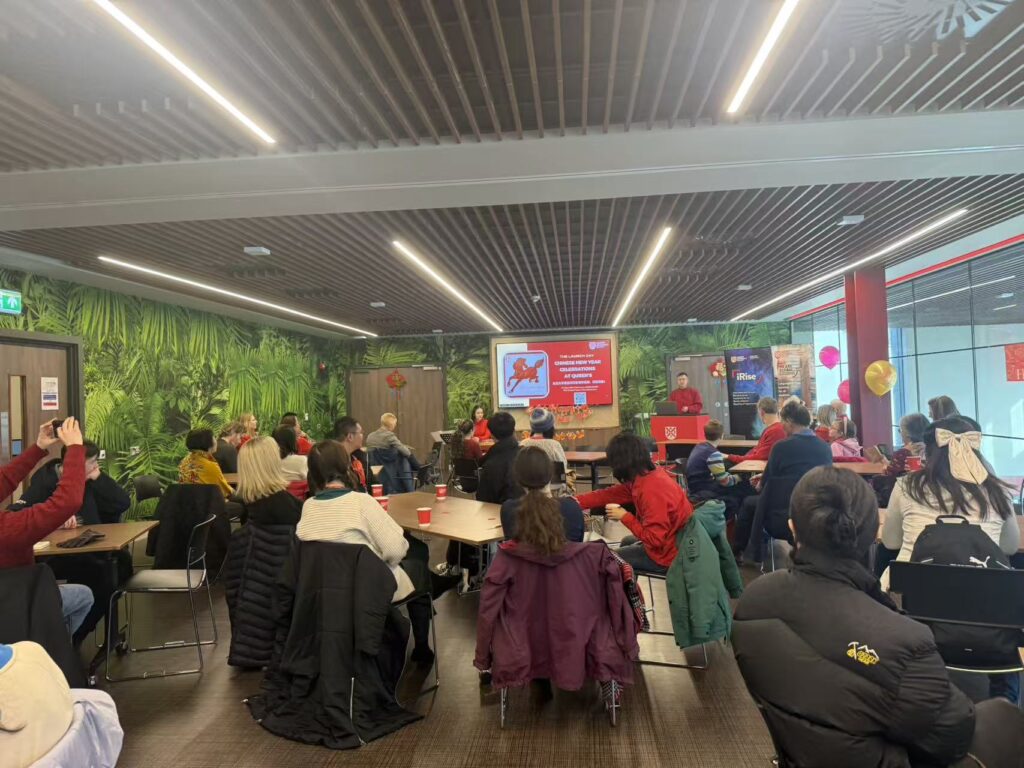
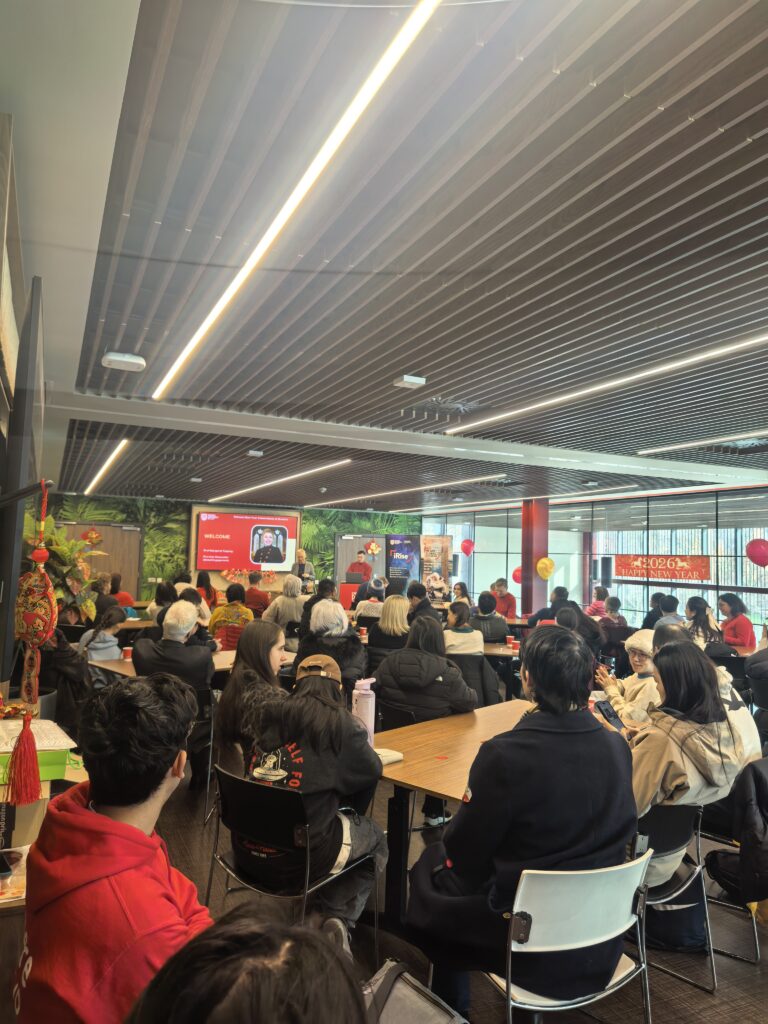
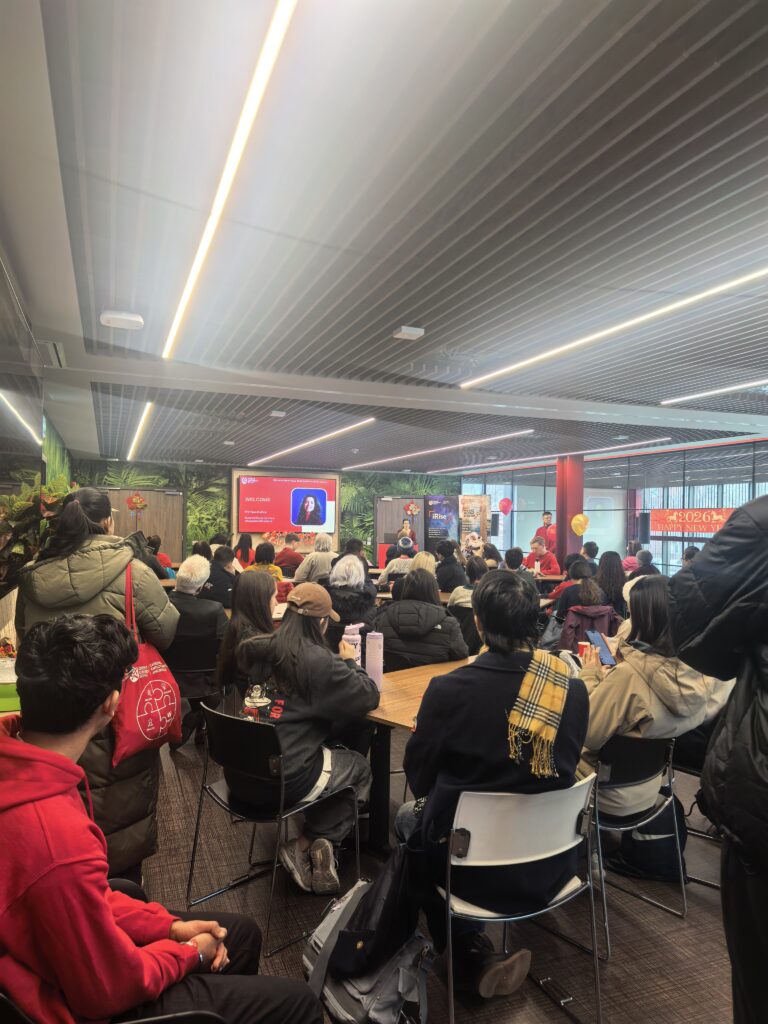
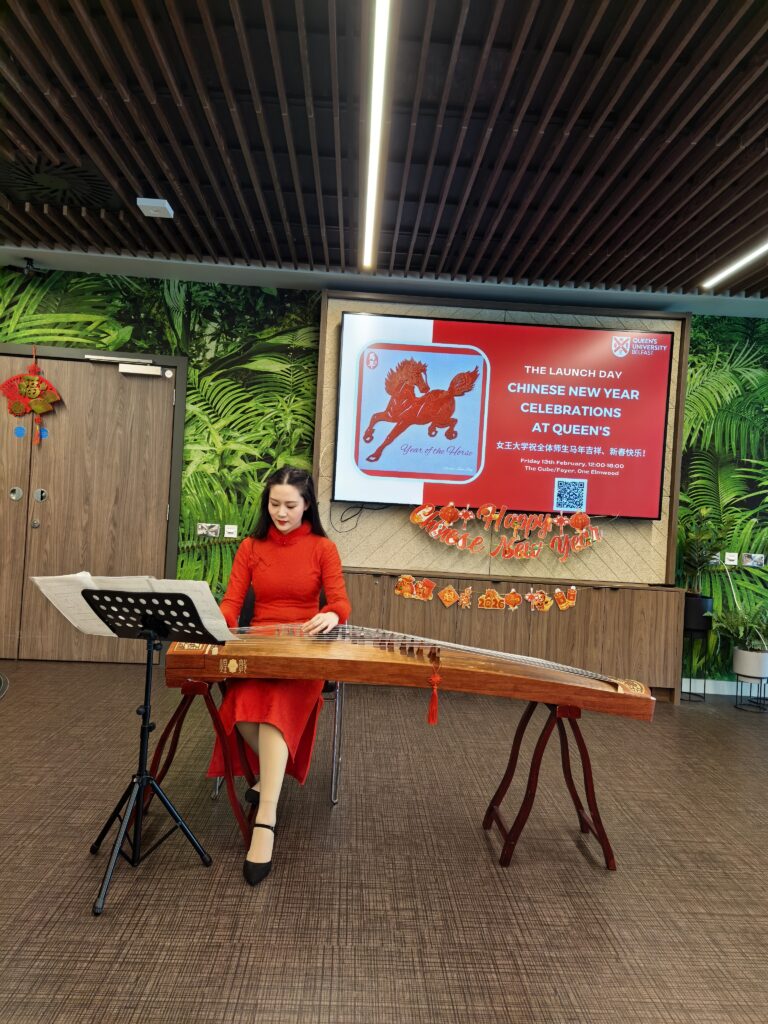
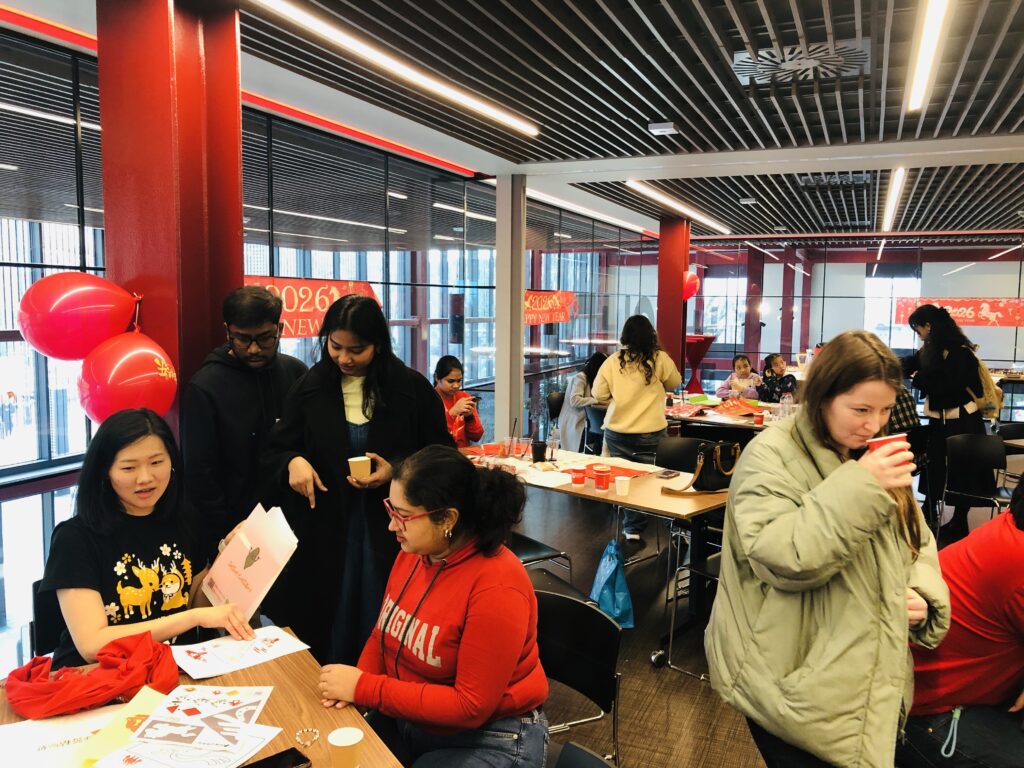
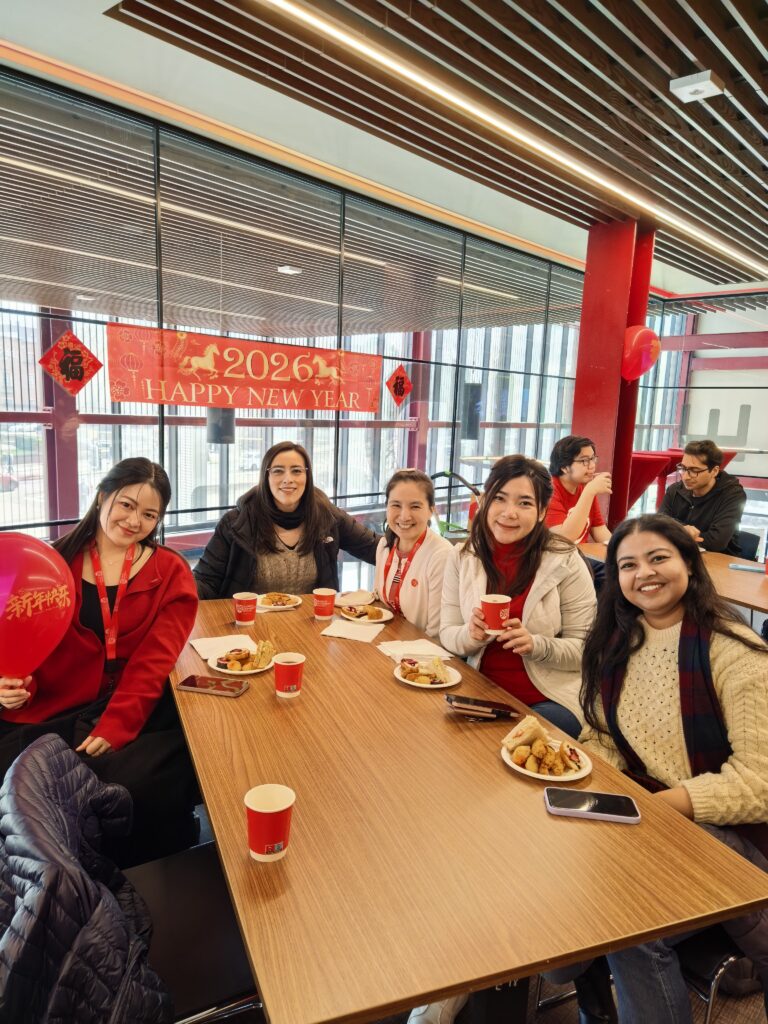
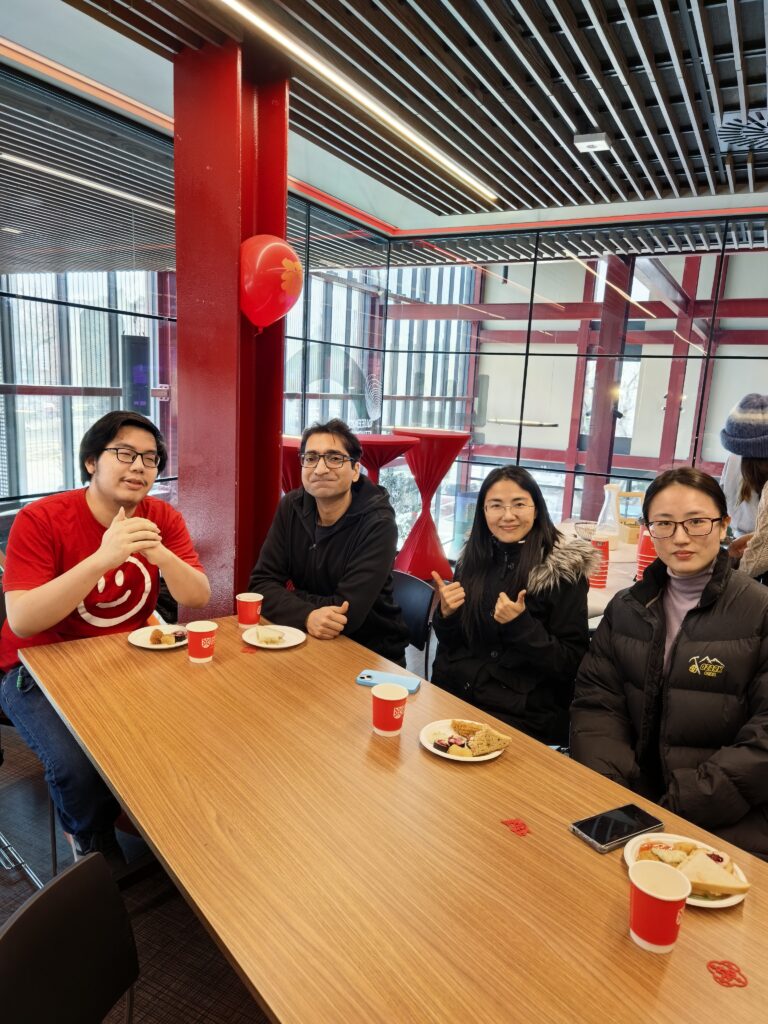
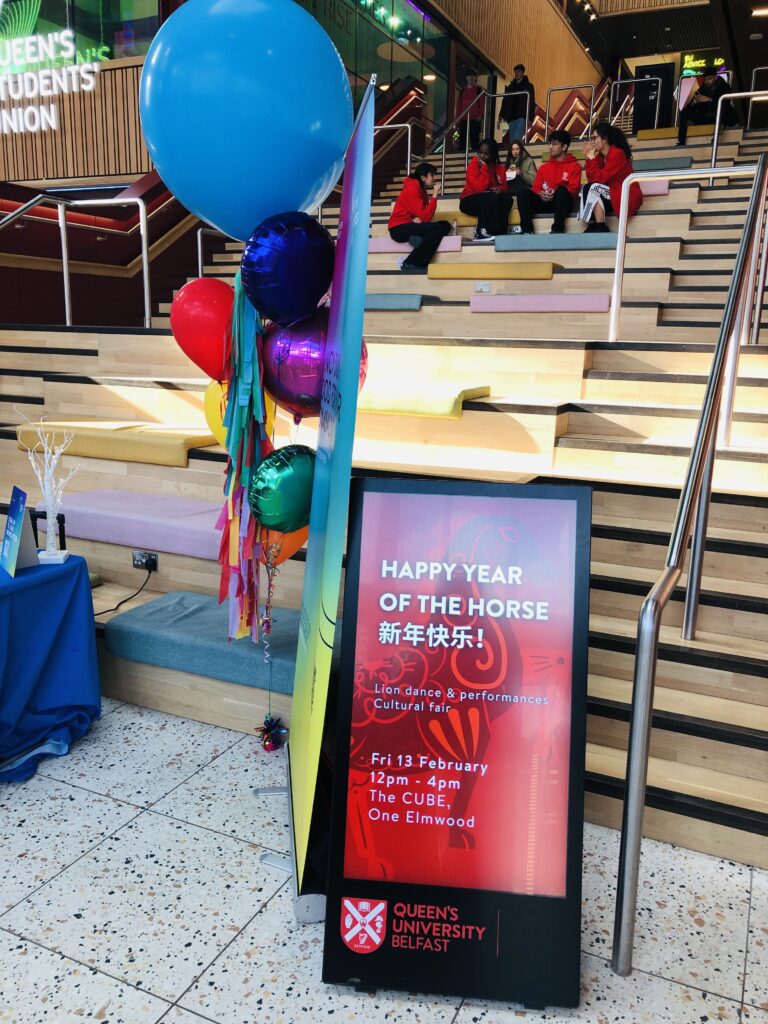
What could be better than a splendid day of sunshine on Friday 13 February, following such a long period of gloomy, rainy weather? On the day, over 60 Queen’s students, staff members, as well as civic partners and guests, joined the Chinese New Year celebration programme at One Elmwood, Queen’s – the hub for intercultural encounters and exchanges.
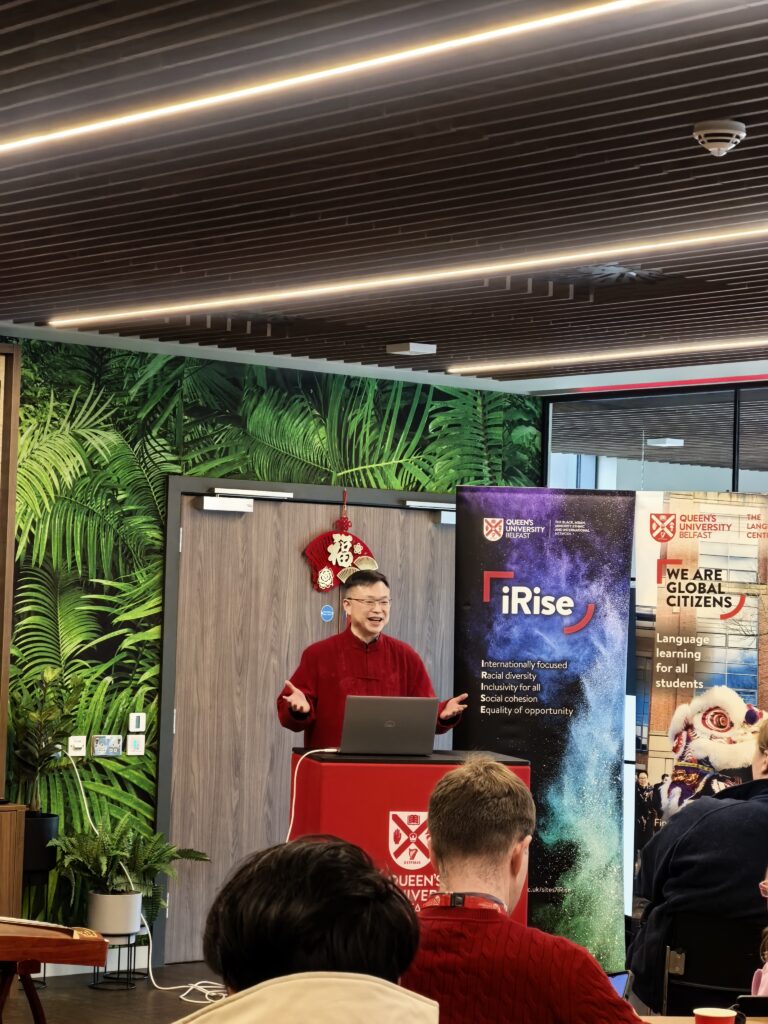
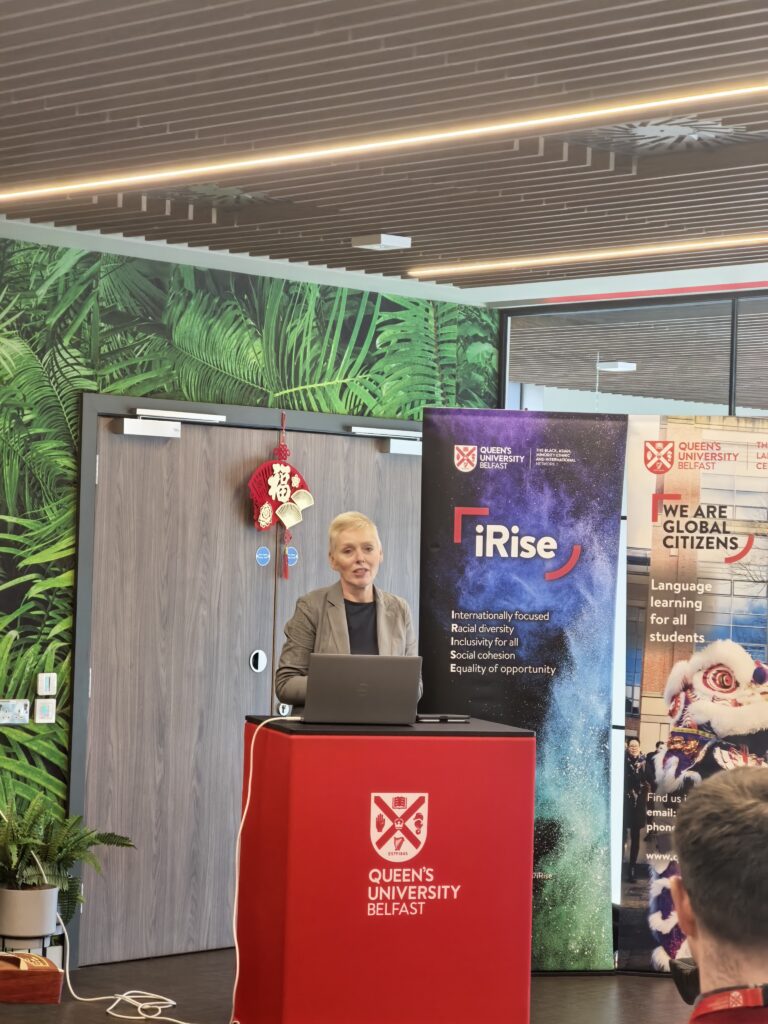
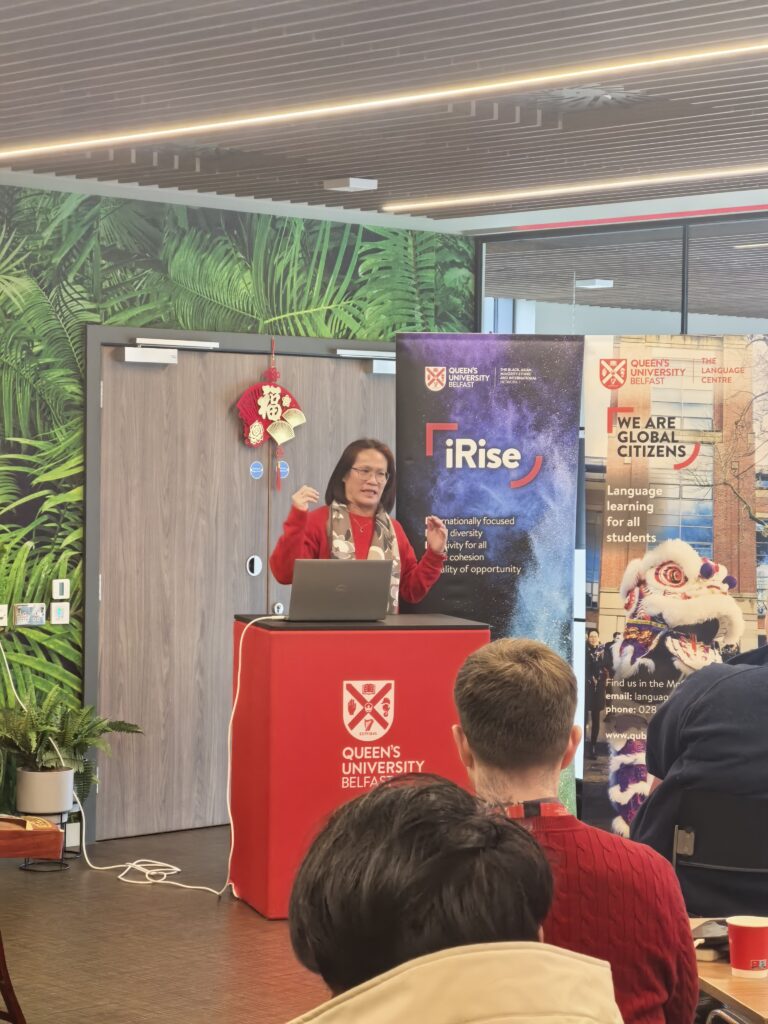
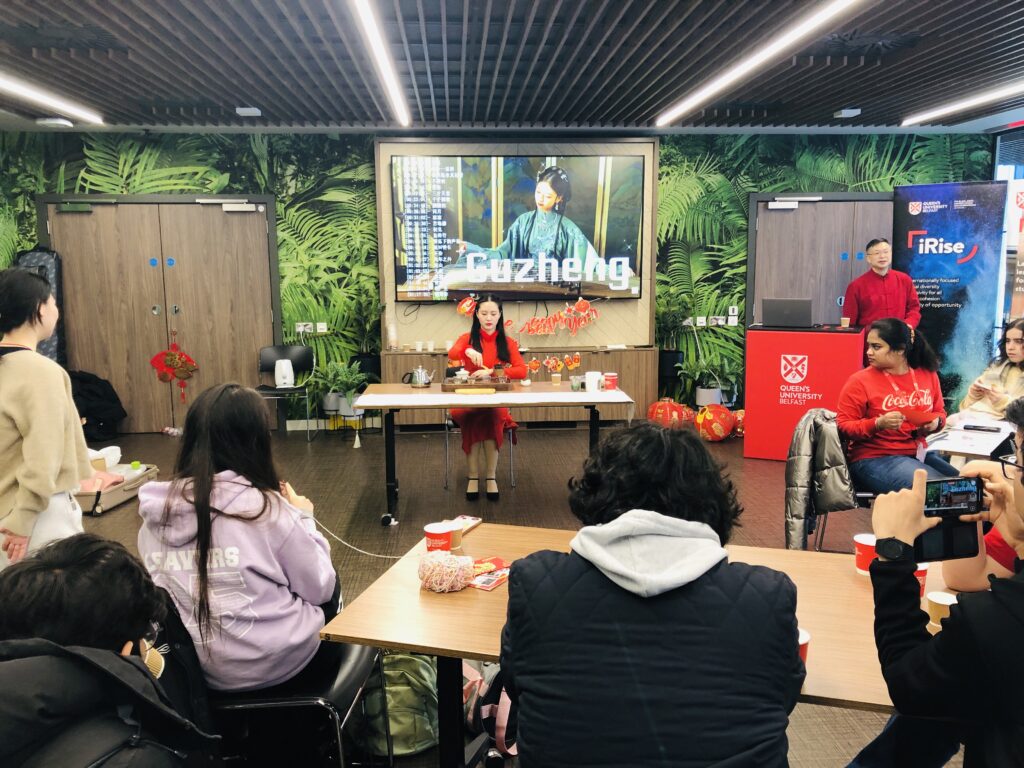
Chaired by Dr Liang Wang, the launch began with a captivating performance of traditional guzheng music by PhD candidate Fei Li from Queen’s Business School. Pro-Vice-Chancellor Professor Margaret Topping delivered the opening remarks on behalf of the University, highlighting Queen’s achievements in global engagement over the past year, particularly with Asian countries such as China and India. Dr Bee-Yen Toh, Co-Chair of the iRise Staff Network, and Thomas Smith, Language Centre Manager, also extended their welcomes to staff, students, and civic partners, emphasising the importance of intercultural understanding through language learning, dialogue and shared activities. Mórrigan McEvoy, Student Officer for Accessible Education, offered her greetings and encouraged students to actively participate in university events and contribute to building a multicultural campus.
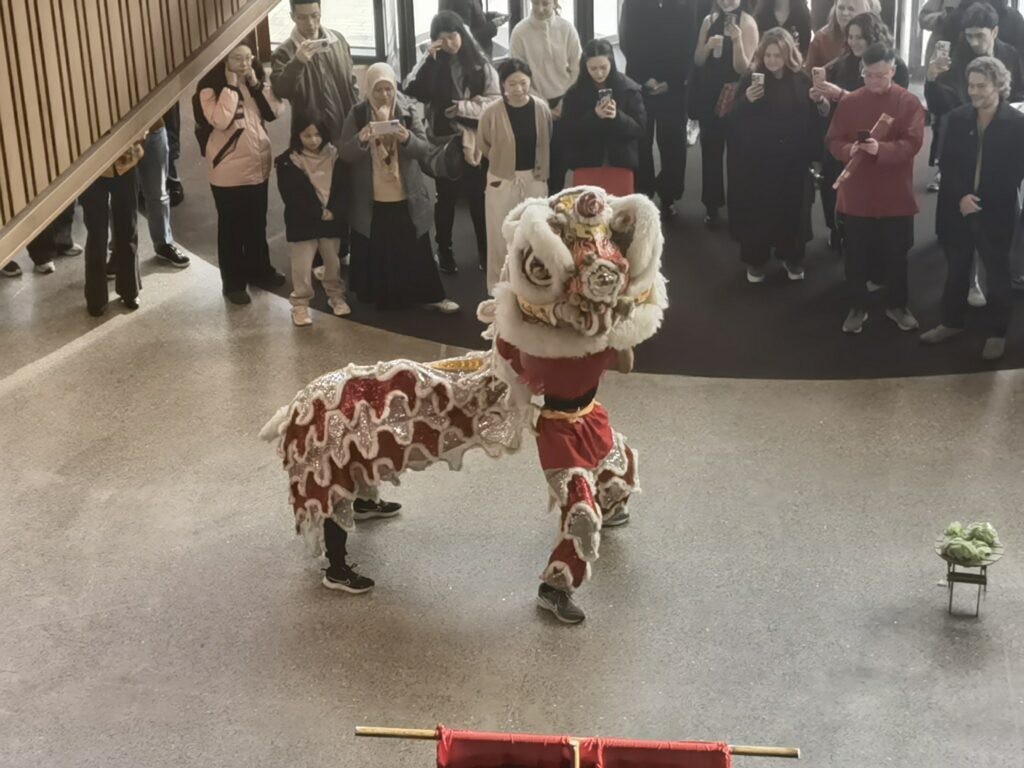
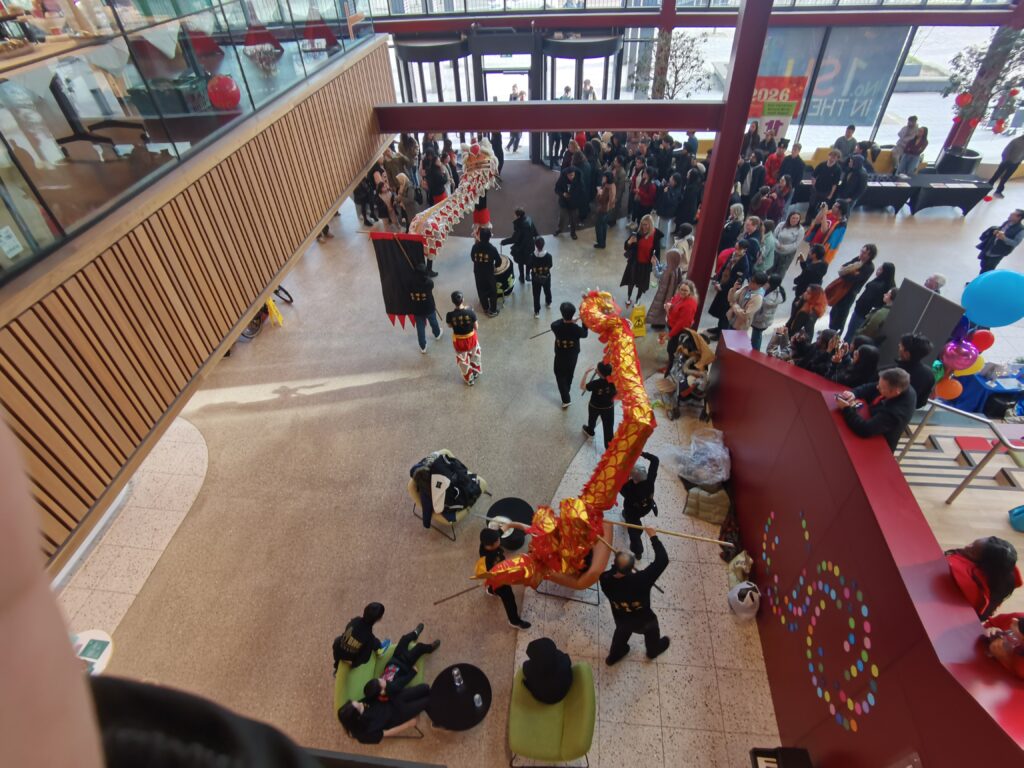
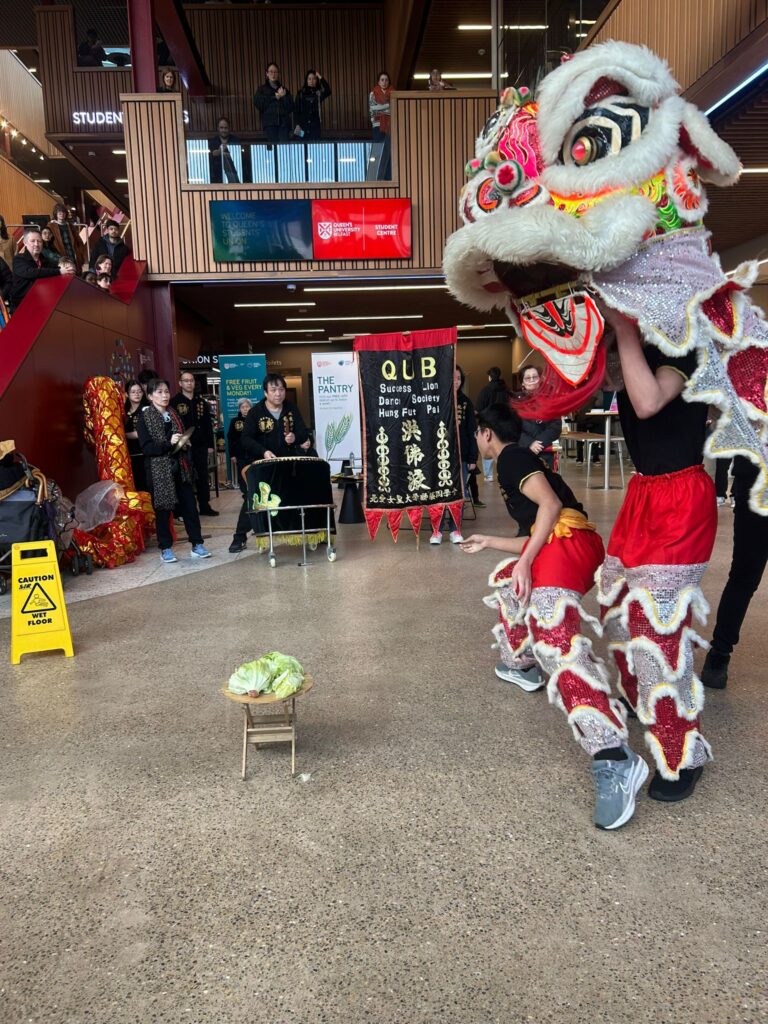
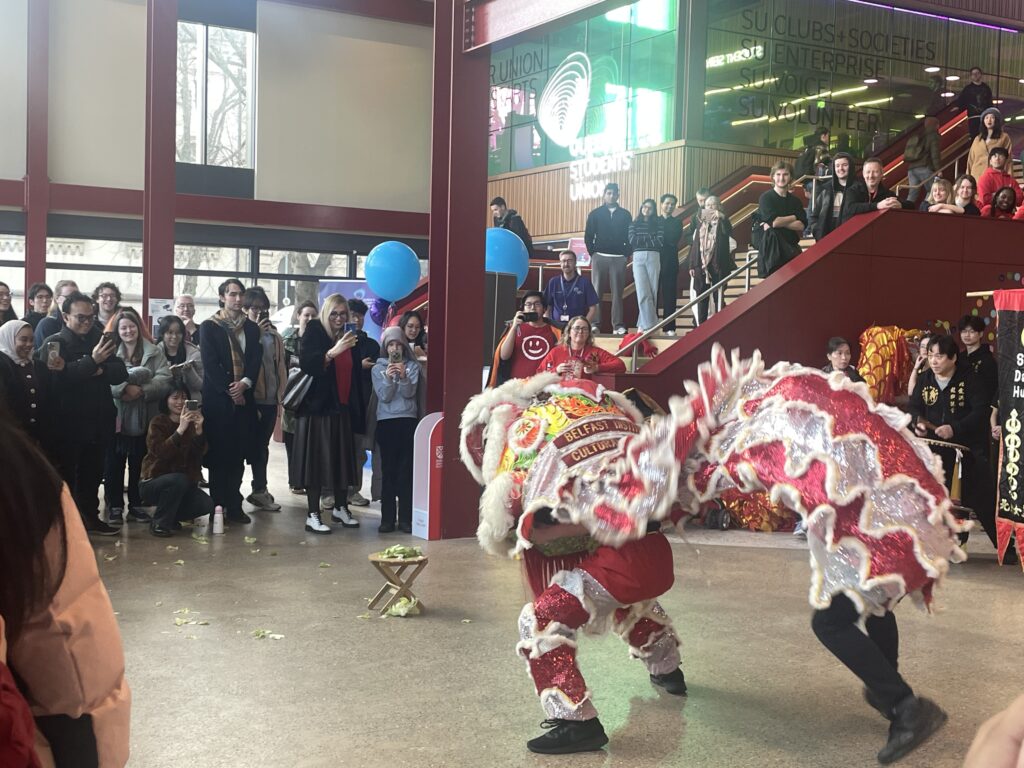
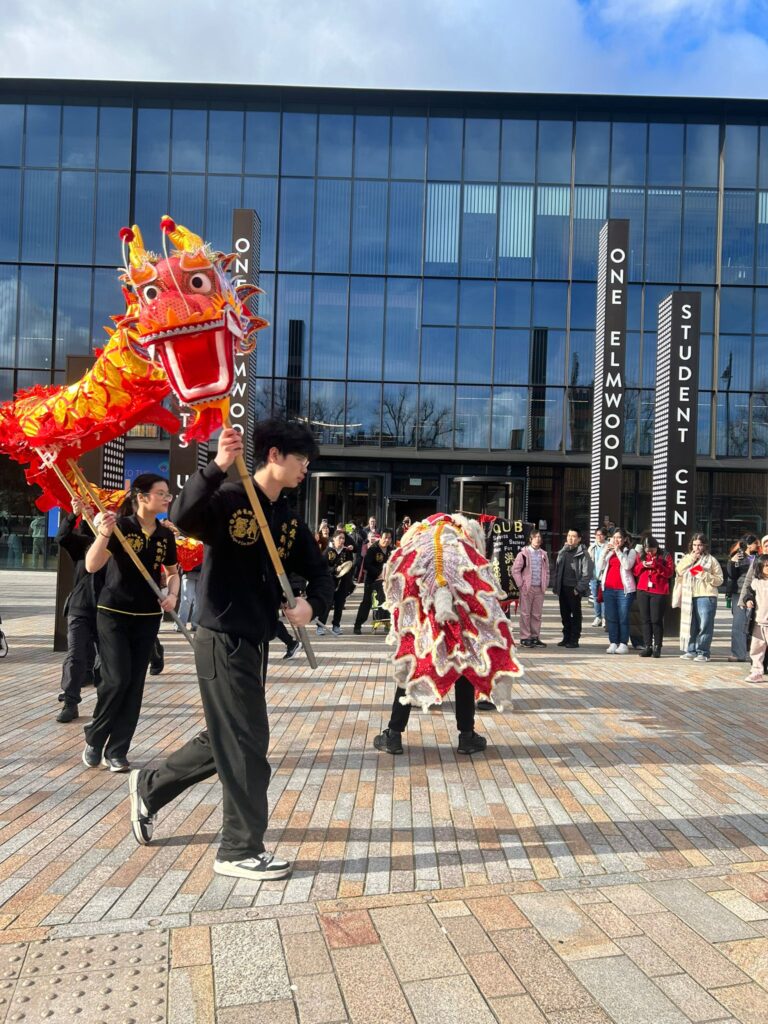
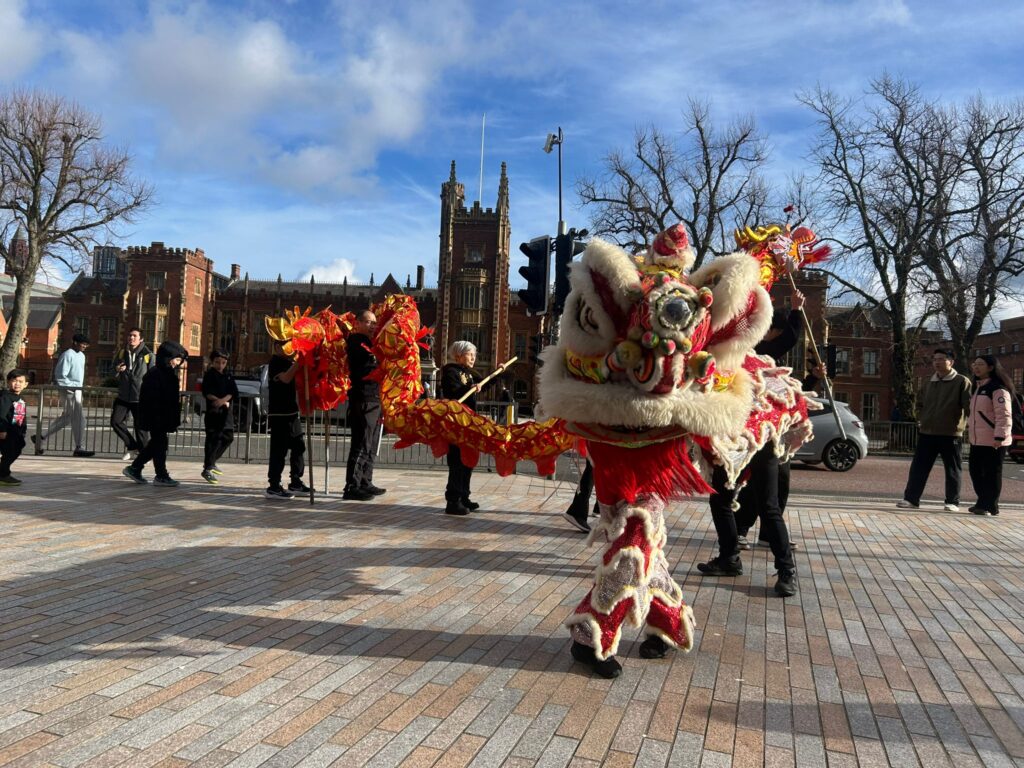
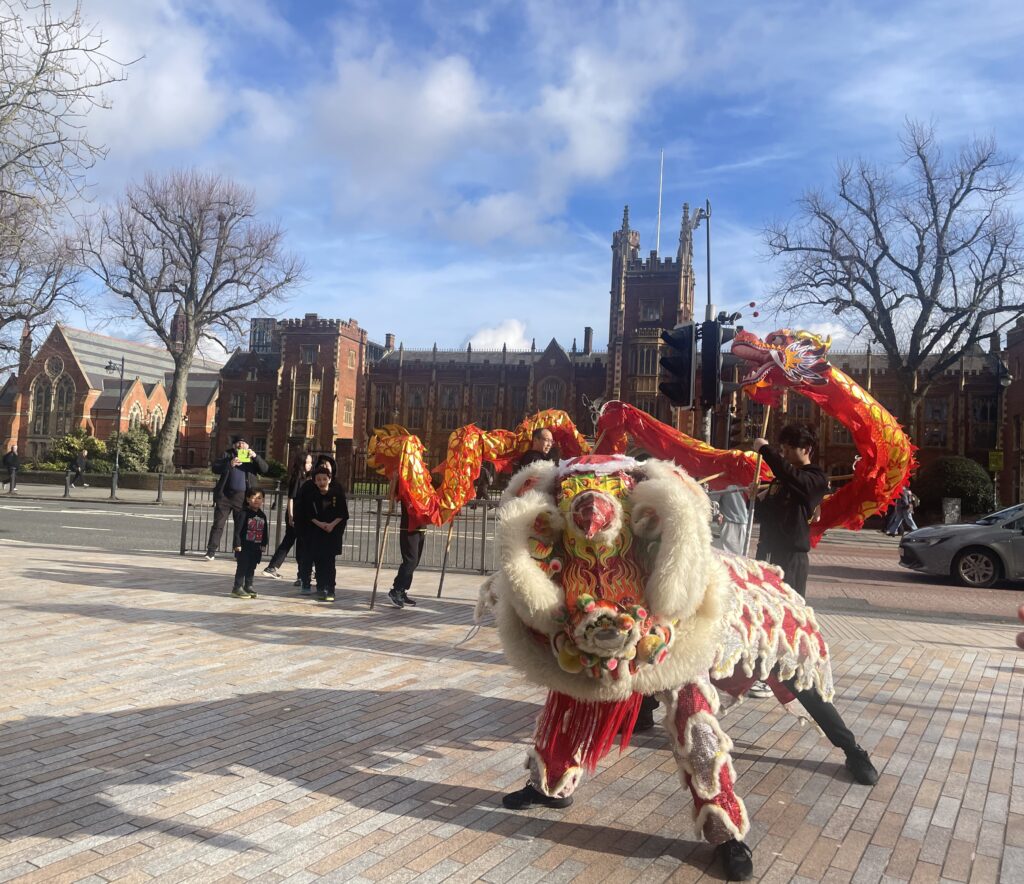
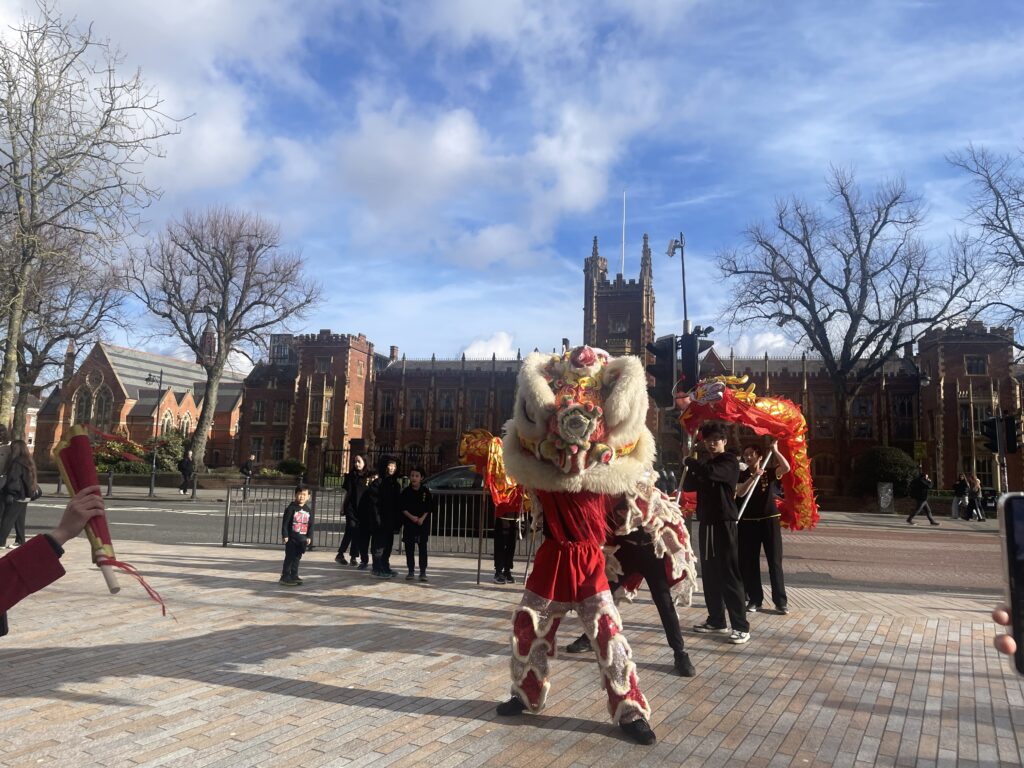
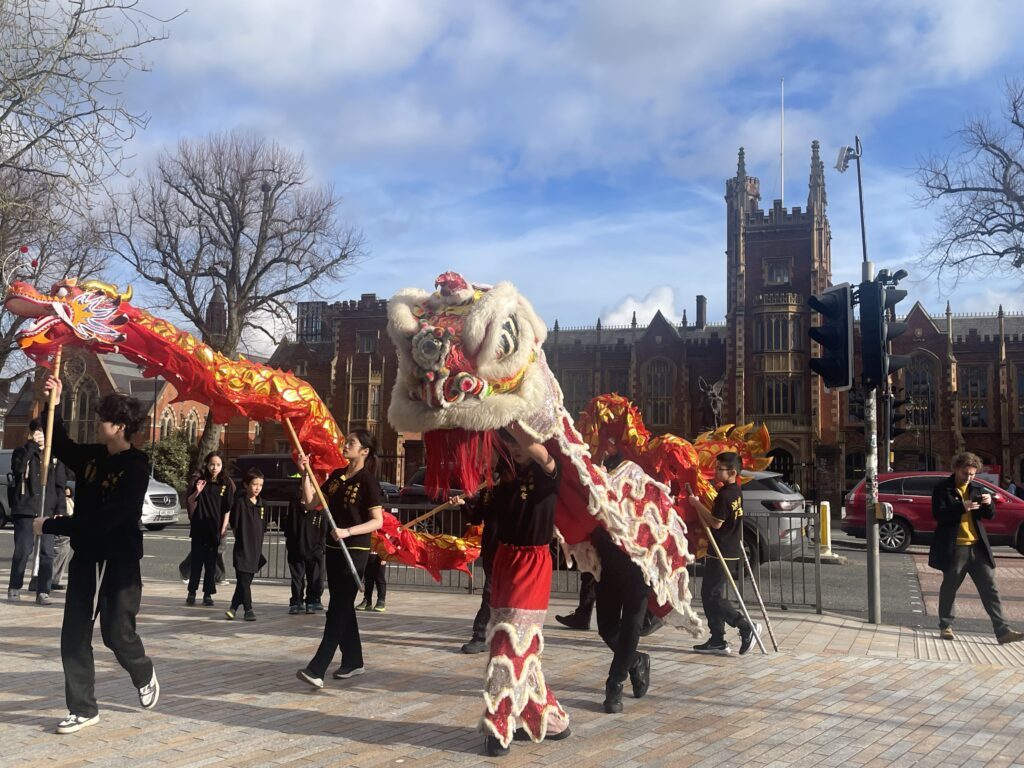
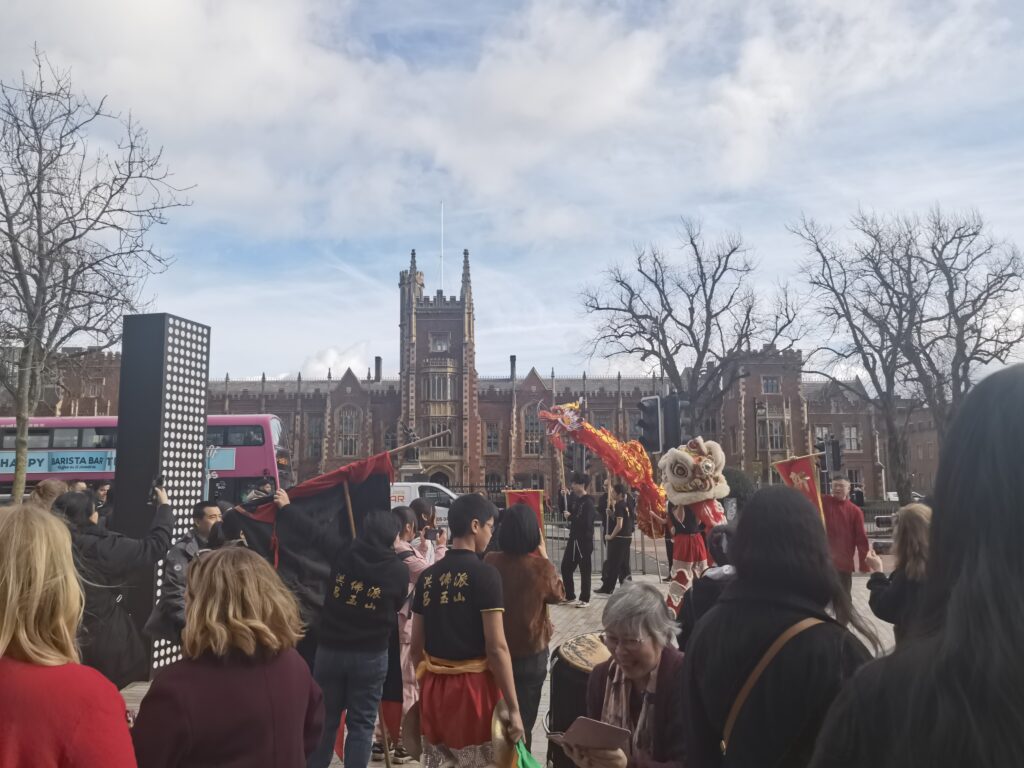
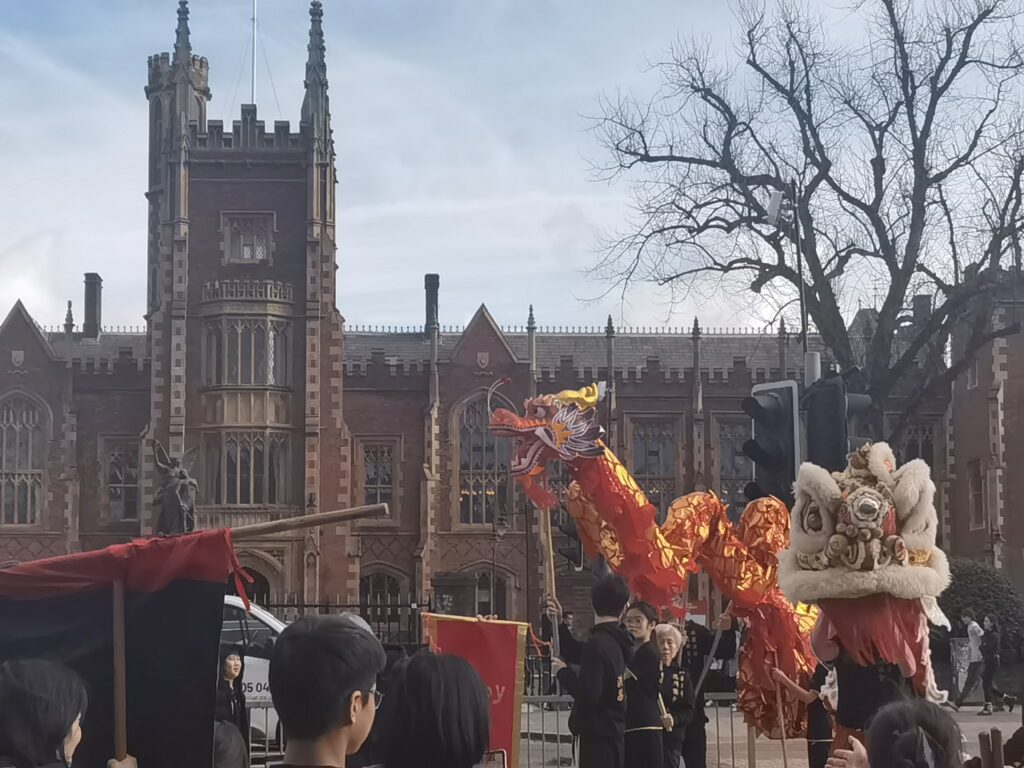
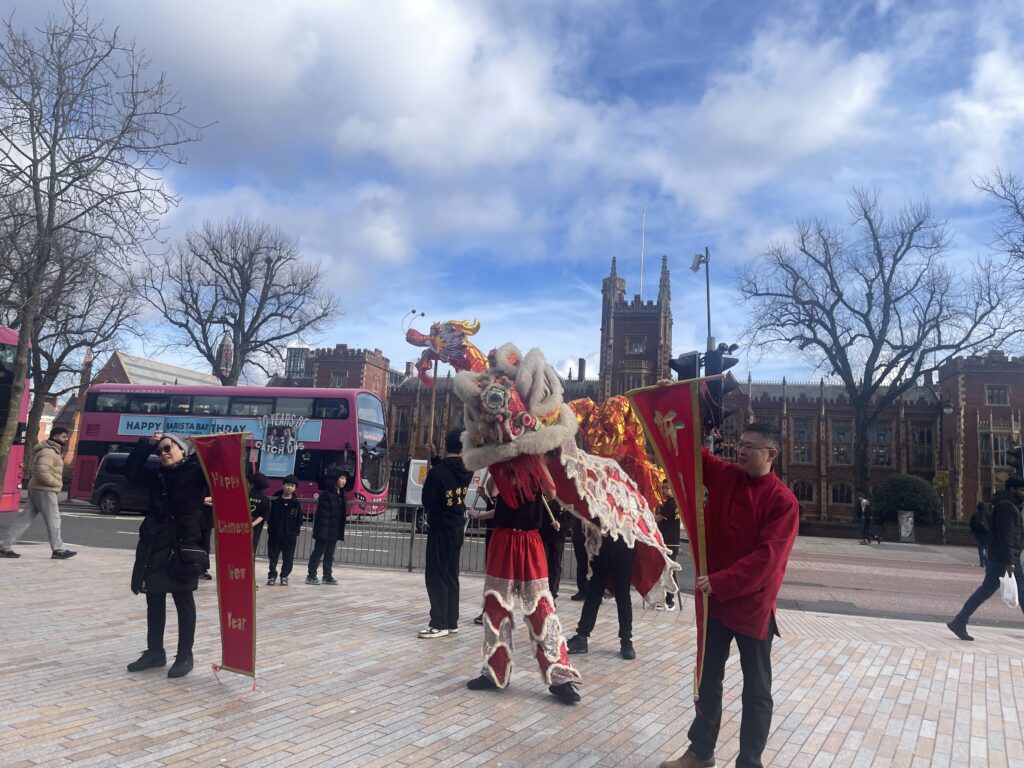
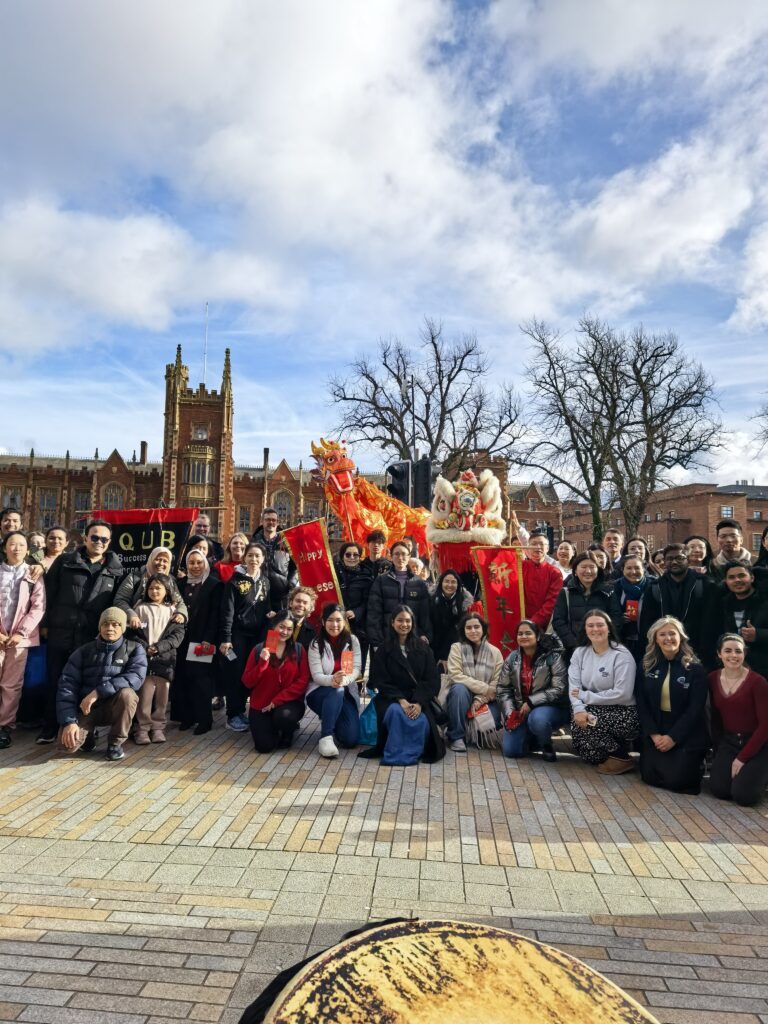
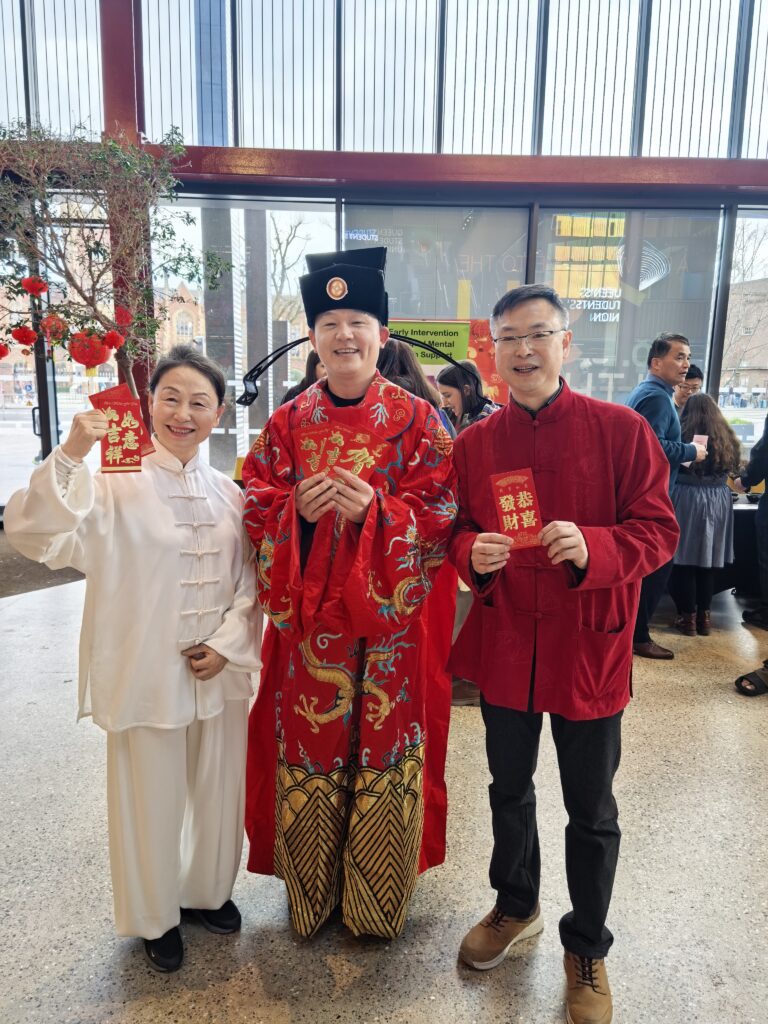
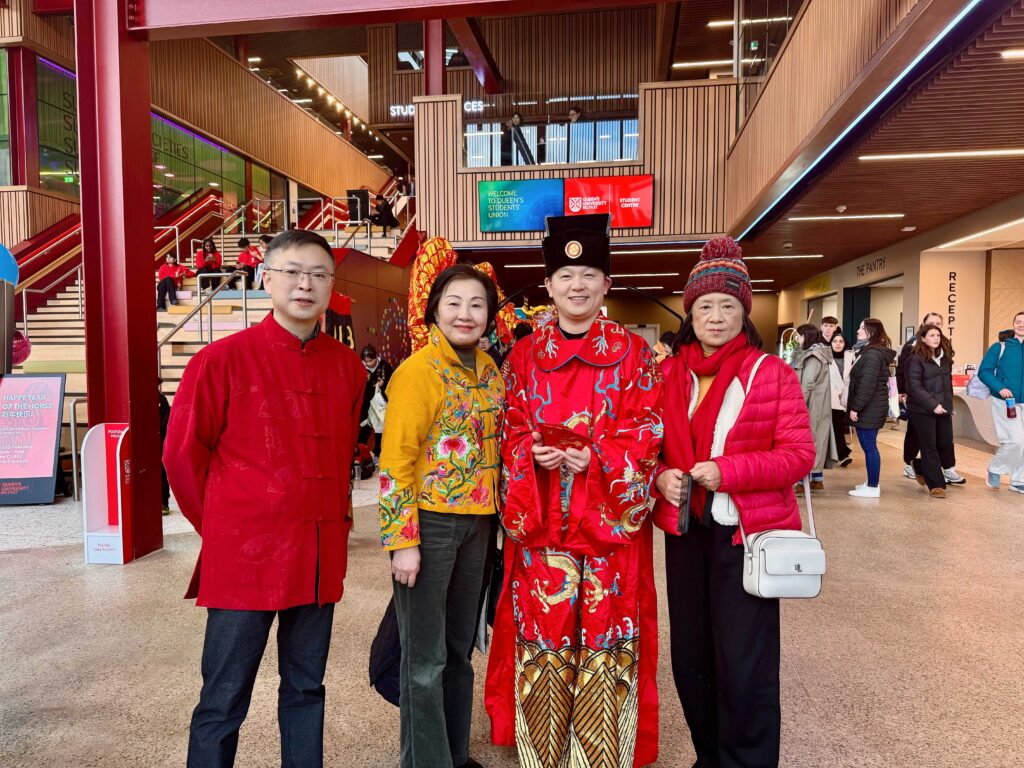
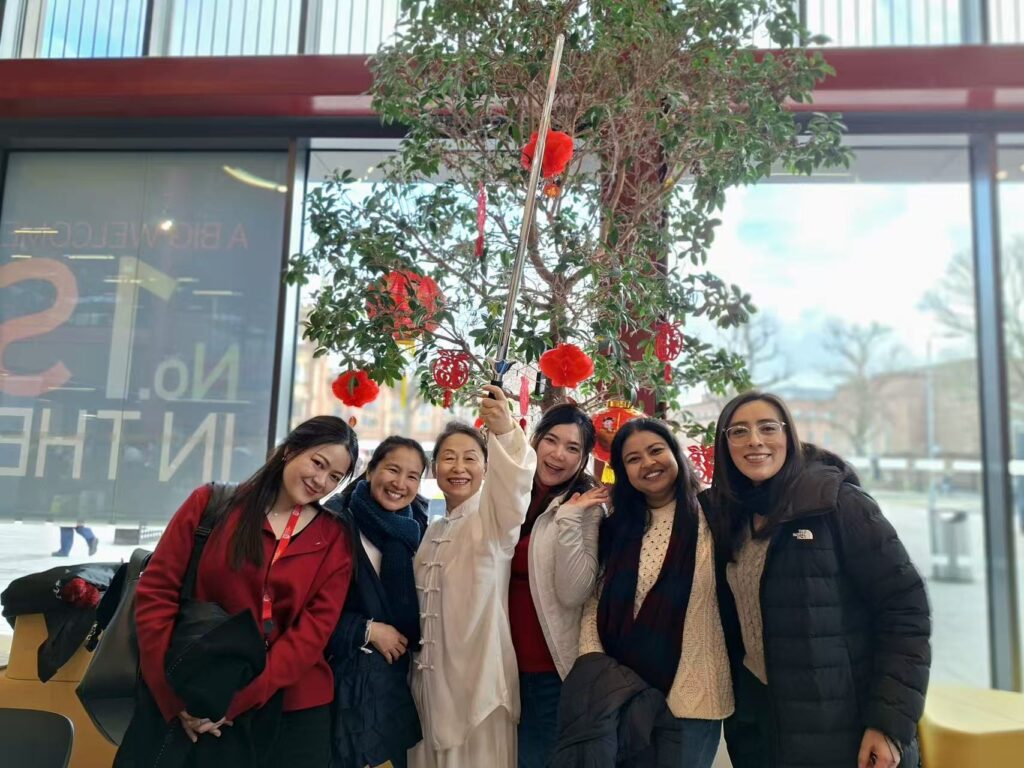
Following the launch, attendees were invited to the ground floor, where the traditional Dragon and Lion dance began in the foyer and continued outside the One Elmwood building. The celebration concluded with a group photo featuring all participants, symbolising the farewell to the Year of the Snake and the welcoming of the Year of the Horse.
_cuva
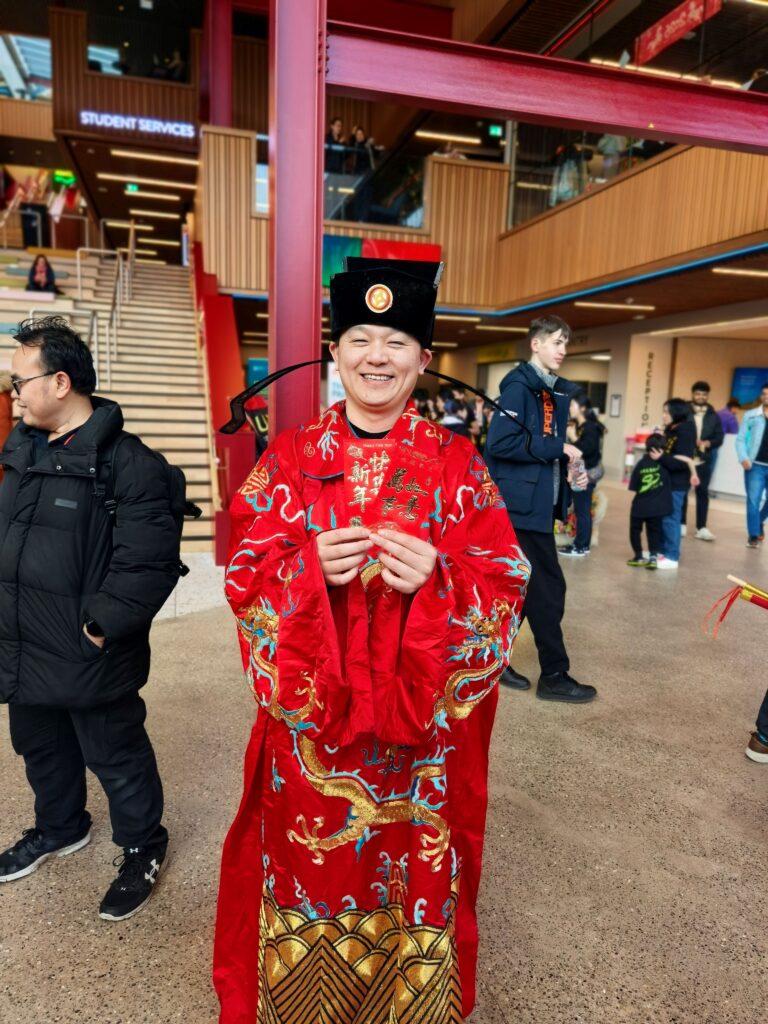
Another highlight of the celebration was the appearance of the God of Fortune, who generously distributed lucky “money” – chocolate coins and replica ancient Chinese coins – to those wishing to embrace good fortune in the year ahead.
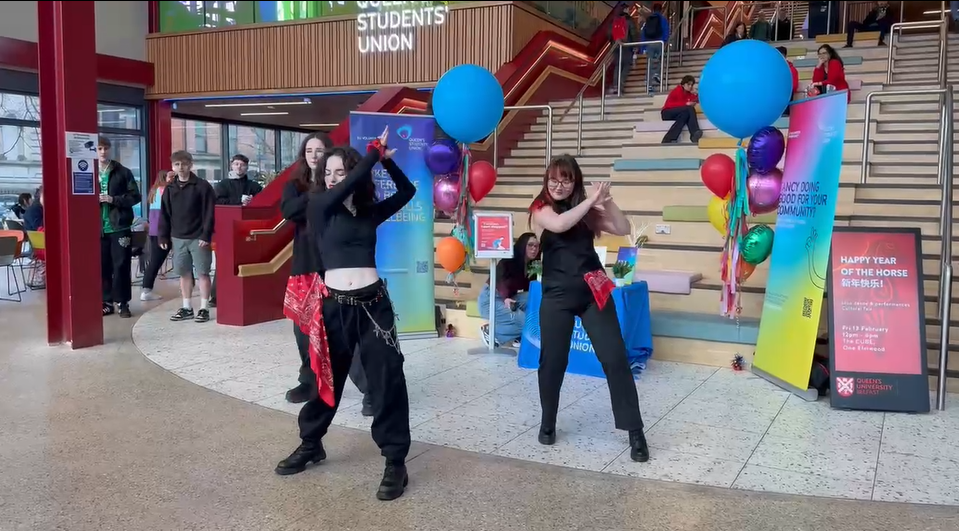
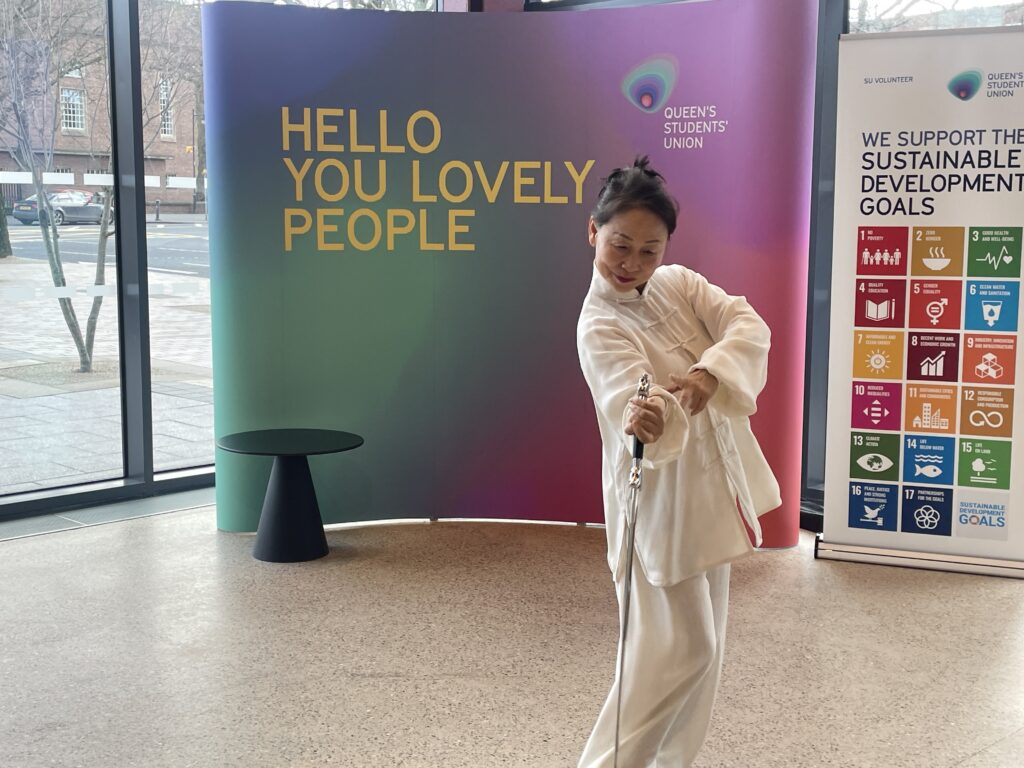
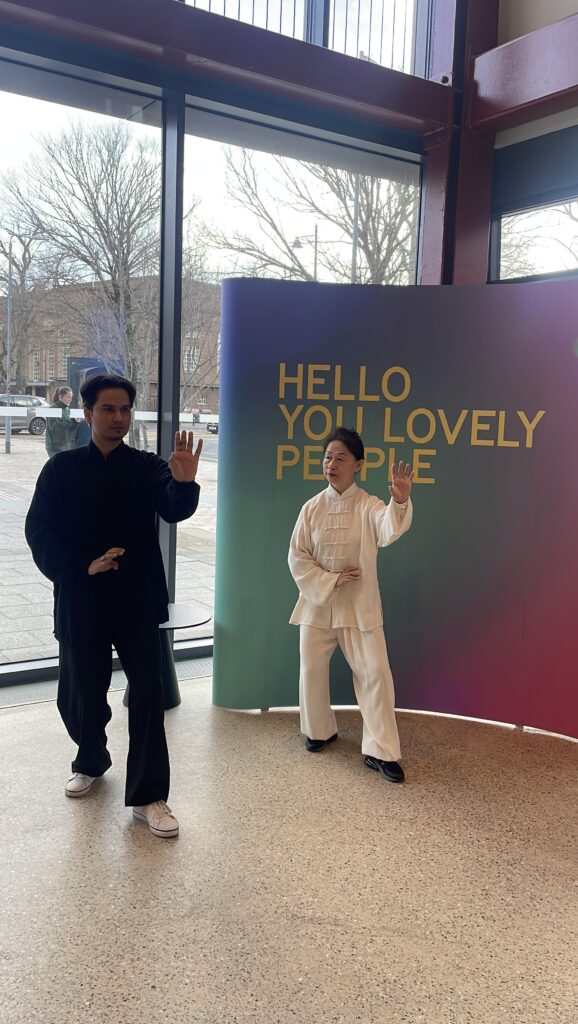
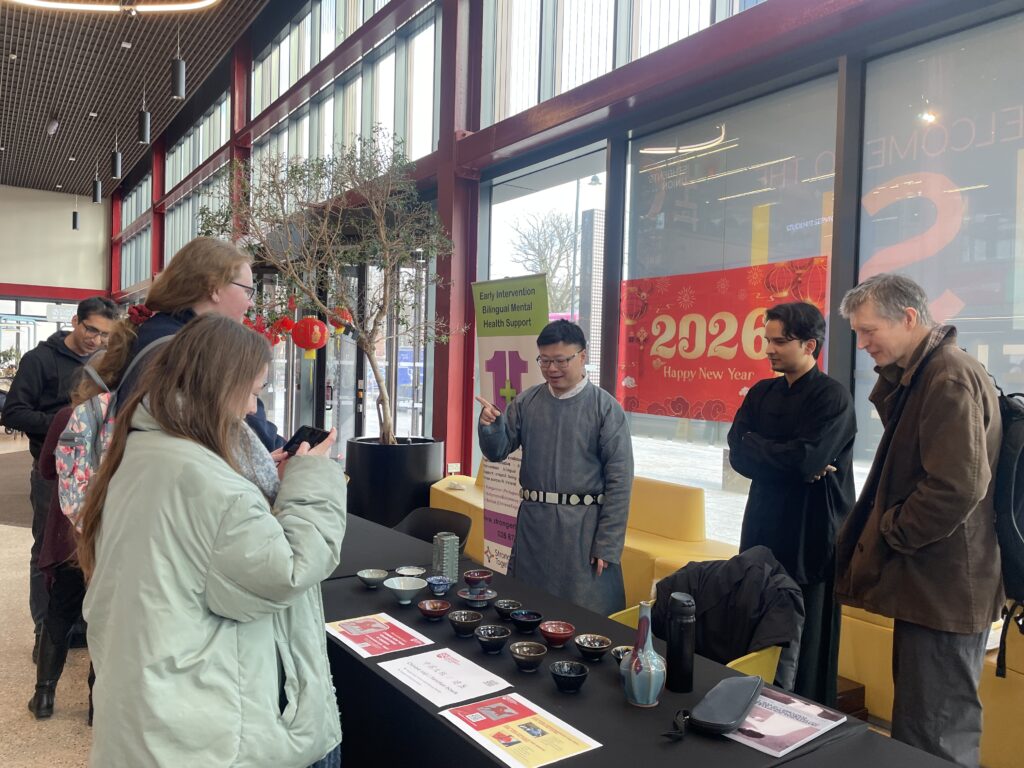
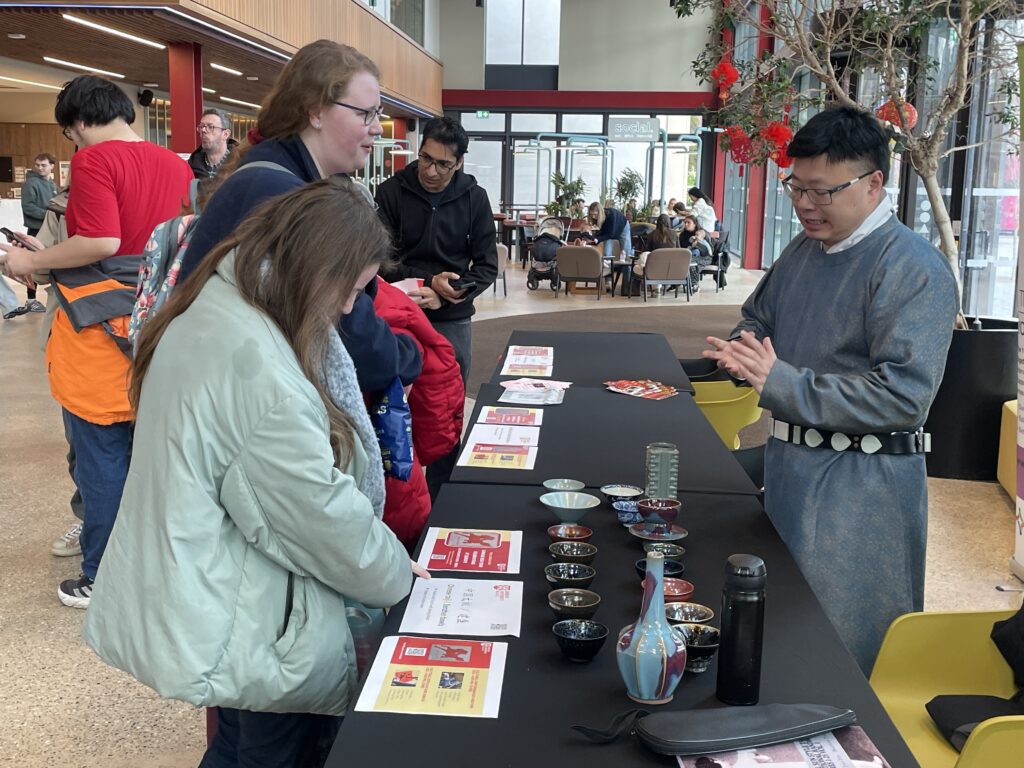
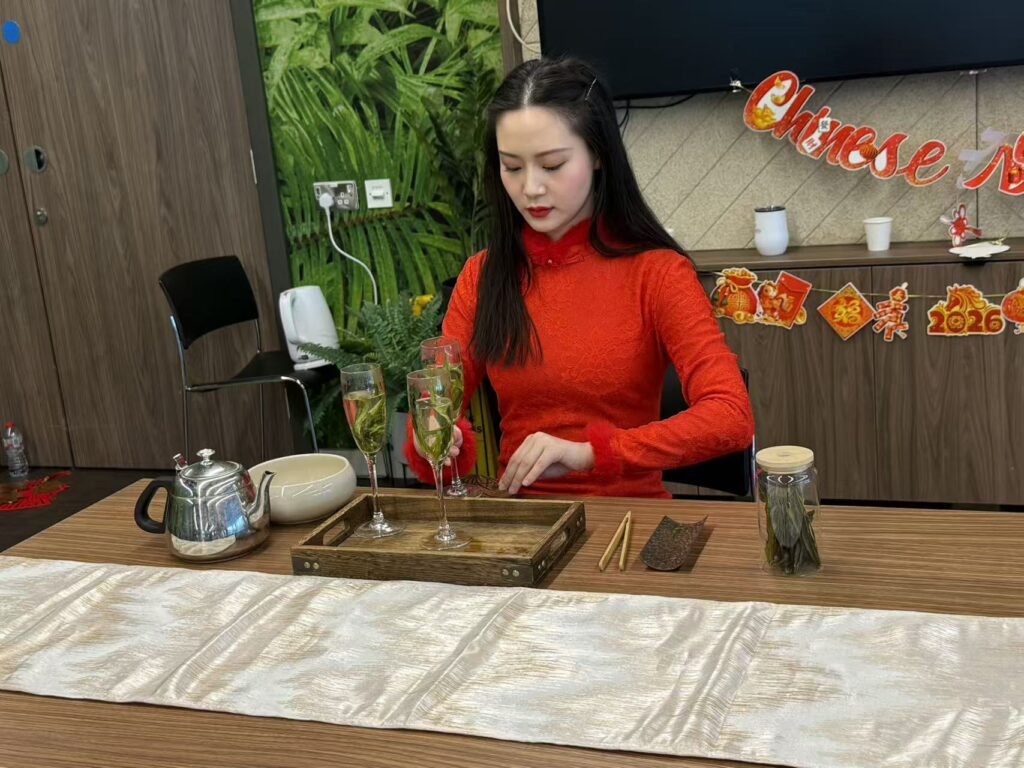
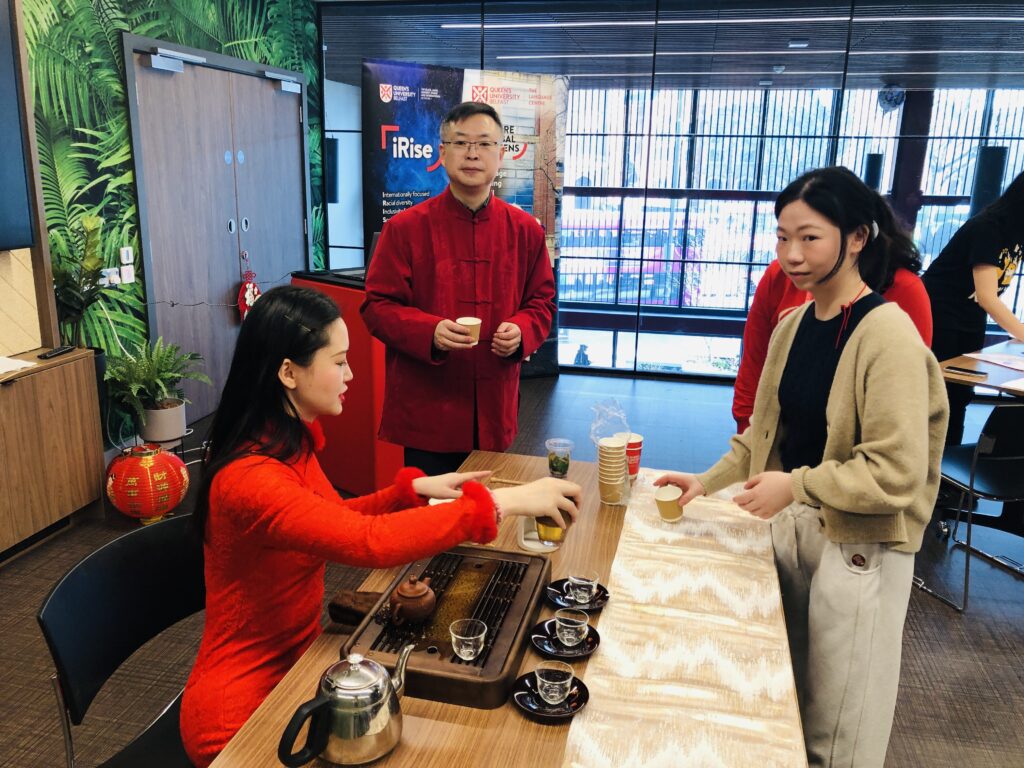
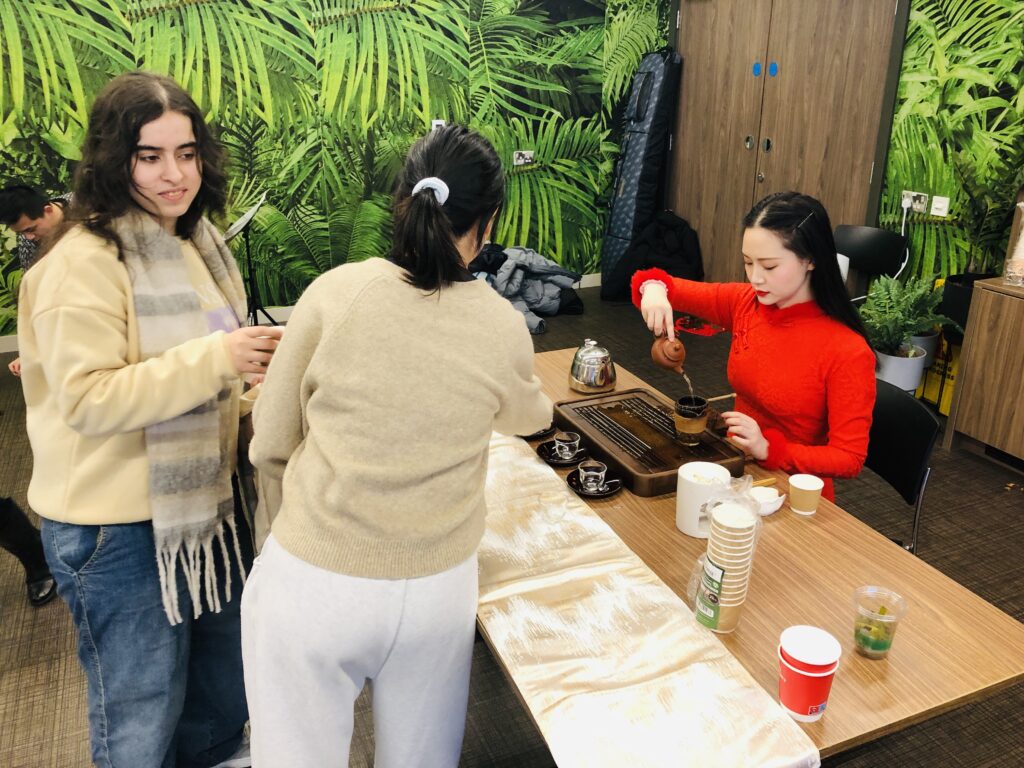
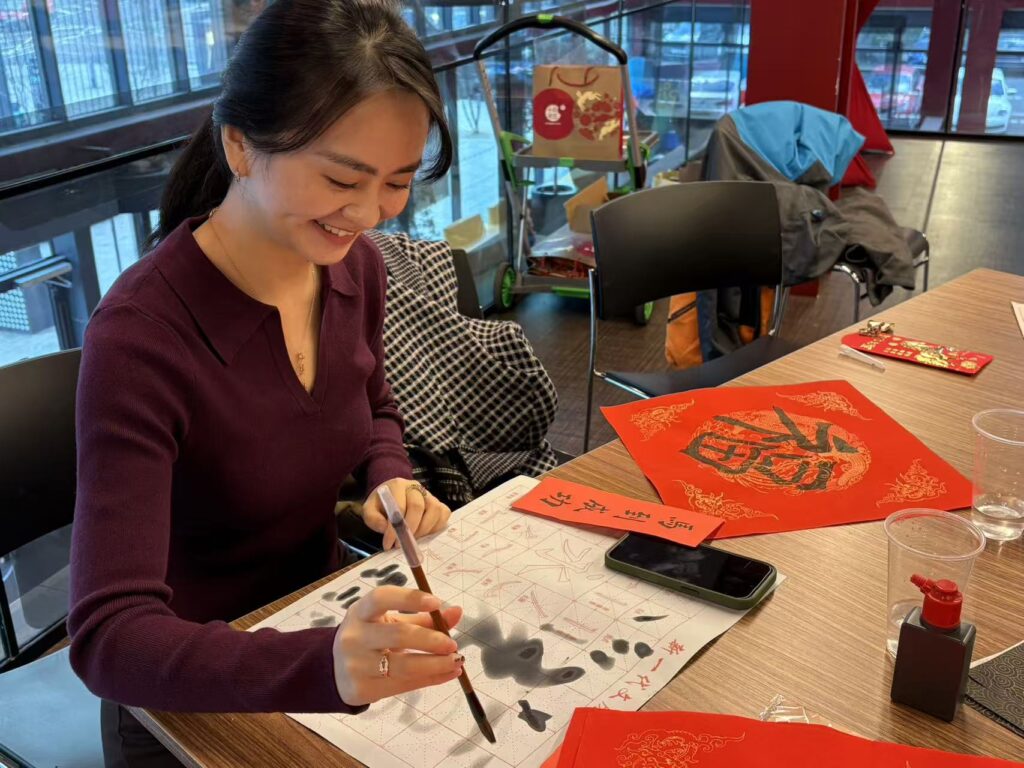
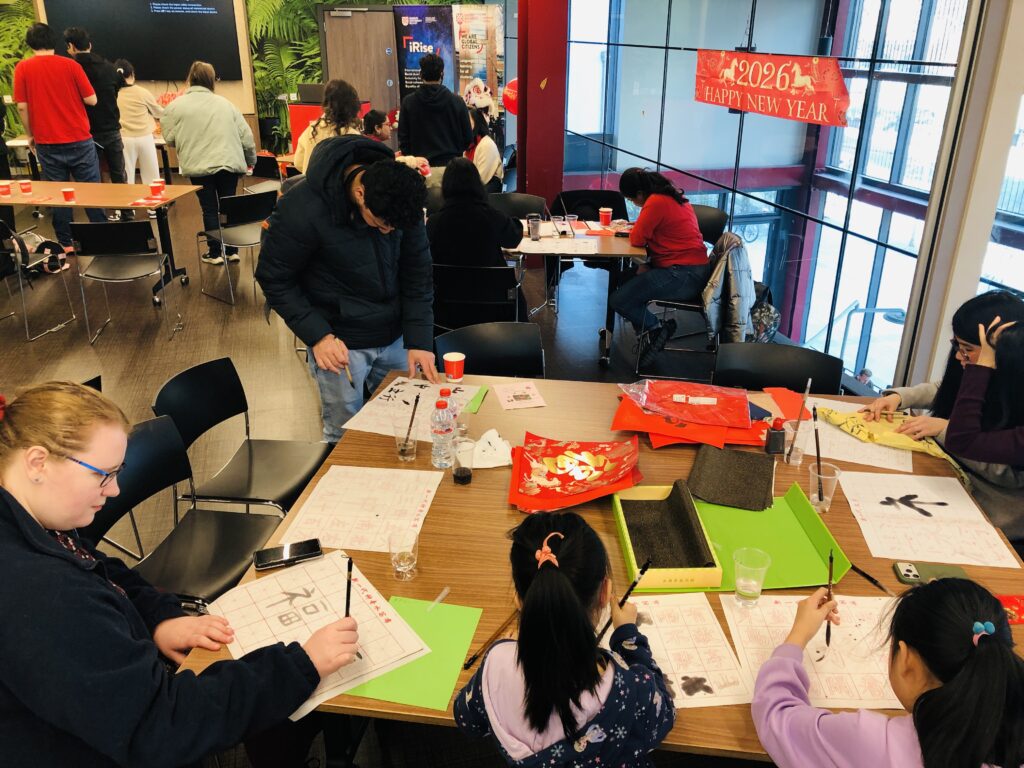
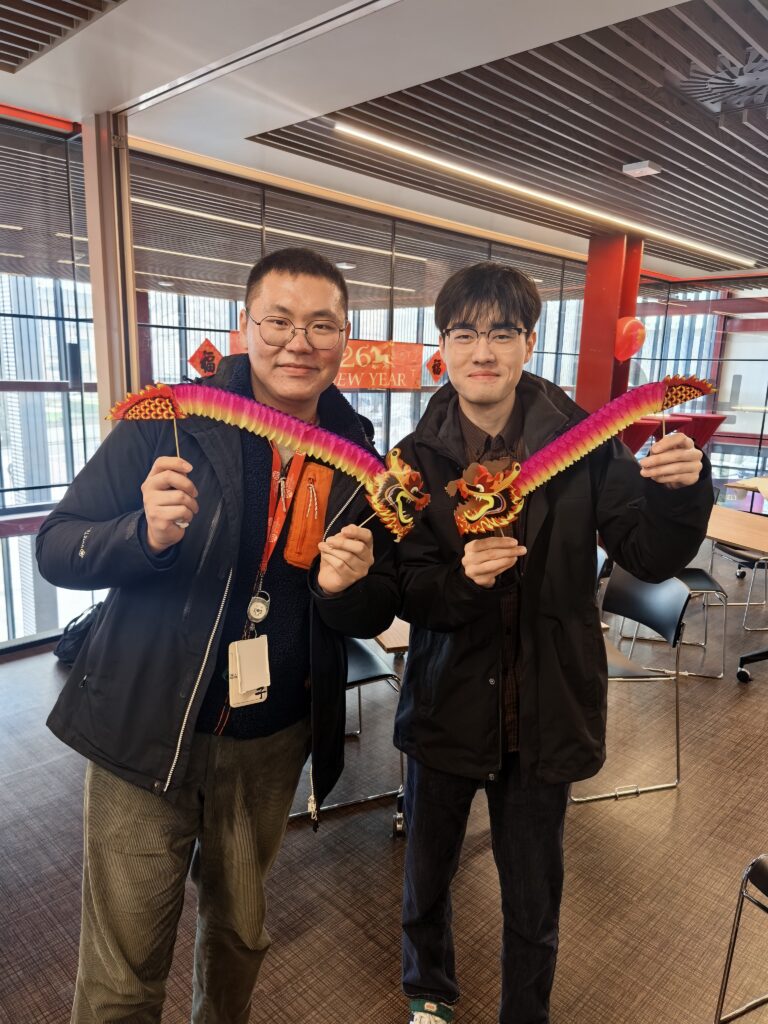
Additional performances included a vibrant K-pop dance, a graceful Tai Chi demonstration, and a Chinese Jianzhan tea cup display in the foyer. Meanwhile, cultural workshops such as calligraphy, paper crafts, tea and incense ceremonies, and guzheng appreciation sessions were held in the Cube, engaging and entertaining participants throughout the afternoon.
_cuva
_cuva
_cuva
_cuva
Blessed by the sunshine and strong support from One Elmwood Student Engagement Team, the event was a great success, with strong attendance and positive social impact. Queen’s is proud of its role as a civic university, promoting diversity, equality, inclusion, and belonging, supported by its vigorous academic and educational innovation.
_cuva
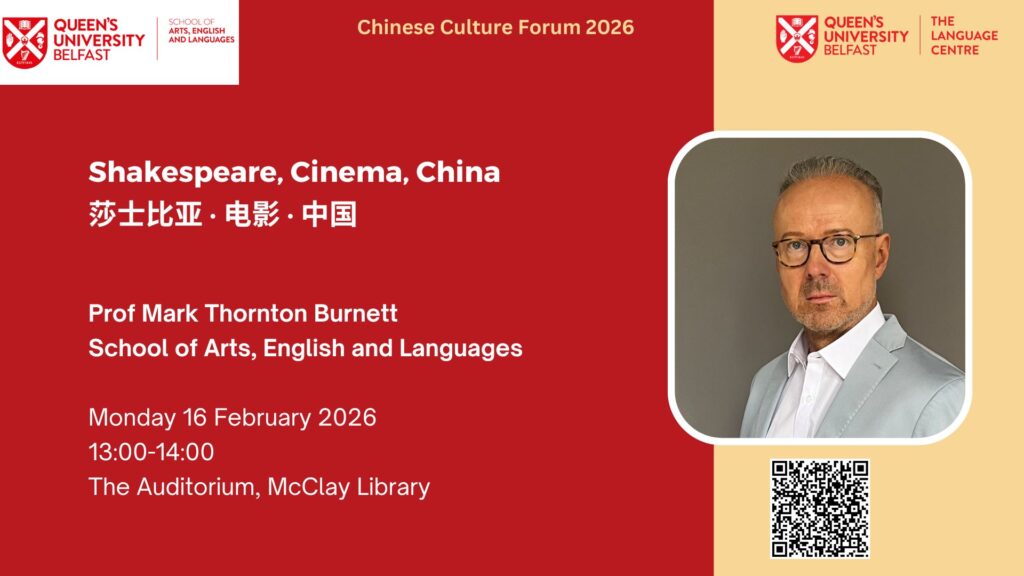
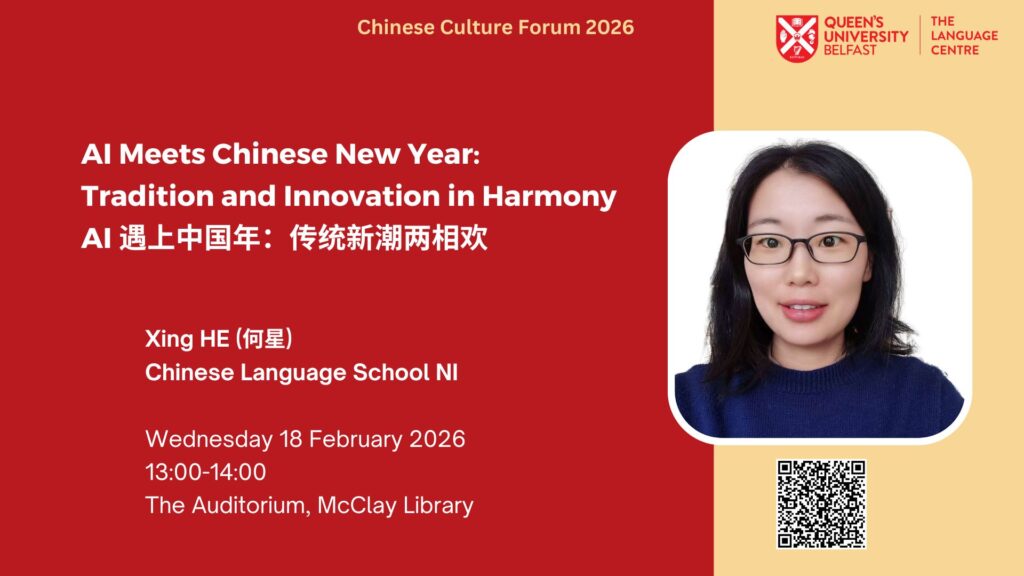
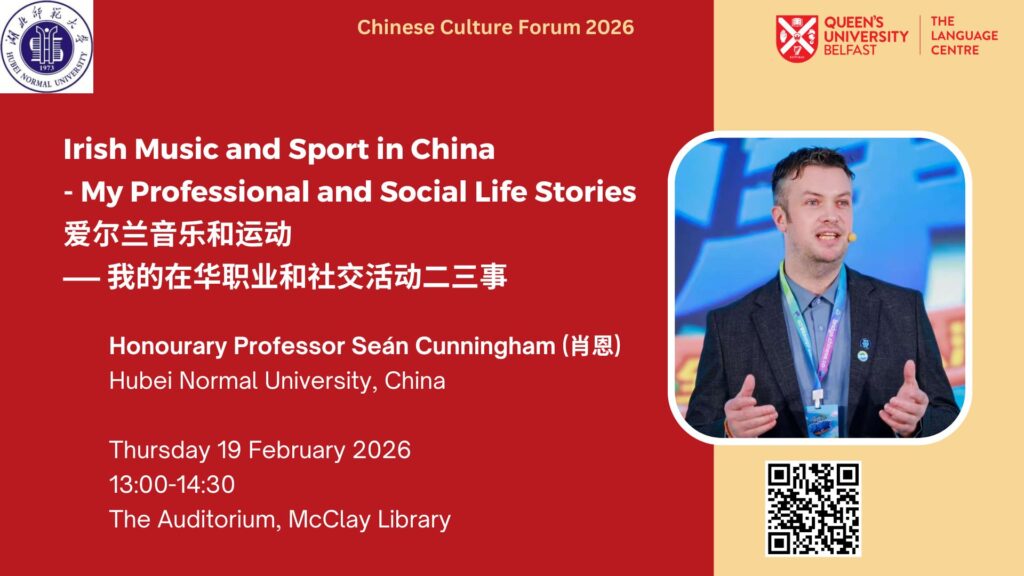
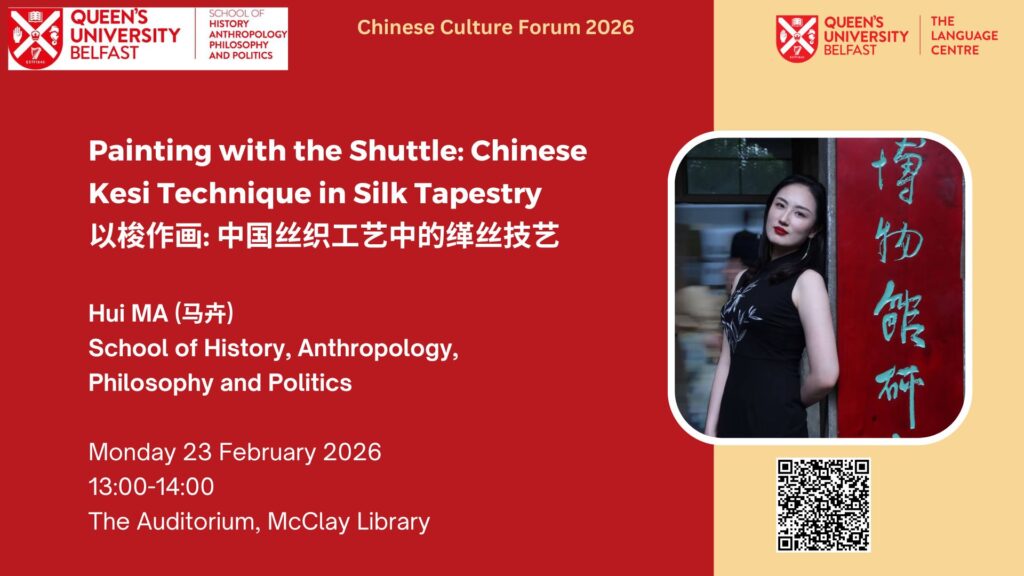
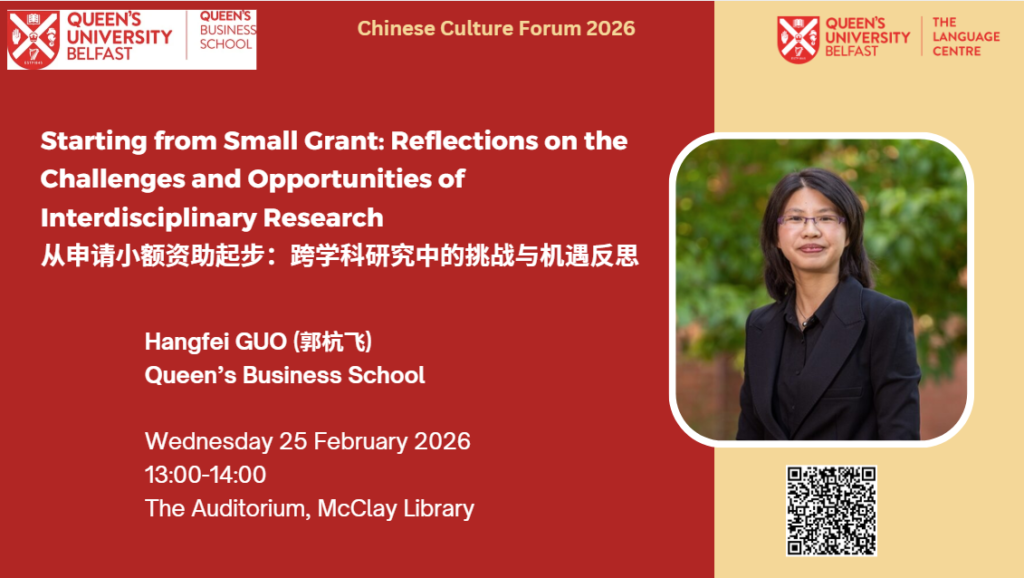
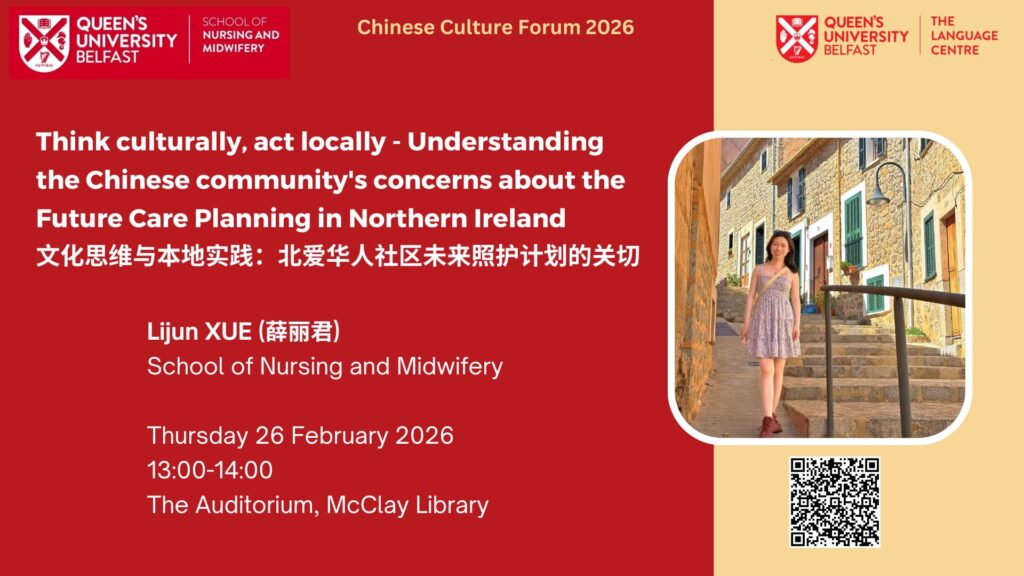
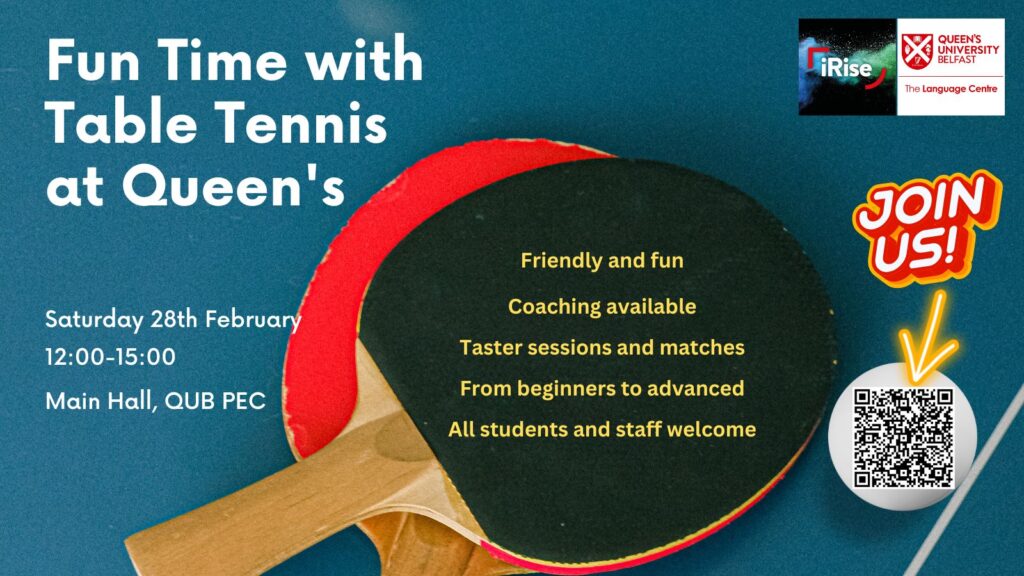
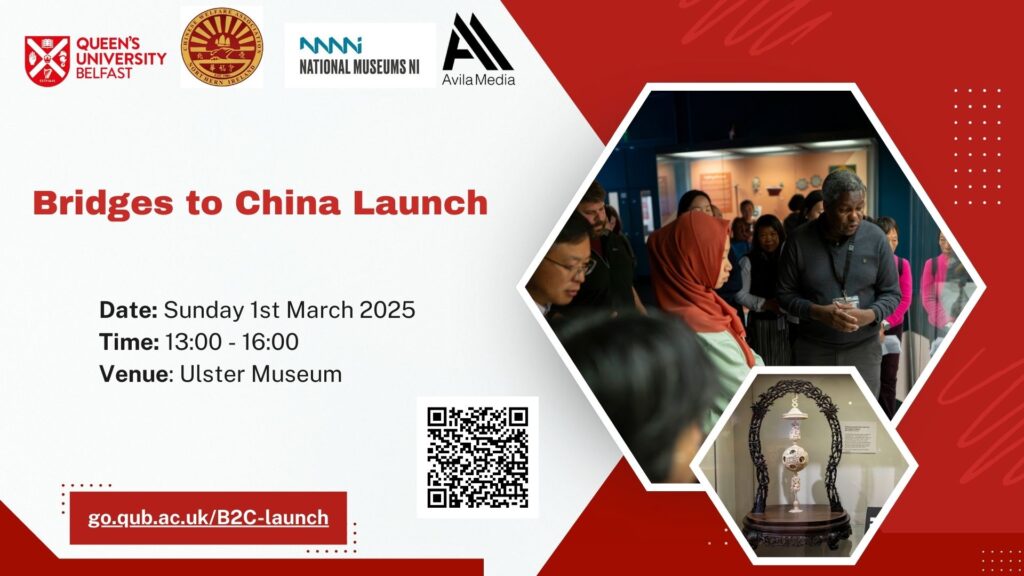
In keeping with Chinese New Year traditions, the celebrations will continue over the next two weeks, featuring six culture talks, a table tennis event, and a QUB-supported collaborative “Bridges to China” launch. All are warmly welcome!
To celebrate the arrival of the Year of the Horse, The Language Centre and Student Engagement Team One Elmwood are delighted to organise two CNY Arts and Crafts workshops scheduled for QUB students, staff and their families to attend on
Monday 19th January and
Friday 6th February
At the workshops (1-4pm), there are also opportunities to do hands-on Chinese calligraphy and paper crafts for the festive decoration.
2. Drawing the Horse Competition and Exhibition
Alongside the workshops, there is the “Drawing the Horse” competition, accompanied by an online exhibition showcasing submitted entries.
In Chinese culture, the Horse symbolises vitality, perseverance, freedom, and success. It is associated with forward momentum, aspiration, and the courage to pursue new horizons -qualities that resonate strongly with learning, creativity, and global engagement within the QUB community.
We invite students and staff to explore these cultural meanings through art and express their own interpretations of the Horse, whether traditional or contemporary, literal or symbolic. All submitted artworks will form part of an online exhibition celebrating creativity, cultural diversity, and the shared spirit of the New Year.
Join us in welcoming the Year of the Horse through drawing, imagination, and cross-cultural appreciation.
Requirement
Participants are encouraged to employ diverse drawing styles and mediums (e.g., sketching, oils, watercolor, sculpture, etc.) as long as they effectively convey your perceptions of the Horse 马/馬 within your own cultural context or Chinese culture. We welcome authentic forms and techniques of presentation, excluding AI-related works.
Submission
Submissions should consist of one drawing per participant, saved as an electronic copy (JEPG/JPG/PNG format, no exceeding 4MB). Please submit your artwork via the provided submission form, accompanied by a brief bio, including your name, status (e.g., educational/professional background), and a concise description of your illustration.
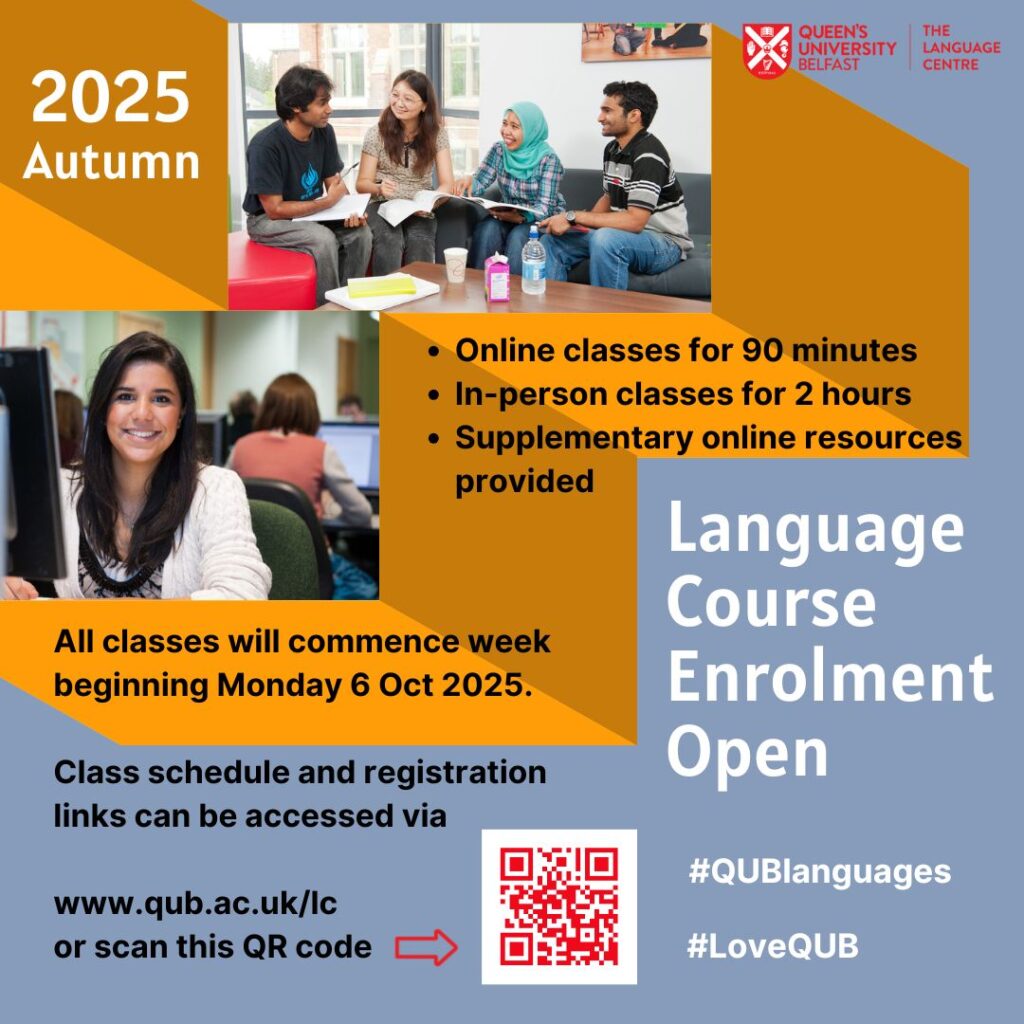
While August is coming to its end, we are pleased to embrace the new academic year to start soon, with two enrolment announcements to go live on and from Monday 1st September.
The Language Centre announcement
We offer almost 70 classes in 12 different languages that have both online and in person teaching. All classes will commence week beginning Monday 6 Oct 2025.
We welcome all to make an early registration as courses are extremely popular and fill up quickly.
The application for the Student Ambassador Programme 25/26 will open on Monday 1st September.
Applications will be first-come first-served basis to meet demand, and as soon as the capacity is reached, the application channel will be switched off.
Any students interested in applying please follow the webpage.
Wish you all have a great start of the new academic term!
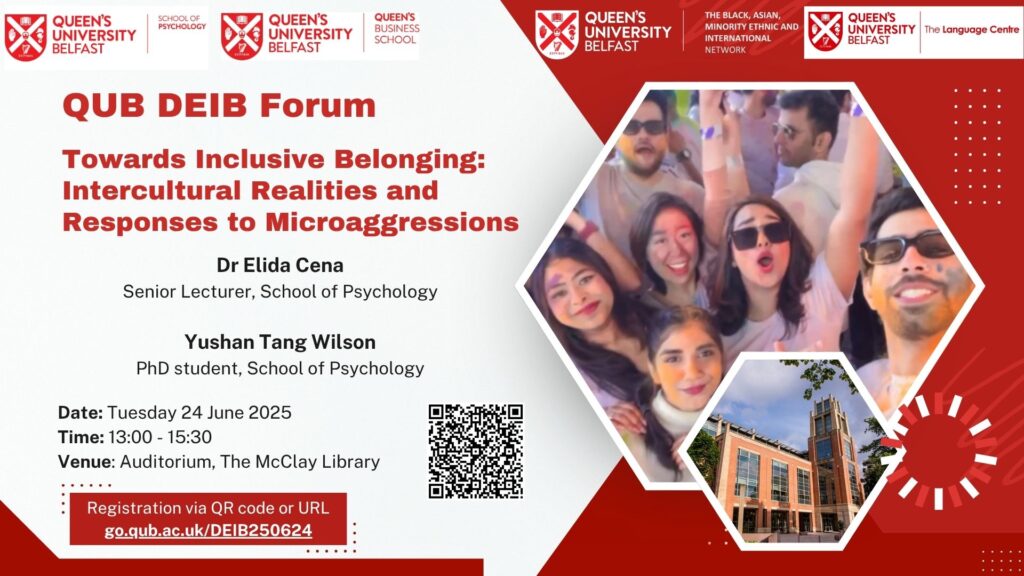
Towards Inclusive Belonging: Intercultural Realities and Responses to Microaggressions
Following the success of the inaugural QUB Diversity, Equality, Inclusion and Belonging (DEIB) Forum in March 2025, the upcoming event will centre on the theme: “Sense of Belonging and Microaggressions among International Students”, with a particular focus on the lived experiences of Chinese and Indian students at Queen’s. Colleagues are warmly welcome to attend this forum, as below:
Date: Tuesday 24 June 2025 Time: 13:00 – 15:30 Venue: The Auditorium, McClay Library
Yushan Tang Wilson, PhD student, School of Psychology
A panel of academic, professional colleagues and student representatives will further explore both the conceptual dimensions and the practical steps needed to enhance inclusion, foster belonging, and address microaggressions within our diverse university community.
Programme:
Welcome Lunch
Introduction
Presentations
Panel discussion
Closing remarks
Places are limited to max. 40 due to room capacity and we have the first-come, first-served policy. The registration form will be closed once places are taken, or by 5 pm, Friday 20th May the latest.
Cena, E., Burns, S., & Wilson, P. (2021). Sense of belonging, intercultural and academic experiences among international students at a University in Northern Ireland. Journal of International Students, 11(4), 812-831. https://doi.org/10.32674/jis.v11i4.2541
Arriving in Shanghai at 7am, after an overnight journey on an 11-hour train, it was safe to say I felt tired, but excitement pulsed in my veins as I had arrived in the city of my dreams. I bid goodbye to my roommate on the train, and met with my colleagues down the corridor. We made our way through the station and hopped into a taxi. Observing the view on the journey from the station to the centre of Shanghai, it seemed quiet, being so early in the morning, but the city was slowly starting to come alive.
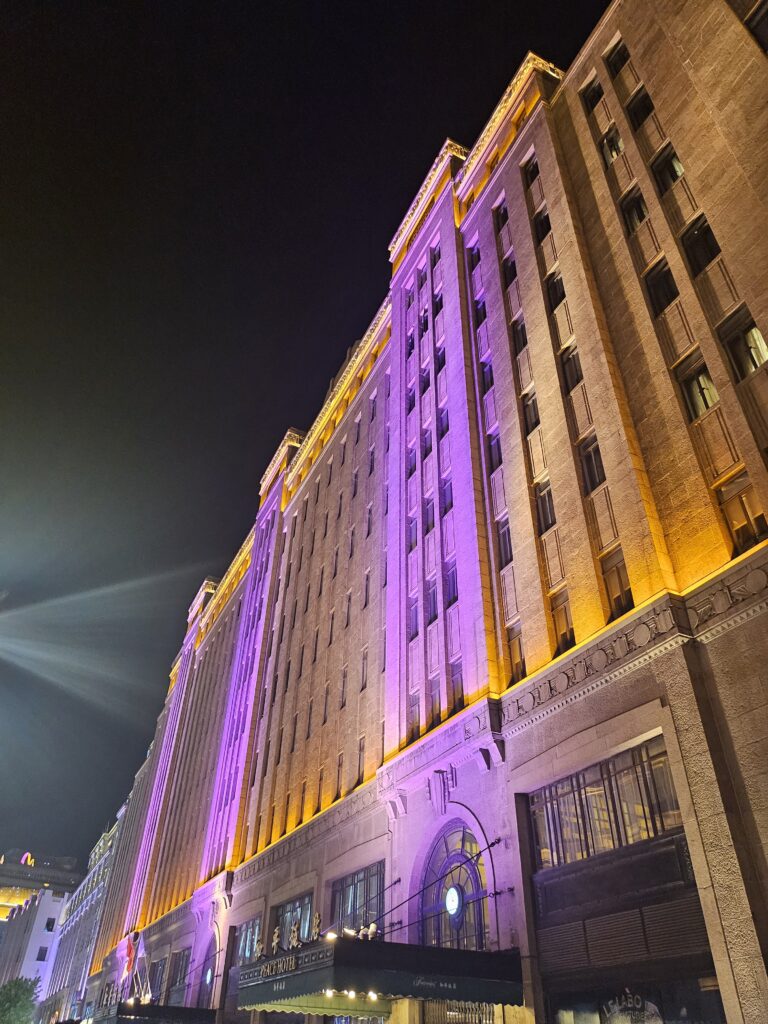
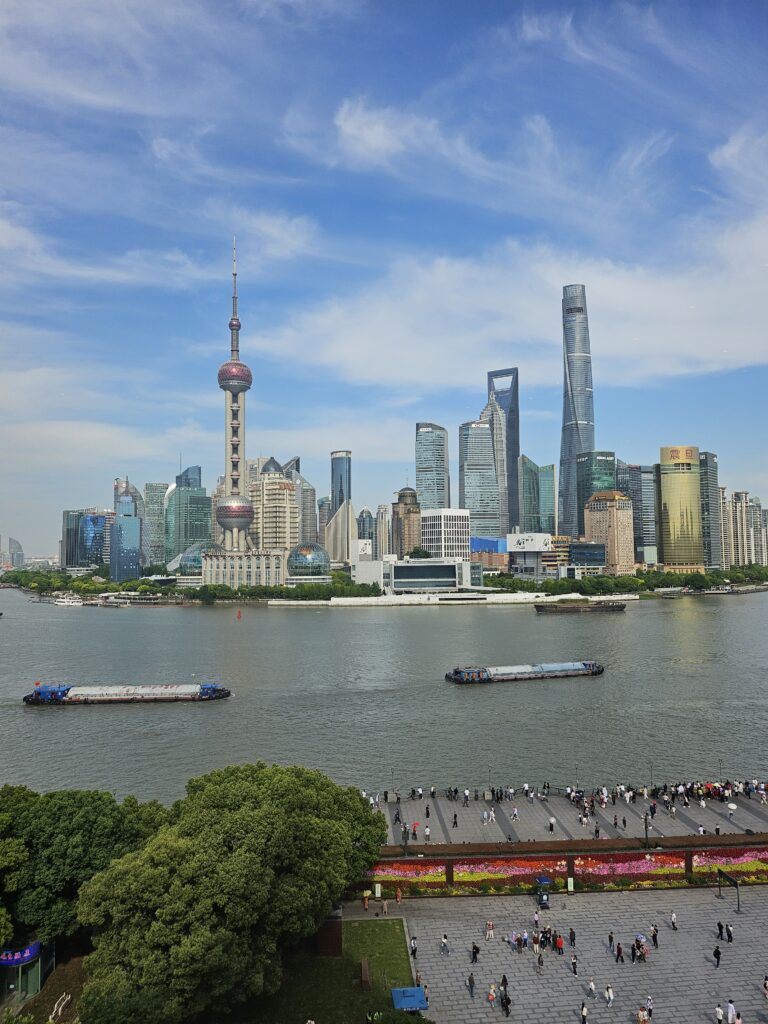
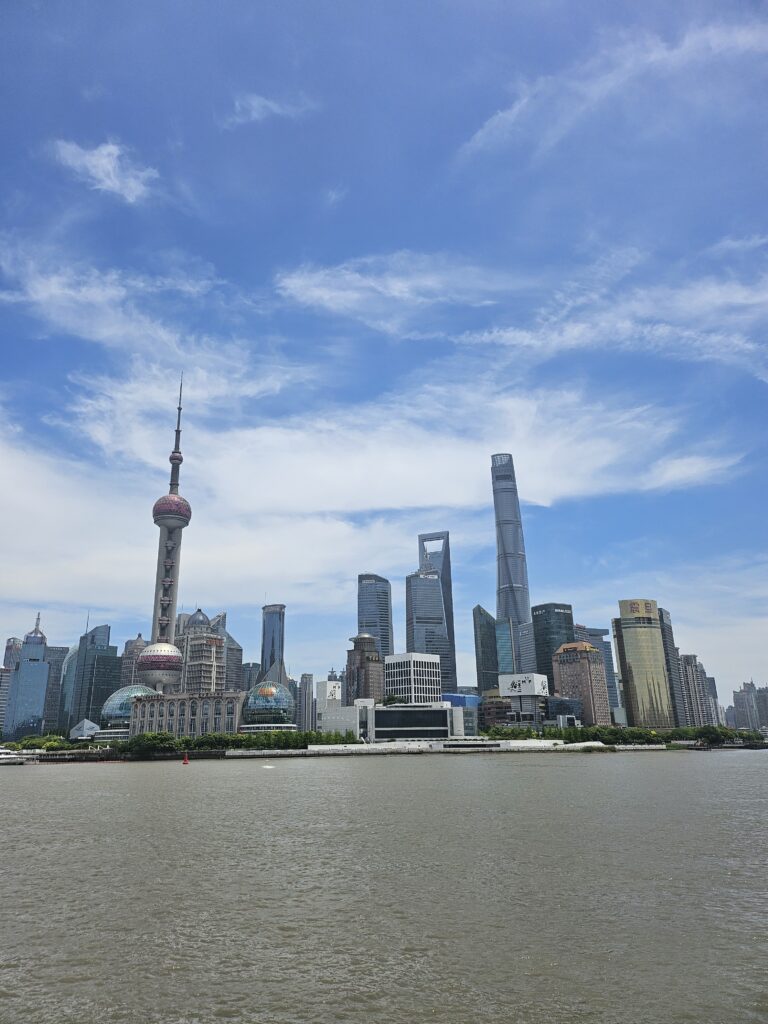
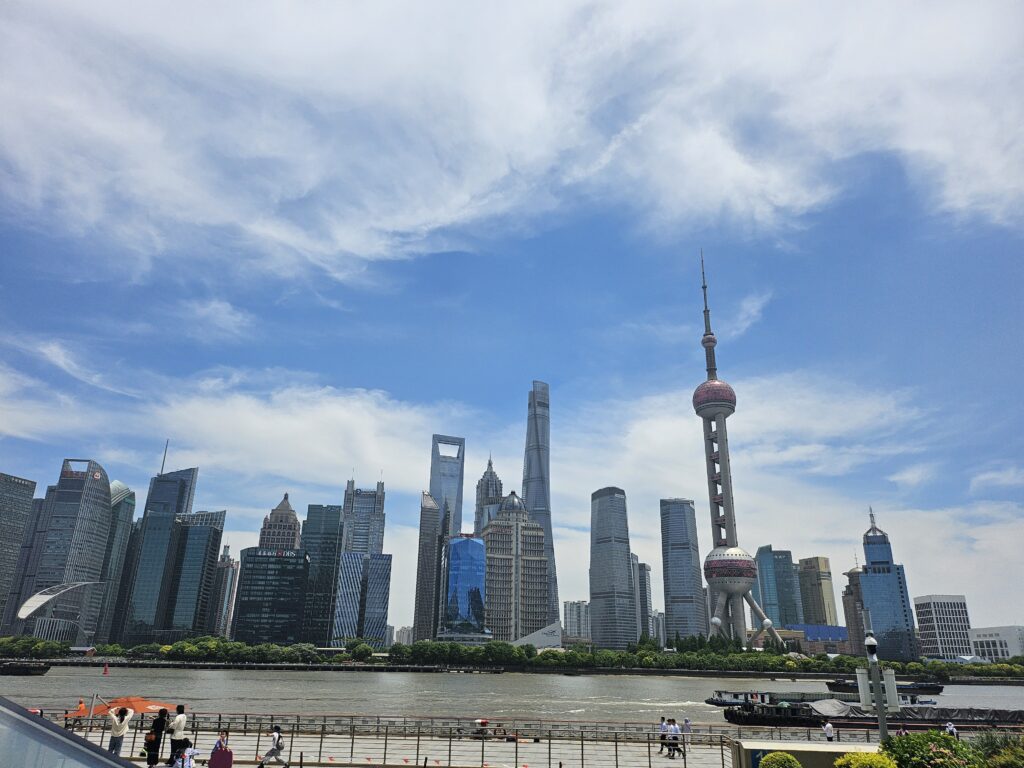
Distracted by the buildings, taking in as much of the city’s scenery as possible, I was not aware that we were nearing our destination, until we turned a corner and I looked out the window to see the Oriental Pearl Tower and towering buildings of the Lujiazui Financial District (陆家嘴金融区, Lùjiāzuǐ jīnróngqū) across the water. My heart leapt at the sight. My colleagues could sense my excitement, pointing out the sights at the window, and I made it my goal to go for a walk along the Bund (外滩, Wàitān) later that day. Being in such close proximity to the Bund was a surprise and a delight, knowing that we were also staying in one of Shanghai’s most famous hotels.
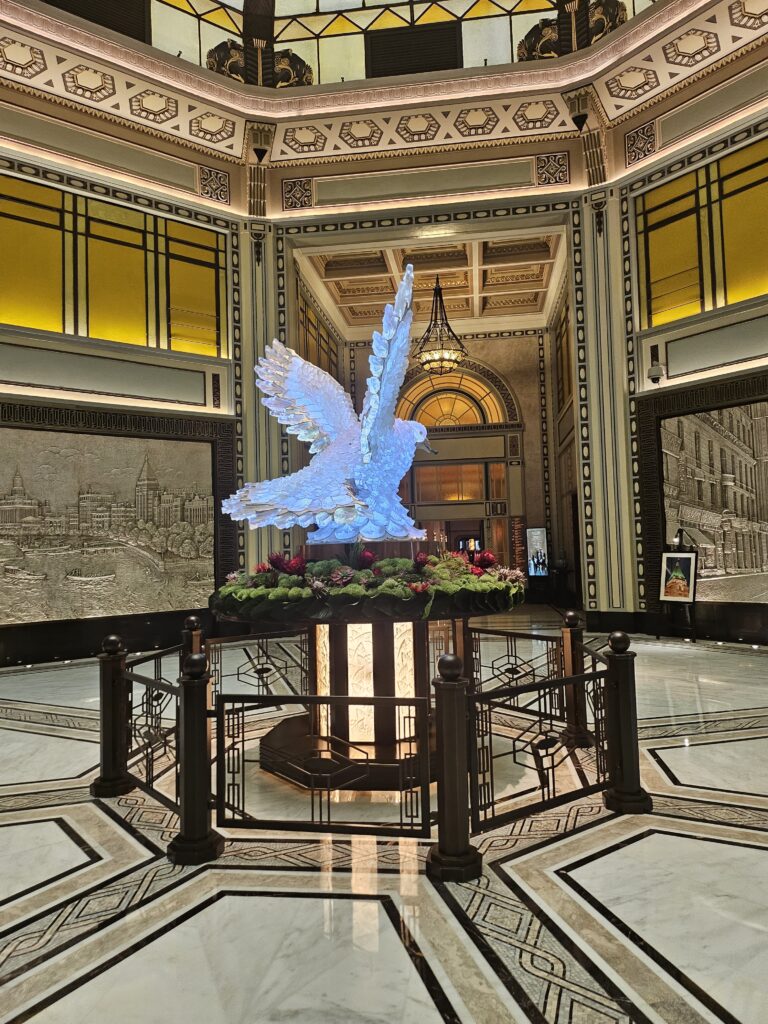
We pulled into the entrance to the Fairmont Peace Hotel (和平饭店, Hépíng Fàndiàn) and l felt like I’d been thrown into the books I’d read about Shanghai. Making our way to reception to get checked in, the lobby was exquisite with a glass sculpture of a dove in the centre. After checking in, we quickly made our way to breakfast, with a selection of Chinese dishes, and continental breakfast; it was certainly a treat to start off my time in Shanghai.
Fairmont Peace HotelFairmont Peace Hotel Lobby
Queen’s Event
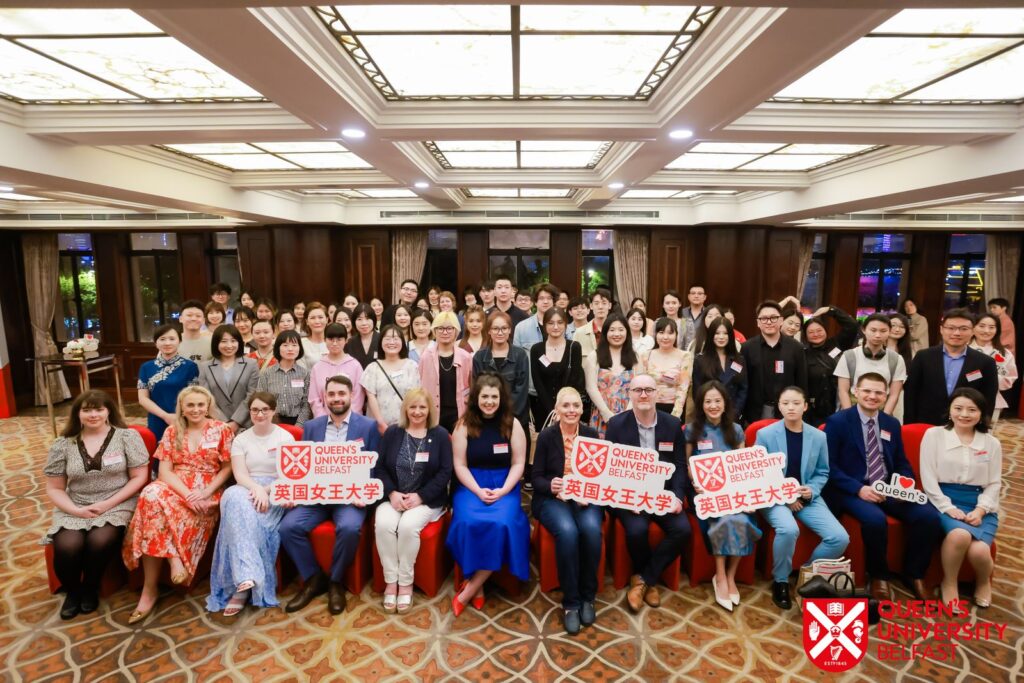
The second Alumni and Offer Holder Event was taking place in the hotel; a grand location for an exciting event. After some rest, I made my way down to the lobby, and the hotel was bustling now. A grand staircase was located just to the right of the lobby. And a popular location it was, as wedding photography was taking place, capturing the architecture in the background of the young couple’s photos.
When I arrived to the function room where set-up for our event was taking place, I could feel my eyes widening at the view from the windows which looked out upon the Huangpu River just outside the building, and crowds bustling as they took pictures of the Financial District and Oriental Pearl Tower (东方明珠塔, Dōngfāng-míngzhū tǎ).
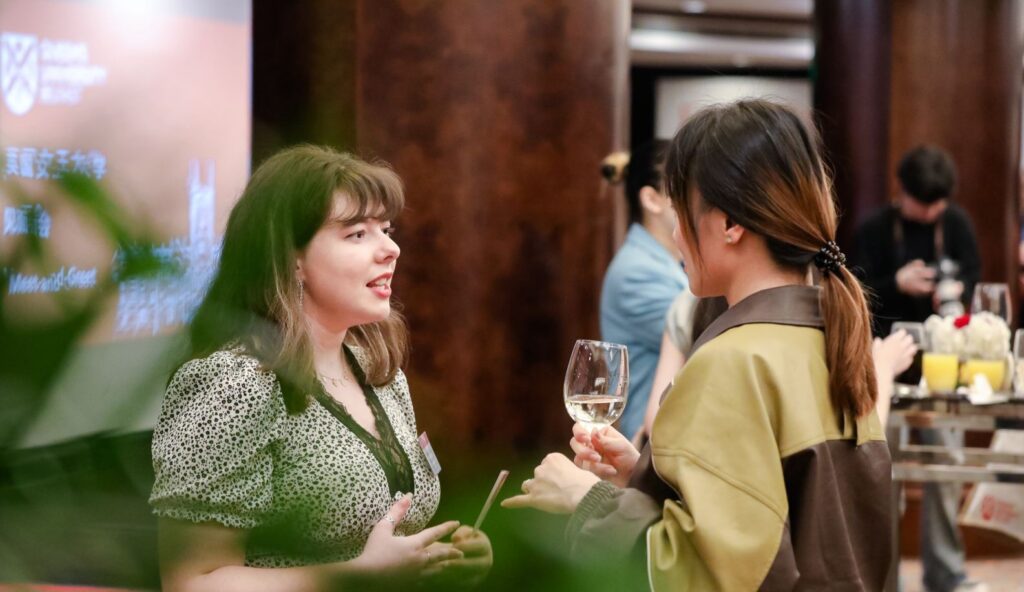
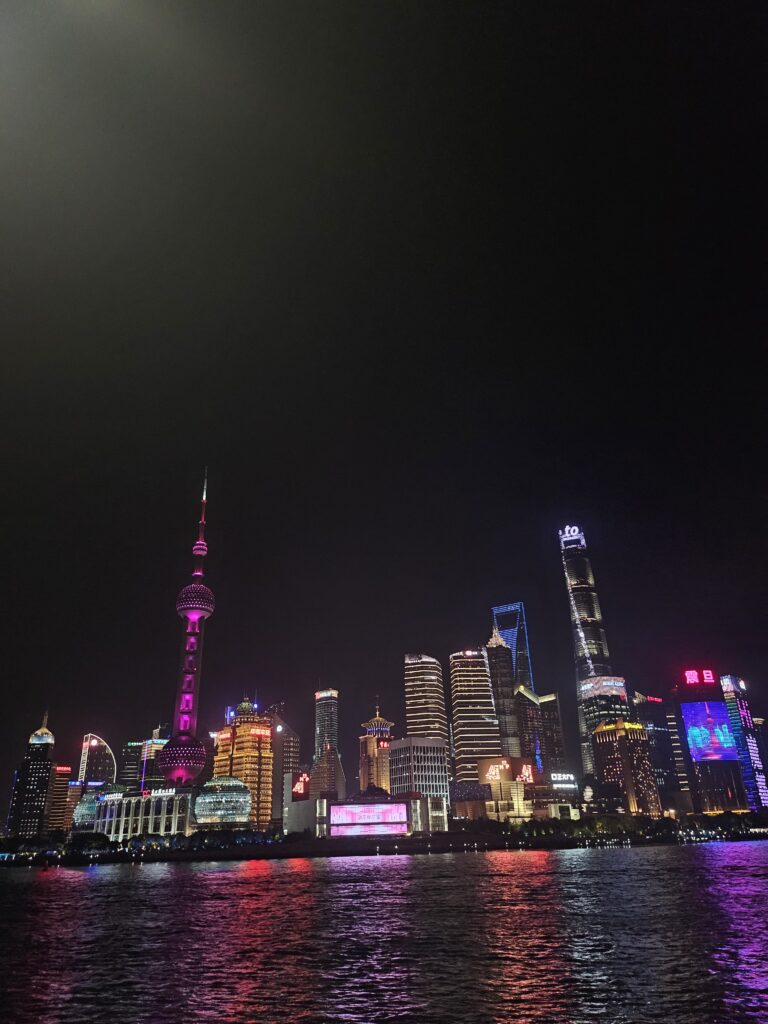
Once the event kicked off, it was buzzing, with excitement from prospective students and our alumni feeling nostalgic as they thought back to their time at Queen’s. The event ended with success, and my colleagues and I met to go for a walk along the Bund. As we exited the hotel, groups of tourists from across China and beyond excitedly took photos of the infamous hotel. Turning to my left, the tall buildings of the Financial District and the matching Oriental Pearl Tower stood glimmering colourfully, against the night sky.
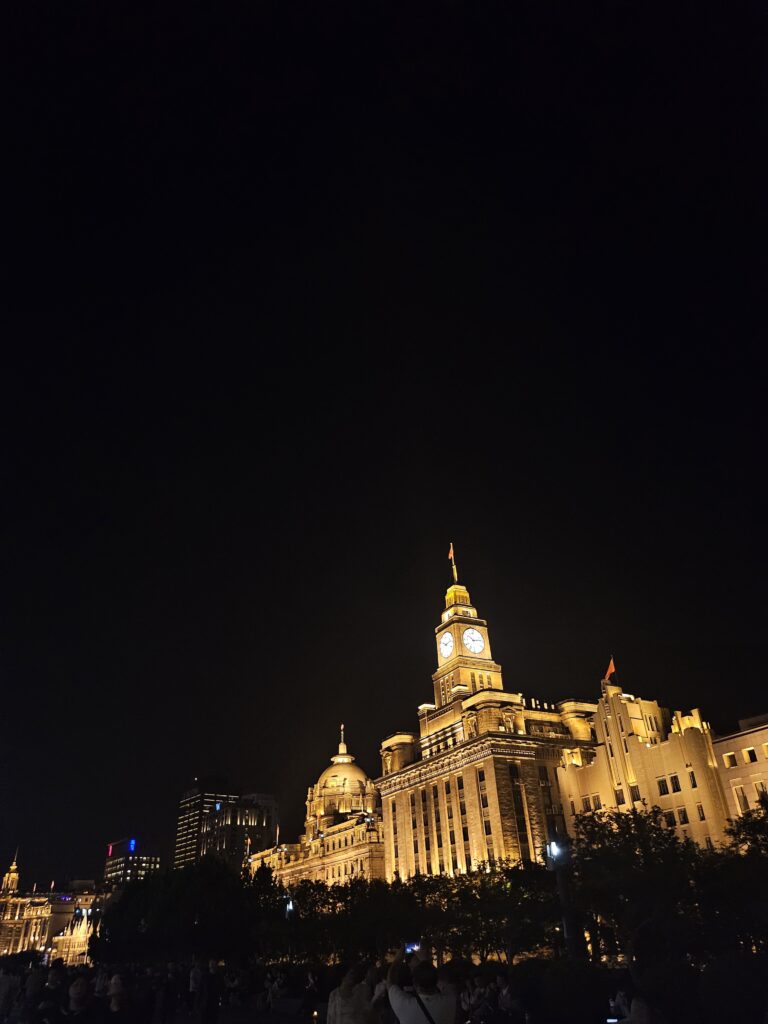
Even after 9pm, the Bund was bustling. People from all over China and the world, taking pictures of the reflecting Financial District on the water, illuminated across the Huangpu River, as the water sloshed under the promenade. I walked along The Bund, taking in the city lights; the lights reflecting off my eyes as I took everything in with awe. It was still warm, indicating summer was here to stay. I slowly walked to the bottom of the promenade and back again, staring at the distant buildings. The streets starting to quiet down as it reached 10pm.
Financial District – The BundThe Bund
When I got back to the hotel, I made my way to the rooftop for one more glance at the view of the city lights. It truthfully felt magical. All those photographs I’d seen, all the books I’d read describing Shanghai; nothing could compare to seeing it in person; it felt surreal.
Discovering my Dream City
The next morning, the sun was shimmering brightly outside – perfect for a walk around the city. I had the day to explore Shanghai, and I couldn’t have asked for a better time of year to explore China, as it was my birthday!
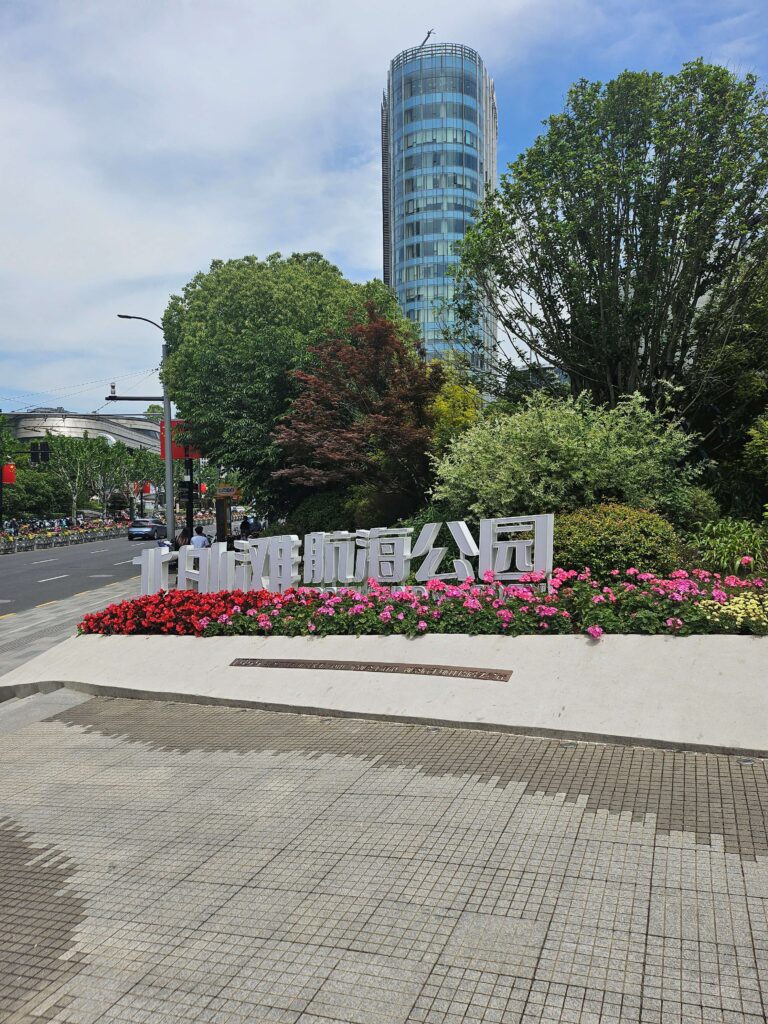
To get recommendations on what to see and do, I went to the best source: Red (小红书, Xiǎohóngshū) , a popular social media app in China. One of the main places recommended to see on 小红书 was the North Bund Bay (北外滩航海公园, Běi wàitān hánghǎi gōngyuán), just a short walk away.
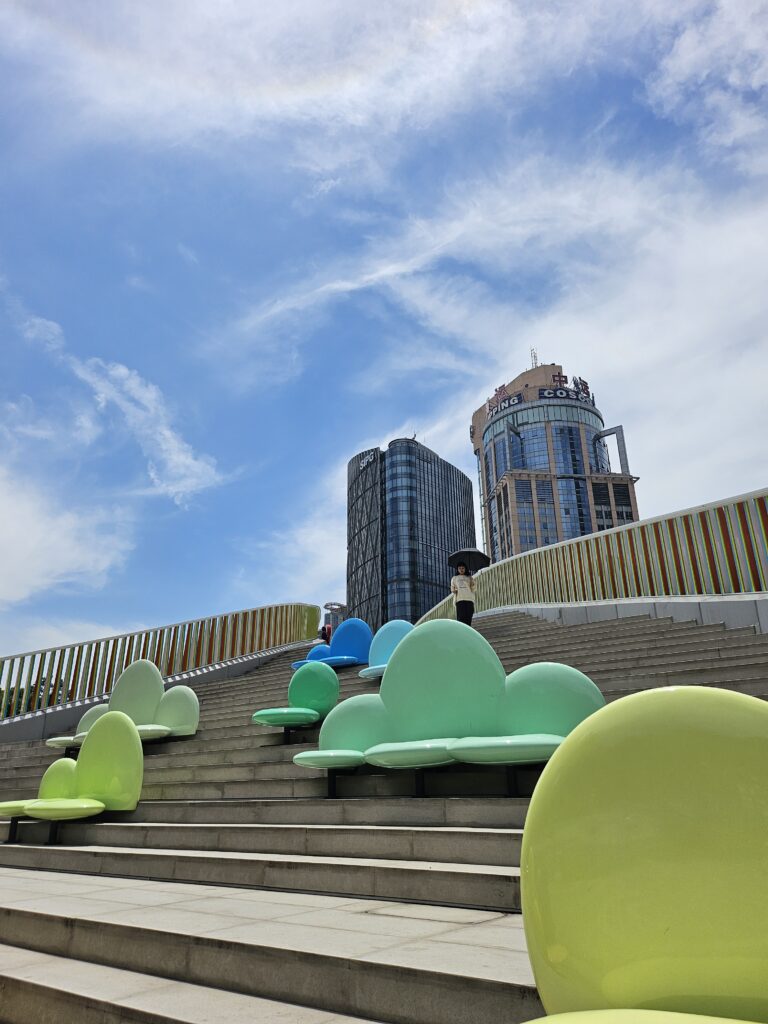
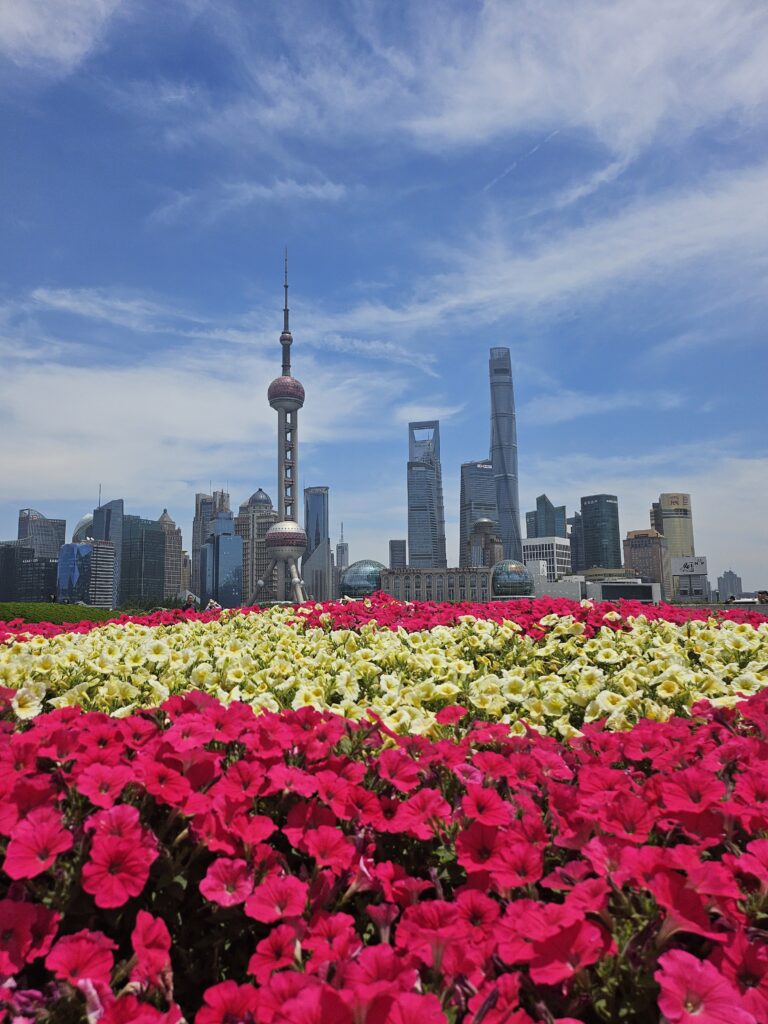
I made my way to the promenade along The Bund again, seeing it in a different perspective in the daylight – still beautiful and gleaming. Colourful flowerbeds lining the promenade, as I made my way towards the North Bund Bay, which consists of a park that leads to the bay, providing another viewpoint of the Financial District. The park is home to a popular photo-op on 小红书, a giant reflective globe in the centre, a futuristic artistic feature, reflecting sights of the Financial District and the park. Seeing the large queue to take selfies in front of the globe, I skipped the selfie opportunity, and continued my walk, which was incredibly relaxing and allowed me to soak up some sun – much missed from the rainy summer back home! I walked along the bay, capturing photos of the sparkling Financial District and watching the boats sail by, a mixture of yachts and small fishing boats floating along the water.
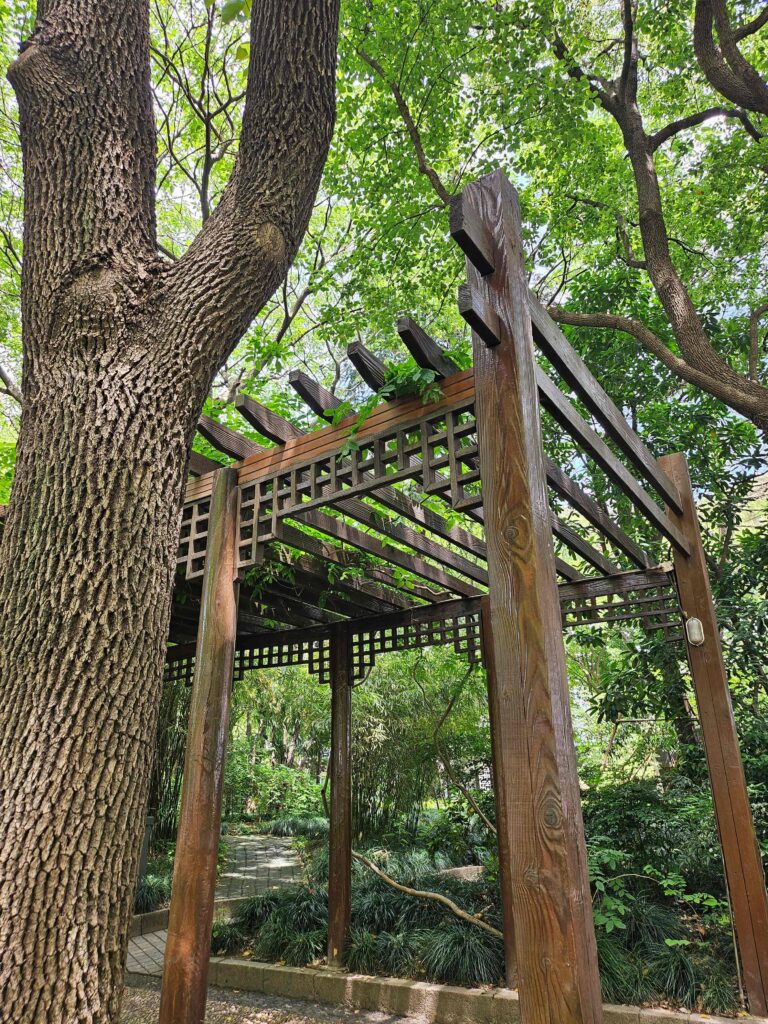
After enjoying the sunrays, I made my way back through the green trees and followed the stone paths along the grass, noting seating areas and ice cream carts sprawled across the park to beat the summer sun. I made my way back to The Bund, walking through another park on my travels, catching a glimpse of the rays of sun peaking in through the greenery. The warm weather was calling for a refreshment, so I wandered along the row of eateries and cafes just below the promenade of The Bund. I popped into a coffee shop, purchasing the Melon Milk tea drink that had caught my eye in the window – perfect for the nearly 30-degree heat. We certainly don’t have these back home!
North Bund Bay
North Bund Bay
Globe in North Bund Bay
Financial District
View from North Bund Bay
Oriental Pearl Tower
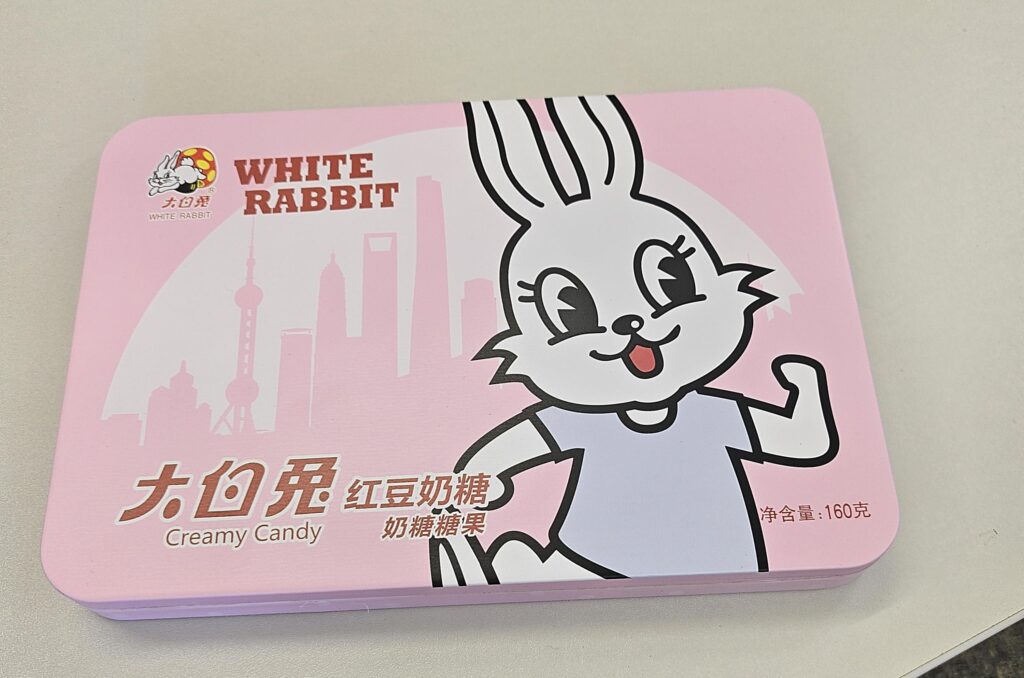
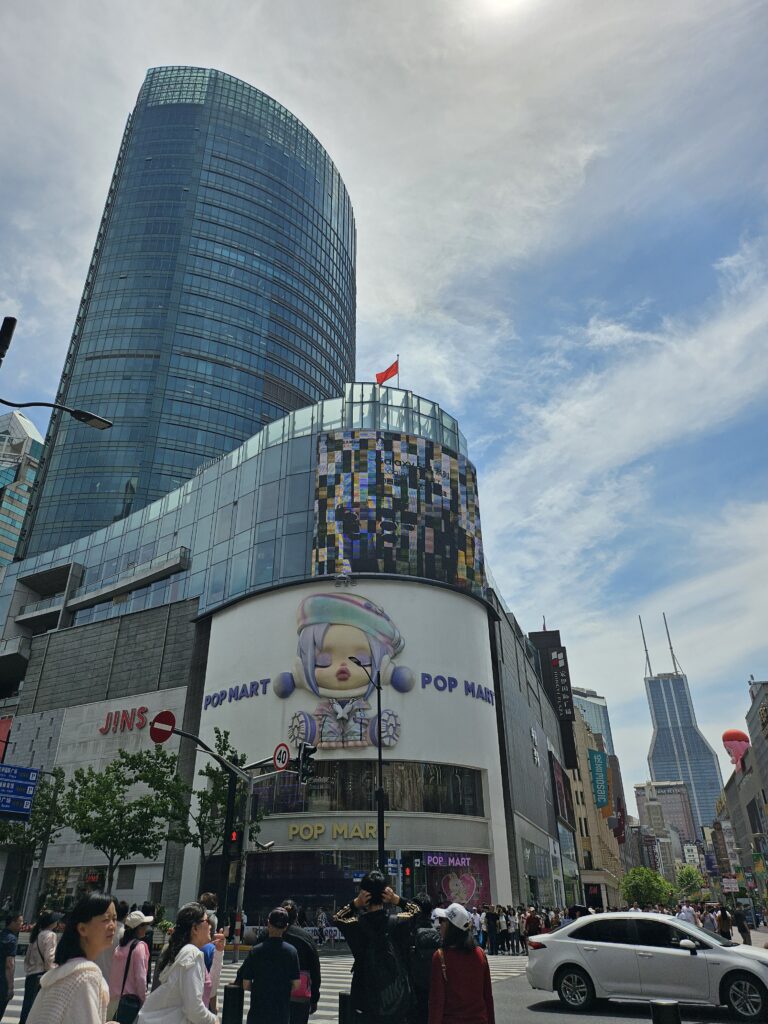
I quickly regained my energy with the refreshing beverage and made my way to Nanjing Road (南京路, Nánjīng lù), a famous shopping street, lined with souvenir shops, luxury brands, shopping centres, markets and more White Rabbit (a popular candy) shops than I could count. The buzz from the streets surrounded the European architecture, then expanded into the modern architecture of the shopping centres.
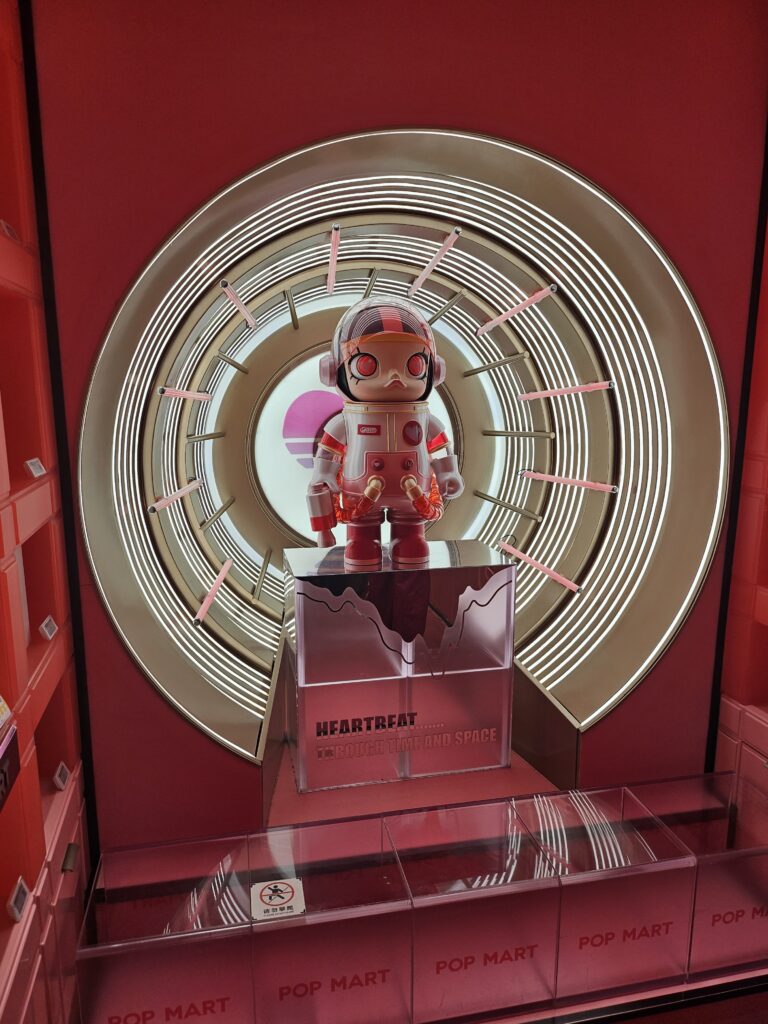
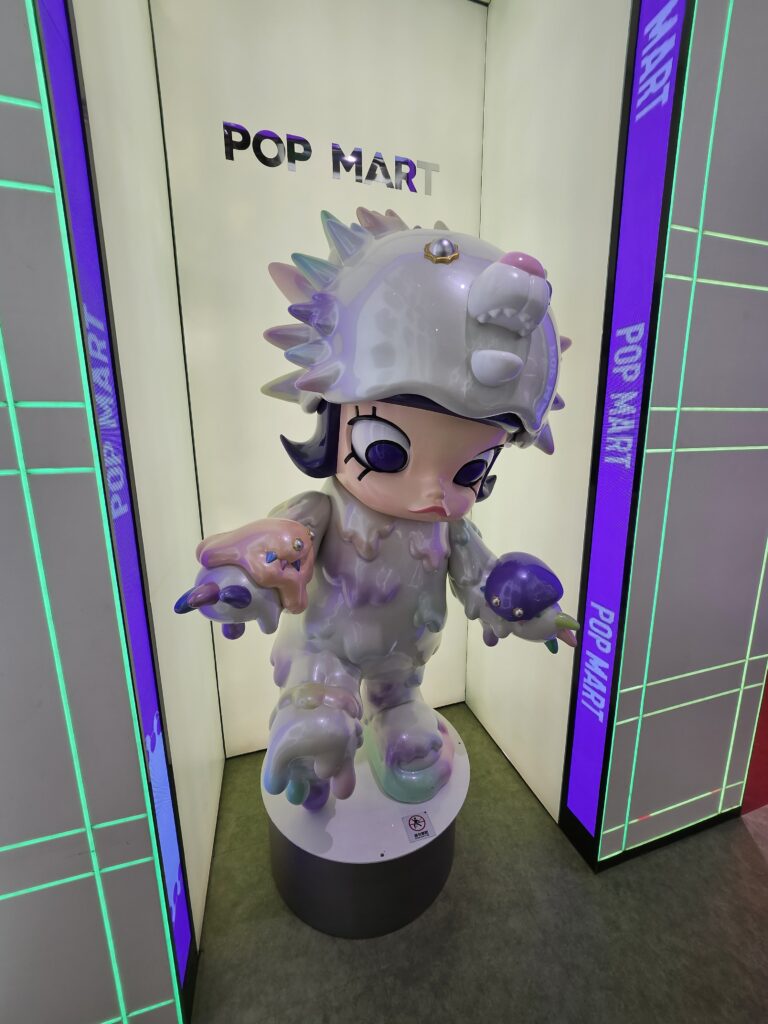
Upon reaching a crossroads, I spotted the Shanghai Popmart flagship store – hard to miss with the giant ‘Skullpanda’ figure above the door. Three floors with varying lines and collections littered the shelves, the selection vast. Staff were extremely helpful, often asking if guests needed assistance, which led to one of them being impressed with my Mandarin, although the only words I uttered were 谢谢 and 我会说一点儿, meaning ‘Thank you’ and ‘I can speak a little,’ in response to their question if I could speak Mandarin. But I’ll take the compliment! I made my way around the shop, curving around the corners, admiring the displays, and made my way up to the top floor, where I found the collaboration collections, and treated myself to a little gift.
The shop led out into a shopping centre, where I explored the mixture of international and local shops. I stopped by an accessories shop to pick up a gift for my mum. The sales assistant didn’t speak English, and despite my attempt to explain my Mandarin was rusty, she continued chatting away to me, explaining the products, and perhaps it was the best language practice I had! As I navigated the conversation, describing my mum’s preferences and style, the sales assistant helped me pick the perfect gift. I also took the opportunity to visit Muji and stock up on some stationery, as one can never have enough, and snacks for travelling the next day.
Nanjing Road
Popmart Flagship Store Shanghai
Popmart Character: Molly
Popmart Character: Molly
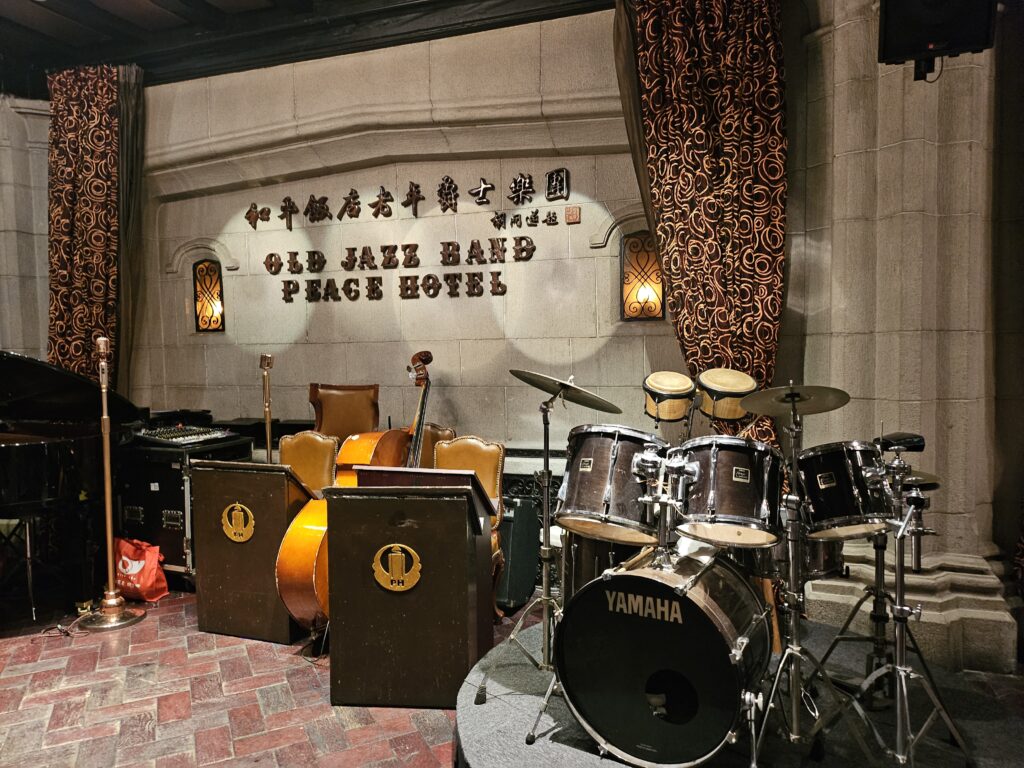
Seeing as the time was well past mid-afternoon, I rushed back to the hotel, to attend a tour, where I was introduced to the history of the hotel, its very own museum housed within, showing photographs throughout the years and preserved decor that made up part of the hotel’s famous history. Gaining an insight into the architecture was fascinating, seeing a consistent style within the smallest of details that made up the grandeur of the building.
Fairmont Peace Hotel Museum
After freshening up, I sat in the lobby with my colleagues as we organised a plan to do some sightseeing that evening. A mother and daughter sat across from us, and struck up a conversation, asking where we were from, as I translated for my colleagues. Their compliments brightened up our evening instantly.
– 你是哪国人? (Nǐ shì nǎguó rén? – Where are you from?) – 我们是爱尔兰人。 (Wǒmen shì Ài’ěrlán rén. – We are Irish.) – 你们都不是美国人吗? (Nǐmen dōu bú shì Měiguó rén ma? – Aren’t you all Americans?) – 不是,我们是爱尔兰人。 (Bú shì, wǒmen shì Ài’ěrlán rén. – No, we are Irish.) – 啊,爱尔兰人。你们都很漂亮。(Ā, Ài’ěrlán rén. Nǐmen dōu hěn piàoliang. – Ah, Irish. You’re all very beautiful.) – 谢谢! (Xièxie! – Thank you!)
We hopped in a taxi using Didi, and for more information on Didi, please check my Guangzhou Travel Diary.
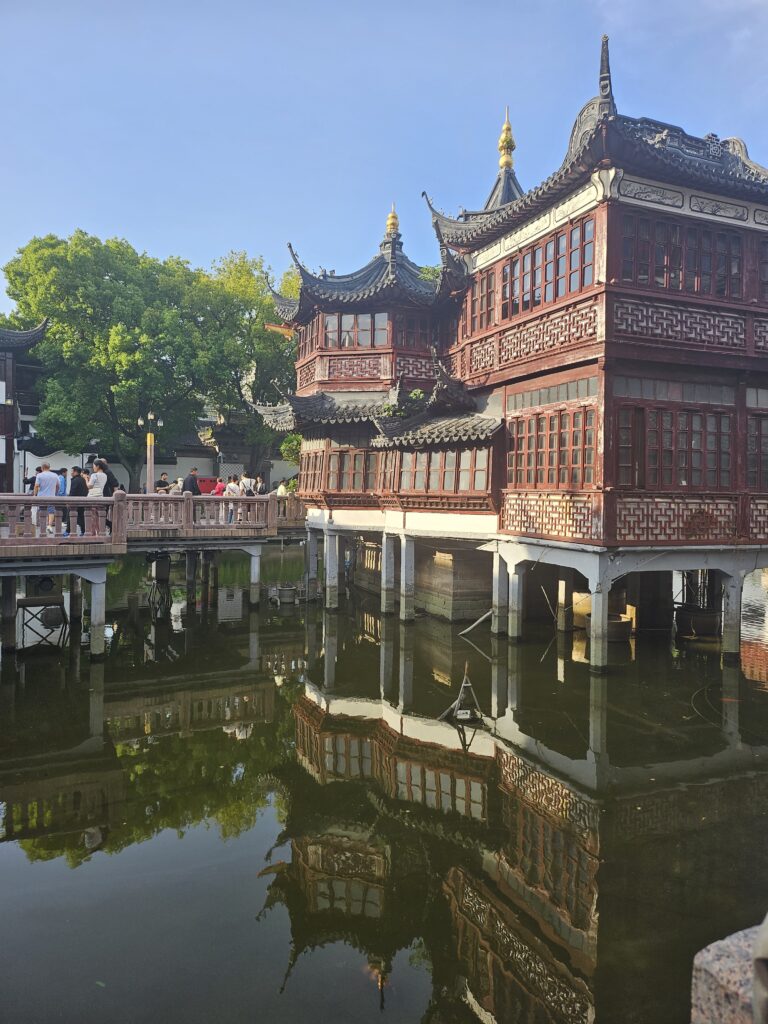
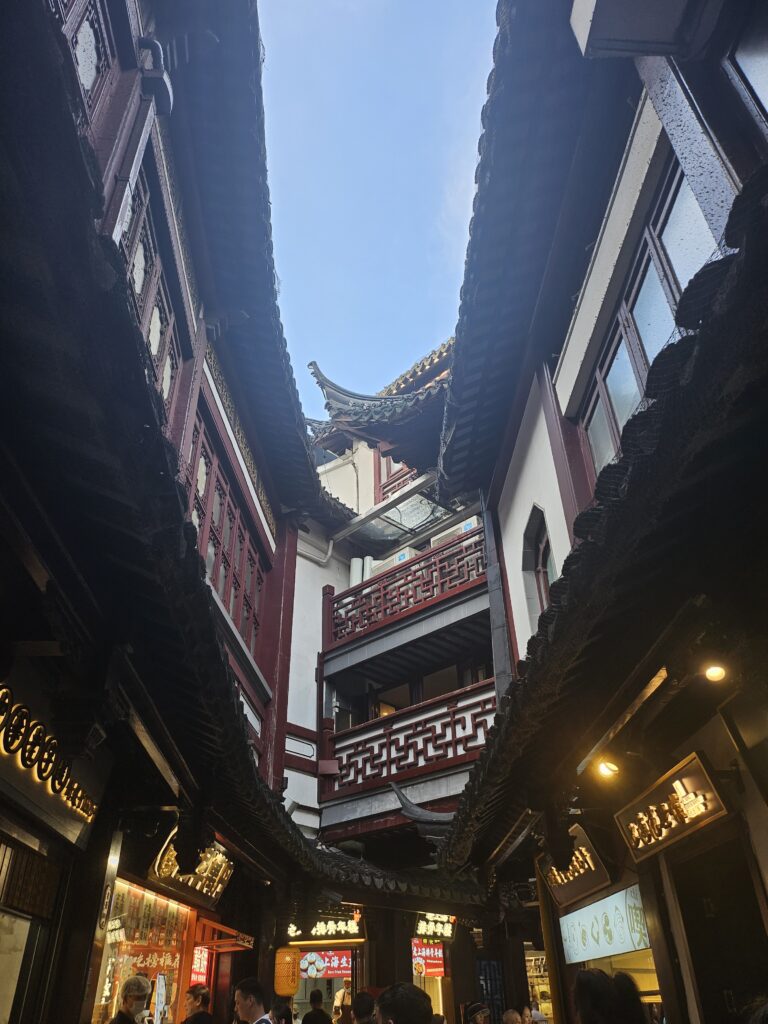
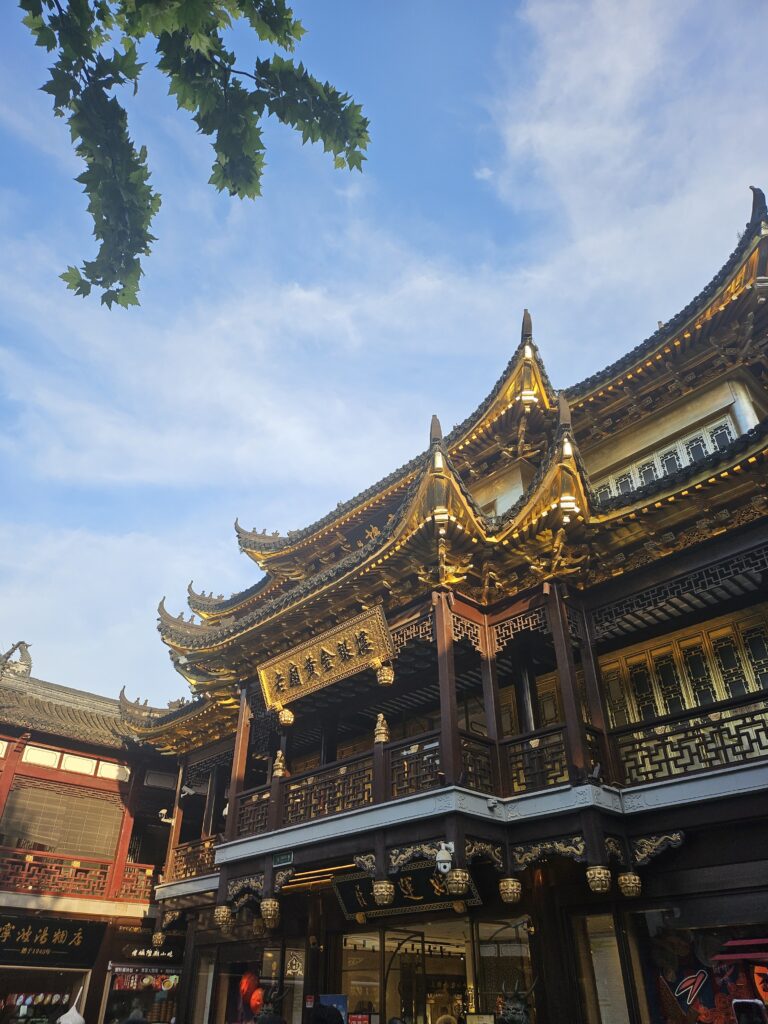
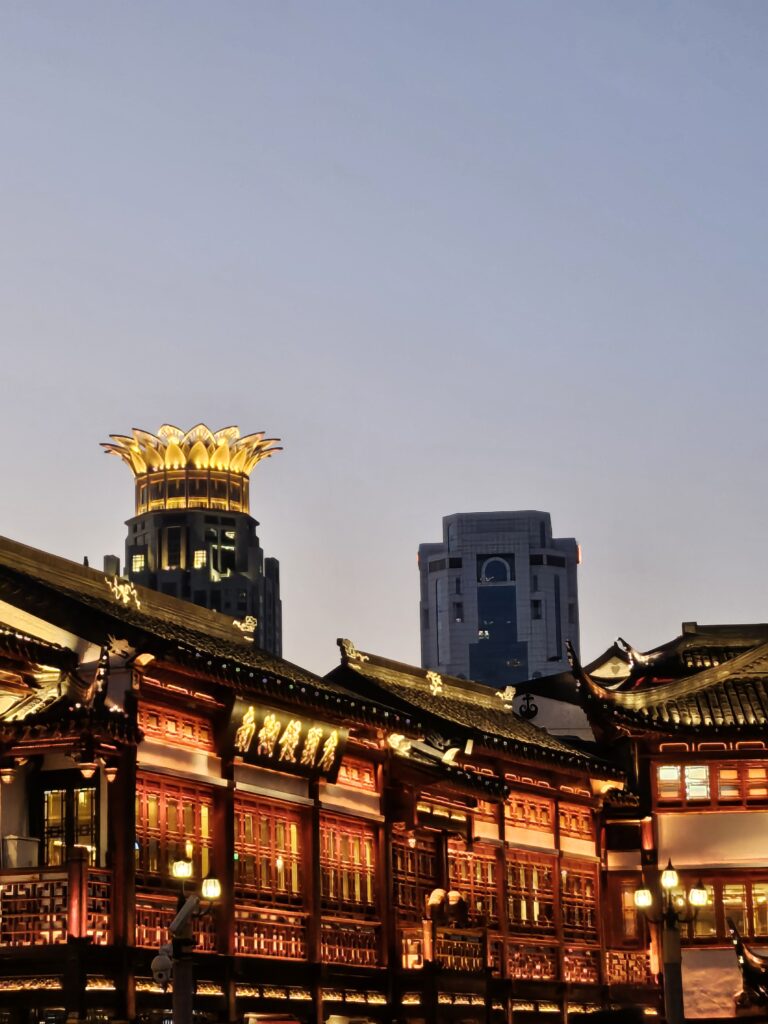
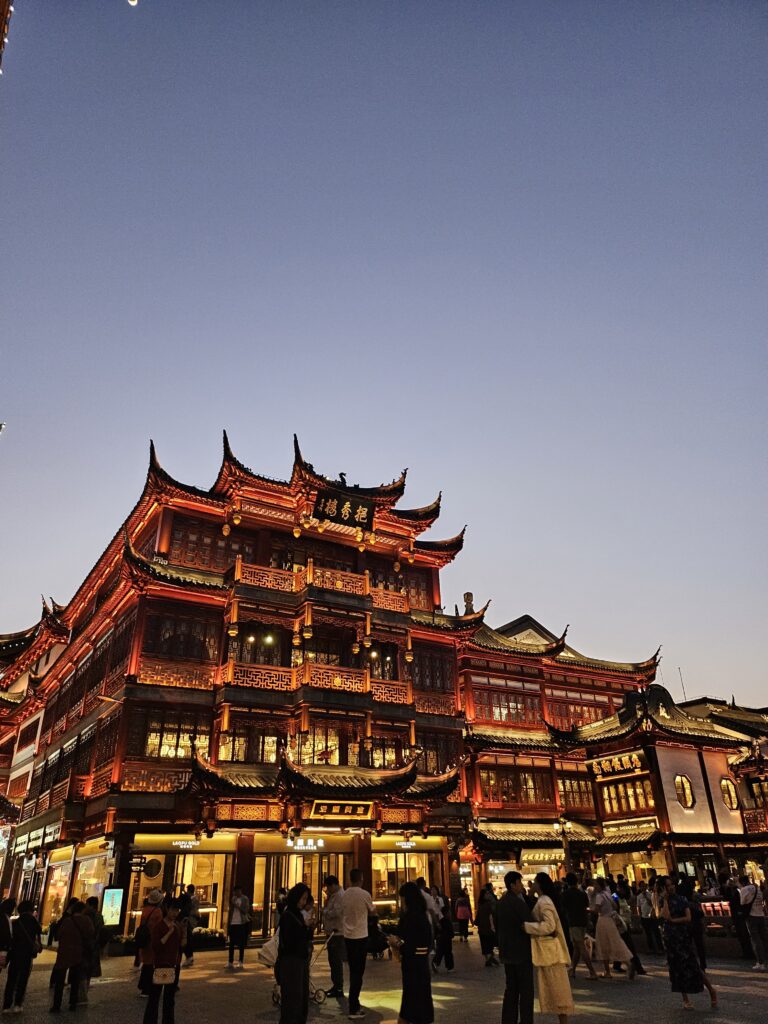
Our sightseeing goal for the evening included Yu Garden (豫园, yùyuán), located in the Old Town (上海老街, Shànghǎi lǎo jiē) in Nanshi, with incredible, historical architecture, the old buildings now housing a variety of shops selling traditional souvenirs, postcards, tea, snacks and candy, cafes and restaurants, and even small shopping centres. Unfortunately, we were disappointed to find out the Yu Garden was closed that day, however, we made the most of the opportunity to do some shopping, picking out souvenirs and gifts for friends and family, and explore this beautiful area of Shanghai. We also took the opportunity to try some Chinese cuisine.
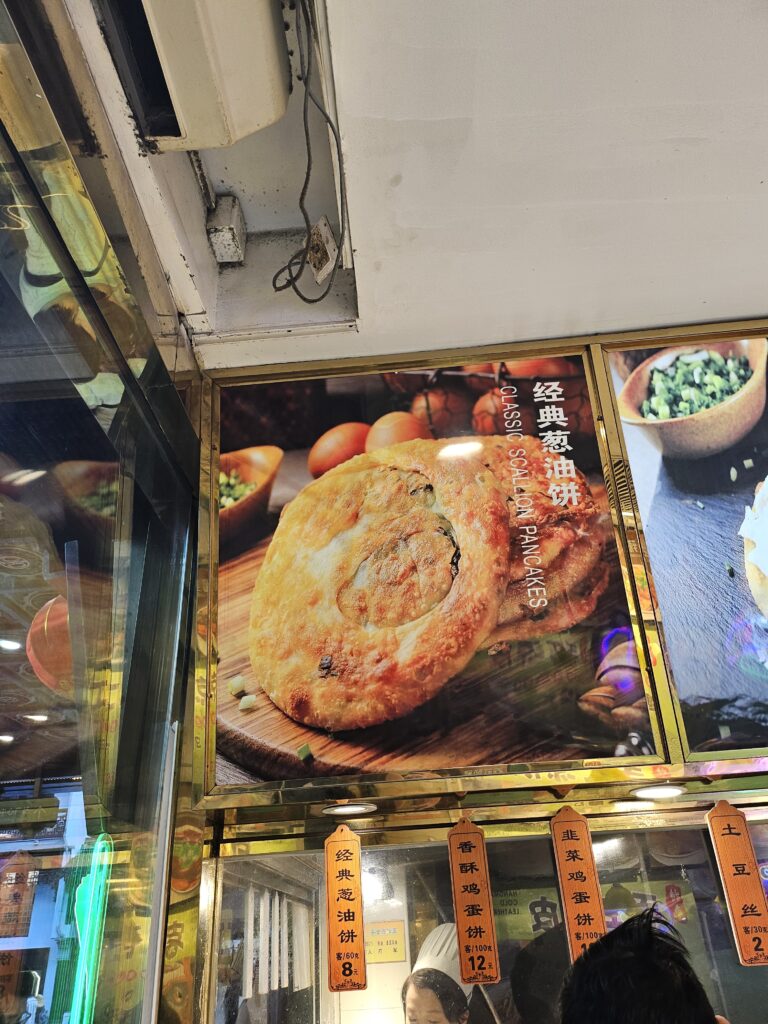
One of my favourite dishes from the whole trip, was a scallion pancake (葱油饼 cōng yóubǐng) – a street food staple that was light, fluffy on the inside, and golden brown and crispy on the outside, and filled with flavour! Only costing less than £2, it was one of the most affordable and delicious dishes. I was so excited to try it, the smell of the amazing, crispy pancake permeated my senses, I took a bite without taking a photo first!
Classic Scallion Pancake advertisement
The old town was absolutely beautiful in the daylight, however, in the evening it became magical as the lights came on and illuminated the streets. A sense of warmth and wonderment filled the streets as we explored the Old Town, seeing it from an entirely new perspective. The lights of the buildings reflected off the water delicately like a painting. It was breathtaking.
Old Town during the day
Old Town during the day
Old Town during the day
Old Town in the evening
Old Town at night
We soon began making our way back to the hotel, deciding to walk and explore the streets of Shanghai in place of taking the metro. The streets still buzzing in the evening housed a mixture of Chinese and European architecture, reflecting its history. Shops and restaurants lined many of the streets. The city lights looked beautiful against the dark, night sky.
In my diary of my time in Guangzhou, I described spotting a poster of Lay Zhang 张艺兴, and how it was easy to spot posters and of many of your favourite Chinese artists and actors across the city, as well as popular video game, movie and TV show characters. Shanghai was no different. When walking past a supermarket I spotted a poster of SEVENTEEN member, The8 (徐明浩 Xu Minghao).
A Birthday Treat
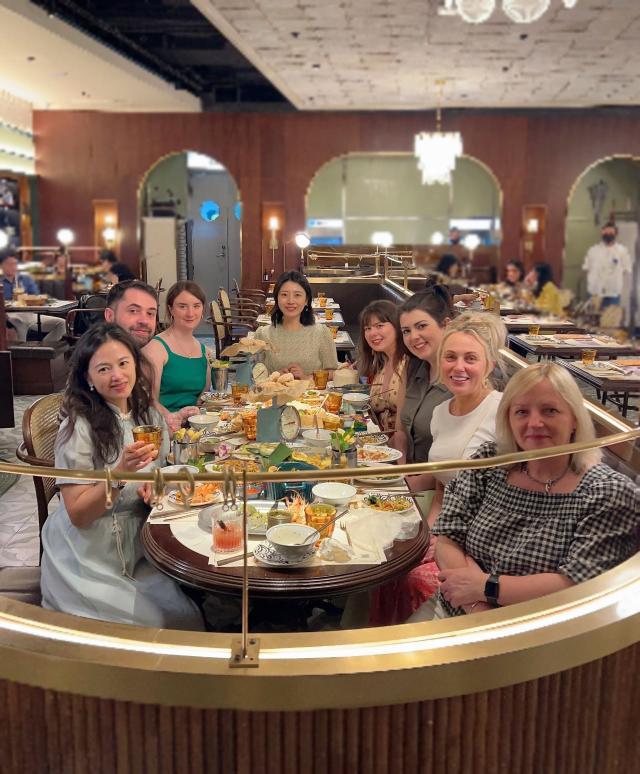
I went for dinner with my colleagues to a Thai restaurant, not far from the hotel, which served an incredible variety of Thai dishes, including papaya salad, spicy chicken and seafood dishes, coconut jelly desserts and fresh coconut water. Half-way through the meal, I was surprised when a bowl of noodles was placed in front of me which I hadn’t remembered ordering, until my colleague explained that in China, many restaurants would present a bowl of noodles to those who are celebrating their birthday as a gift, the noodles representing a long life. This was a delightful surprise, the significance of the birthday meaning even more, as 2024 was the Year of the Dragon, and, in fact, is my Chinese Zodiac.
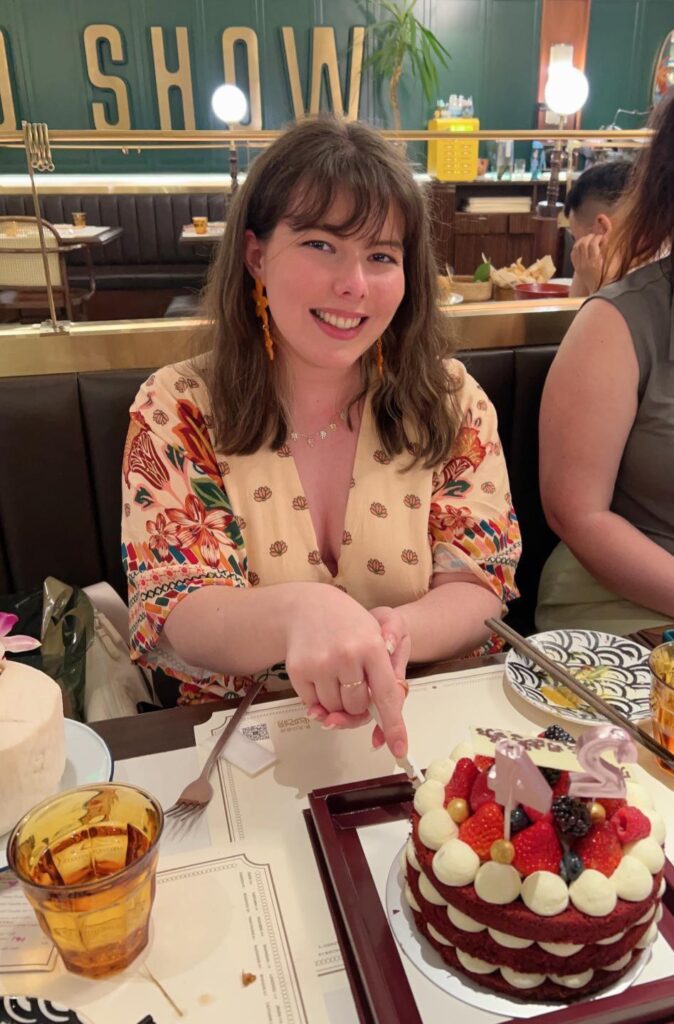
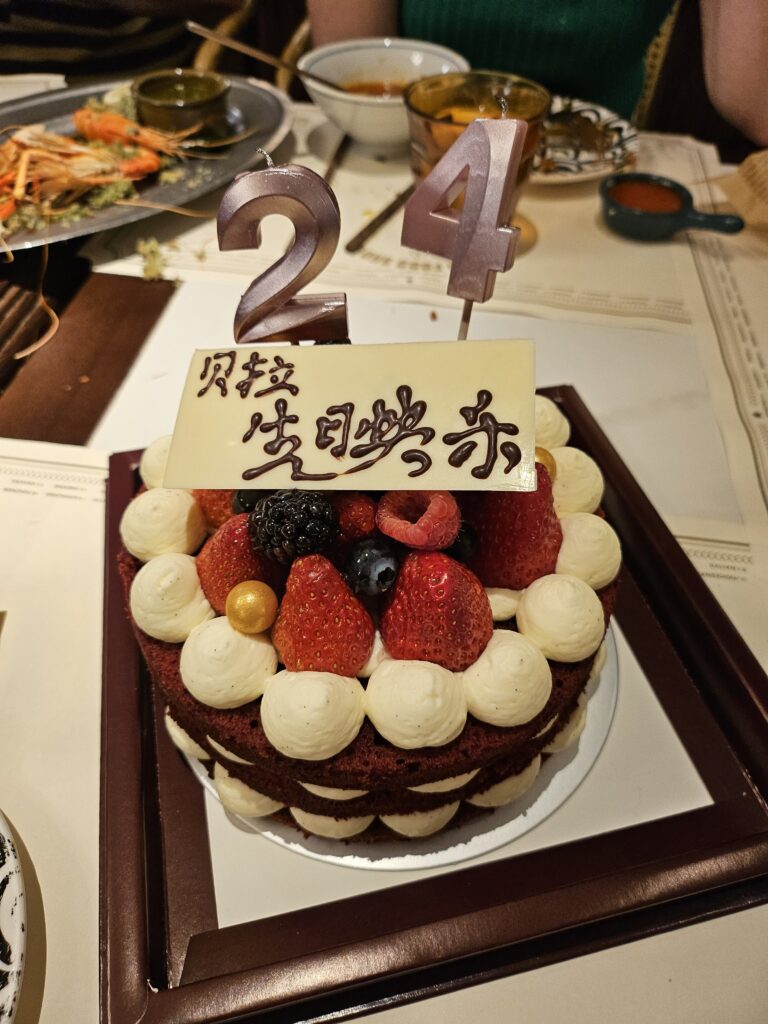
As we finished up the dinner, stuffed from delicious delicacies, the evening wasn’t over just yet. I was greeted with the most incredible surprise of a birthday cake. The cake was decorated with fresh fruit, and a greeting written in chocolate: 贝拉,生日快乐 (Bèilā, shēngrì kuàilè), meaning Happy Birthday, Bella. My Chinese name is 苏蔓伊, however, my colleagues grew fond of the nickname, 贝拉, a sound translation from English, and I’m quite the fan of it too!
Birthday Dinner with Colleagues
Birthday Dinner
Birthday Cake
I was so grateful for the amazing surprise, not only exploring China and getting to enhance my work experience, using the skills developed in my degree, I was also getting to celebrate my birthday in a dream city with a supportive group of people. This was the perfect way to end the night, as the next morning we were up early to catch the train to Jinan!
Thank you so much for reading this blog of my time in Shanghai, stay tuned to read more about my trip to China, where I visited Jinan, Chengdu, Zhengzhou and Beijing!
Being an international student at Queen’s never means that one has to bury their heads into books and articles for their academic study. Instead, proactively partaking in a range of academic and social events can benefit them hugely.
In this post, Yufei Yang (杨雨菲), a MA candidate in Children’s Rights, tells us how she felt about being an international conference assistant during her study at Queen’s.
“While assisting at the conference, this international event enabled me to connect with participants from around the world, representing diverse cultures and backgrounds.”
Yufei yang, pG student from school of social sciences, education and social work, qub
In September, as an international student assistant, I had the privilege of participating in the “CHILDREN’S RIGHTS PARTICIPATION & EDUCATION SYMPOSIUM,” marking one of the highlights of my inspiring cross-cultural (跨文化 kuàwénhuà) journey since I came to study at Queen’s. This conference brought together distinguished scholars and experts from Poland (波兰 Bōlán) , Ireland (爱尔兰 Ài’ěrlán) , China (中国 Zhōngguó) and many other nations, engaging deeply in discussions about children’s rights (儿童权利 értóng quánlì) and education (教育 jiàoyù).
Presentation at the conference | Photo: Yufei Yang
While assisting at the conference, this international event enabled me to connect with participants from around the world, representing diverse cultures and backgrounds. It was an enriching experience that highlighted the richness and excitement of cross-cultural communication (跨文化交际 kuàwénhuà jiāojì). Interacting with representatives from Poland, Ireland, and other countries provided insights into unique perspectives and practices regarding children’s rights and education.
Conference Panel | Photo: Yufei Yang
Through group discussions (小组讨论 xiǎozǔ tǎolùn) and workshops (工作坊 gōngzuòfǎng), I shared best practices from my home country alongside international participants, delving into the challenges within the realm of children’s rights and education. Scholars (学者 xuézhě) from various nations passionately presented their research progress and reports, not only enriching academia with new insights and innovations but also inspiring other professionals.
This collaborative effort fostered a better understanding of each other’s cultures and backgrounds, emphasizing the significance of respect (尊重 zūnzhòng) and understanding (理解 lījiě). Beyond academic exchange (学术交流 xuéshù jiāoliú), the symposium showcased the power of international cooperation (国际合作 guójì hézuò). Our collective focus on the future of children’s rights and education reinforced the understanding that these goals can be better achieved through global collaboration (全球协作 quánqiú xiézuò).
Overall, this symposium on children’s rights and education served as a vibrant cross-cultural adventure, underlining the value of international academic exchange. It opened doors to broader explorations for the future, igniting a passion for the continued pursuit of knowledge.
Author: Yufei YANG Editor: Lauren McShane and Liang WANG
As the Chinese proverb goes, ‘What Paradise is to the Heaven, Suzhou and Hangzhou are to the earthly urban (上有天堂,下有苏杭 shànɡ yǒu tiāntánɡ, xià yǒu Sū-Hánɡ)’. This blog post will give you a glance over Suzhou city (苏州) in Jiangsu province, following Jiangyue CHEN (陈江月), a QUB graduate in TESOL, who recently relocated to Shanghai (上海) for her new job and paid her first visit to its neighbouring city.
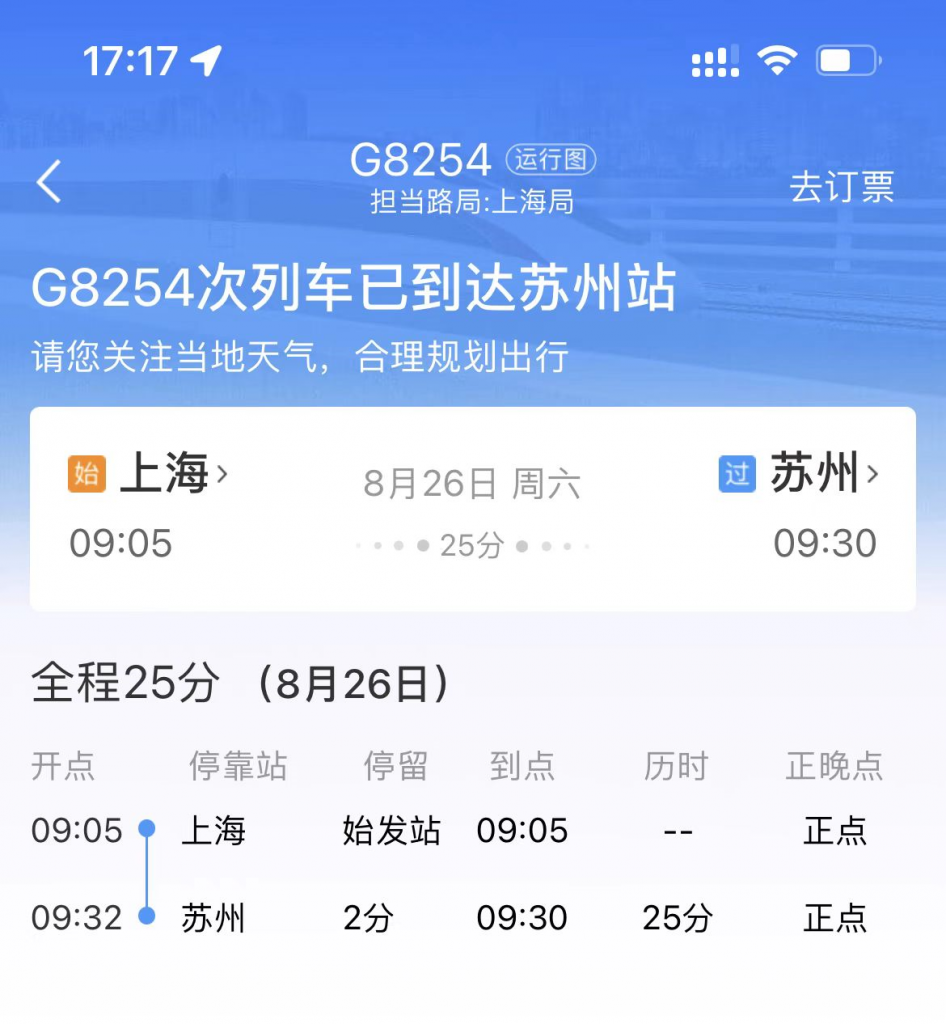
I set off from Shanghai at 9:00 in the morning and arrived in Suzhou in just half an hour by high-speed train (高铁 gāotiě).
The screenshot of the e-ticket from Jiangyue’s mobile app.
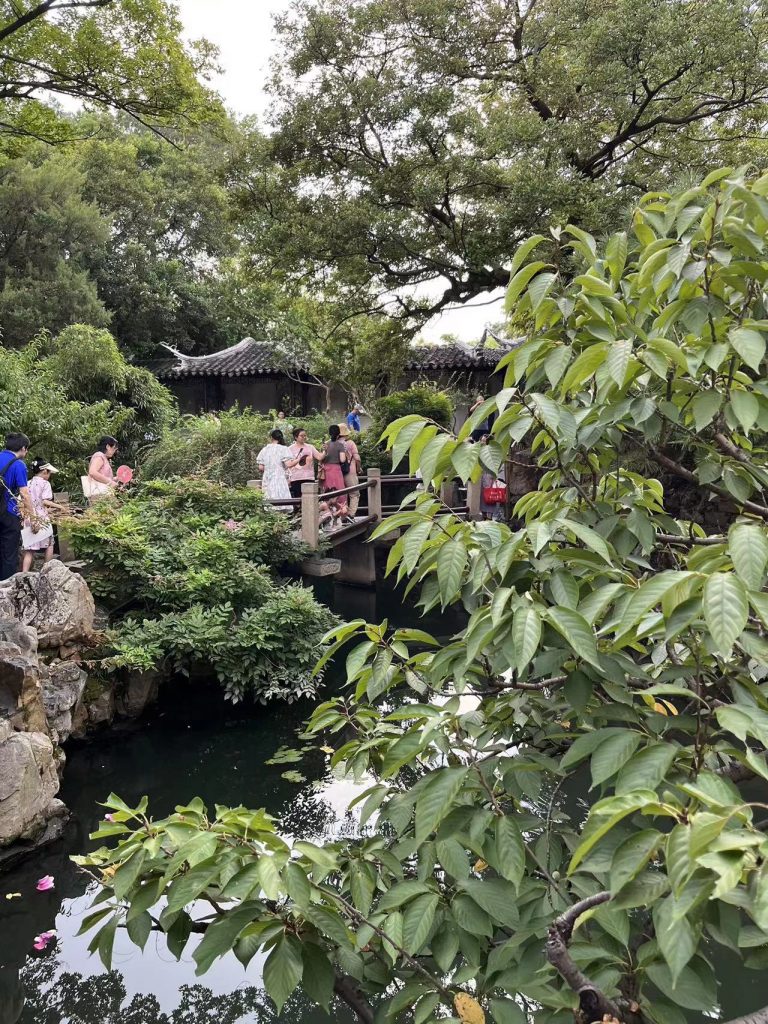
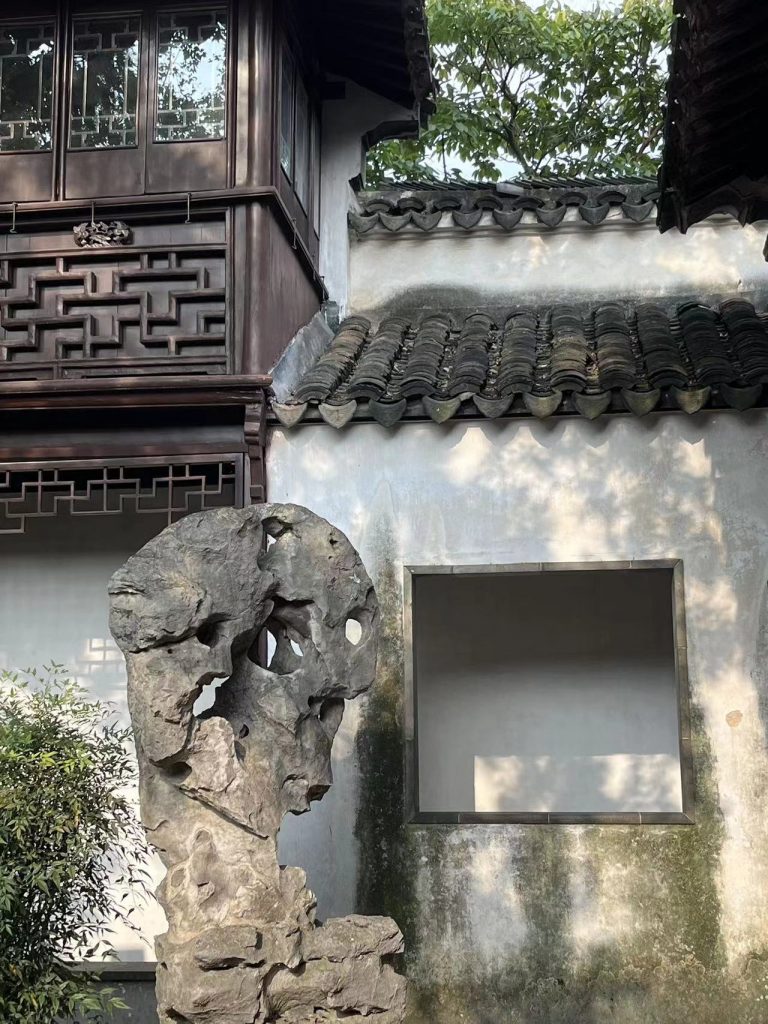
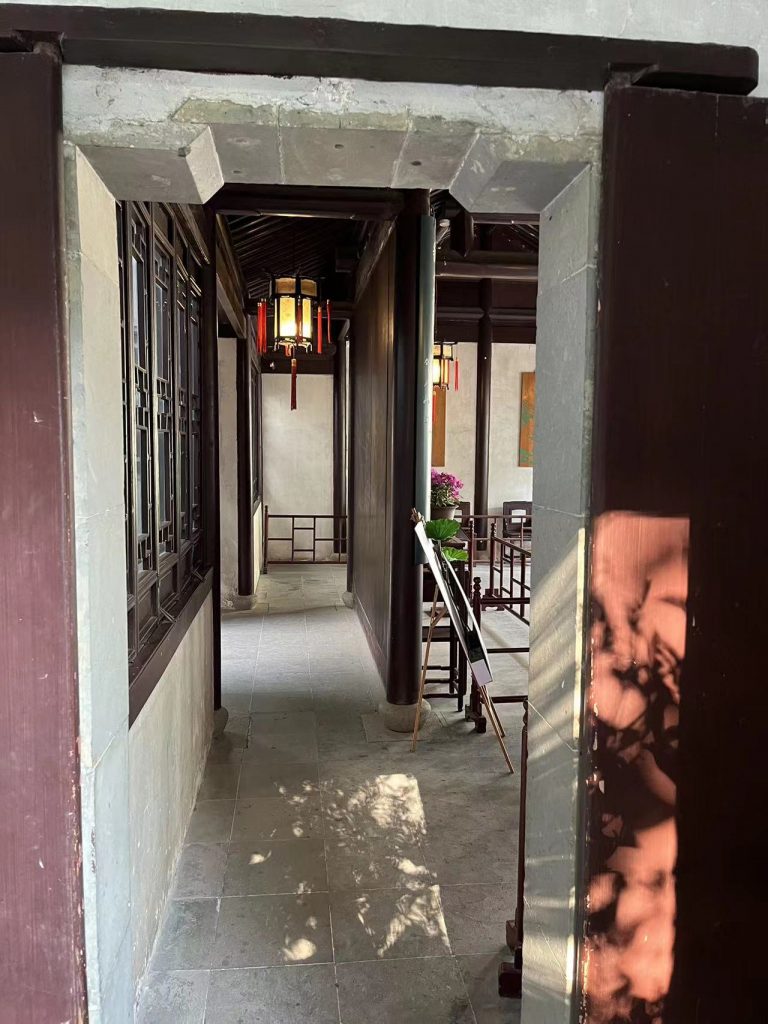
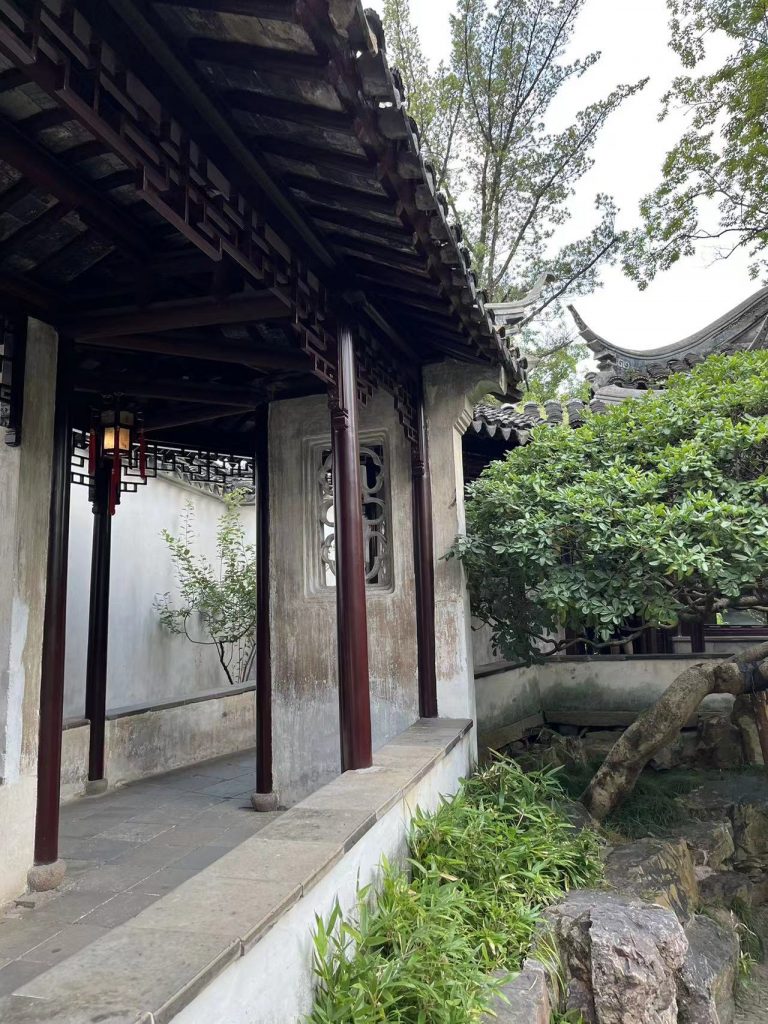
Suzhou is a charming city in the southeast of China, famous for its long history, rich culture and exquisite ancient gardens. Suzhou has many attractions worth visiting, among which Hanshan Temple (寒山寺 Hánshān Sì), Pingjiang Road (平江路 Píngjiāng Lù) and Couple’s Garden (耦园 Ǒu Yuán) are three must-sees.
Hanshan Temple寒山寺
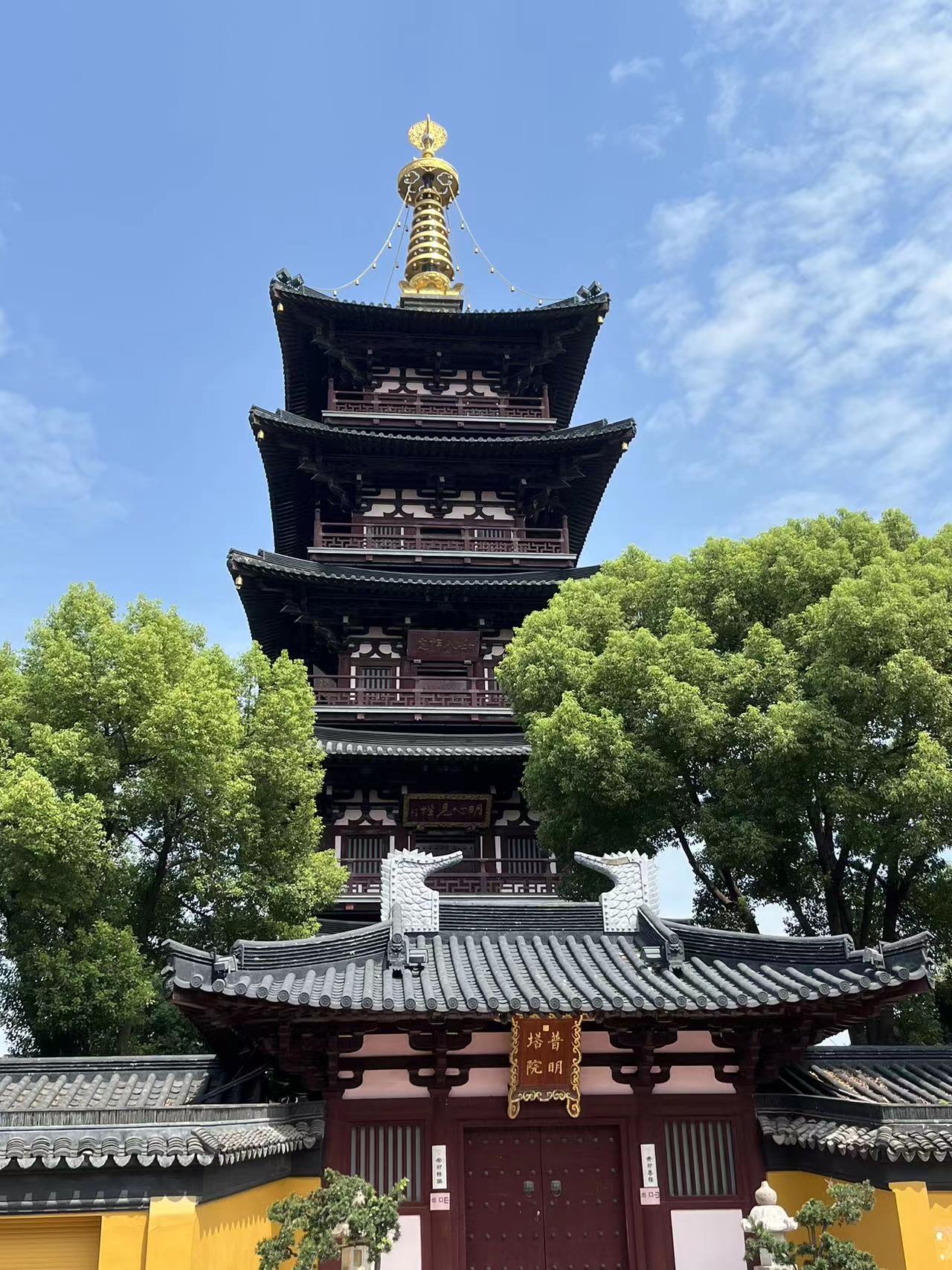
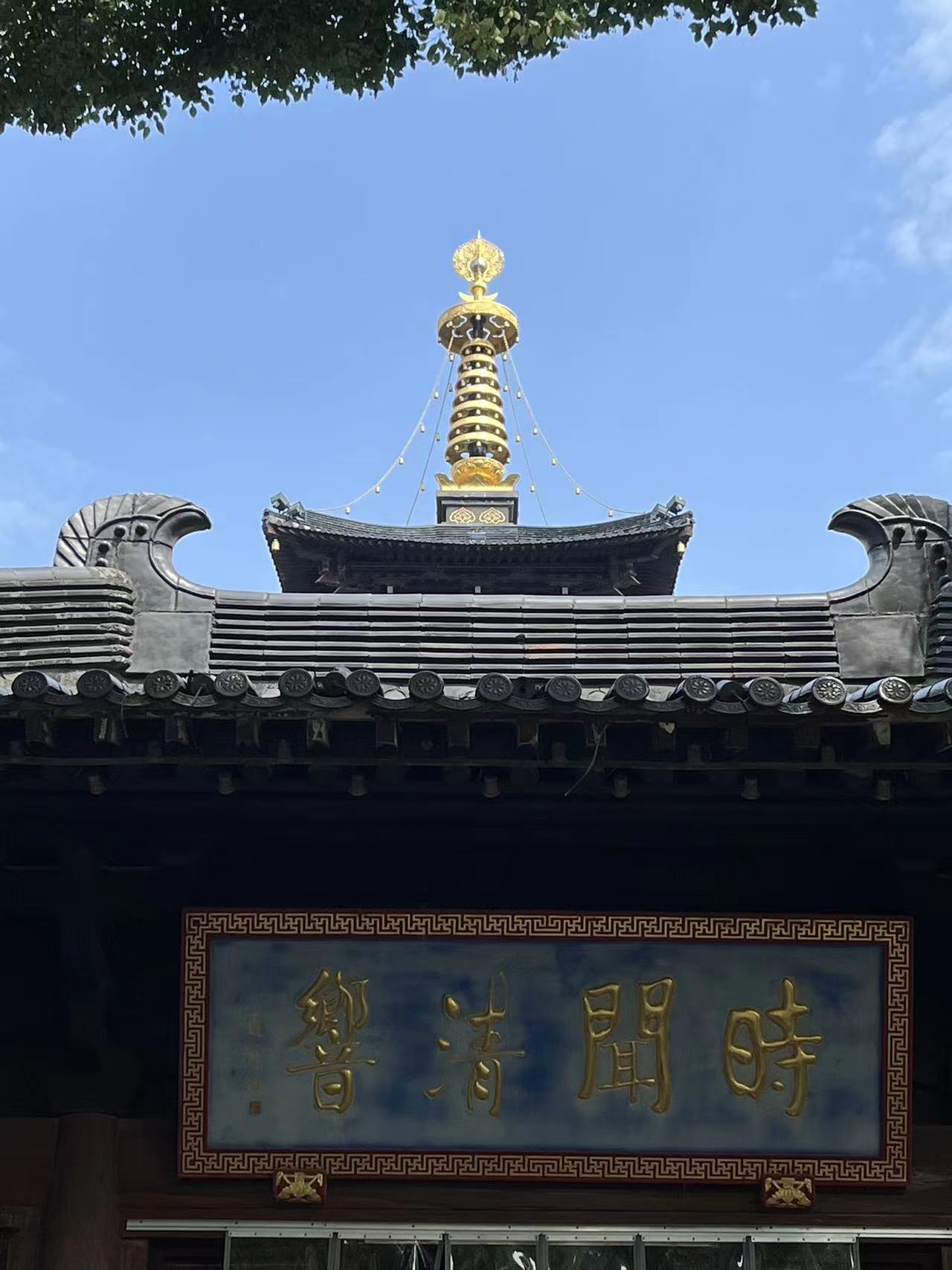
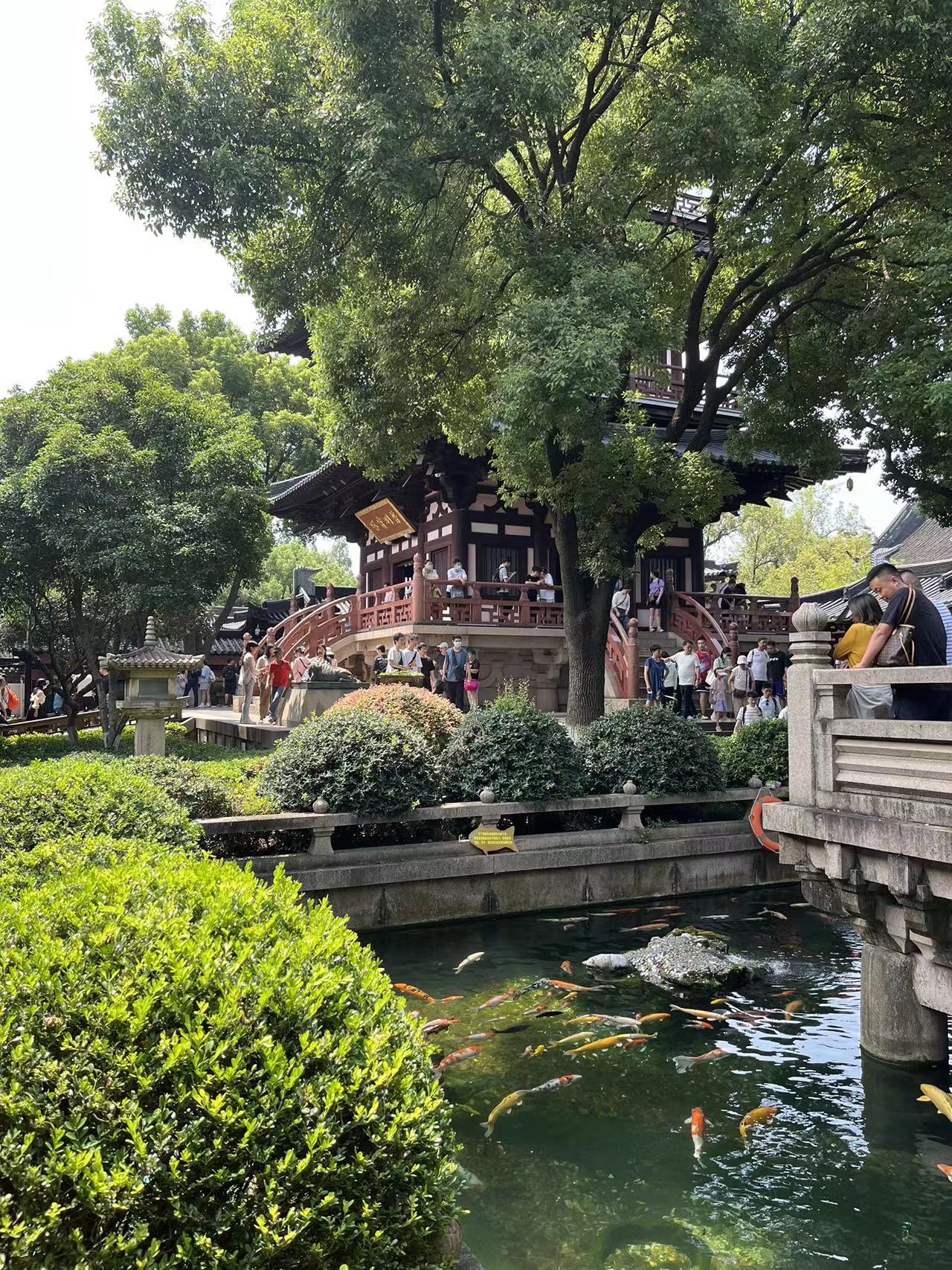
Hanshan Temple is one of the oldest Buddhist temples in China, dating back to the 6th century. It is named after a legendary monk and poet named Hanshan, who lived here with his friend Shide. Their poems are full of Zen wisdom and life humor, and are collected in the book “Cold Mountain Poems”. Hanshan Temple has a tranquil and elegant atmosphere, with various buildings such as the Mahavira Hall (大雄宝殿 Dà Xióng Bǎo Diàn), the Bell Tower and the Puming Pagoda. It also houses many precious relics and artworks, such as the Tang dynasty bronze Buddha, the Song dynasty stone carving of the Diamond Sutra, and the Ming dynasty wood carving of the Eighteen Arhats (十八罗汉 Shíbā Luóhàn). Hanshan Temple is famous for its bell ringing ceremony on New Year’s Eve, which attracts thousands of visitors every year to listen to the 108 strokes of the giant bell and pray for blessings.
Hanshan Temple | Photo: Jiangyue CHEN
Hanshan Temple | Photo: Jiangyue CHEN
Hanshan Temple | Photo: Jiangyue CHEN
Hanshan Temple | Photo: Jiangyue CHEN
Pingjiang Road平江路
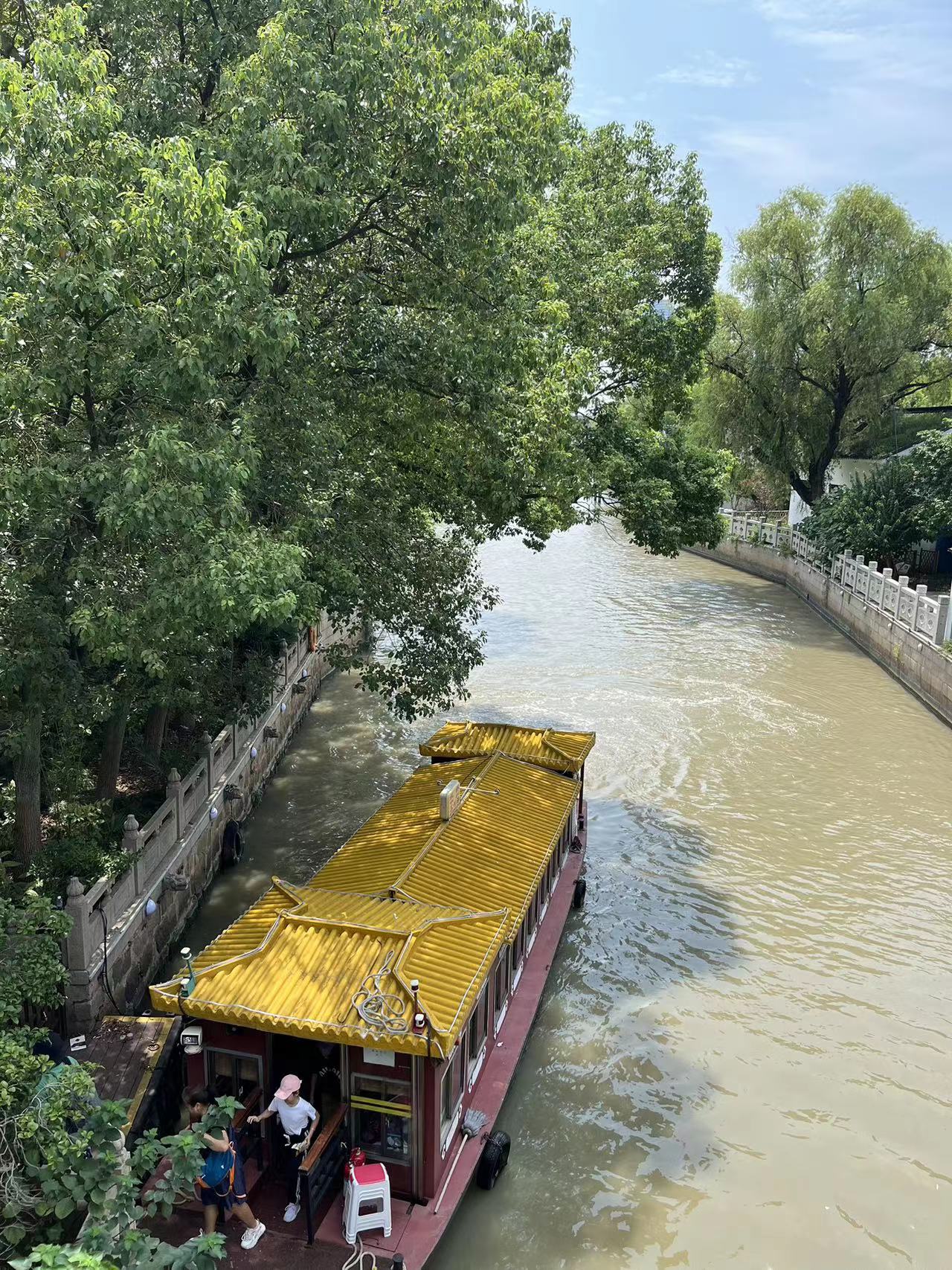
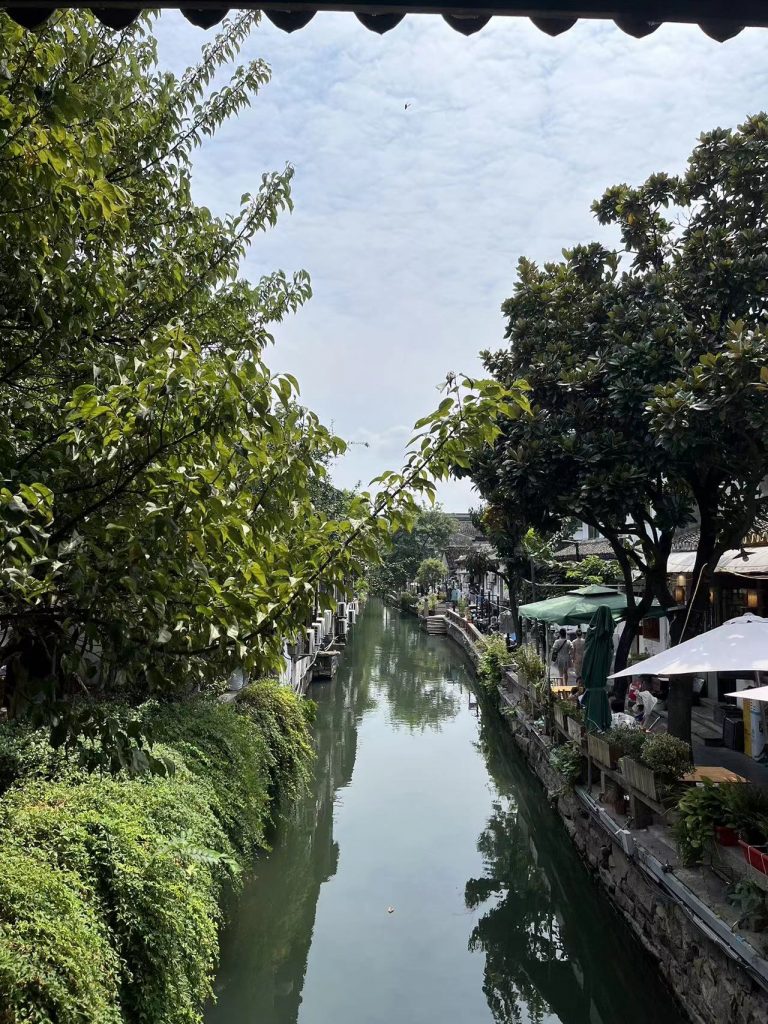
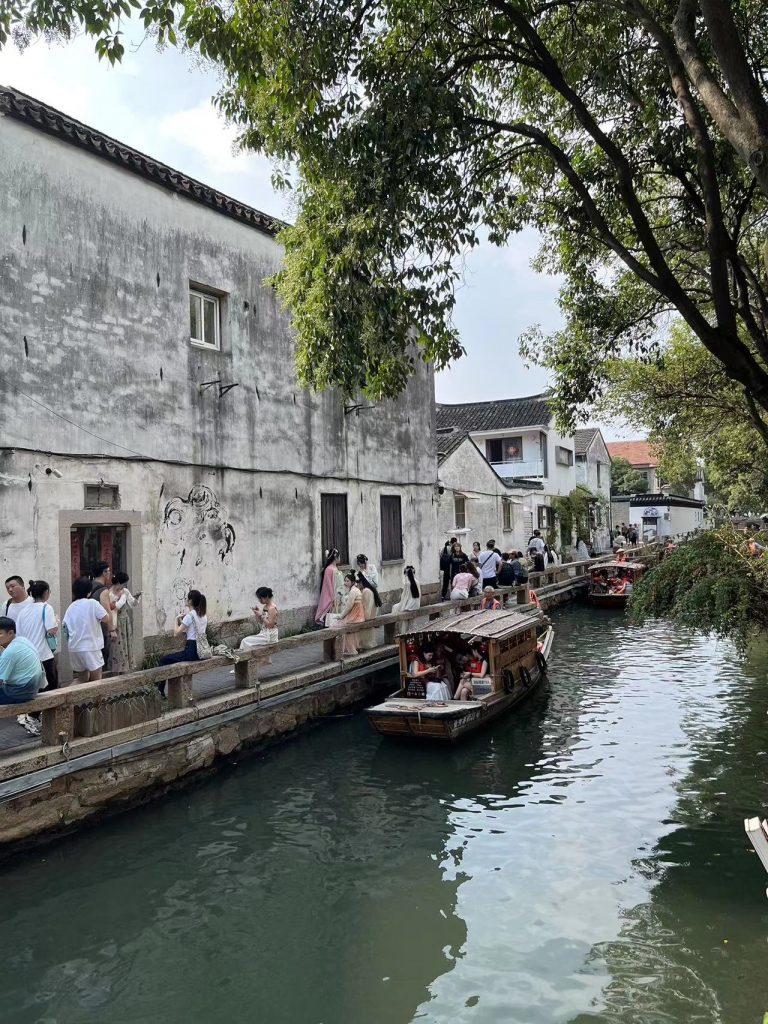
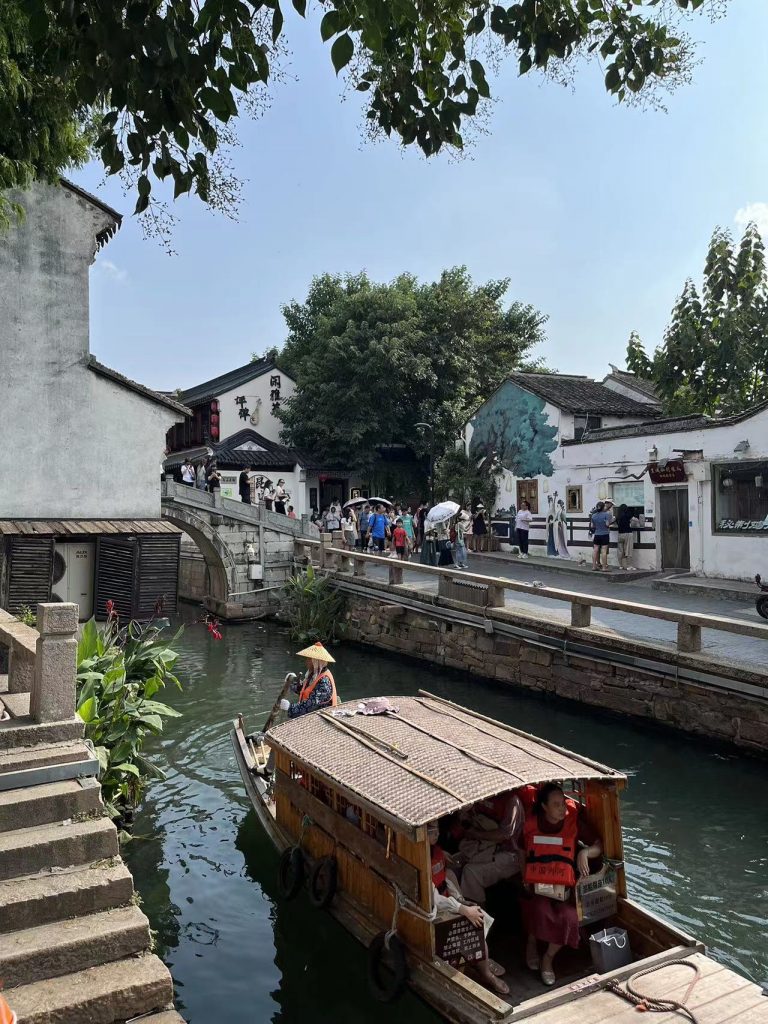
Pingjiang Road is the most well-preserved historical street in Suzhou’s old city area, reflecting the style of the Tang and Song dynasties. It was an important grain storage and transport center in southern China during the Ming and Qing dynasties. Pingjiang Road is 1606 meters long, and was selected as one of the “Top Ten Historical Streets in China” in 2009. Along Pingjiang Road, there are many quaint shops and bars, selling various Suzhou specialties such as food, handicrafts, tea, etc. There are also many cultural celebrities’ former residences and historical sites, such as Sai Jinhua’s former residence, Zhang Xueliang’s former residence, Couple’s Garden, etc. Pingjiang Road has a beautiful night view when the lights are on. You can take a hand-pulled boat on the river and enjoy the scenery.
Pingjiang Road 1 | Photo: Jiangyue CHEN
Pingjiang Road 1 | Photo: Jiangyue CHEN
Pingjiang Road 1 | Photo: Jiangyue CHEN
Pingjiang Road 1 | Photo: Jiangyue CHEN
Pingjiang Road 1 | Photo: Jiangyue CHEN
Couple’s Garden耦园
Couple’s Garden was originally named Shiyuan Garden, built in the late Qing dynasty by Shen Bingcheng, who changed its name to Couple’s Garden after he met his talented wife Yan Yonghua. They lived here for eight years in seclusion. Couple’s Garden is a good place for couples to visit, as well as for those who want to appreciate Suzhou gardens in a quiet environment. Couple’s Garden is a twin garden, with an east garden and a west garden. The east garden is the essence of Couple’s Garden, with magnificent yellow stone rockeries and “Three Friends of Winter” made of boxwood and privet trees. The west garden is small and exquisite, a good place for reading books. Couple’s Garden also has many details and cultural elements that show the love story of Shen and Yan, such as Chengqu Caotang Hall, Wusuyun Pavilion, Tingqin Pavilion, etc. Couple’s Garden is surrounded by water on three sides and connected to the street on one side. It also has a private pier where you can take a boat to explore the surrounding water town.
Ou Yuan Garden | Photo: Jiangyue CHEN
Ou Yuan Garden | Photo: Jiangyue CHEN
Ou Yuan Garden | Photo: Jiangyue CHEN
Ou Yuan Garden | Photo: Jiangyue CHEN
Ou Yuan Garden | Photo: Jiangyue CHEN
Ou Yuan Garden | Photo: Jiangyue CHEN
There are many more interesting places in Suzhou worth exploring. The Suzhou Museum is another must-see place on my list. However, it requires bookings at least one week in advance and I missed it. Never mind, I will save it for next time – not too long!
Local delicacies
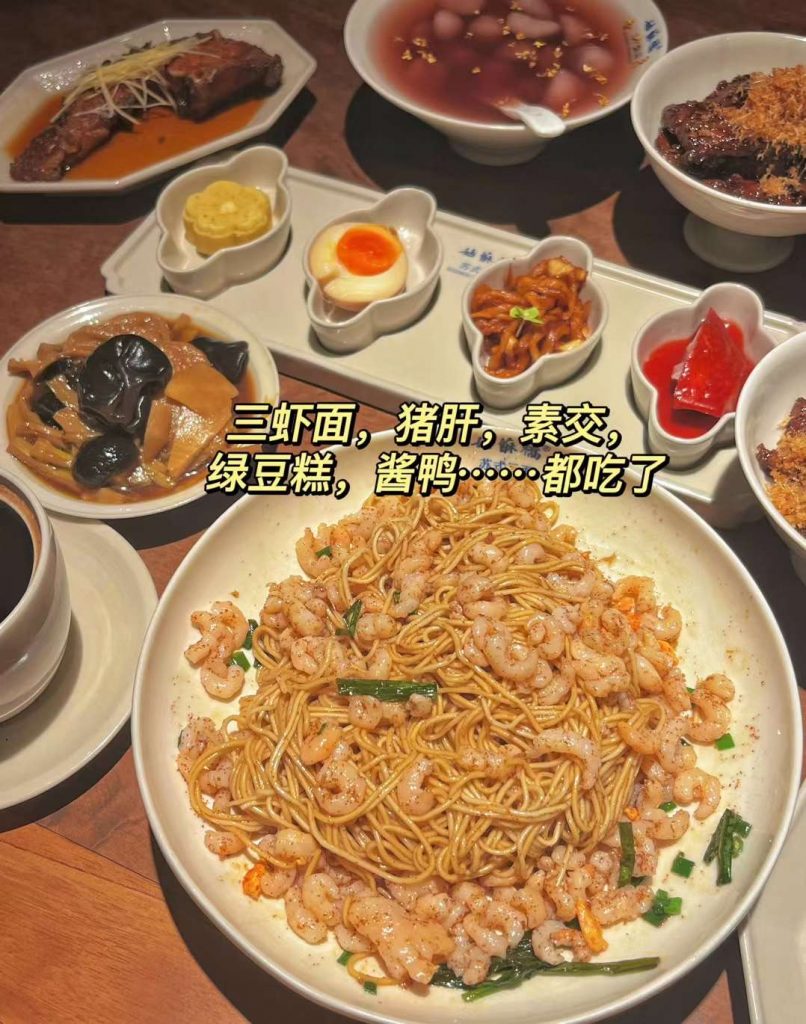
Besides these three attractions, Suzhou also has a lot of delicious food to offer. Suzhou cuisine is one of the eight major cuisines in China, featuring fresh ingredients, light taste and delicate appearance. Below are three dishes made of fresh water produces – I ordered and tasted the first two:
San-xia noodles (三虾面 Sān-xiā miàn), or Trinity of Shrimps style noodles, is a seasonal specialty in Suzhou. The name comes from the three parts of fresh water shrimps used in the serving: shrimp meat and shrimp roe and eggs. The noodles are topped with a generous amount of shrimps, as well as eggs, lard and scallions. The dish is served dry, with a clear broth on the side. The noodles are chewy and the shrimps are tender and fragrant.
San-xia noodles (三虾面) served in a large plate, with side dishes to accompany | Photo: Jiangyue CHEN
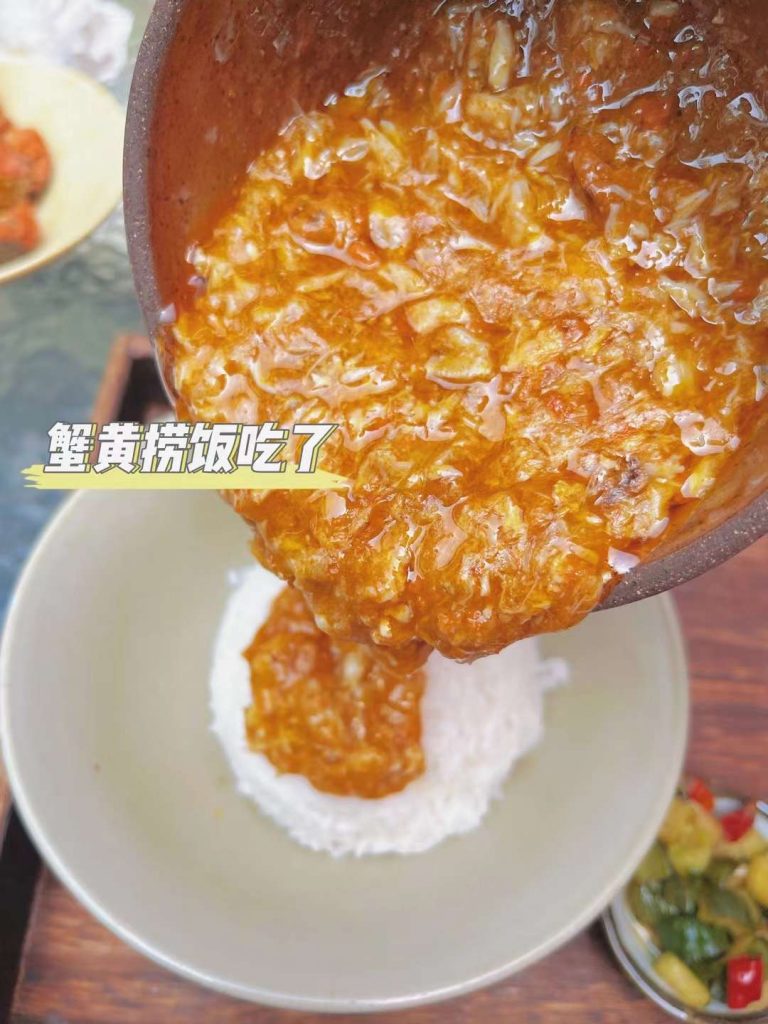
Crab roe rice (蟹黄饭 Xièhuáng fàn) is also a seasonal delicacy that can only be enjoyed in autumn, when the hairy crabs are at their best. The rice is cooked with the roe and meat of the crabs, as well as some seasonings such as ginger, soy sauce and sugar. The rice is rich and creamy, with a strong crab flavor and aroma. The dish is usually served with vinegar and ginger shreds to balance the greasiness.
Serving the crab roe on rice in a bowl | Photo: Jiangyue CHEN
Drunken crab (醉蟹 zuì xiè) is a cold dish that is made by marinating raw hairy crabs in yellow rice alcohol, salt, sugar and spices for several days. The crabs are then refrigerated until they are ready to eat. The crabs are soft and juicy, with a hint of alcohol and spice. The dish is said to have health benefits such as nourishing the blood, clearing the heat and moistening the lungs. I hope to try this dish on a later visit.
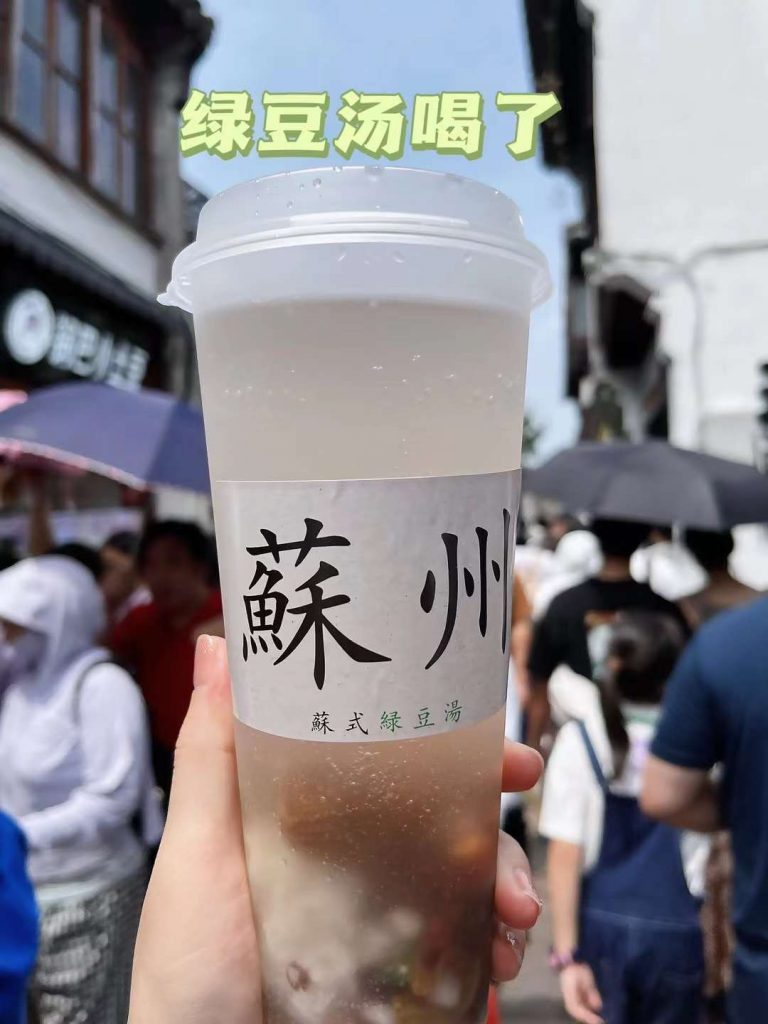
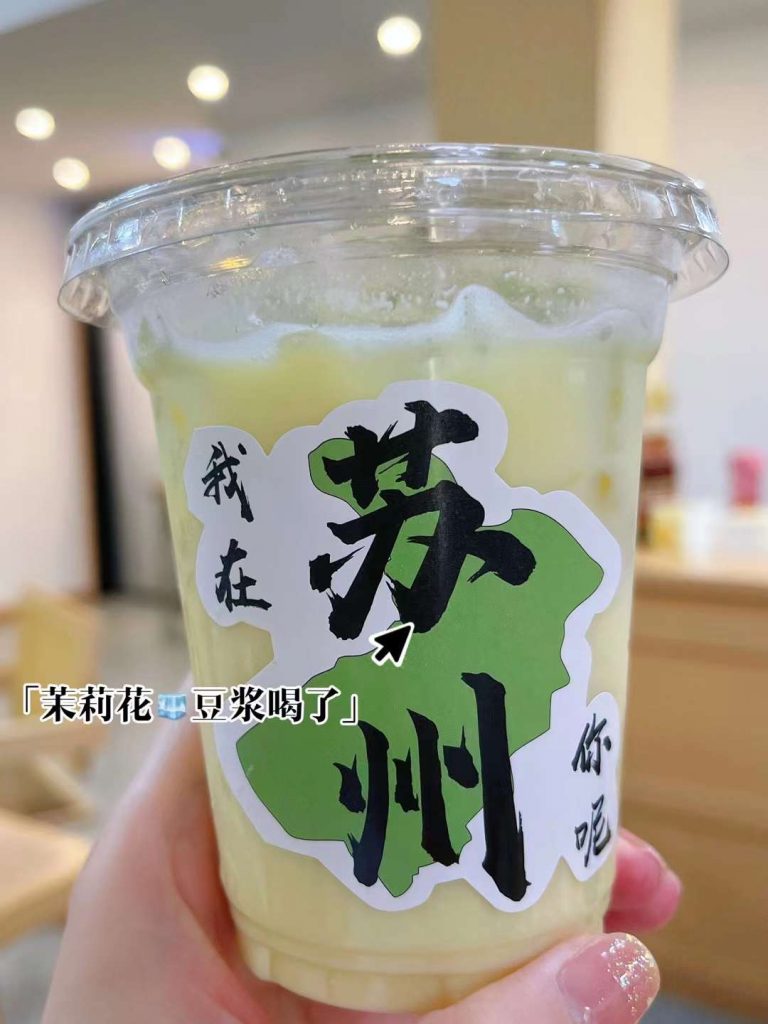
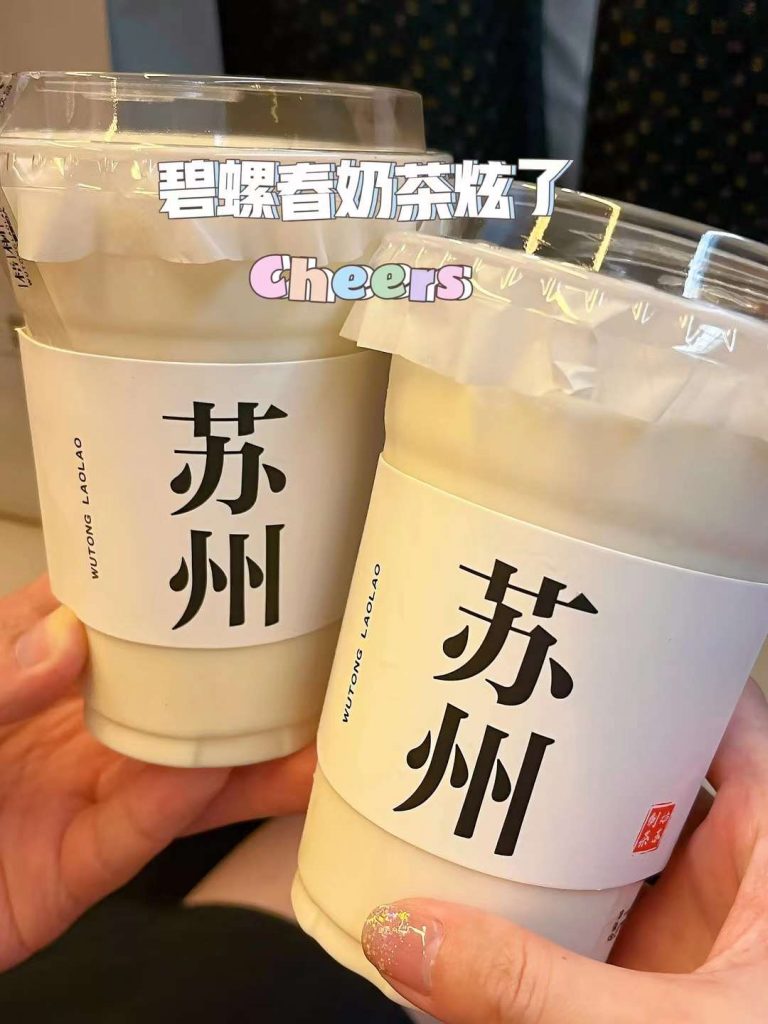
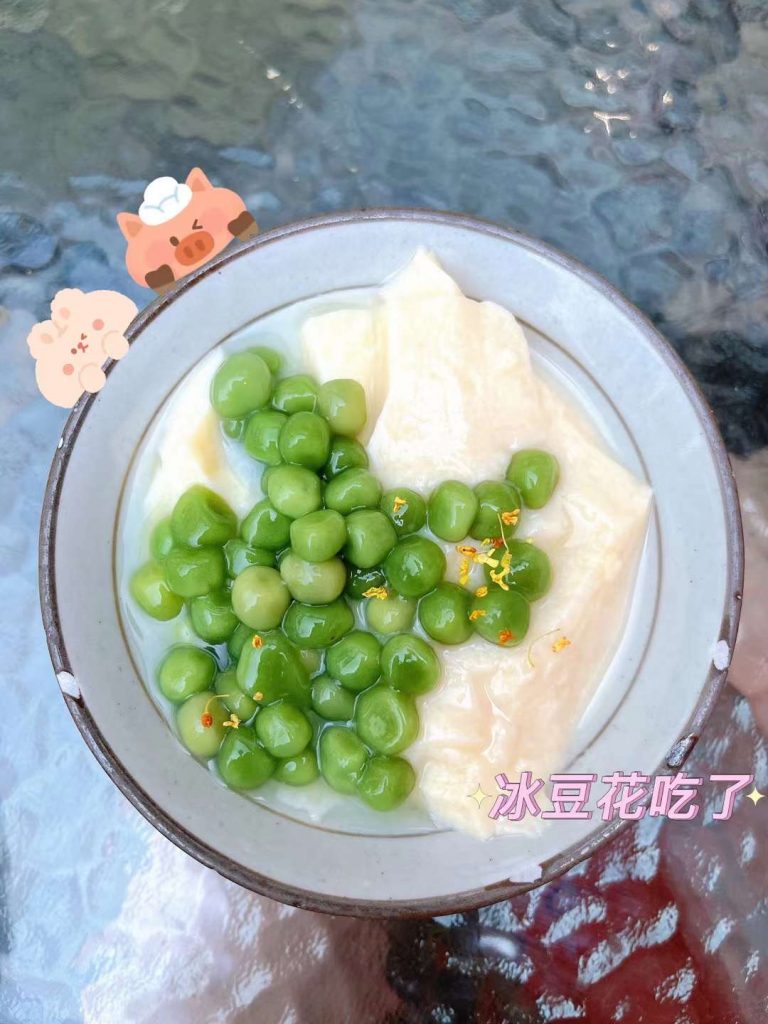
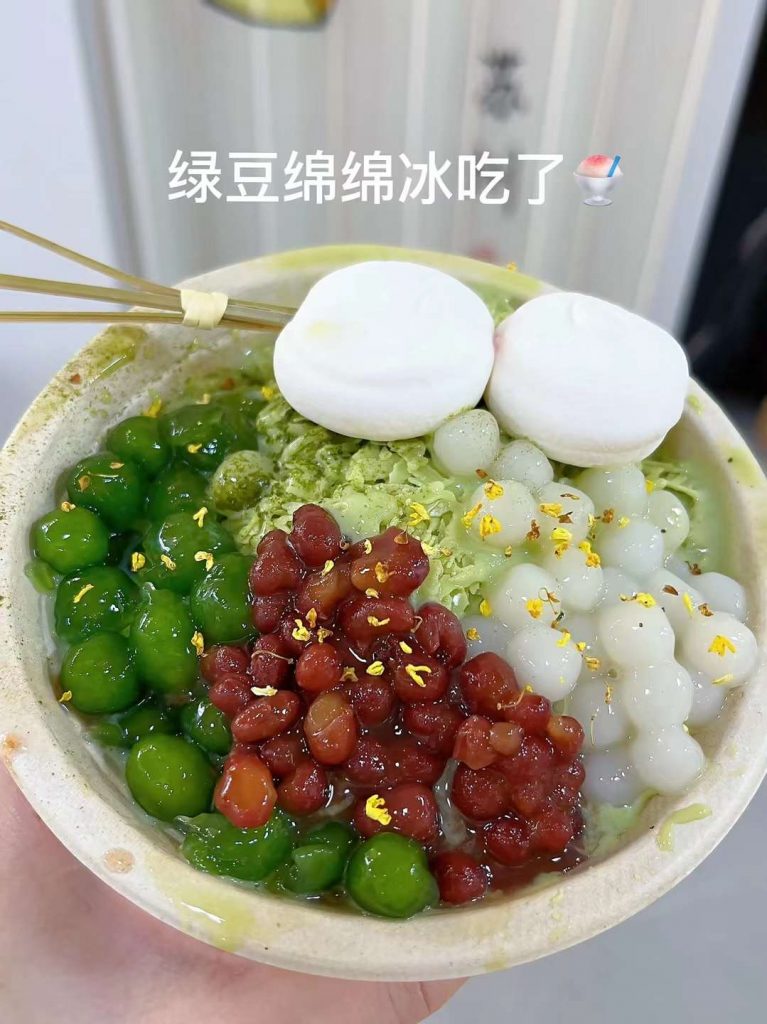
In addition, I have enjoyed tasting various local snacks and drinks, as below. Hope you all get a chance to visit Suzhou and taste the difference one day.
Suzhou brand – Mung bean soup | Photo: Jiangyue CHEN
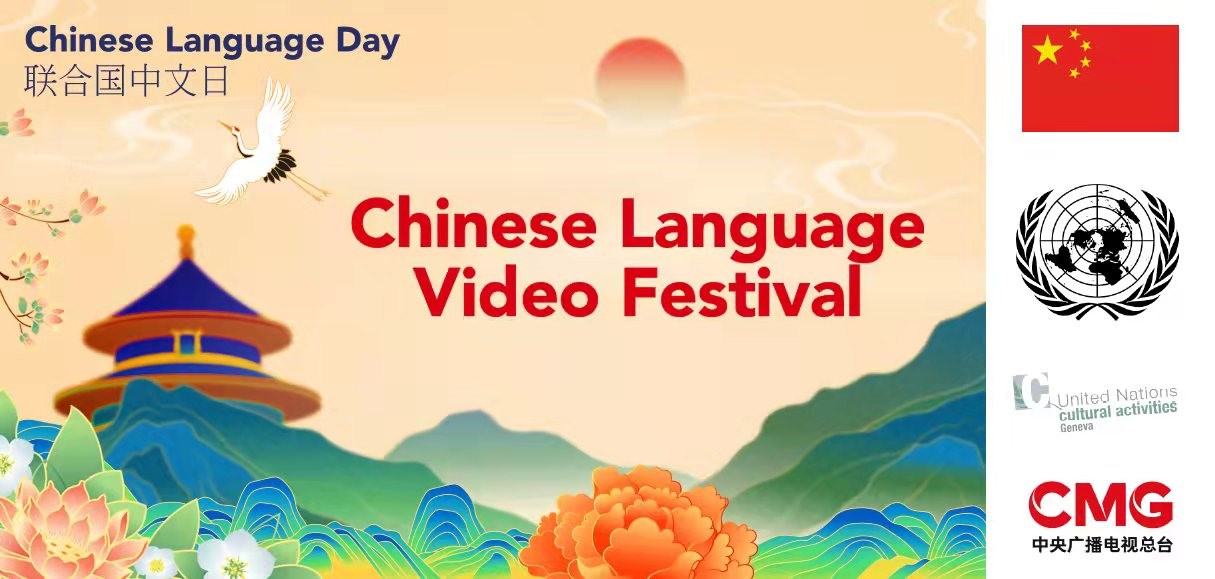
‘China Chic’: Chinese Language Video Festival launched to celebrate UN Chinese Language Day
CGTN.COM
The theme this year is “China Chic” – a modern take on traditional Chinese heritage from young people around the world. As China has continued to progress and innovate, unique cultural elements have been adapted to fit the very latest trends, with the younger generation increasingly aware of regional differences.
All non-native Chinese speakers from around the world are invited to submit an original video showcasing the beauty of Chinese traditions and how they are incorporated into the modern world.
Please note that The Language Centre is not involved in this competition provision. Any queries regarding this competition shall be sent to the organiser directly.
2022 Chinese Competition of Charitable Projects & Business Innovations for UK University Students
Following the successful running of the online Chinese Competition of Charitable Projects and Business Innovations for UK University Students in 2020 and 2021 despite the COVID-19 pandemic, the 2022 Competition will be held in April 2022, organised by Centre for Language Education and Cooperation, UK.
Competition Date: 10th April 2022 (Sunday)
Format: Zoom Online
Contestants’ Qualifications: Undergraduate, postgraduate and PhD students studying at schools, faculties, departments, Confucius Institutes and language centers of the UK universities and people who take part-time courses, short courses and/or evening classes at the UK universities in 2021 to 2022. The mother tongue is not Chinese and the key family members’ mother tongue is not Chinese.
Theme: Topics related to charitable projects and business innovations, including but not limited to charitable projects, business plans, product introductions, introduction of companies and enterprises, business cases, project initiatives and market researches.
Content: Speech presentation*: 8 to 10 minutes Q&A: 5 minutes *Remarks: If there are videos produced by the contestant imbedded in the presentation, the videos can be no more than twice and longer than 1 minute.
Language: Mandarin Chinese
Prizes: Contestants who rank top 6 of the competition will be awarded certificates and partial contribution to the return airfare of undertaking work placement and/or attending business Chinese classes in China. The rest of the contestants will be awarded certificate of participation of the competition and souvenirs.
Enrollment: 1) Contestants please complete and submit the online application form together with the speech synopsis and other required supporting documents no later than 5pm on 11th March (Friday) 2) Participating universities please email the signed and dated confirmation form to the Organising Committee on later than 5pm on the 11th March (Friday).
Number of Contestants: In principle no more than 3 contestants from each participating university.
Support from the industry: Senior business personnel of the UK based key Chinese entreprises and companies and the local British counterparts will join the judging panel of the competition and provide awards for the competition as well as offer work placement for prominent contestants of the competition.
Contact: Name: Christina Zhang Email: bccompetition@clecuk.org
To provide the best experiences, we use technologies like cookies to store and/or access device information. Consenting to these technologies will allow us to process data such as browsing behavior or unique IDs on this site. Not consenting or withdrawing consent, may adversely affect certain features and functions.
Functional
Always active
The technical storage or access is strictly necessary for the legitimate purpose of enabling the use of a specific service explicitly requested by the subscriber or user, or for the sole purpose of carrying out the transmission of a communication over an electronic communications network.
Preferences
The technical storage or access is necessary for the legitimate purpose of storing preferences that are not requested by the subscriber or user.
Statistics
The technical storage or access that is used exclusively for statistical purposes.The technical storage or access that is used exclusively for anonymous statistical purposes. Without a subpoena, voluntary compliance on the part of your Internet Service Provider, or additional records from a third party, information stored or retrieved for this purpose alone cannot usually be used to identify you.
Marketing
The technical storage or access is required to create user profiles to send advertising, or to track the user on a website or across several websites for similar marketing purposes.