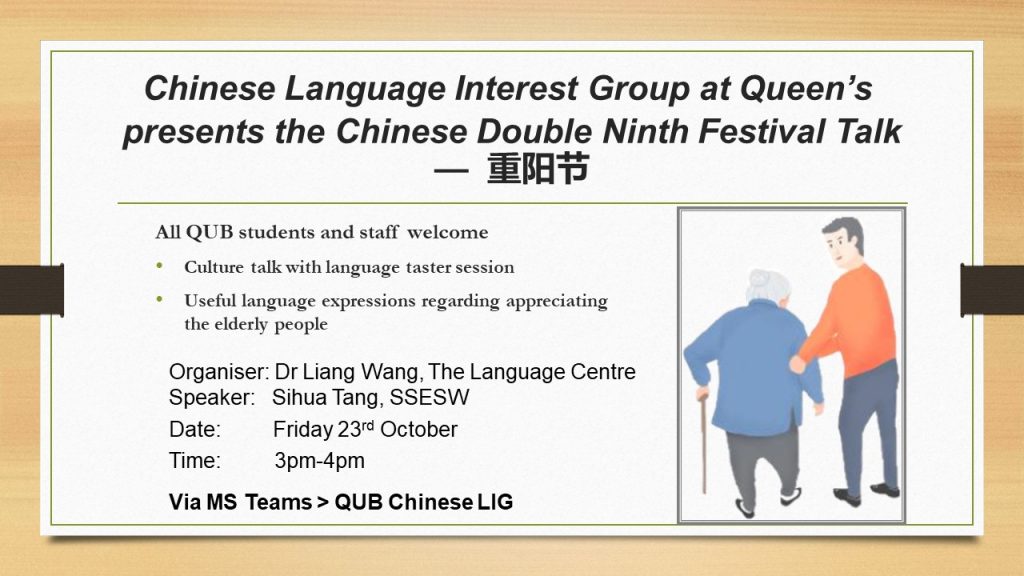
This year the Double Ninth Day falls on Sunday 25th October. In Chinese it is called as 重阳 (Chóngyáng), also known as Seniors’ Day. What does it mean then? Why is it related to the elderly historically and contemporarily in Chinese society? What do Chinese people do on the day?
Come join in our latest session of the Chinese Culture Forum 2020 series, delivered by Sihua Tang, a Master in Education candidate from SSESW, Queen’s and also enthusiastic volunteer in promoting language and culture.
For members of the public who would like to attend, please leave your name and email contact in the comment box (will not be displayed) below so that we can send you the invitation link.
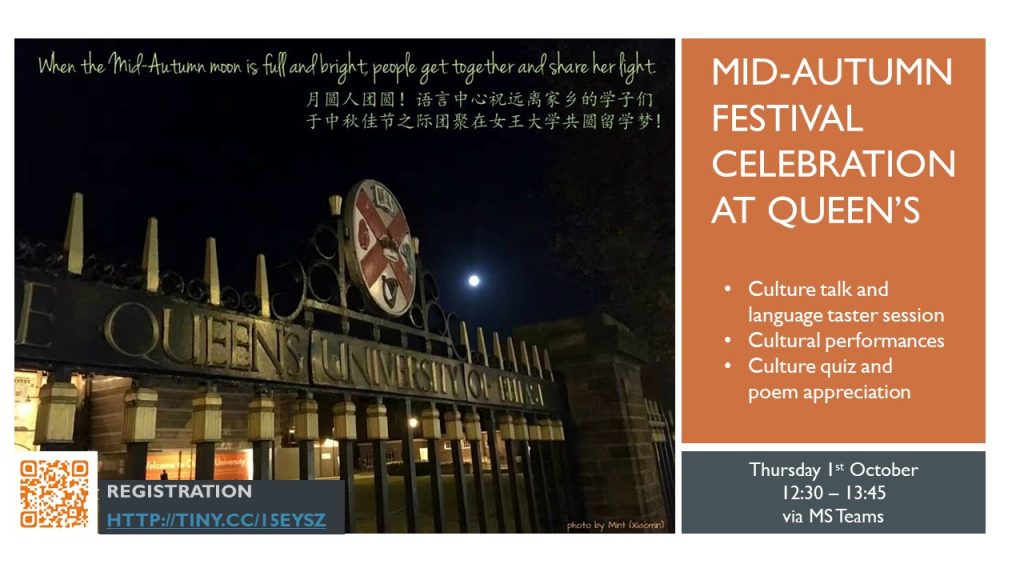
This year the Mid-Autumn Festival, 中秋节 (Zhōngqiū jié) in Chinese, falls rightly on the 1st October, which coincides the Chinese National Day.
At Queen’s we are hosting an online celebration including a culture talk with language taster session, cultural performances, a culture quiz and poem appreciation, contributed by Queen’s Chinese students and alumni. The event is scheduled between 12:30 and 13:45 on the day. You are all very welcome to attend the session with the information and registration link below:
Festive greeting with invitation from the Language Centre
Normally people would greet each other by saying 中秋节快乐 (Happy Mid-Autumn Festival). However, in this special time of facing pandemic threat, we can add 安康 (ānkāng), meaning peace and healthy, after 快乐 (kuàilè), which becomes “中秋节快乐安康 (Zhōngqiū jié kuàilè ānkāng)”.
中 (zhōng) – middle, centre
秋 (qiū) – autumn
中秋 (Zhōngqiū) – mid-Autumn
节 (jié) – festival, day
快乐 (kuàilè) – happy
安康 (ānkāng) – peace and healthy
To learn more Chinese vocabulary and expressions in a structured way, you are welcome to attend one of our Chinese courses for non-specialist purposes.
Please submit your answers in the comment box below.
Q1. Mid-Autumn Festival is the time for people to ______ in China. A. travel for sightseeing B. have dragon boat races C. worship family ancestors D. have family reunion
Q2. When is the Mid-Autumn Festival due, according to the Chinese lunar calendar? A. the 1st day of the 8th month B. the 8th day of the 8th month C. the 15th day of the 8th month D. the last day of the 8th month
Q3. What particular dessert do Chinese people like to eat on Mid-Autumn Festival? A. pan cake B. moon cake C. pork pie D. jiaozi dumpling
Q4. What do Chinese people, home and abroad, particularly do on this particular occasion? A. watching TV and playing cards B. making moon cakes and pies C. watching the moon and thinking of family D. going to pubs and eating out
Q5. In which year did the Mid-Autumn festival become an official holiday in China? A. 2008 B. 2004 C. 2010 D. 2001
Q6. What kinds of Chinese mythology are closely related to Mid-Autumn Festival? A. The Monkey Myth B. The Moon Goddess Chang’e C. Yu, the hero who rebuilt the Earth D. Yi, the hero who shot suns
Q7. How many suns did Yi shoot down from the sky? A. 10 B. 9 C. 8 D. 1
Q8. Why did Chang’e leave Yi? A. Yi could not afford the cost of living B. Chang’e’s parents did not allow her to be with him C. Chang’e did not love Yi anymore D. In order to keep the elixir, Chang’e swallowed it and ascended to the moon
Q9. What does this radical part ‘𥫗’ mean in the character of ‘筝 (zheng, or Chinese zither)’? A. bamboo B. wood C. Stone D. Grass
Q10. What is normally written on the surface of a mooncake? A. Greetings and wishes for the festival celebration B. The company trademark/logo/slogan which made the mooncake C. Instructions of how to taste the mooncake D. The ingredients of the mooncake
With new students’ arrival and returning students back to Queen’s, the campus is full of welcomes and smiles – although social distance should still be maintained. The first charted airplane from Beijing to Belfast in ready on its way, due to departure in the evening on the 18th Sept. Let’s wish them a smooth and pleasant journey!
How to say ‘welcome’ in Chinese?
Photo taken at the Belfast City Airport. The welcome board displays multilingual expressions of ‘Welcome’ messages. However, some messages, including Chinese, are hardly visible due to background colour. Image@ Liang Wang.
So, to say ‘welcome’ in Chinese, one would at least say the word ‘欢迎’ twice to demonstrate a real welcoming atmosphere, plus a smiling face, and perhaps shaking hands in formal and business contexts. One seldom hugs or kisses to welcome people in the Chinese culture.
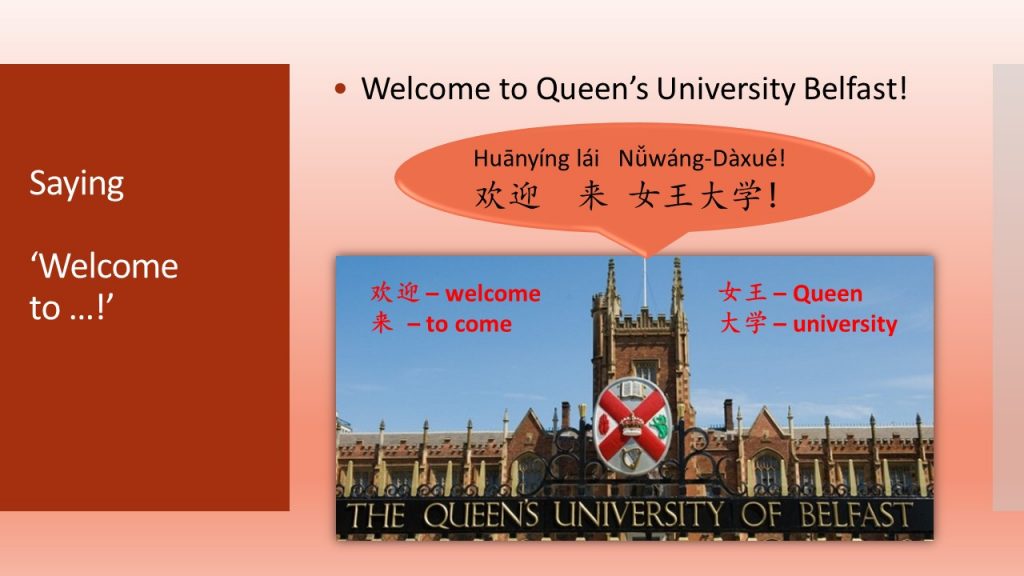
How to say ‘Welcome to Queen’s University Belfast!’, then?
The gate and The Lanyon Building of Queen’s University Belfast. Image@QUB
Now that you know how to say ‘welcome’ – 欢迎, the order of the message is exactly the same as in English in this expression. Let’s learn a few more vocabulary, including Queen’s in Chinese.
来 (lái) – to come
女王 (nǚwáng) – queen
大学 (dàxué) – university
贝尔法斯特 (Bèi’ěrfǎsītè) – Belfast
Queen’s University Belfast (Queen’s in a known context) has its Chinese equivalence, which is called 贝尔法斯特女王大学. It can be further shortened as 女王大学 in the local context. Therefore, put together, the whole expression can be 欢迎来(贝尔法斯特)女王大学!
The new semester language courses are open for registration now
LANGUAGE CENTRE PROGRAMME
AUTUMN 2020
Registration opens on Monday 7 September at 00:30 and close promptly at 17:00 on Thursday 8 October. Classes are expected to be extremely popular and usually fill up quickly, so early registration is strongly recommended.
I just want to thank you, Yu and all the Language Centre team for this course and all the resources over the past few weeks. The free and open access has been fantastic and this Mandarin course has been a great starter for me! … I will certainly keep my eye on Language Centre updates, and hope that I may return to the next course in the future! In the meantime, I look forward to consolidating the Mandarin taught in this course …
Many thanks again, and please pass my thanks on to Yu for her great teaching, 谢谢!
Lockdown Language Learning – Mandarin Chinese recordings uploaded
With the completion of the last live clinic of Lockdown Chinese session, all the resources and recordings are now available via the Mandarin Chinese Section.
Whilst we do not have an official end date after which these resources will no longer be available, once the initial 5/10 weeks of live clinics comes to an end, we will review the situation on an ongoing basis and the resources will be removed alongside the transition to more normal working routines.
If you would like to stay with us in the follow-up Chinese language courses, please keep an eye on the update of our Language Centre website.
Thanks again for your great participation and enthusiasm! Stay safe and positive for a summer break.
The date for the Chinese day was selected from Guyu (“Rain of Millet”), which is the 6th of 24 solar terms in the traditional East Asian calendars, to pay tribute to Cangjie. Cangjie is a very important figure in ancient China, claimed to be an official historian of the Yellow Emperor and the inventor of Chinese characters. Legend has it that he had four eyes and four pupils, and that when he invented the characters, the deities and ghosts cried and the sky rained millet. From then on, Chinese people celebrate the day Guyu in honour of Cangjie. In the Gregorian calendar, it usually begins around April 20.
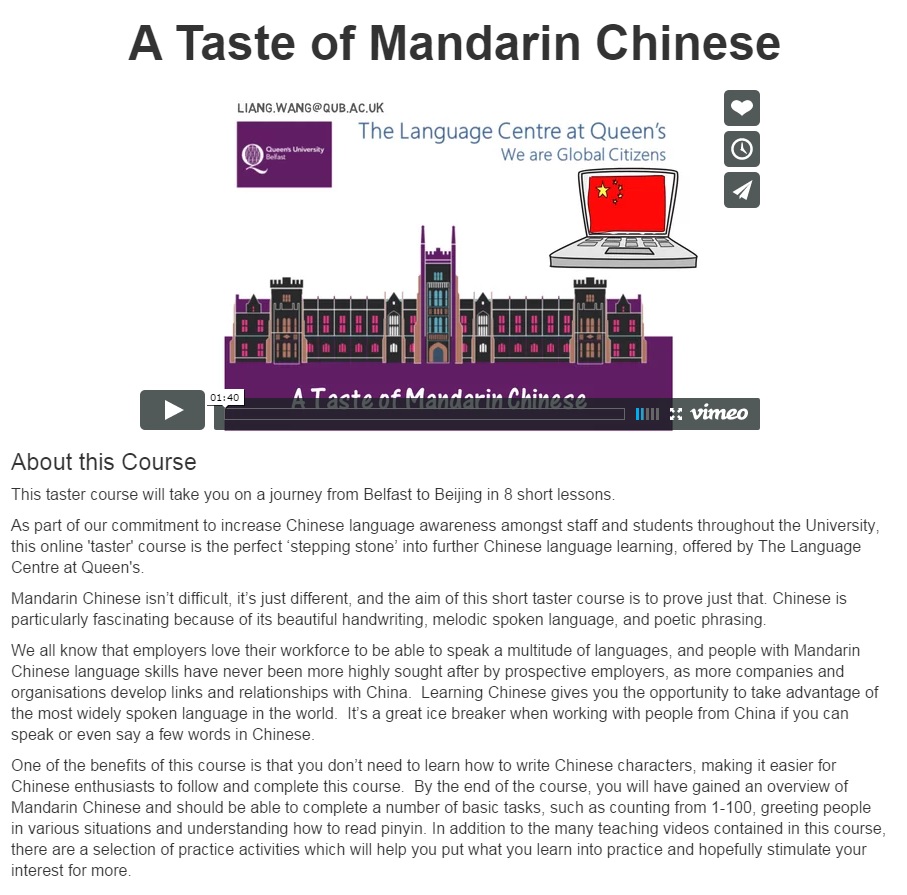
To celebrate the UN Chinese Language Day as part of the promotion of multilingualism and cultural diversity, ALL Queen’s staff members and students are welcome to sign up for the Taste of Mandarin Chinese online course which is a self-paced learning resource.
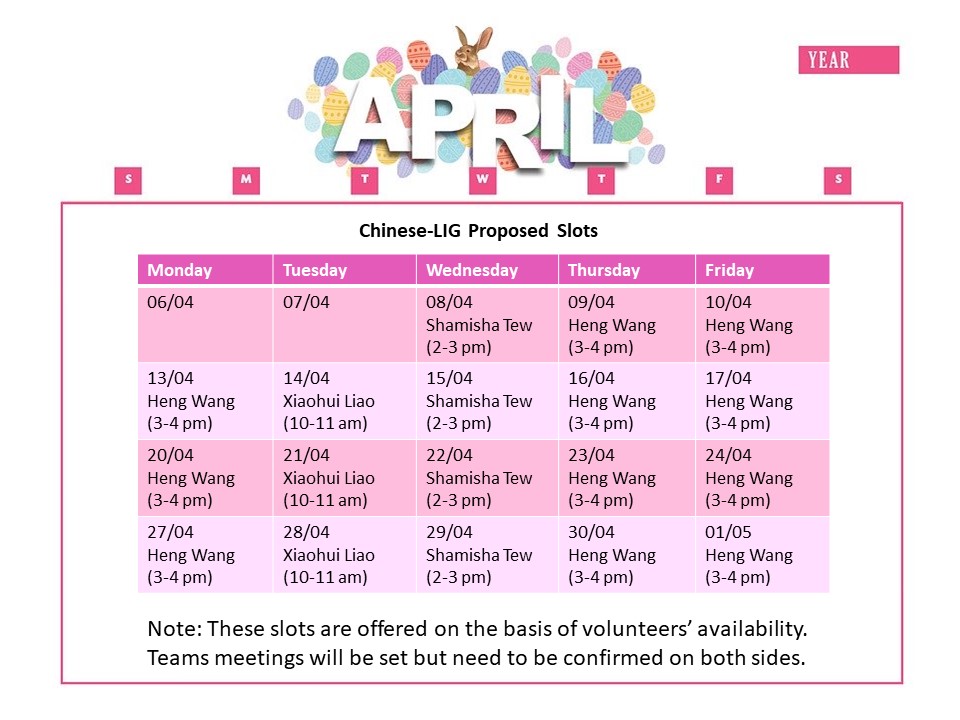
Following our successful celebrations of CNY 2020 at Queen’s, we are pleased to update you that the Chinese Language Interest Group(Chinese LIG) will be up and running. This is a student-led learning community that aims to enhance a better understanding of Chinese culture through learning its language, with social activities taking place throughout the academic year. It is led by voluntary Chinese studentsfor learners of Chinese or anyone who’s genuinely interested in Chinese language and culture at Queen’s and beyond. You do not have to be registered for a Mandarin Chinese course in order to attend, nor do you need to have a high language level to begin with. All you need is the enthusiasm and willingness to participate in and contribute to group activities, online or onsite.
To better inform us about your availability for participation, we would like to run a poll for the most mutually convenient time slots. Would you please select the slots for attendance by completing the online poll by Sunday 01/03 so that we could firm up the slots?
If you would like to attend a Chinese class with Language Centre, our 3rd semester enrolment is open now until Thursday 16th April. See Language Centre Website for details.
We wish you every success in your study of the Chinese language.
Original image from Pixabay
Manage Consent
To provide the best experiences, we use technologies like cookies to store and/or access device information. Consenting to these technologies will allow us to process data such as browsing behavior or unique IDs on this site. Not consenting or withdrawing consent, may adversely affect certain features and functions.
Functional
Always active
The technical storage or access is strictly necessary for the legitimate purpose of enabling the use of a specific service explicitly requested by the subscriber or user, or for the sole purpose of carrying out the transmission of a communication over an electronic communications network.
Preferences
The technical storage or access is necessary for the legitimate purpose of storing preferences that are not requested by the subscriber or user.
Statistics
The technical storage or access that is used exclusively for statistical purposes.The technical storage or access that is used exclusively for anonymous statistical purposes. Without a subpoena, voluntary compliance on the part of your Internet Service Provider, or additional records from a third party, information stored or retrieved for this purpose alone cannot usually be used to identify you.
Marketing
The technical storage or access is required to create user profiles to send advertising, or to track the user on a website or across several websites for similar marketing purposes.