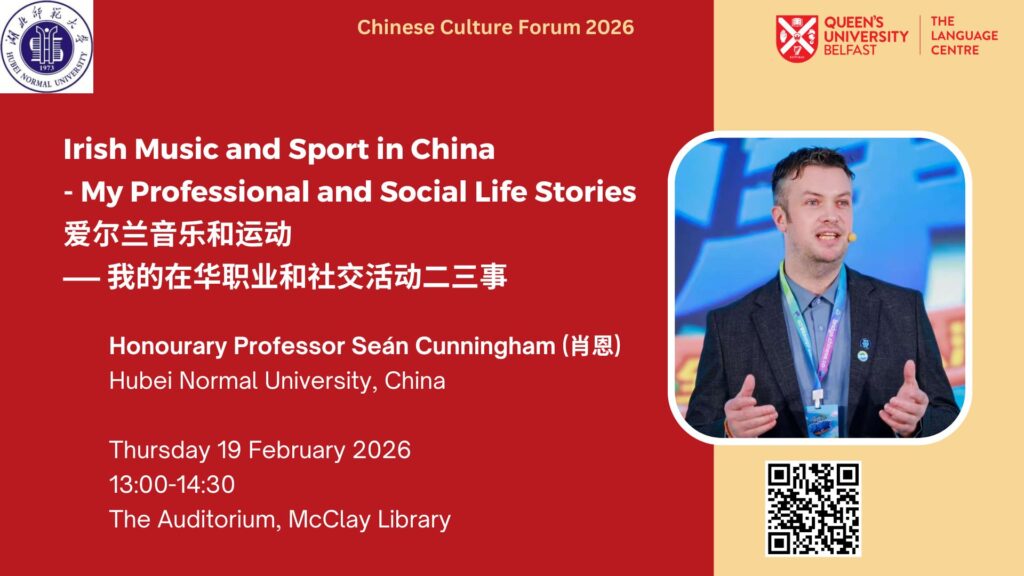
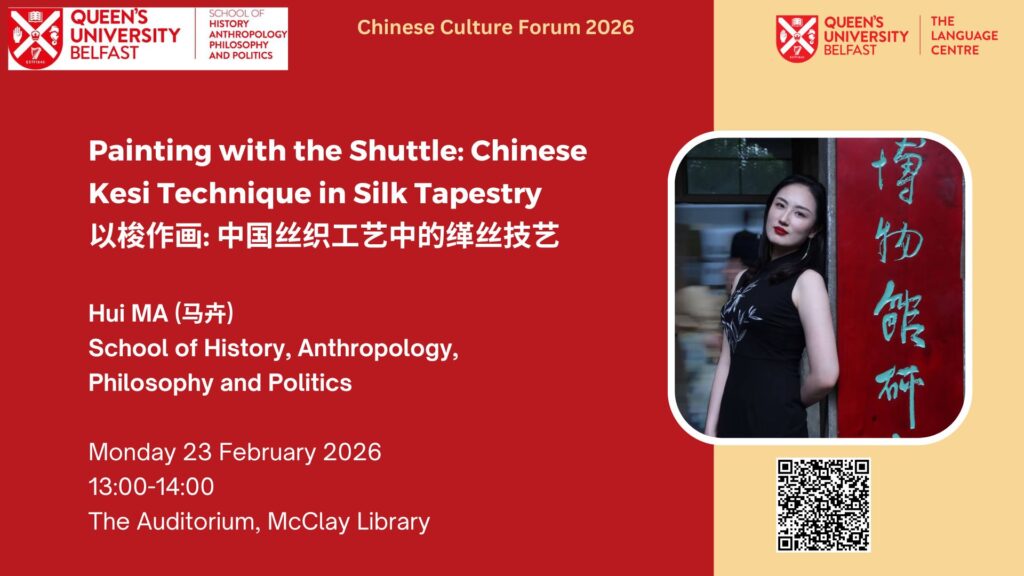
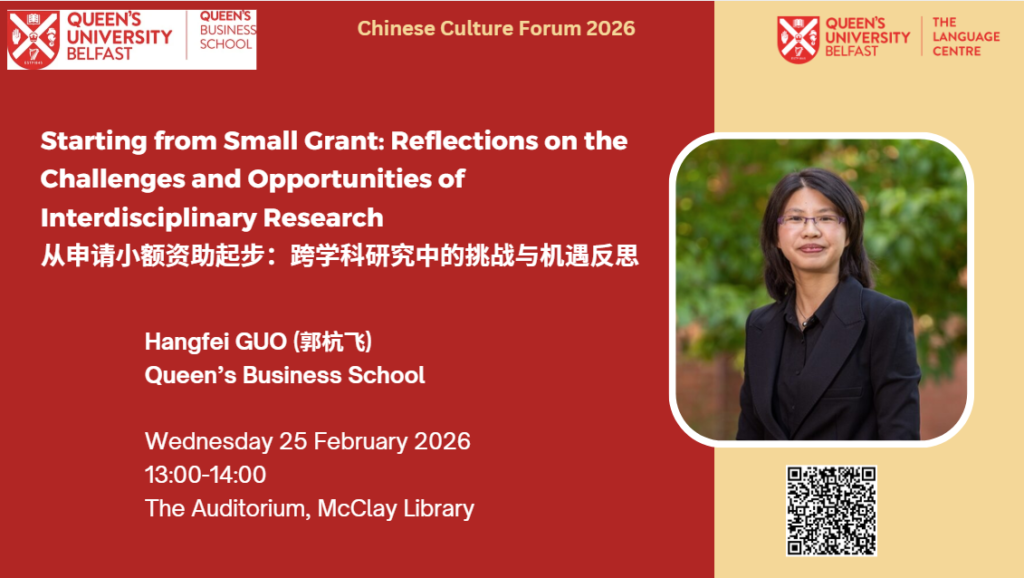
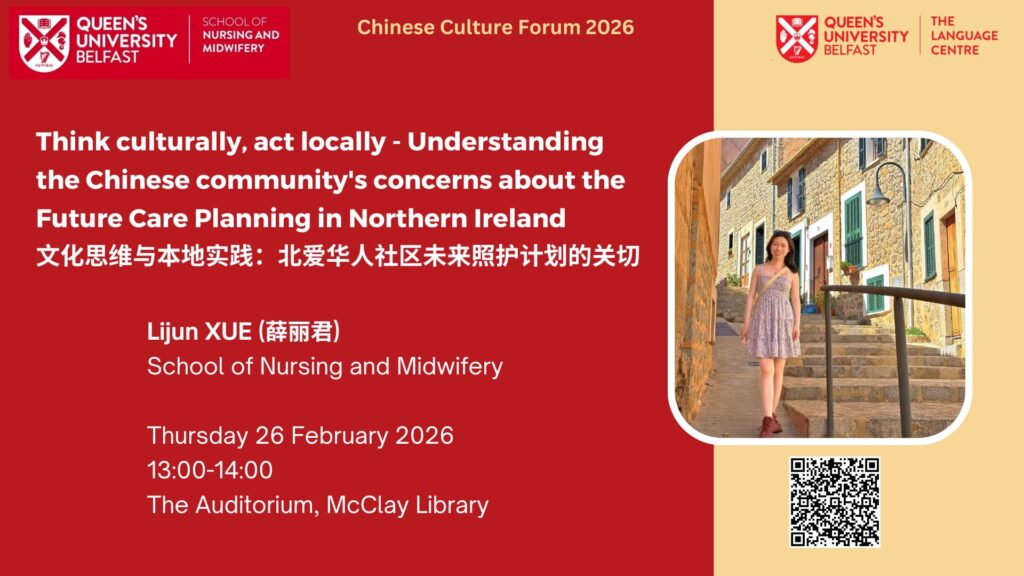
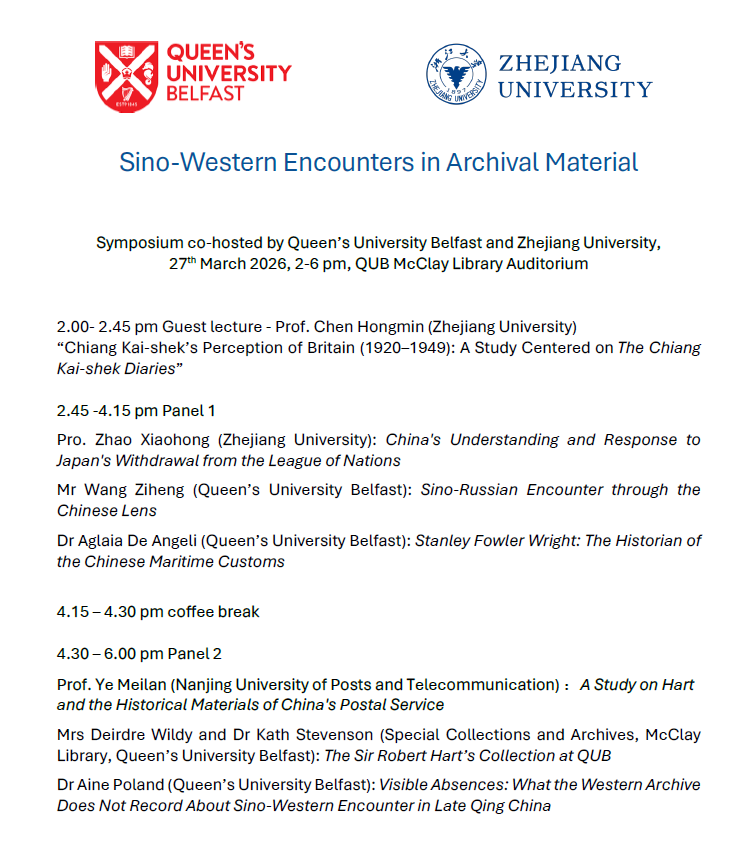
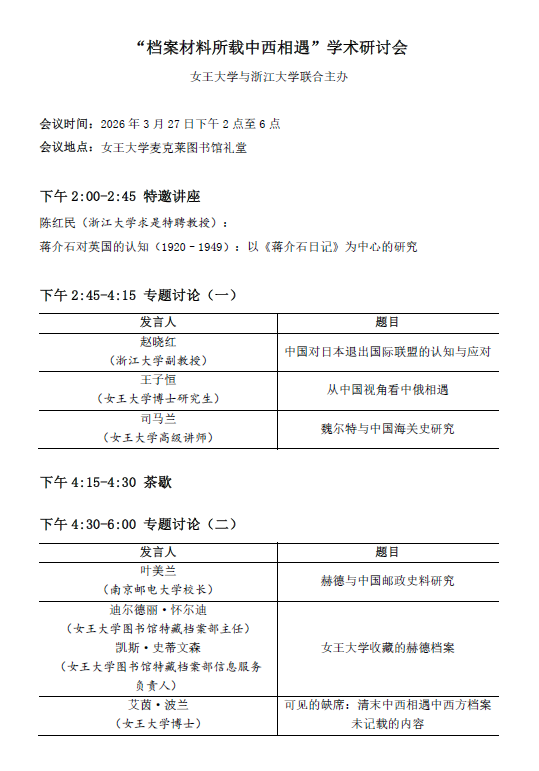
Symposium co-hosted by Queen’s University Belfast and Zhejiang University
Date: Friday 27 March 2026
Time: 2:00-6:00 pm
Venue: The Auditorium, QUB McClay Library
Programme (English)
Programme (Chinese)
All staff and students are warmly welcome!
Date: Friday 27 March 2026
Time: 2:00-6:00 pm
Venue: The Auditorium, QUB McClay Library
Programme (English)
Programme (Chinese)
All staff and students are warmly welcome!
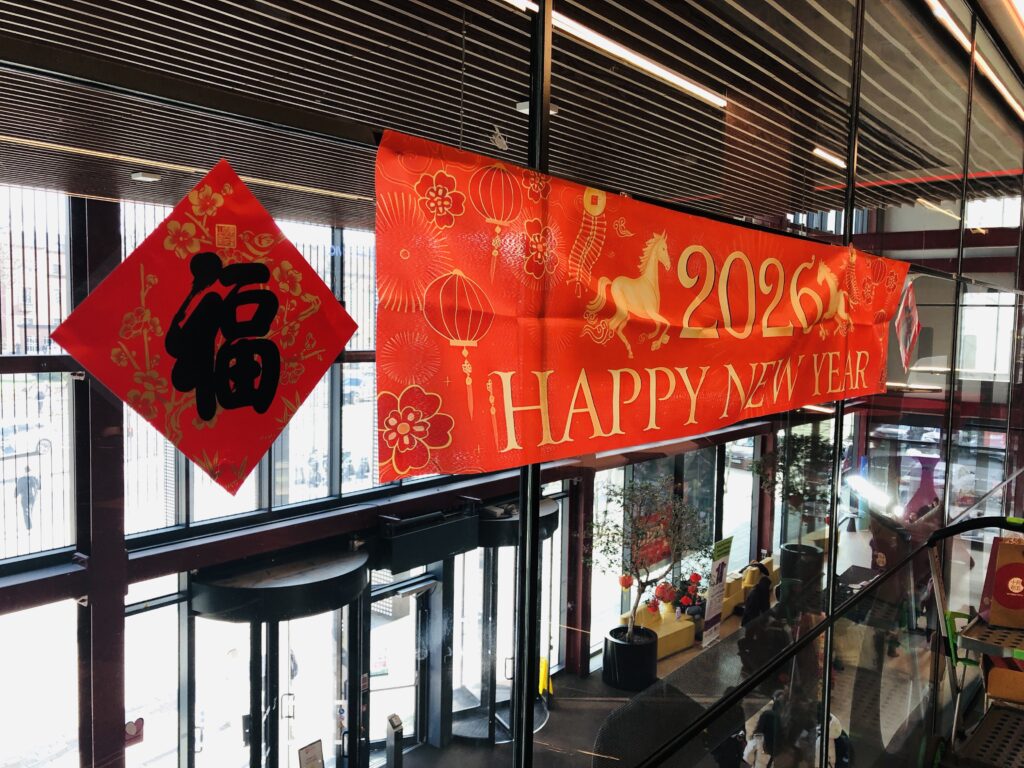
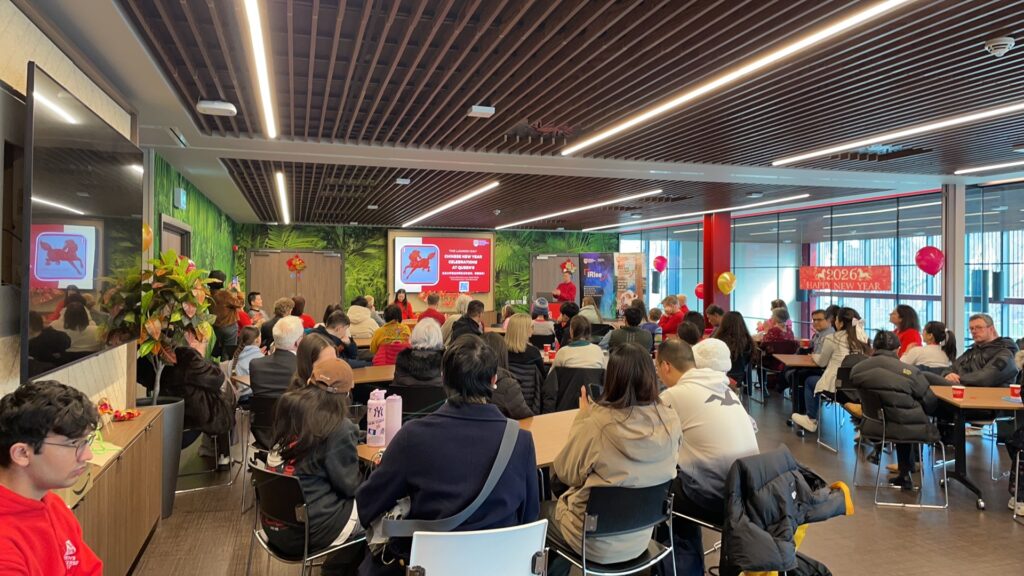
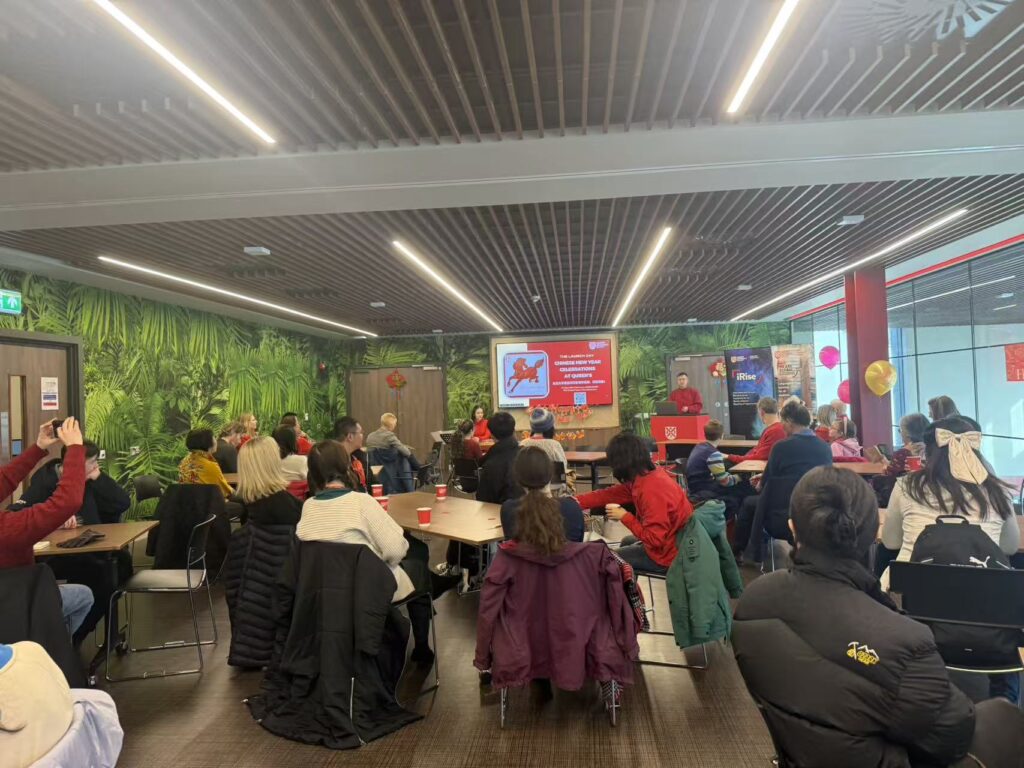
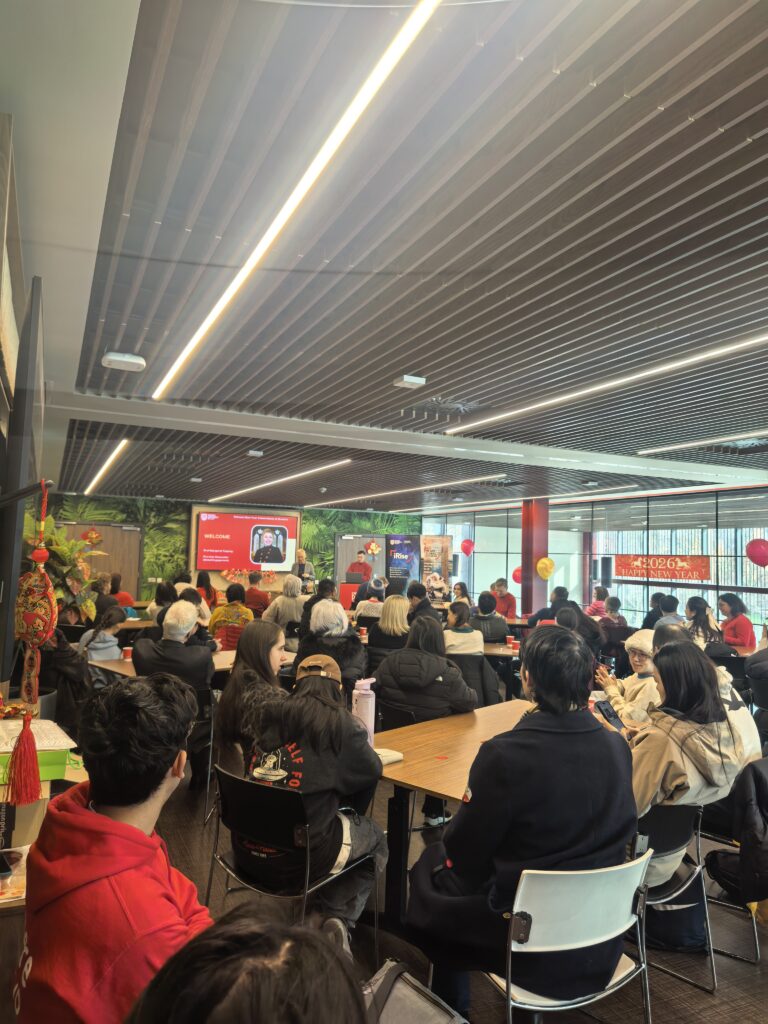
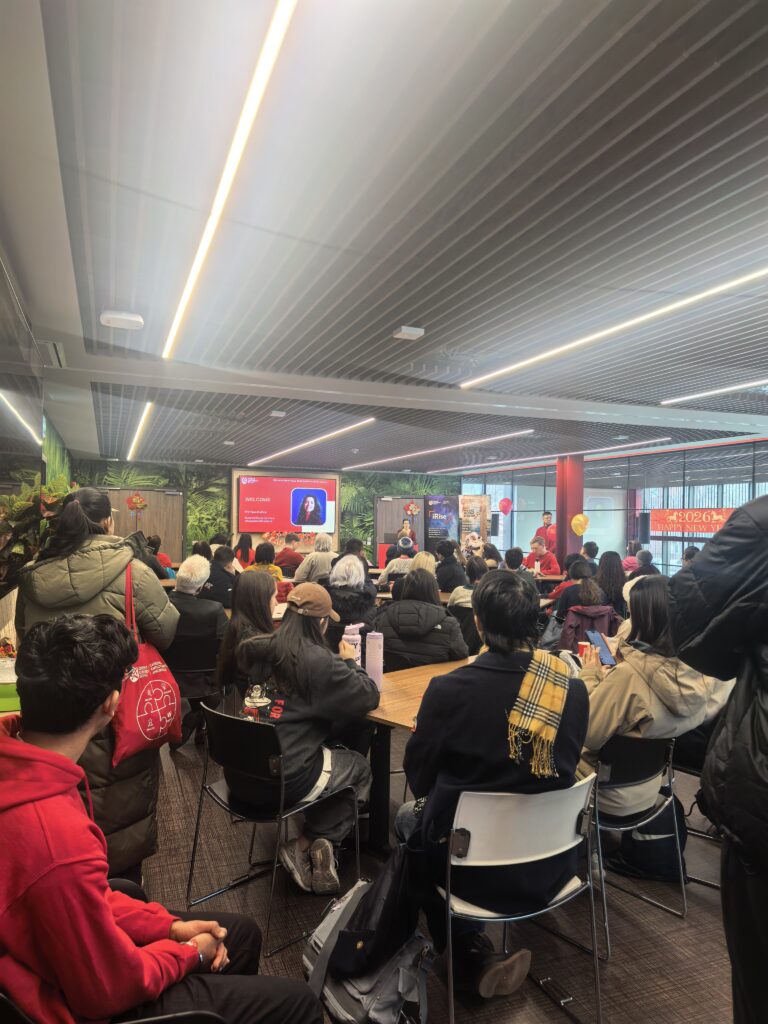
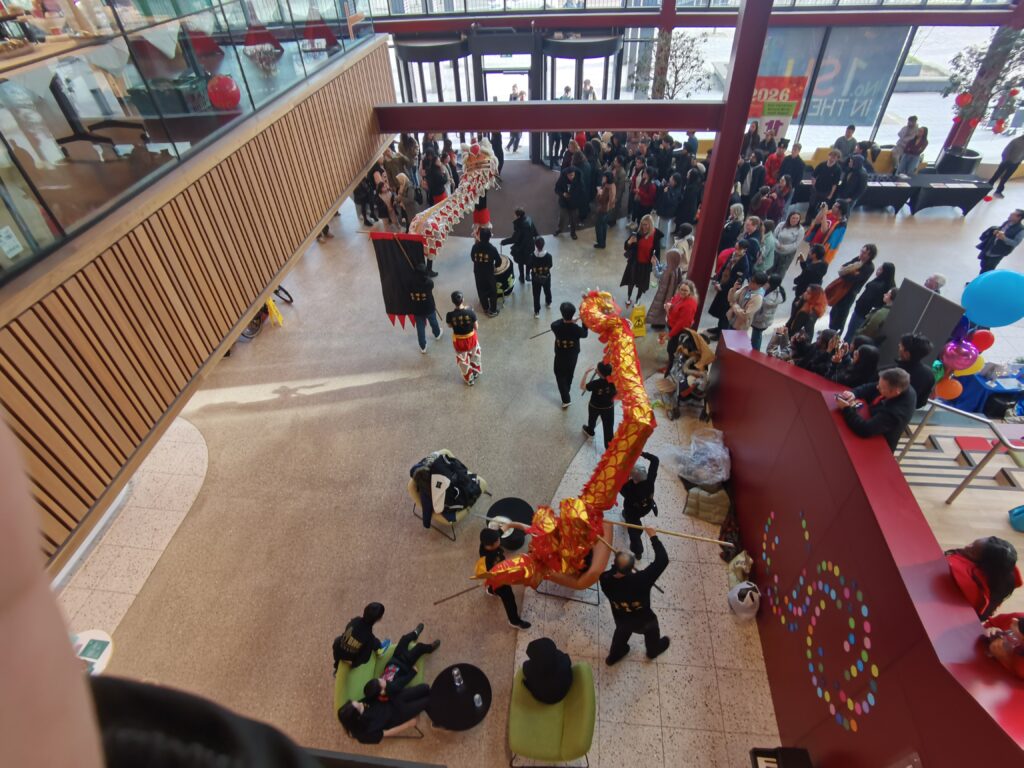
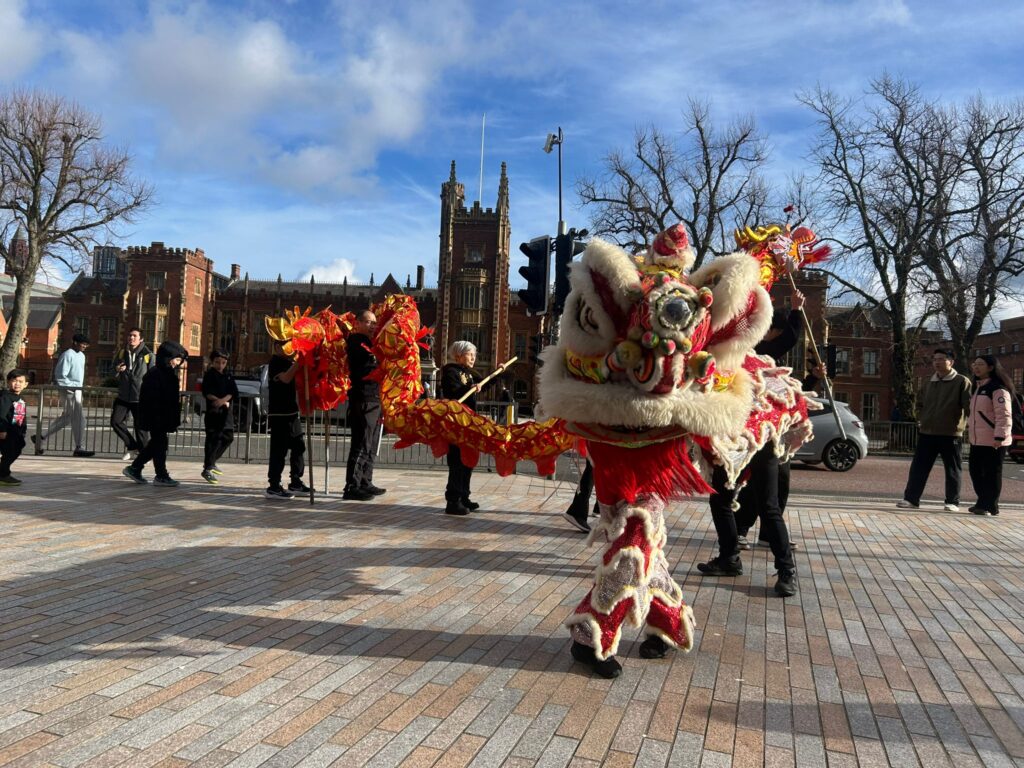
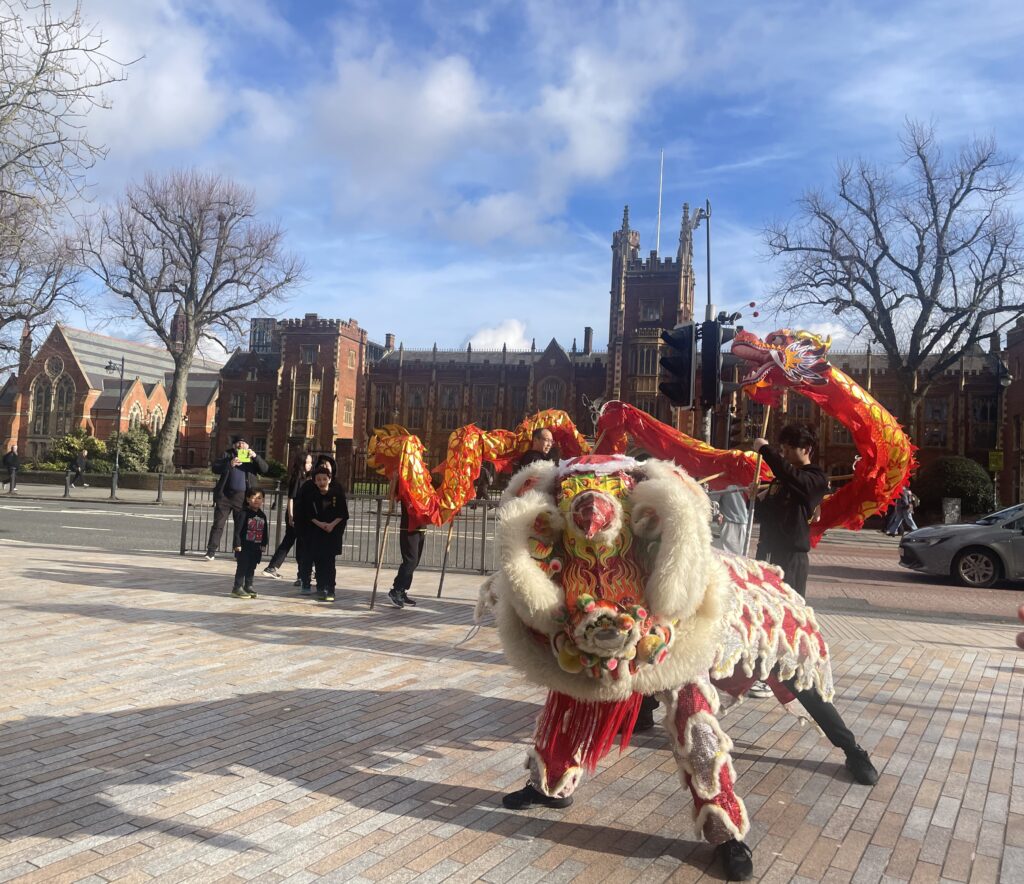
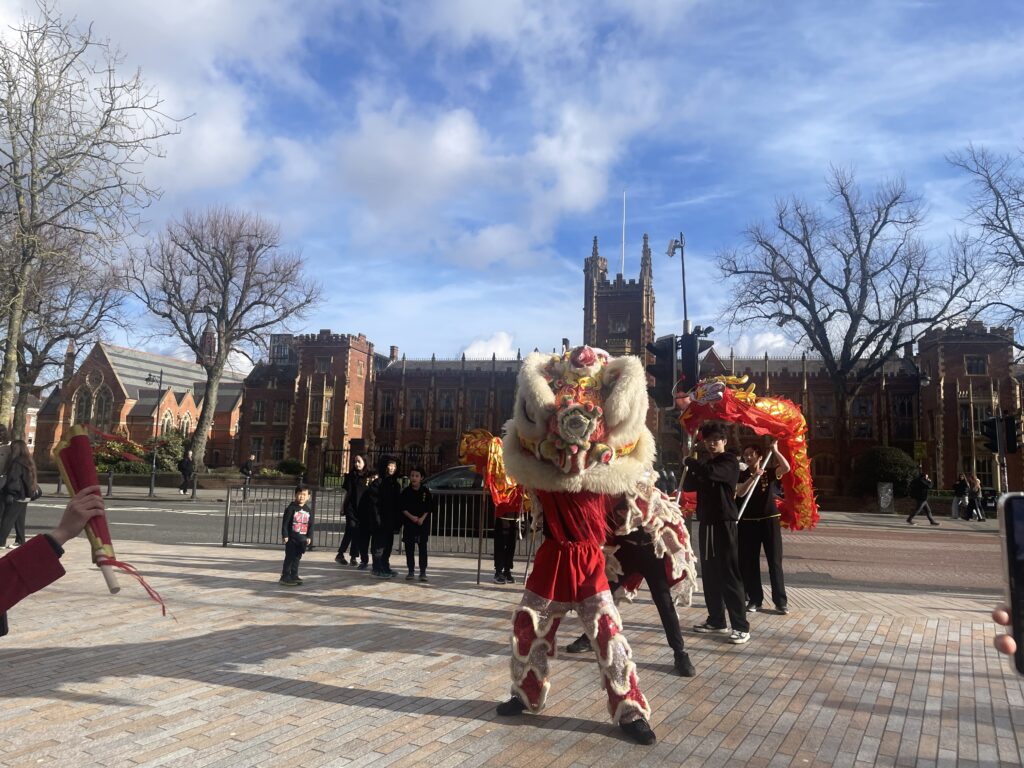
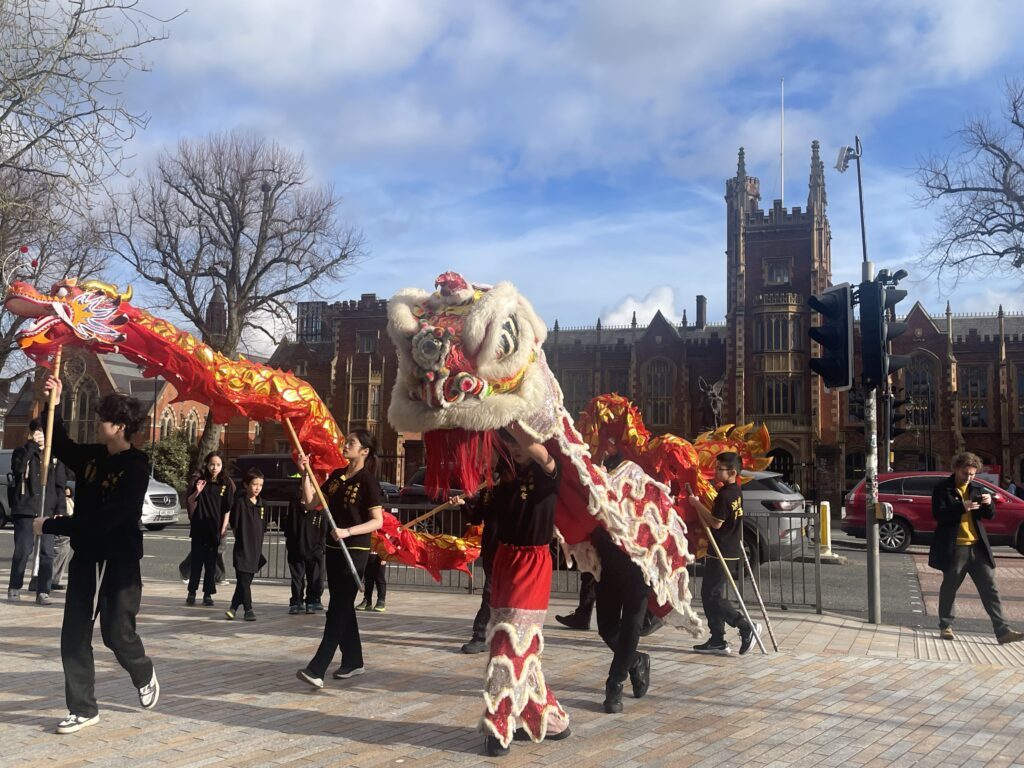
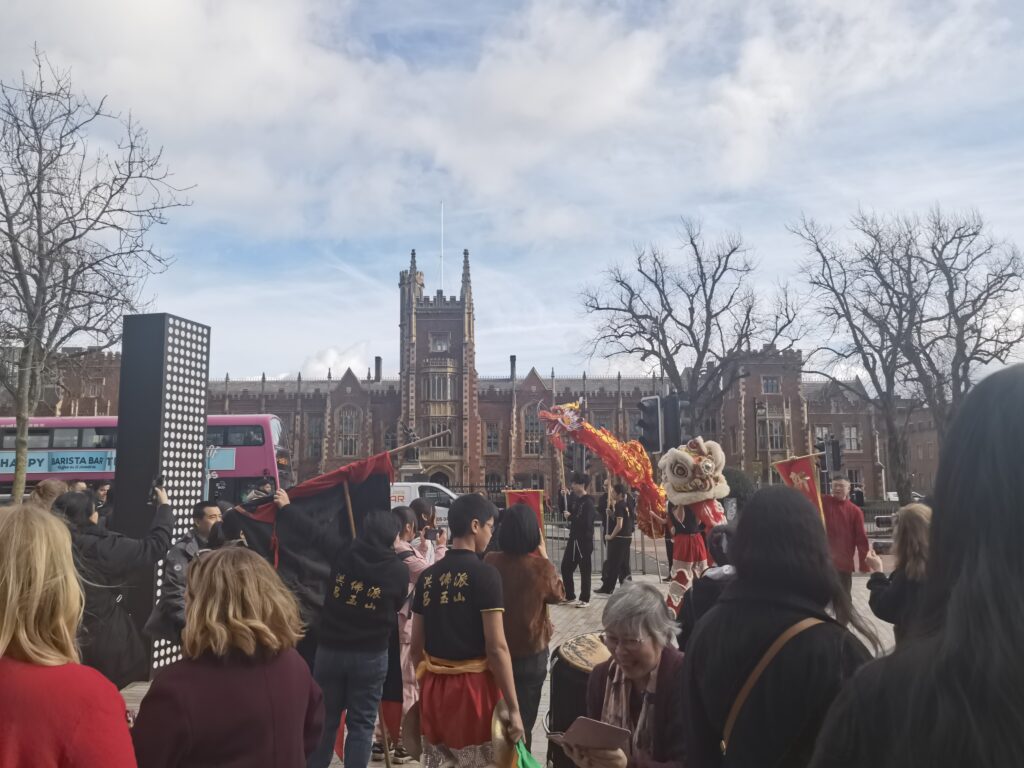
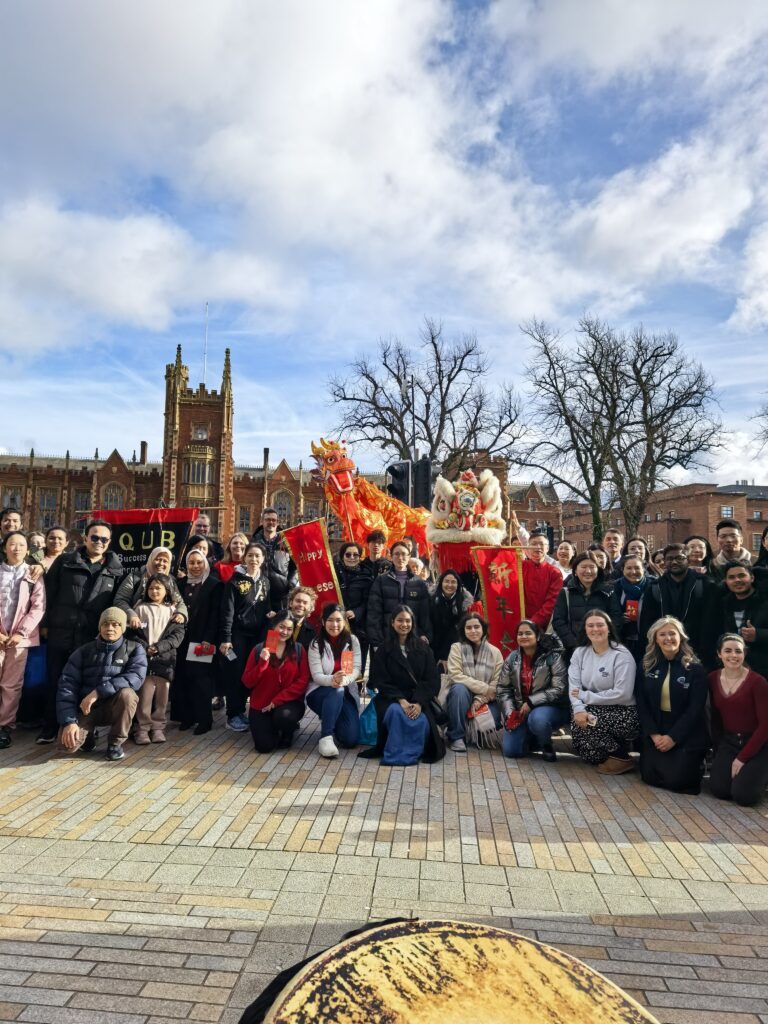
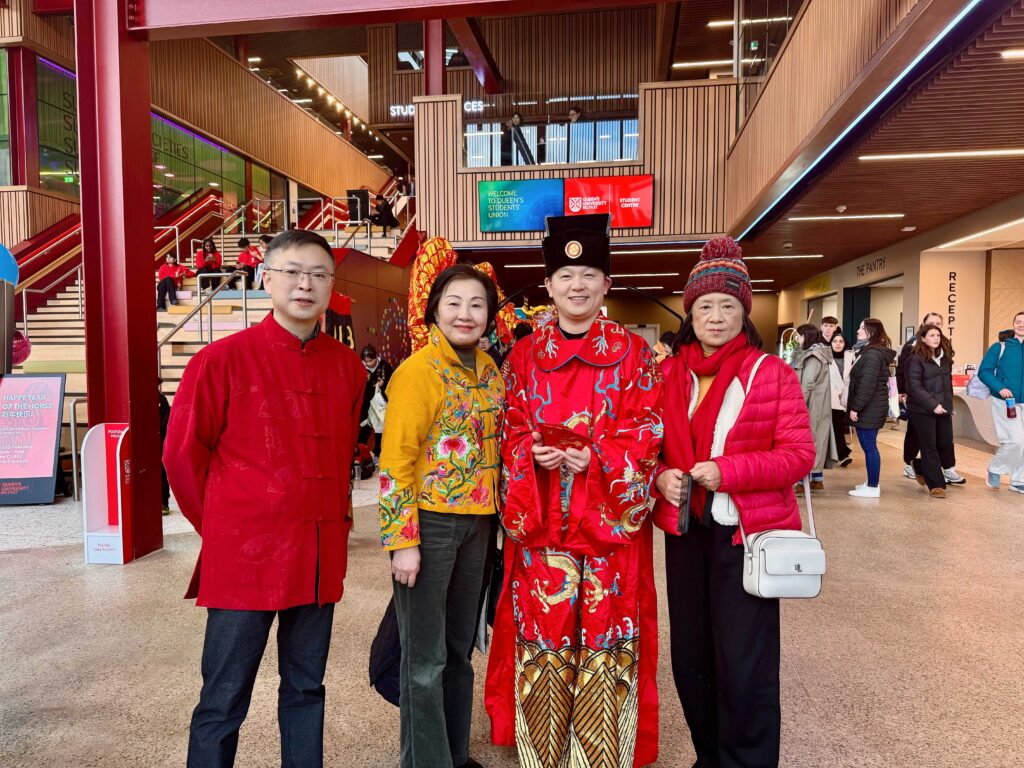
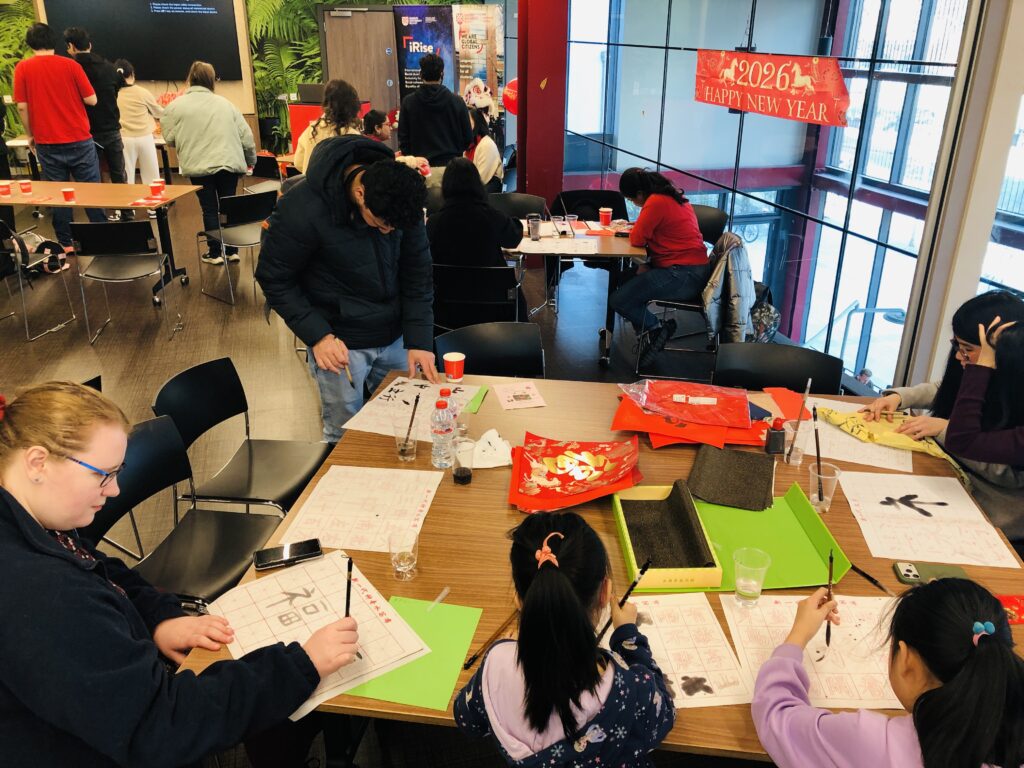
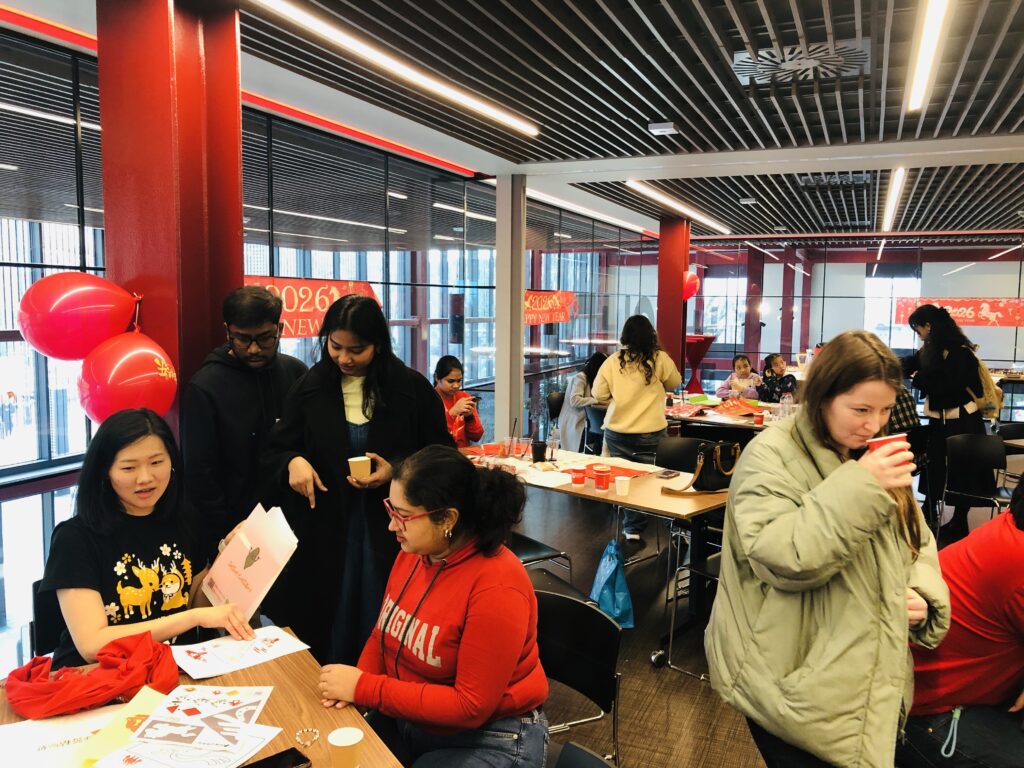
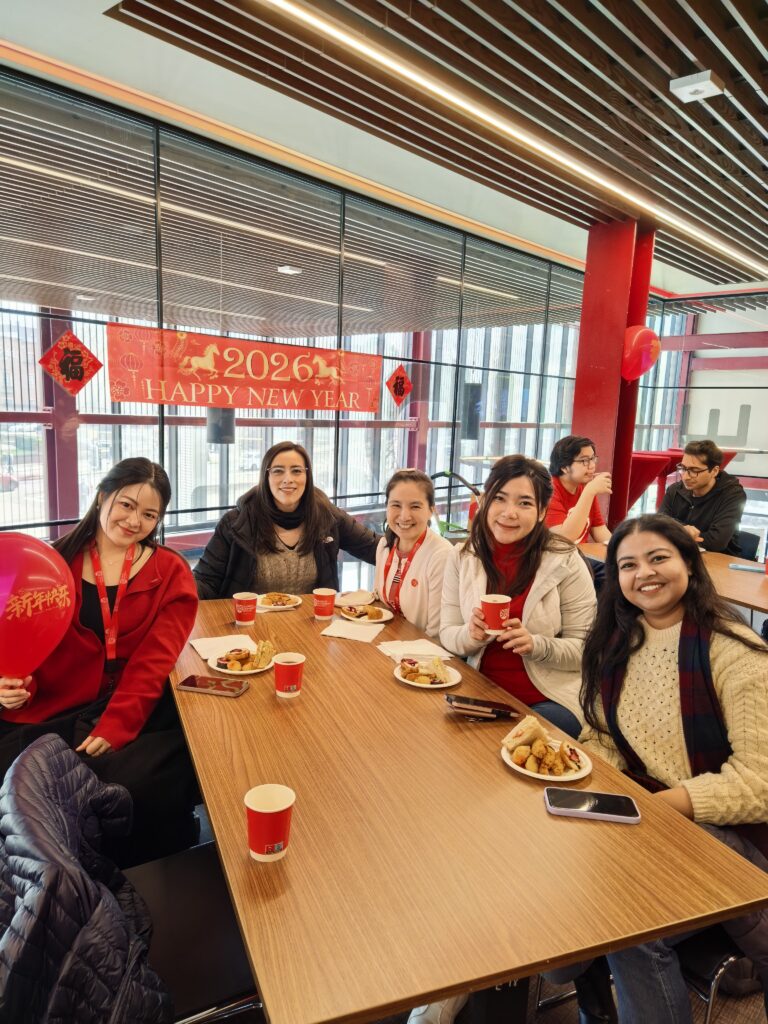
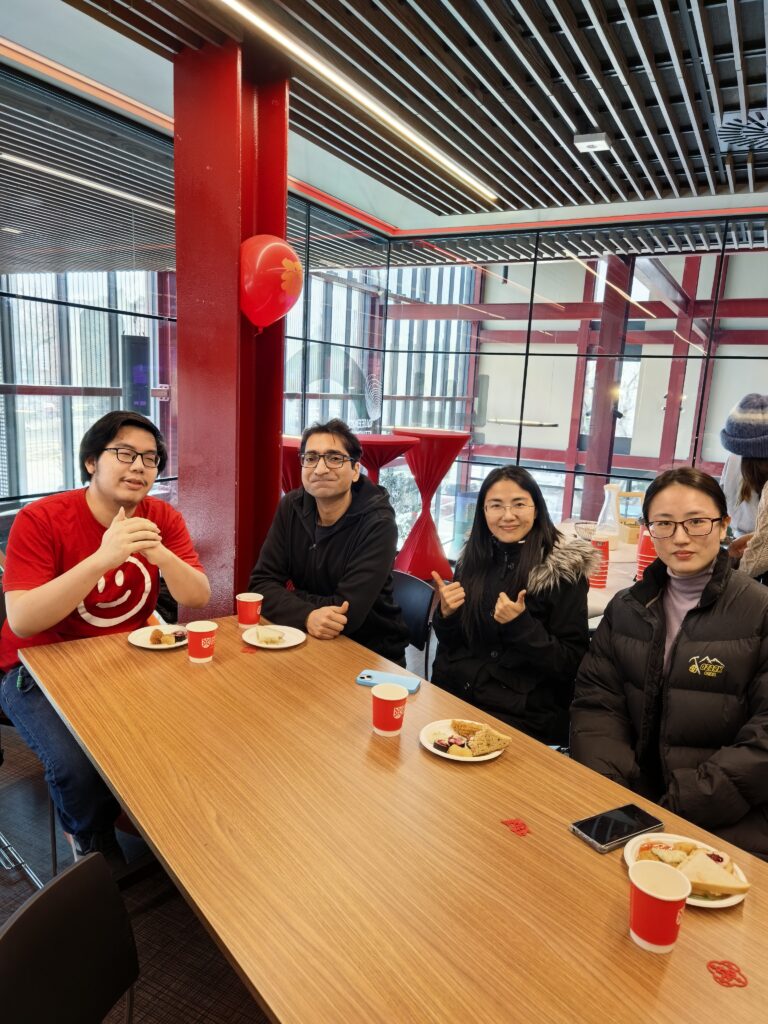
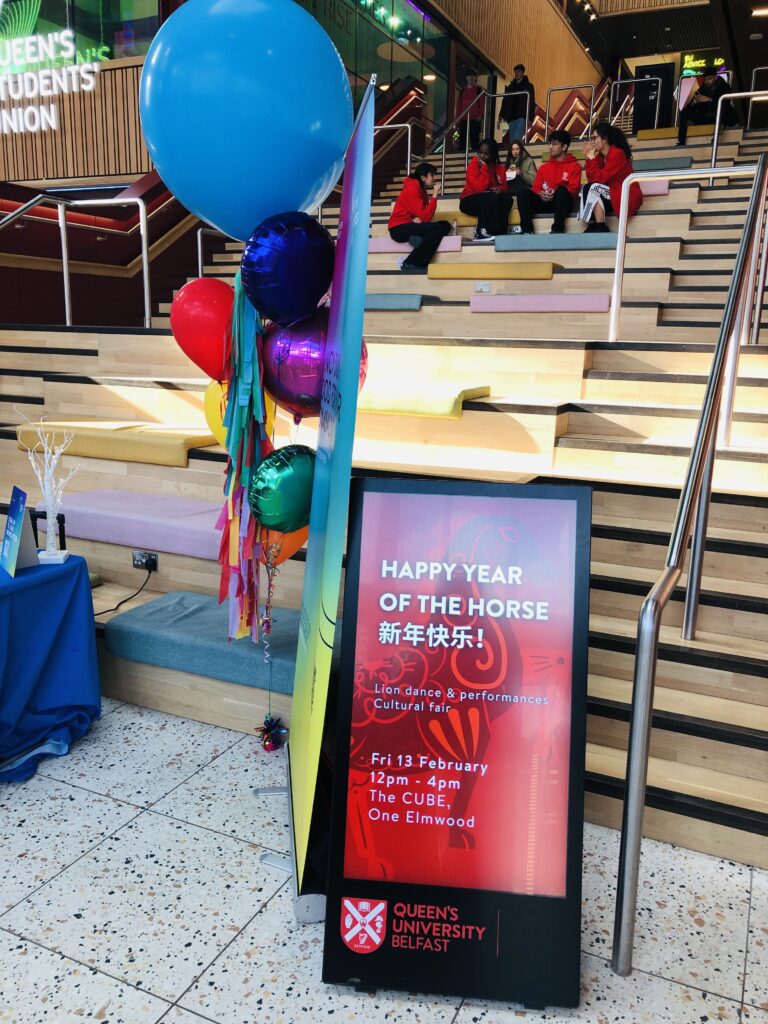
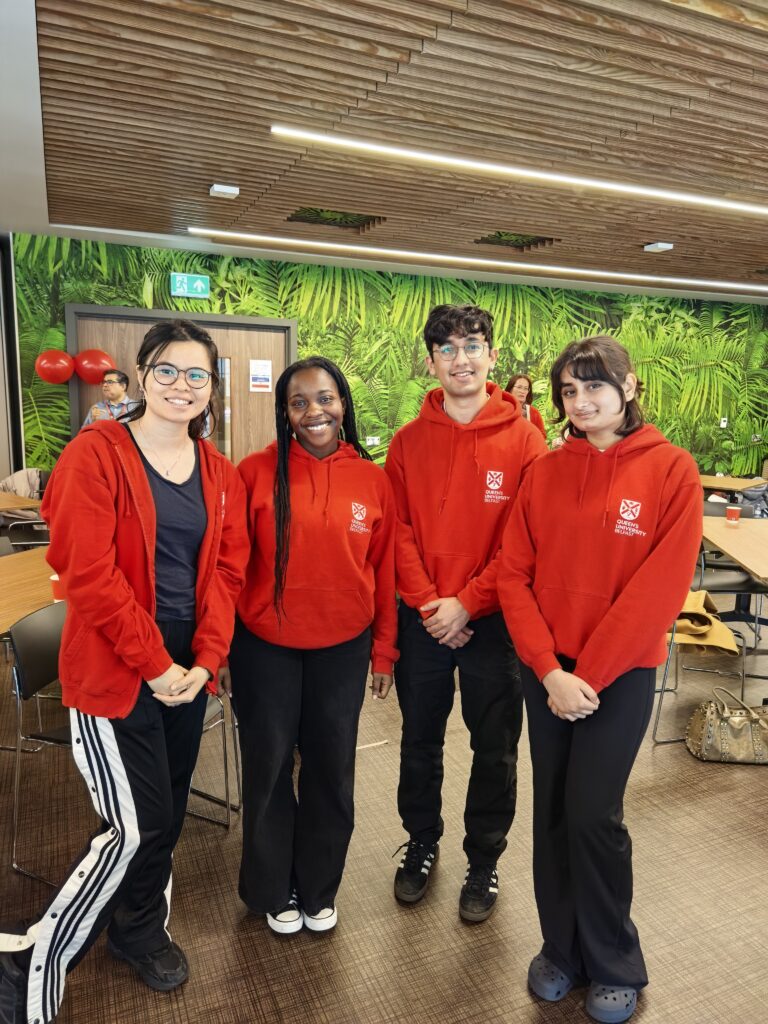
What could be better than a splendid day of sunshine on Friday 13 February, following such a long period of gloomy, rainy weather? On the day, over 60 Queen’s students, staff members, as well as civic partners and guests, joined the Chinese New Year celebration programme at One Elmwood, Queen’s – the hub for intercultural encounters and exchanges.
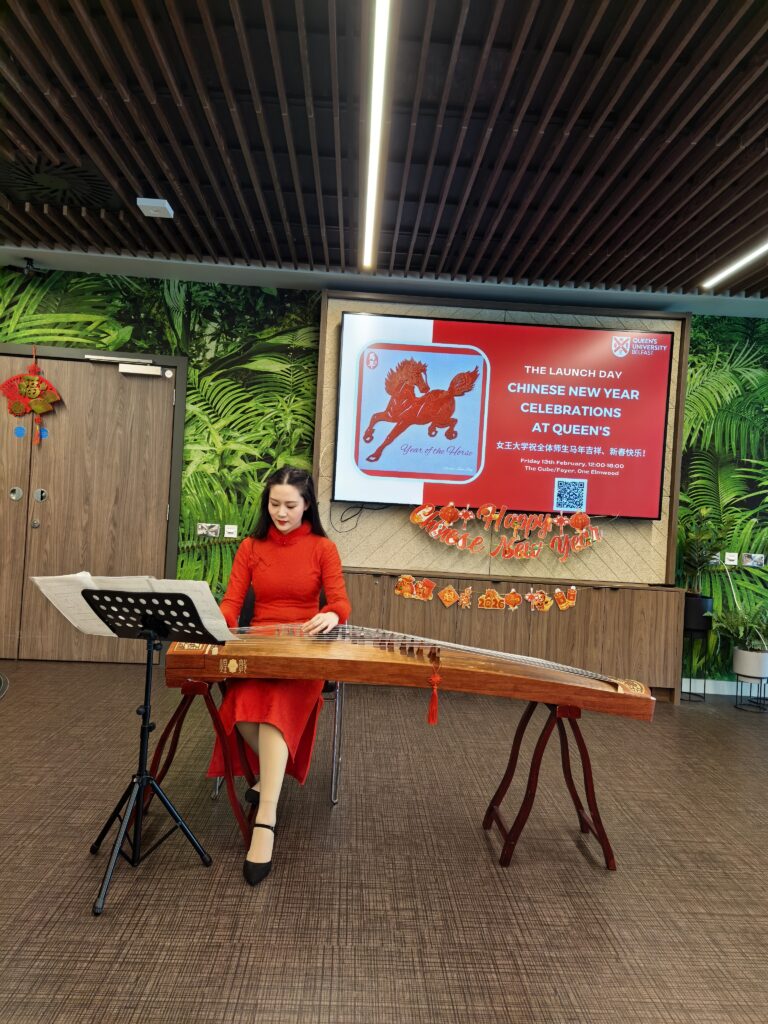
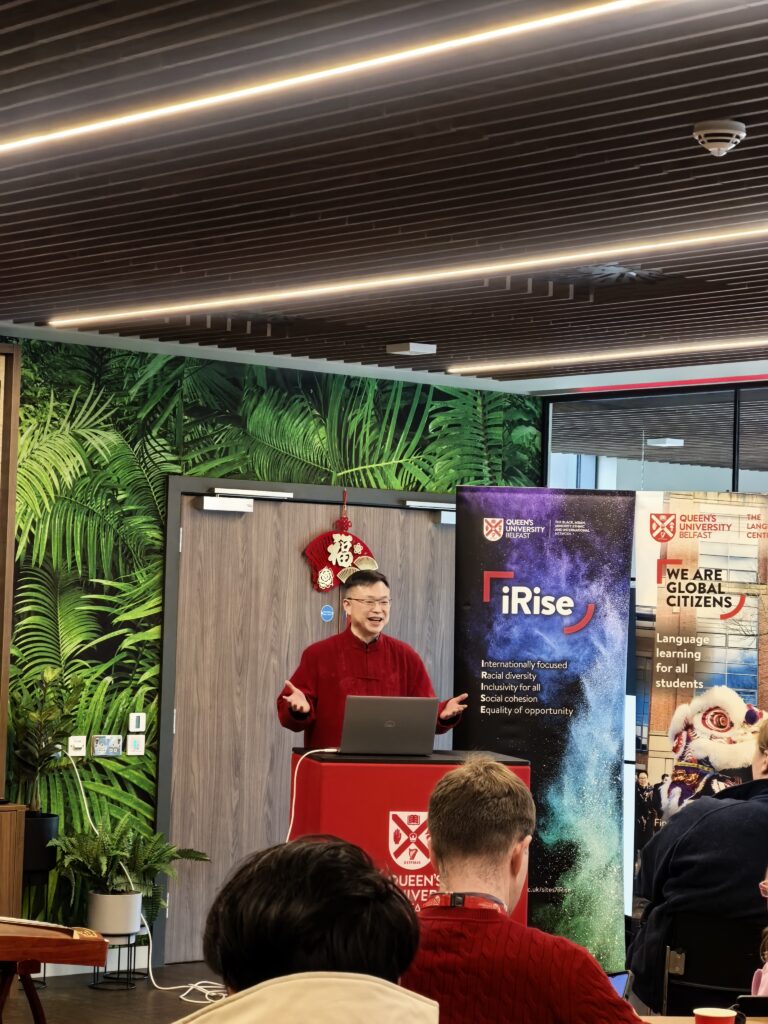
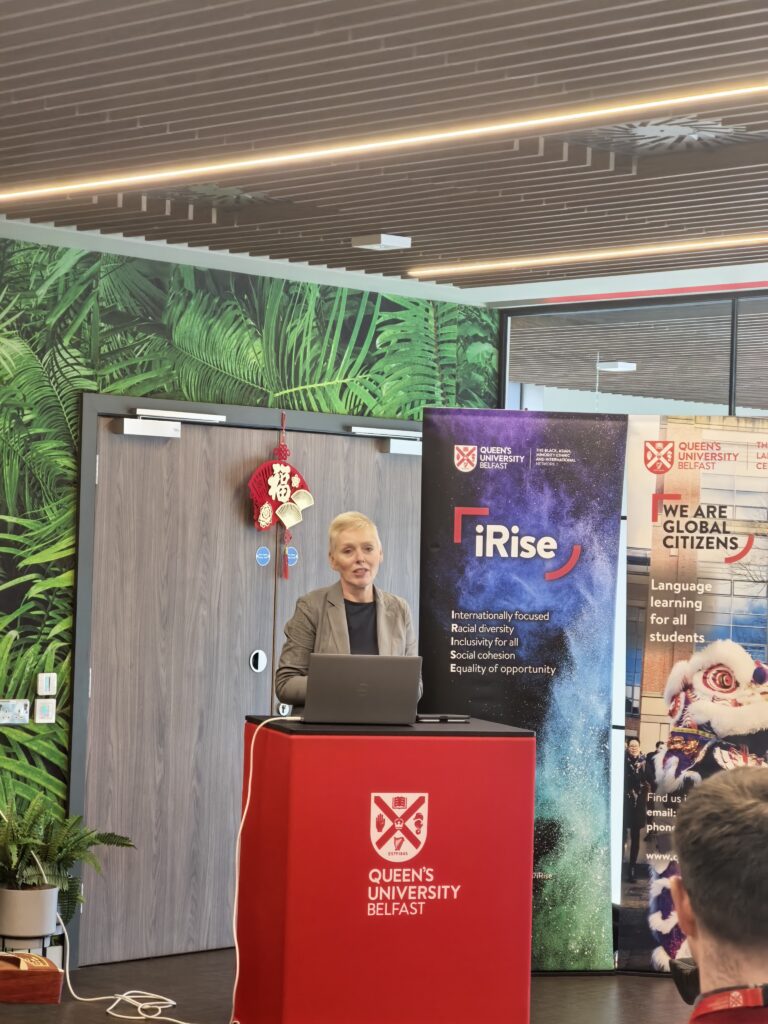
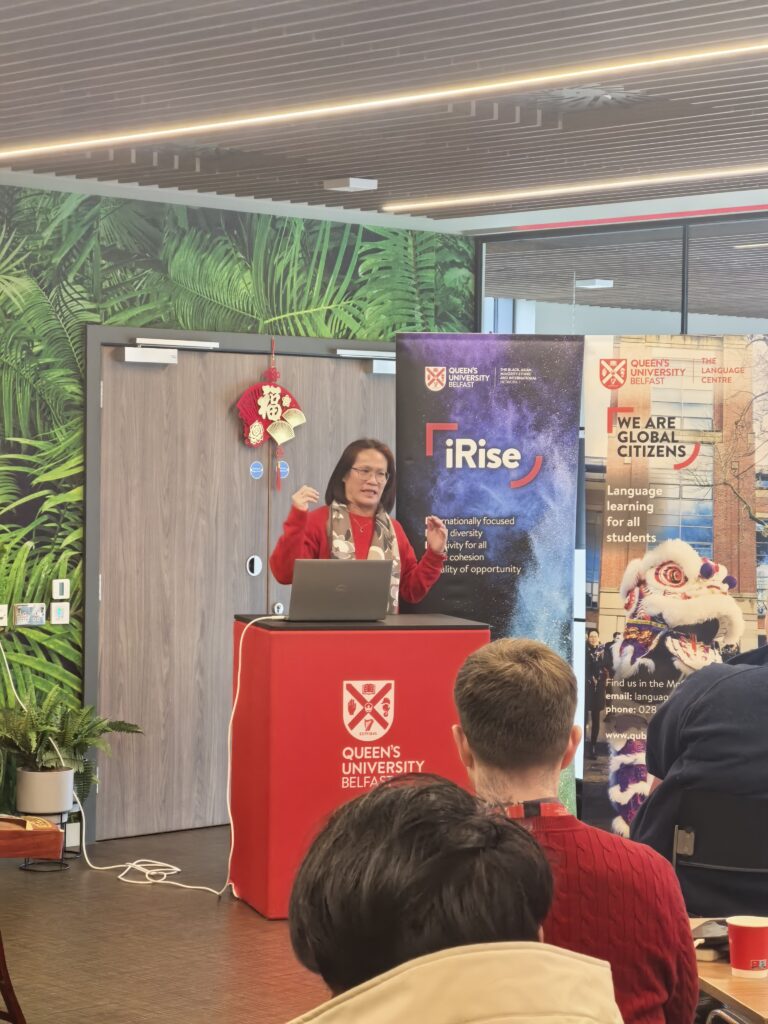
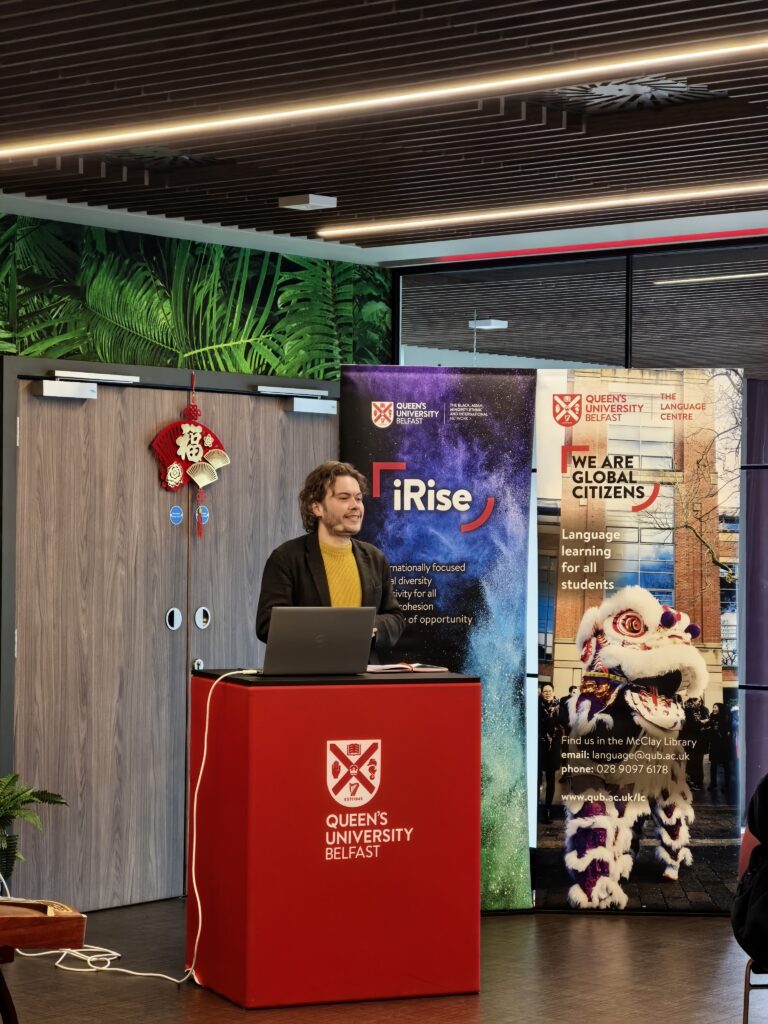
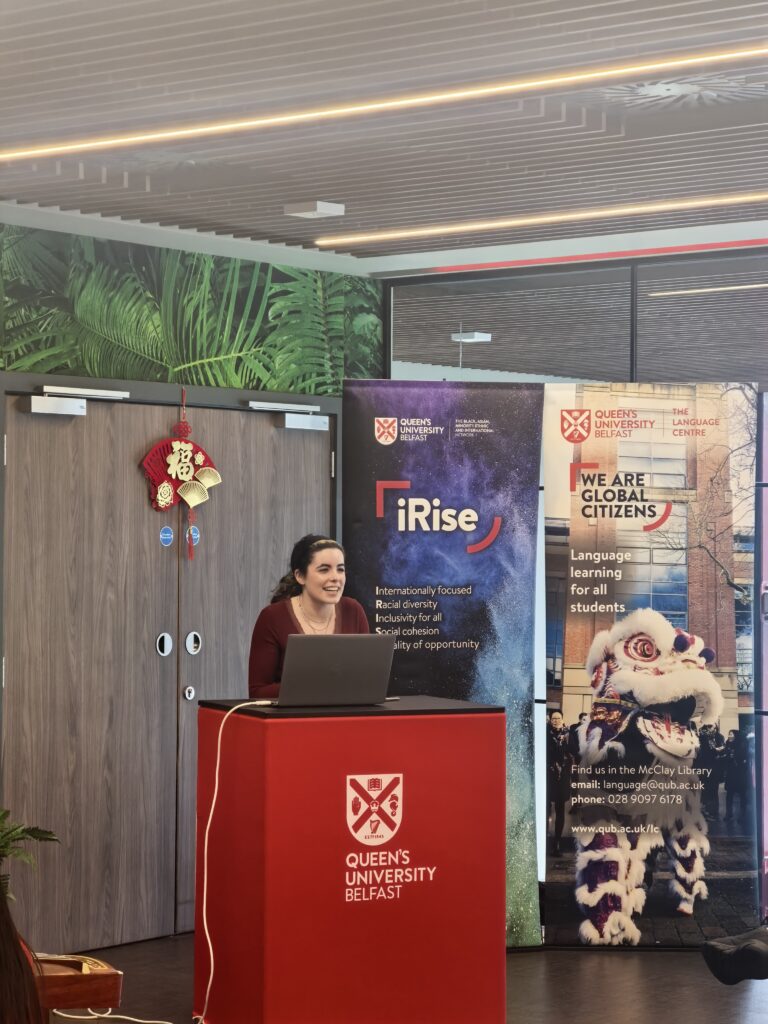
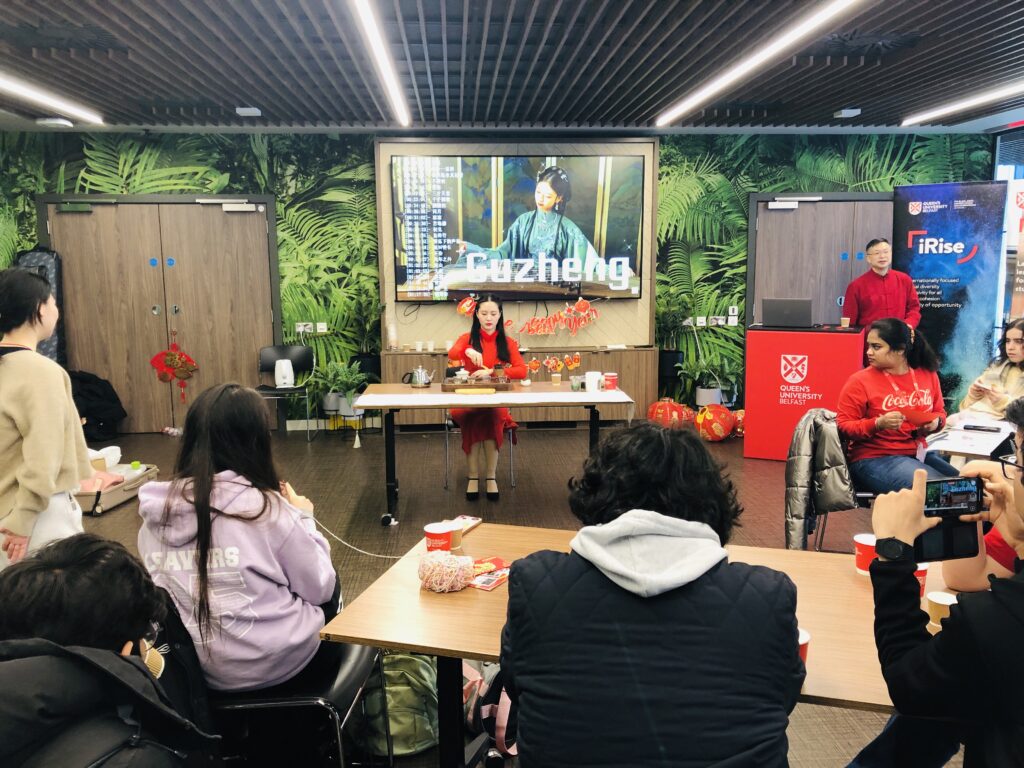
Chaired by Dr Liang Wang, the launch began with a captivating performance of traditional guzheng music by PhD candidate Fei Li from Queen’s Business School. Pro-Vice-Chancellor Professor Margaret Topping delivered the opening remarks on behalf of the University, highlighting Queen’s achievements in global engagement over the past year, particularly with Asian countries such as China and India. Dr Bee-Yen Toh, Co-Chair of the iRise Staff Network, and Thomas Smith, Language Centre Manager, also extended their welcomes to staff, students, and civic partners, emphasising the importance of intercultural understanding through language learning, dialogue and shared activities. Mórrigan McEvoy, Student Officer for Accessible Education, offered her greetings and encouraged students to actively participate in university events and contribute to building a multicultural campus.
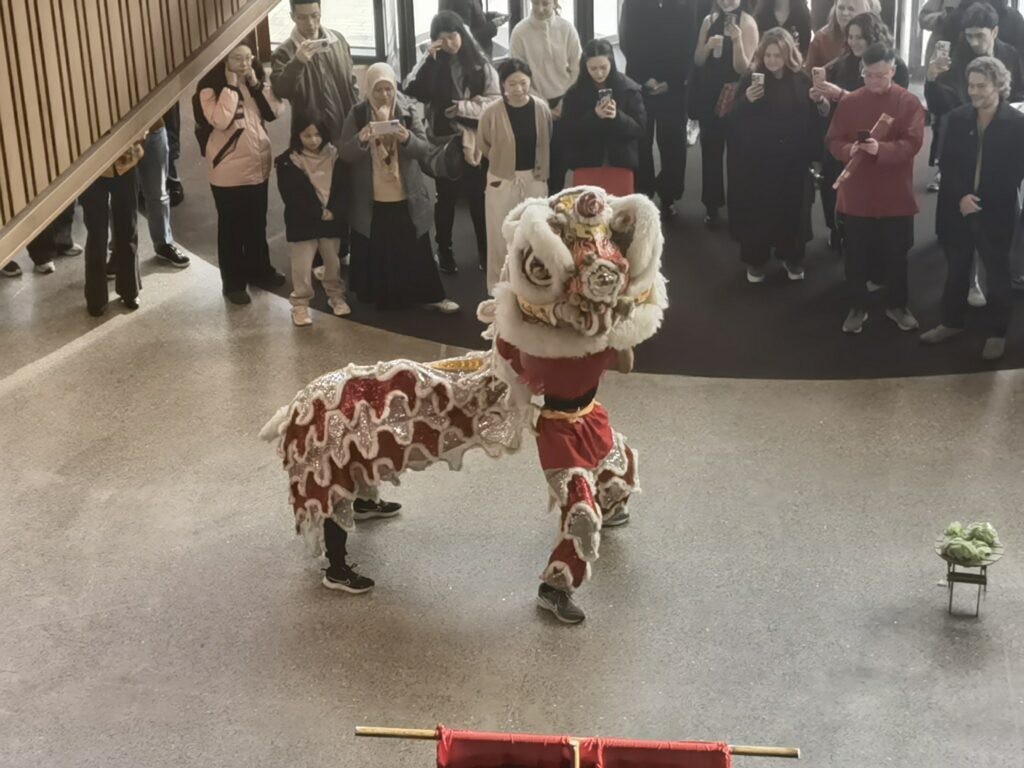
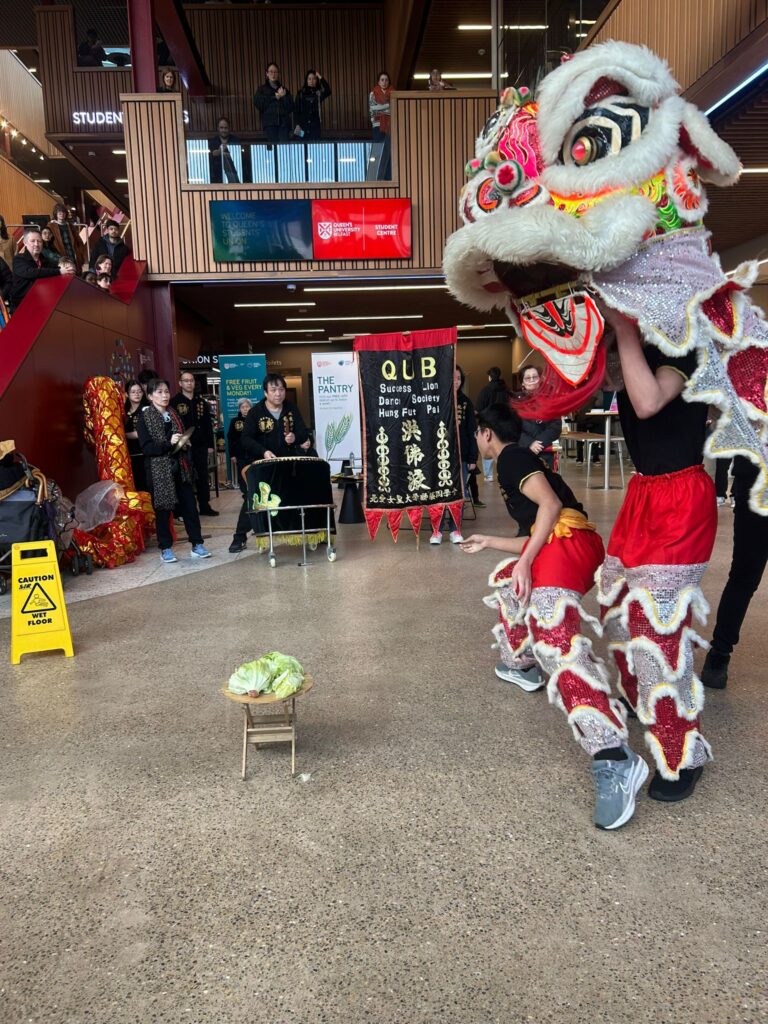
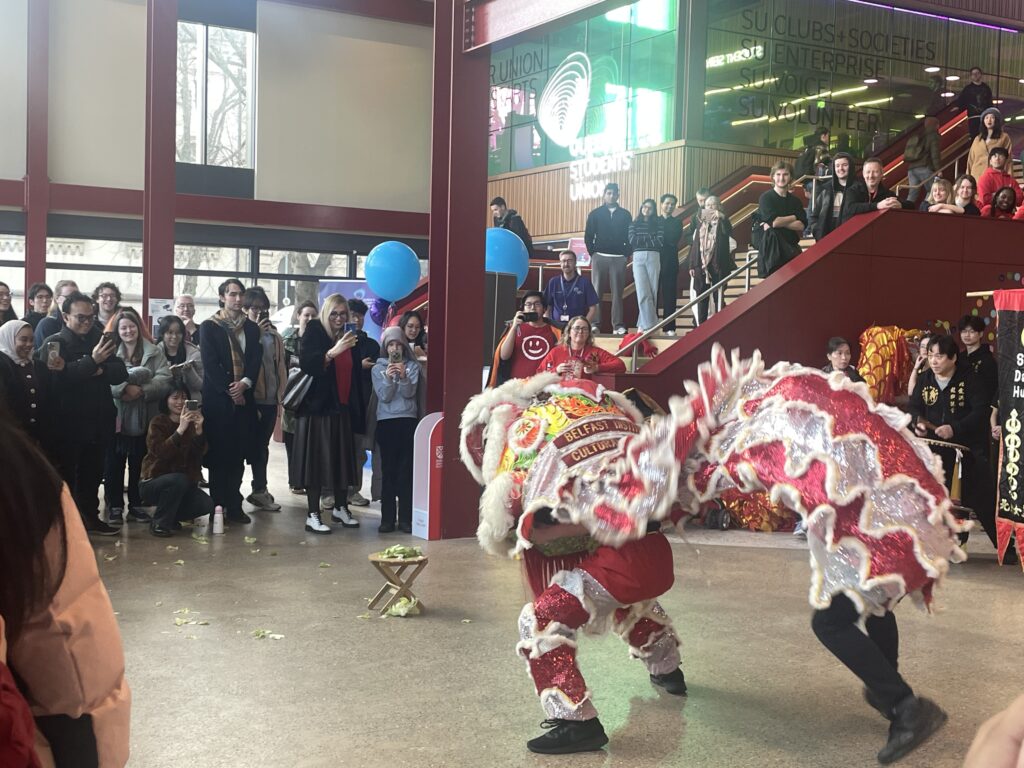
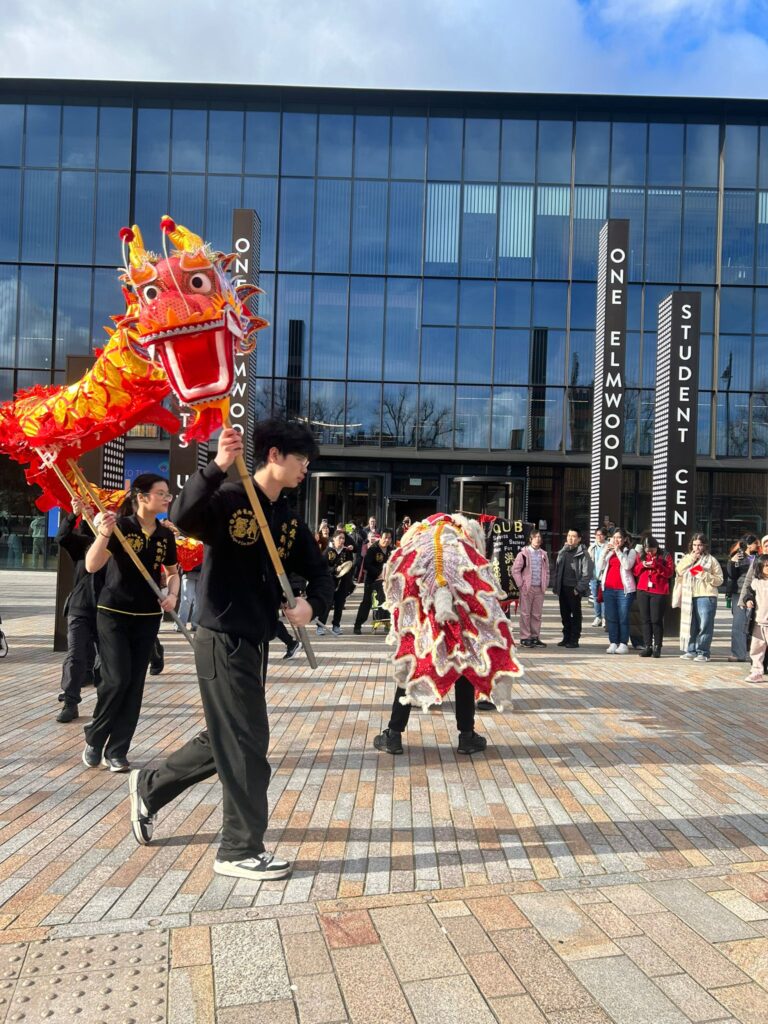
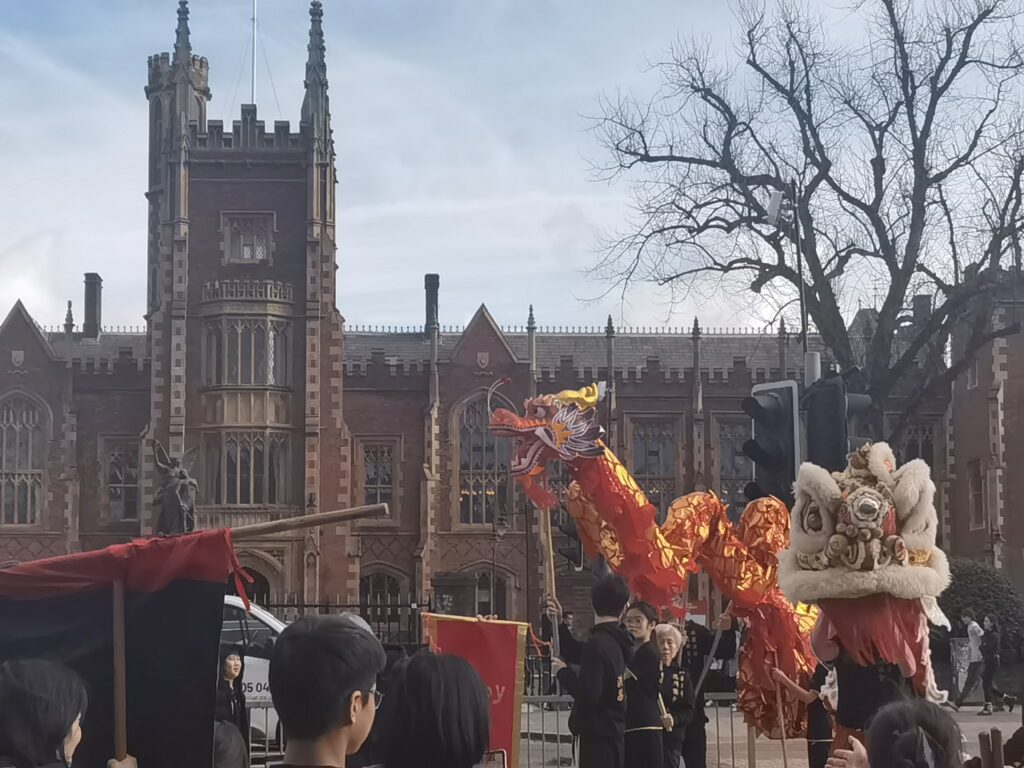
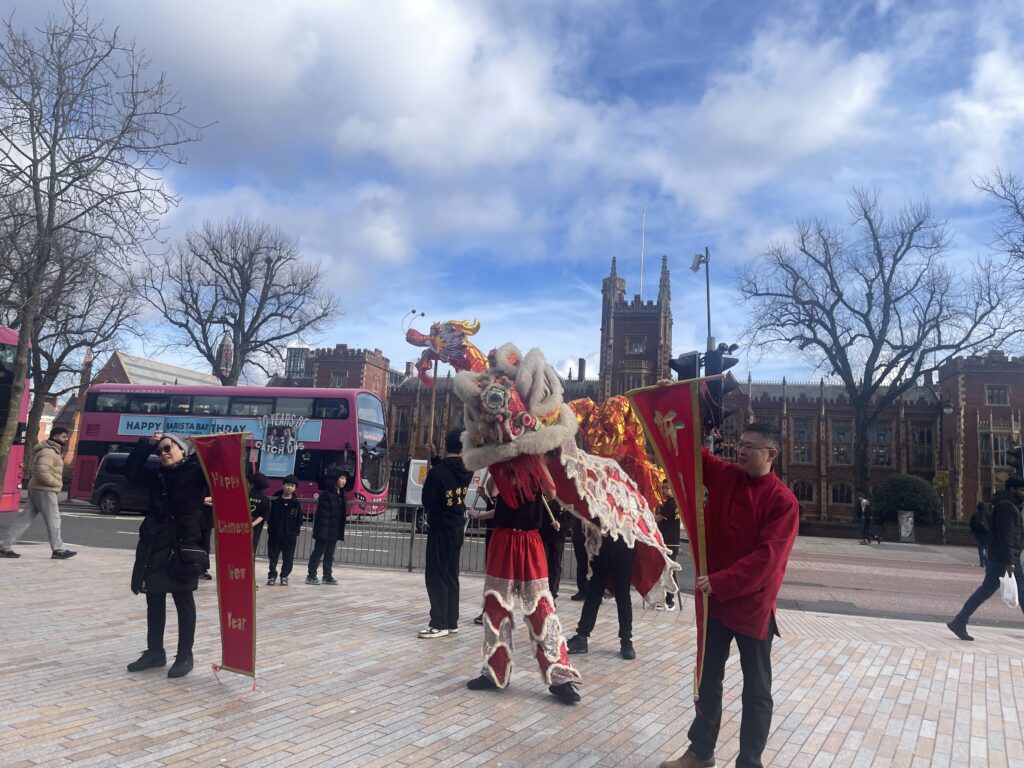
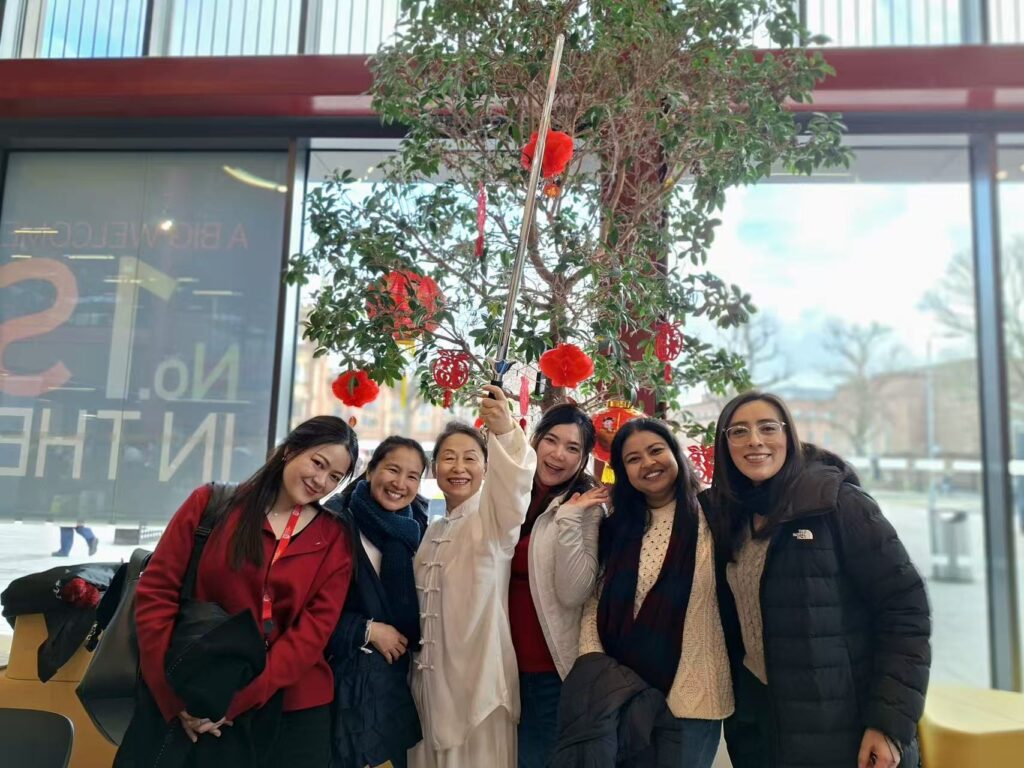
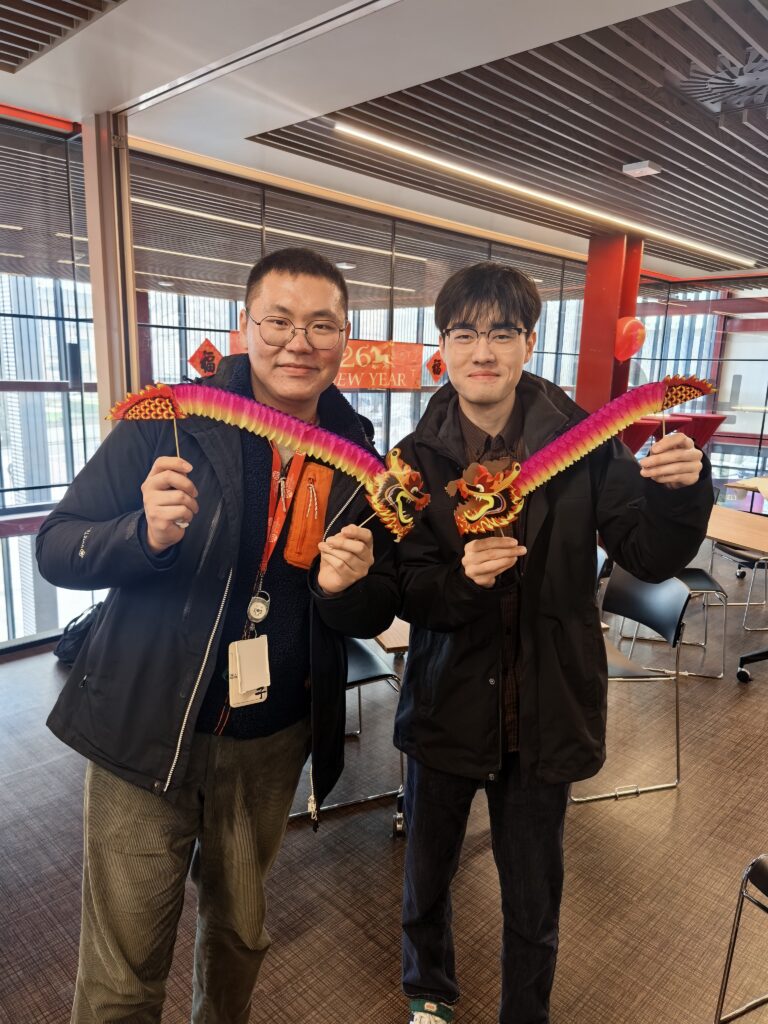
Following the launch, attendees were invited to the ground floor, where the traditional Dragon and Lion dance began in the foyer and continued outside the One Elmwood building. The celebration concluded with a group photo featuring all participants, symbolising the farewell to the Year of the Snake and the welcoming of the Year of the Horse.
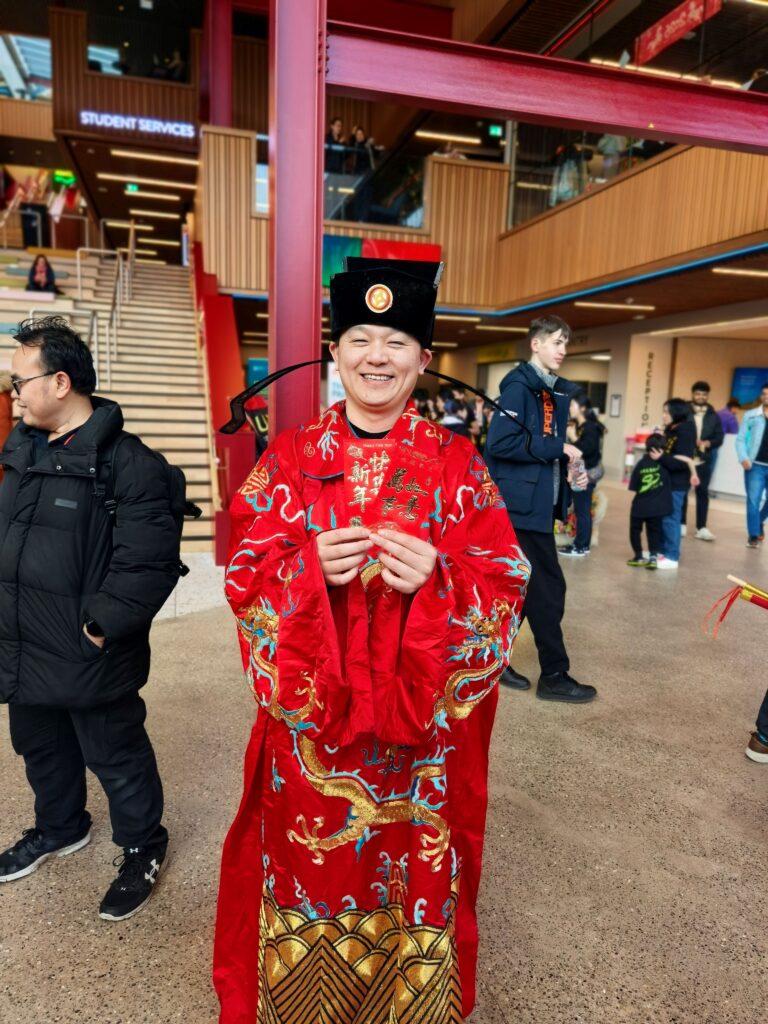
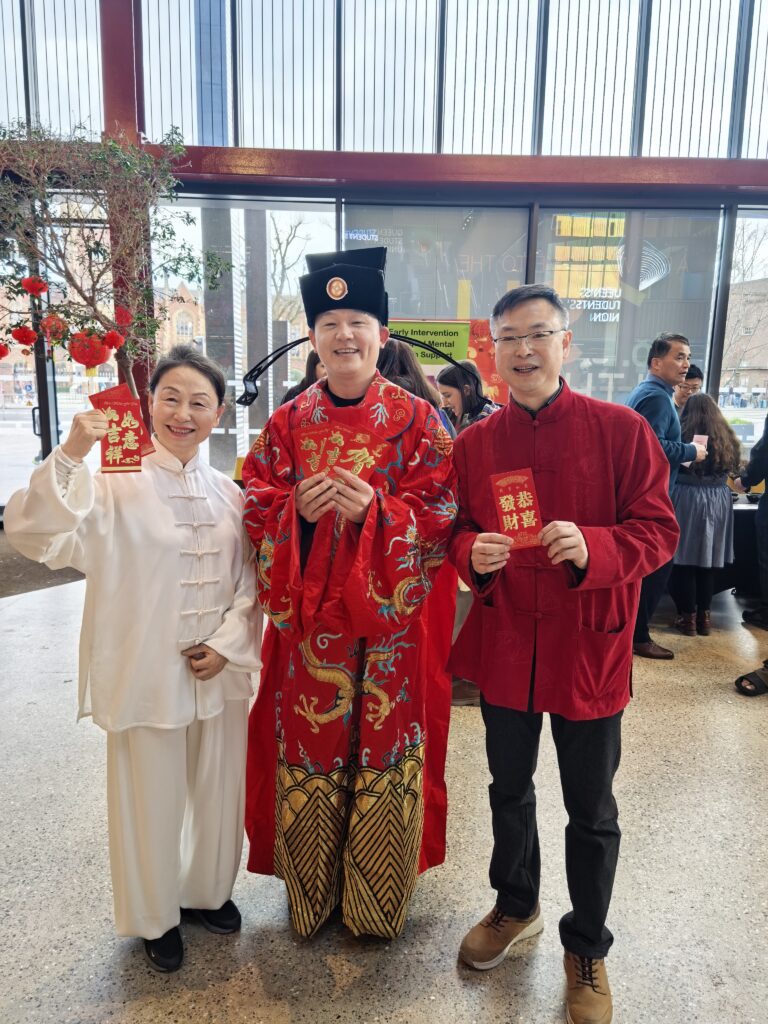
Another highlight of the celebration was the appearance of the God of Fortune, who generously distributed lucky “money” – chocolate coins and replica ancient Chinese coins – to those wishing to embrace good fortune in the year ahead.
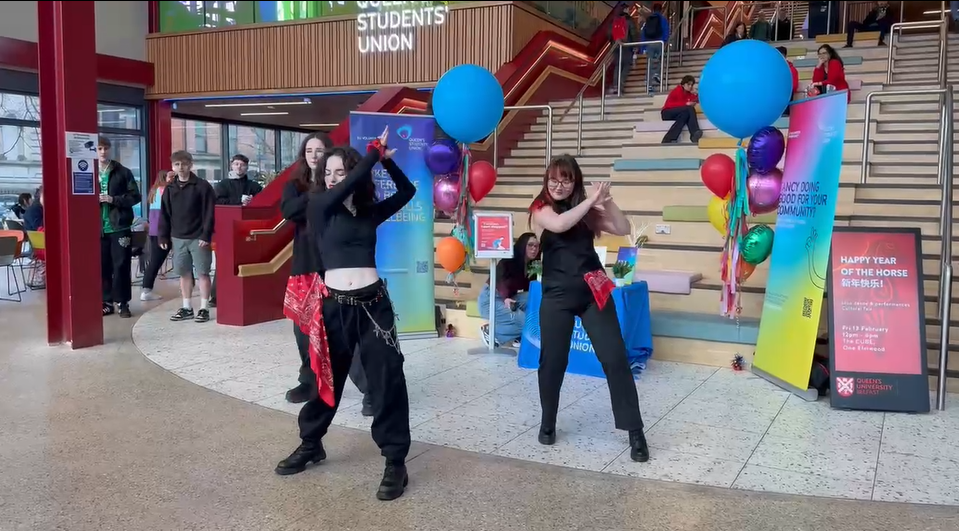
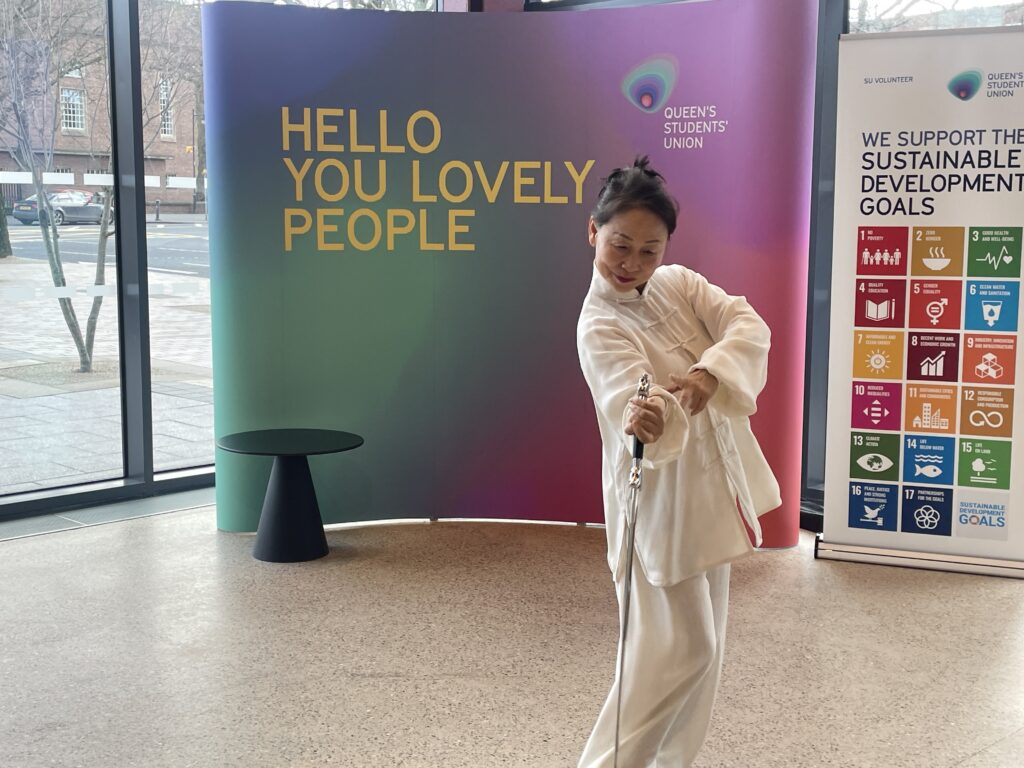
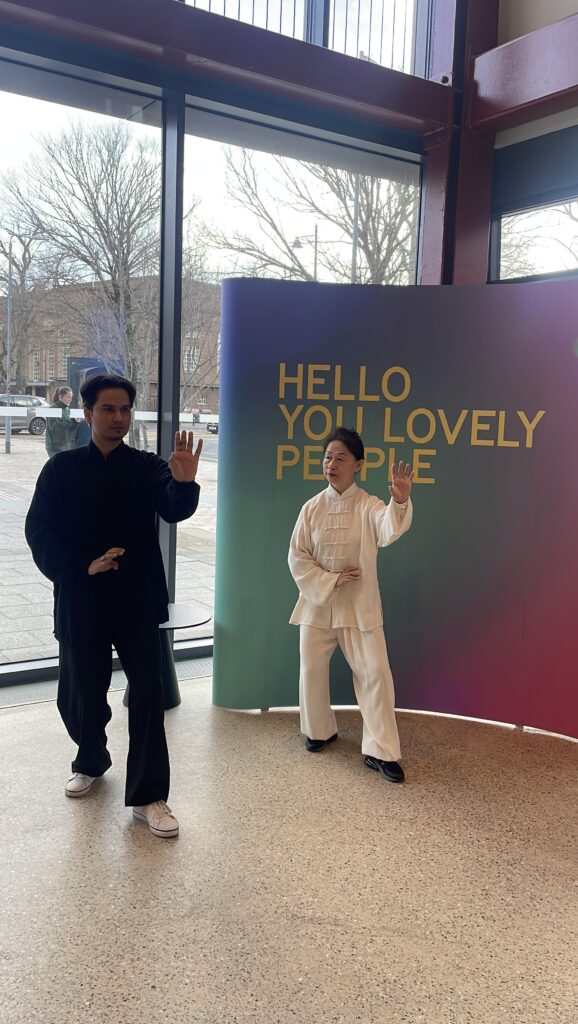
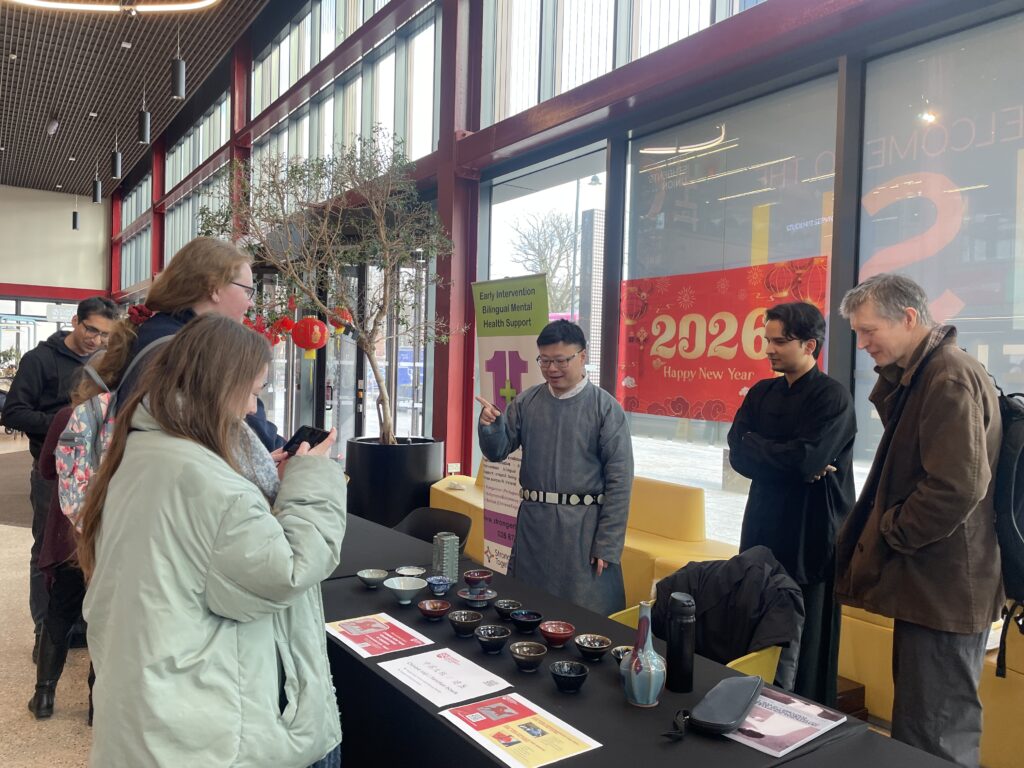
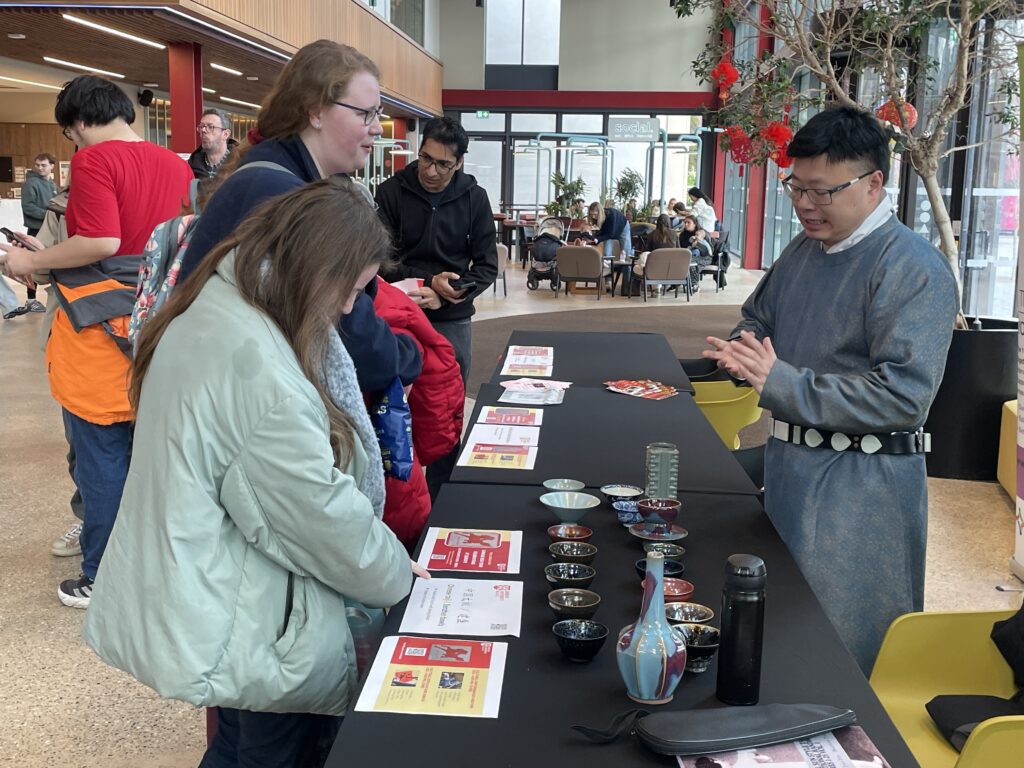
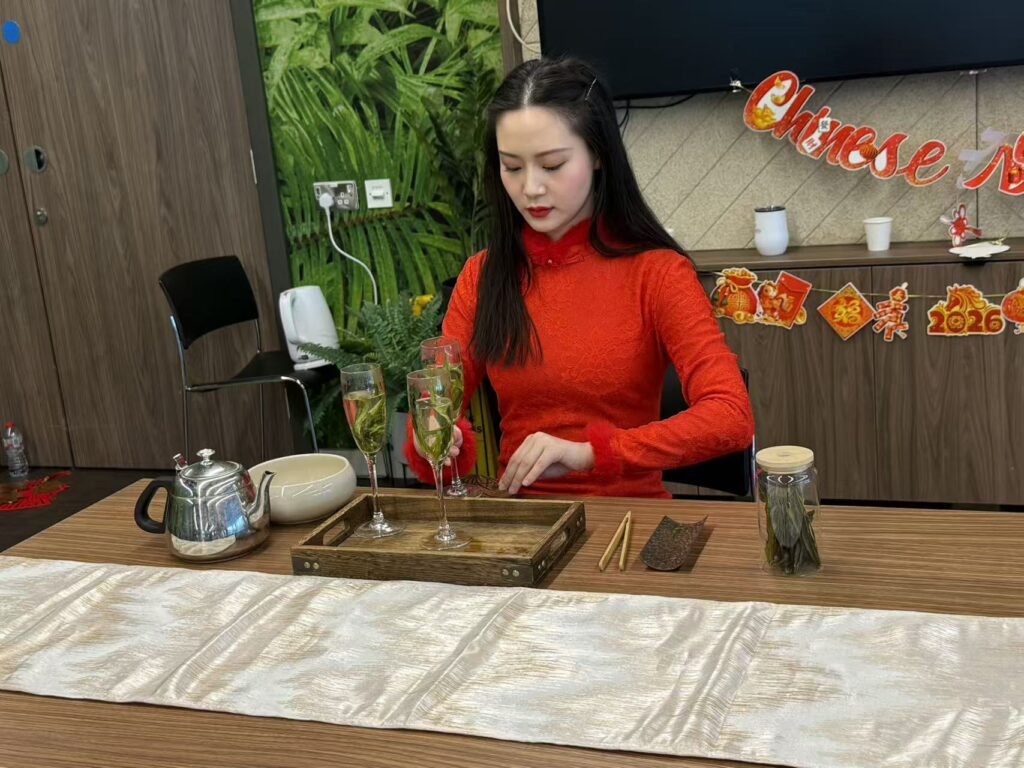
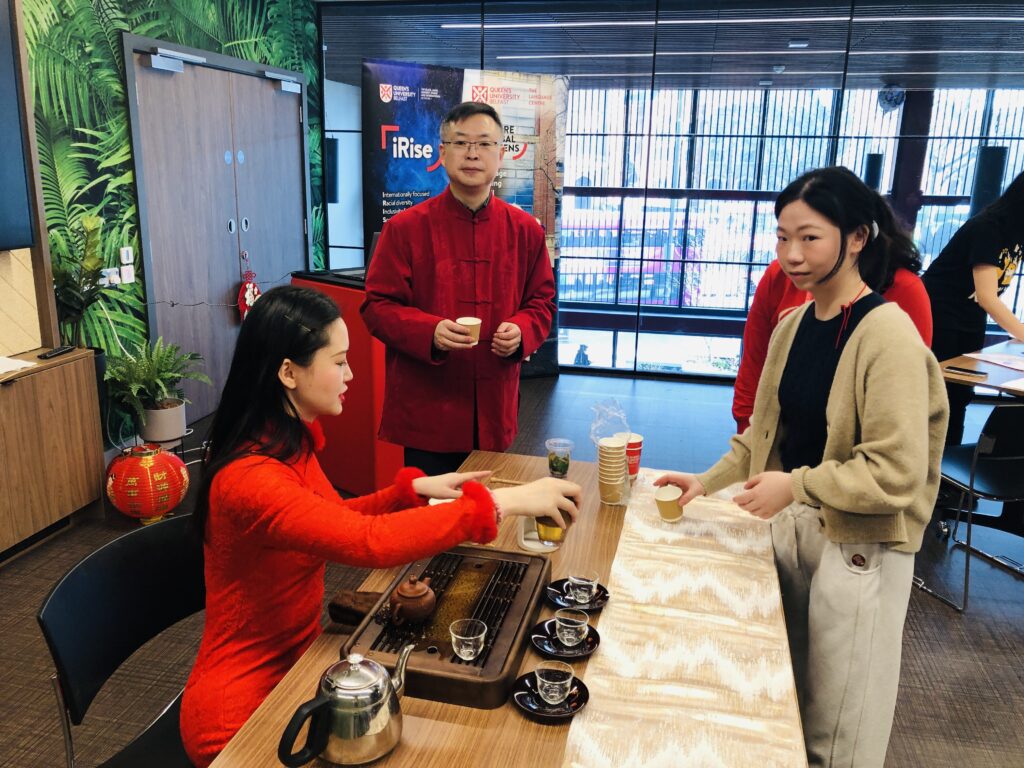
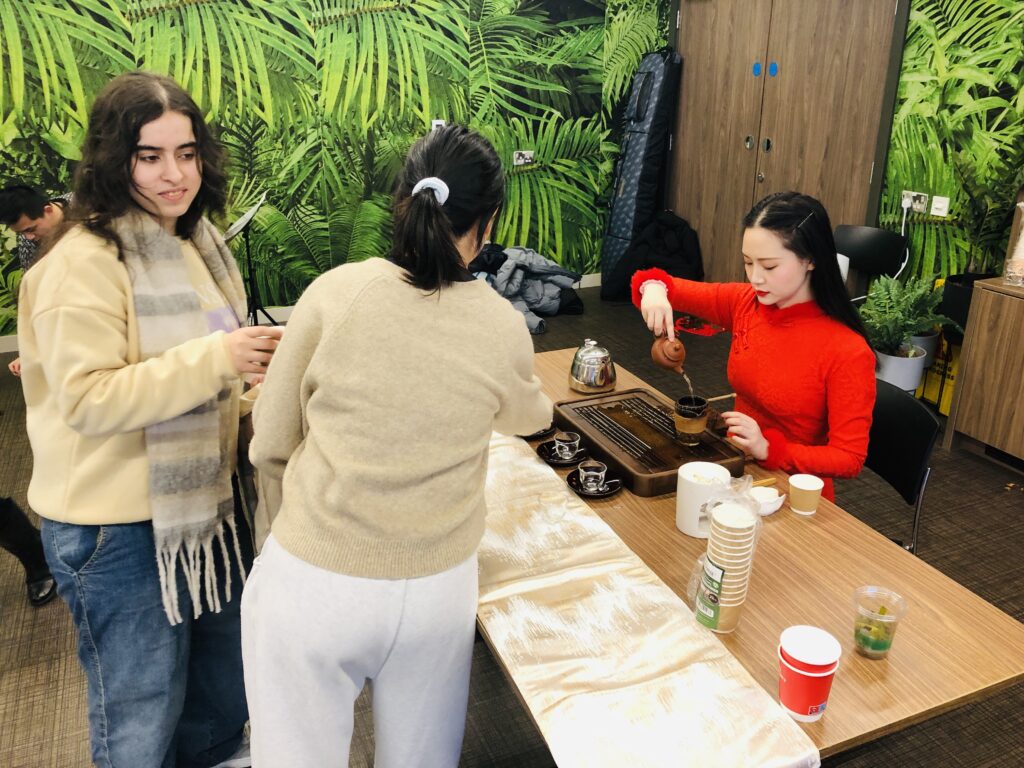
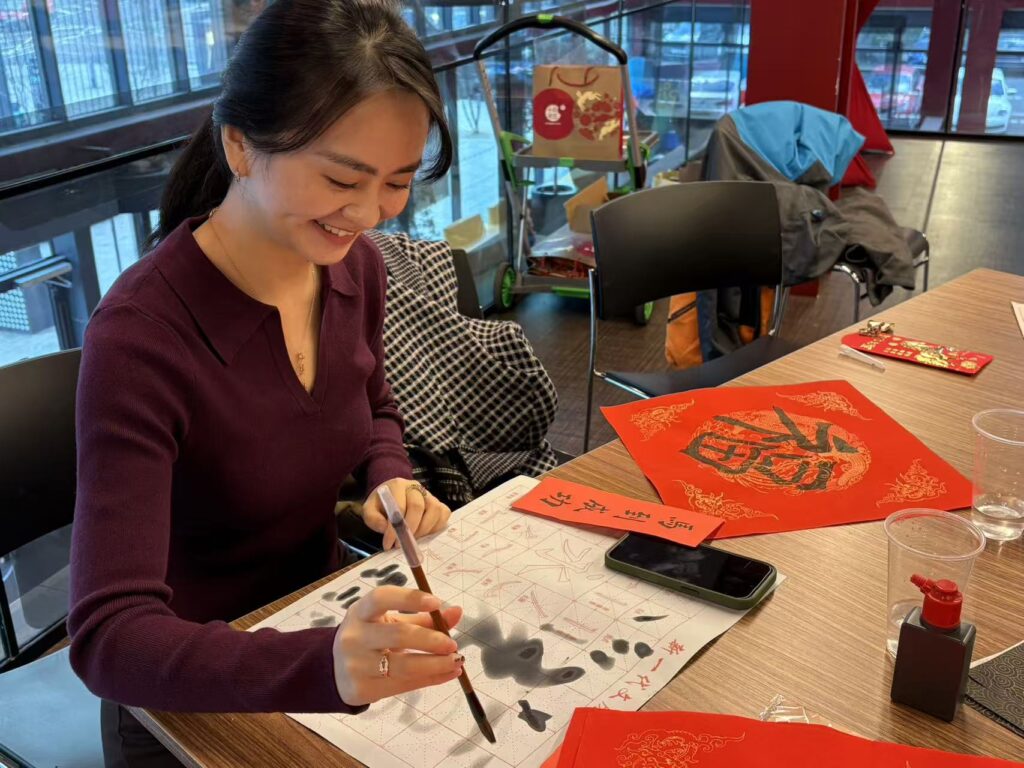
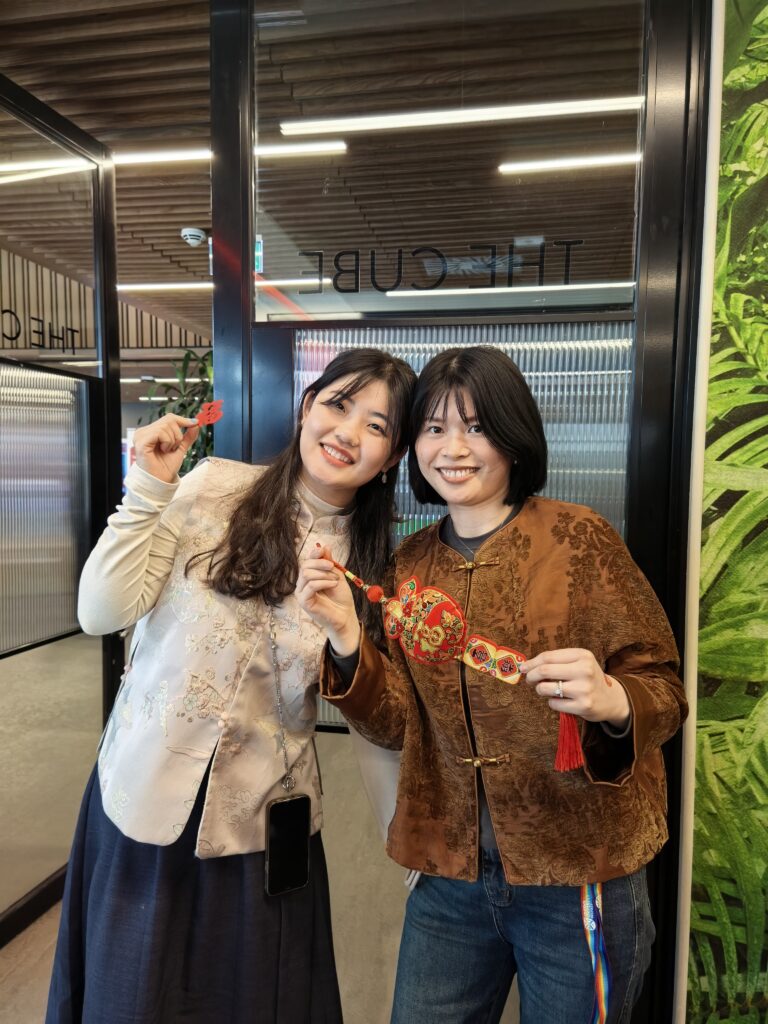
Additional performances included a vibrant K-pop dance, a graceful Tai Chi demonstration, and a Chinese Jianzhan tea cup display in the foyer. Meanwhile, cultural workshops such as calligraphy, paper crafts, tea and incense ceremonies, and guzheng appreciation sessions were held in the Cube, engaging and entertaining participants throughout the afternoon.
Blessed by the sunshine and strong support from One Elmwood Student Engagement Team, the event was a great success, with strong attendance and positive social impact. Queen’s is proud of its role as a civic university, promoting diversity, equality, inclusion, and belonging, supported by its vigorous academic and educational innovation.
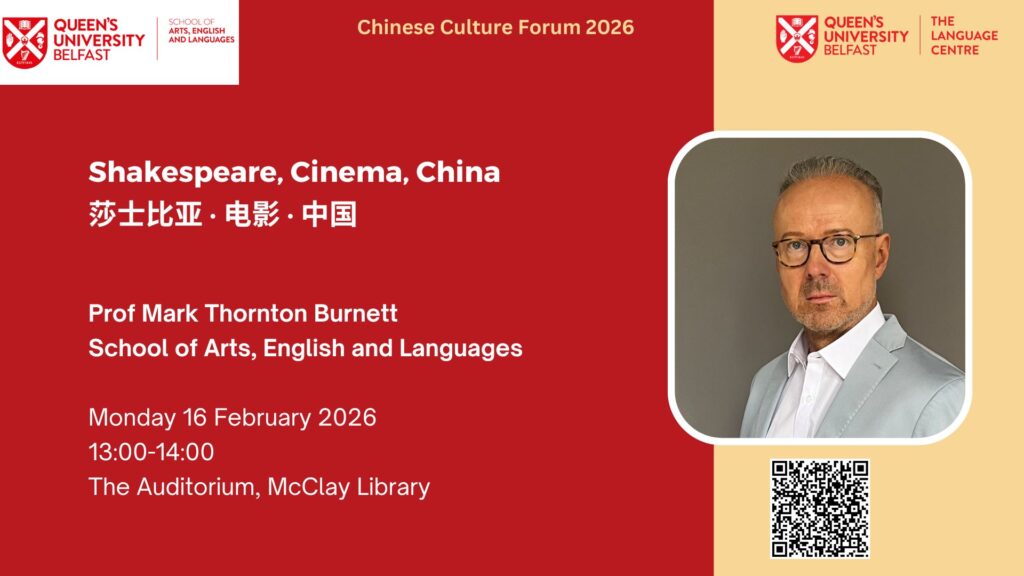
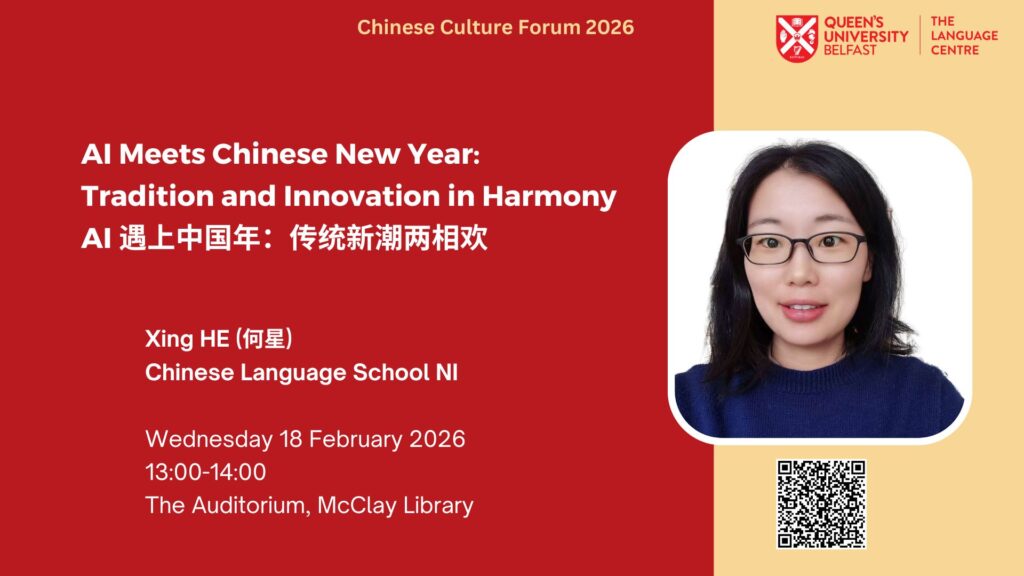
In keeping with Chinese New Year traditions, the celebrations will continue over the next two weeks, featuring six culture talks, a table tennis event, and a QUB-supported collaborative “Bridges to China” launch. All are warmly welcome!
For more upcoming events, please visit Chinese Culture Programme 2026 Homepage.
Despite a busy – and perhaps slightly tedious – November filled with deadlines and submissions, the Chinese community at Queen’s, including both scholars and students, continues to bring campus life to full vigor and vitality.
This month, two academic seminars are scheduled, and we warmly invite you to attend and take part in these stimulating academic dialogues.
Ni Yang, PhD student from School of History, Anthropology, Philosophy and Politics, will present ‘1976-1995: The Intersection of Urbanisation and Artistic Liberation in China: Beijing East Village’ at the History Seminar.

This seminar examines Beijing East Village (1992–1995) as a unique outcome of China’s post-Mao transformation, set against the backdrop of urban restructuring, market reforms, and shifting cultural policies. Following the end of the Cultural Revolution and the ideological thaw of the 1980s, Beijing underwent rapid urbanisation, the demolition of traditional neighbourhoods, expansion of infrastructure, and emergence of informal ‘urban villages’ on the city’s periphery. In these liminal zones, beyond full state control, artists forged new spaces for experimentation. East Village became a focal point where figures such as Rong Rong, Lü Nan, Zhang Huan, and Ma Liuming developed radical performance and photographic works that challenged social norms and redefined artistic freedom. Through case studies including 12 Square Metres, Fen-Ma Liuming’s Lunch, and To Add One Metre to an Anonymous Mountain, this seminar explores how photography mediated between transient performances and enduring cultural memory, amplifying their impact across domestic and international contexts. Situating East Village within the broader currents of economic reform, spatial politics, and cultural negotiation, it reconsiders the role of art in documenting, critiquing, and shaping a rapidly transforming society.
Ni Yang is a PhD student specialising in the intersection of history and photography, examining how images both document and shape historical change. His doctoral research investigates the cultural, political, and urban transformations of post-Mao China, analysing how photography operates as a medium for recording social realities, constructing public memory, and negotiating cultural identity. By situating photographic practice within the broader historical currents of reform, urbanisation, and shifting cultural policy, his work reveals the complex interplay between visual culture and the lived experience of historical transition.
Refreshments, drinks, and snacks will be provided. We look forward to seeing you there!
Seminar 2
Dr Zi Yang, on behalf of the Private and Commercial Research Cluster, warmly invites you to join the research seminar with Professor Xiahong Chen, a visiting scholar from China University of Political Science and Law, on Tuesday 18th November in Board Room 2 (MST / 08 /014), School of Law.

Professor Xiahong Chen is Research Fellow at the Bankruptcy Law & Restructuring Research Centre of the China University of Political Science and Law (CUPL) and Senior Editor and Director of the Journal of CUPL (core comprehensive academic journal in China). He is an internationally recognised scholar of bankruptcy and insolvency law, with over 18 books and numerous impactful articles in leading journals, including Annotations to the Enterprise Bankruptcy Law (Peking University Press 2021) and Notes on Bankruptcy Law (Law Press 2021). His research has been translated internationally, and he is a member of INSOL Europe, INSOL International, and the American Bankruptcy Institute. The talk with focus on China’s recent Insolvency Law reform.
Refreshments, drinks, and snacks will be provided. We look forward to seeing you there!
With the arrival of spring, Chinese scholars are showcasing their vibrant academic contributions. This April, Queen’s University is excited to present two engaging talks on Chinese culture.
Talk 1
For this Friday’s History Seminar, PhD student Ziheng Wang from School of History, Anthropology, Philosophy and Politics presents his research work titled ‘The Apple of My Eye: The Chinese Depiction towards Russia since the 1990s’.
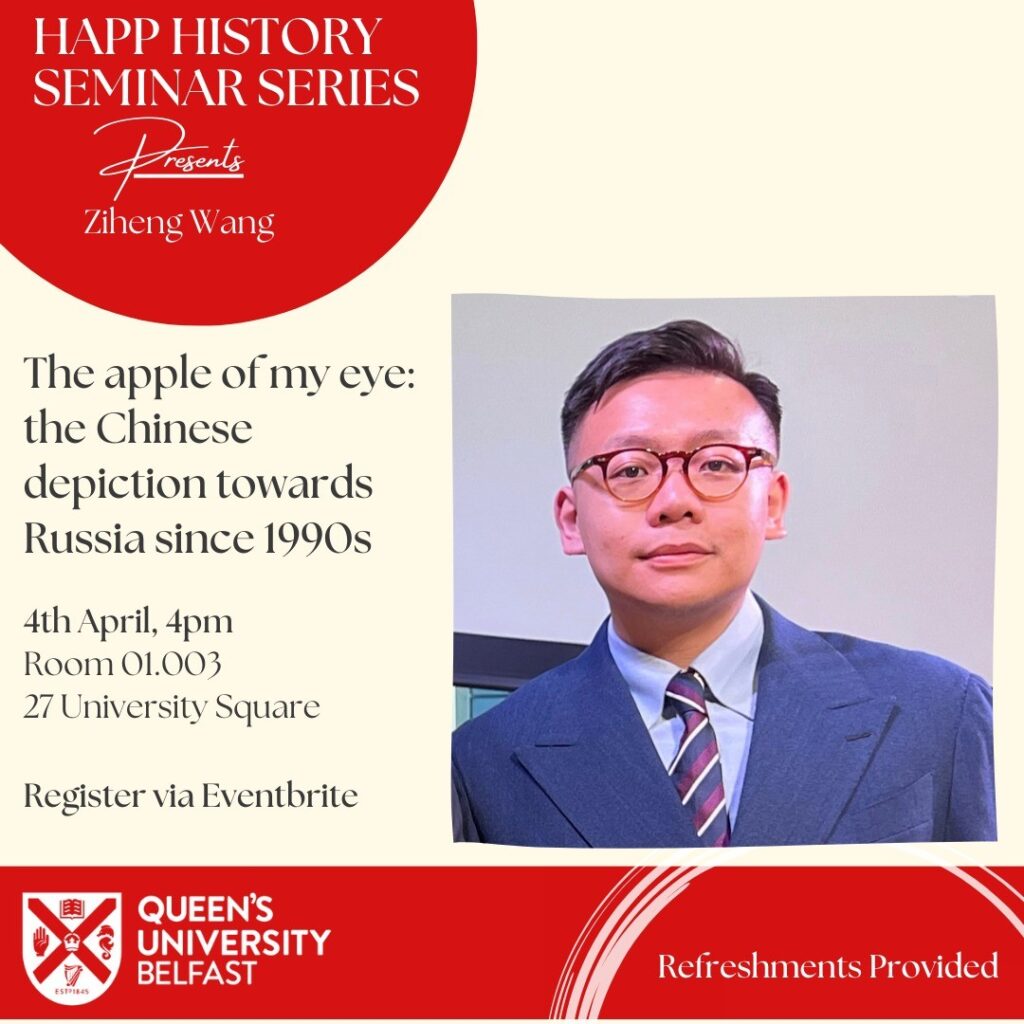
All welcome, refreshments provided!
Talk 2
In the following Friday, Chinese tutor Heng Wang from QUB Language Centre will present an introduction on how Islam has developed in China since 7th century, and how it has intertwined with local culture and religions.
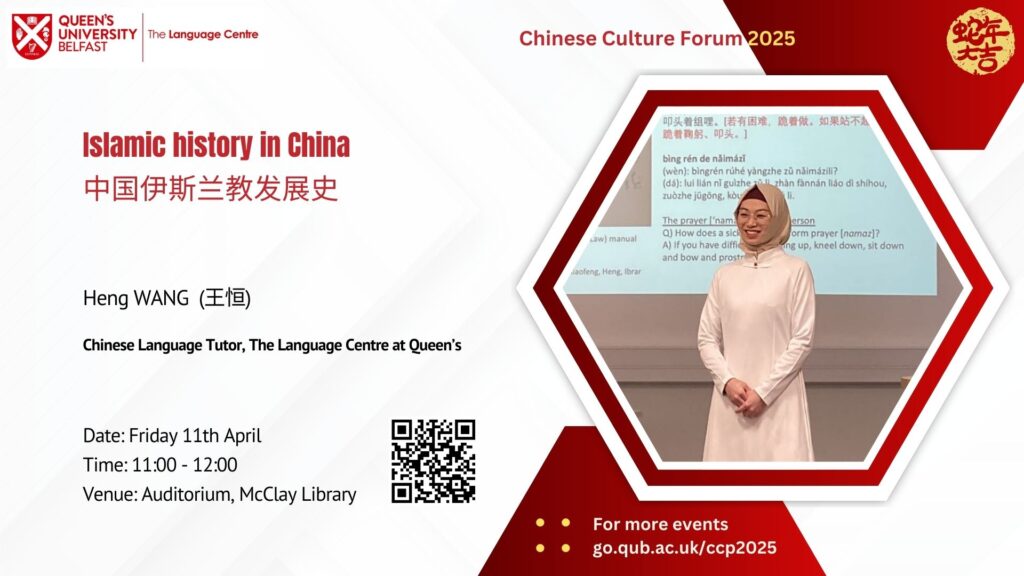
For more information and registration, read the post below:
Wish you all a happy and productive April!
The School of History, Anthropology, Philosophy and Politics has announced its Spring Dialogues to welcome a cohort of their students and alumni to share their research work at the Seminar Series, with Liang HE, a Chinese graduate in Philosophy, being the first one on its programme.
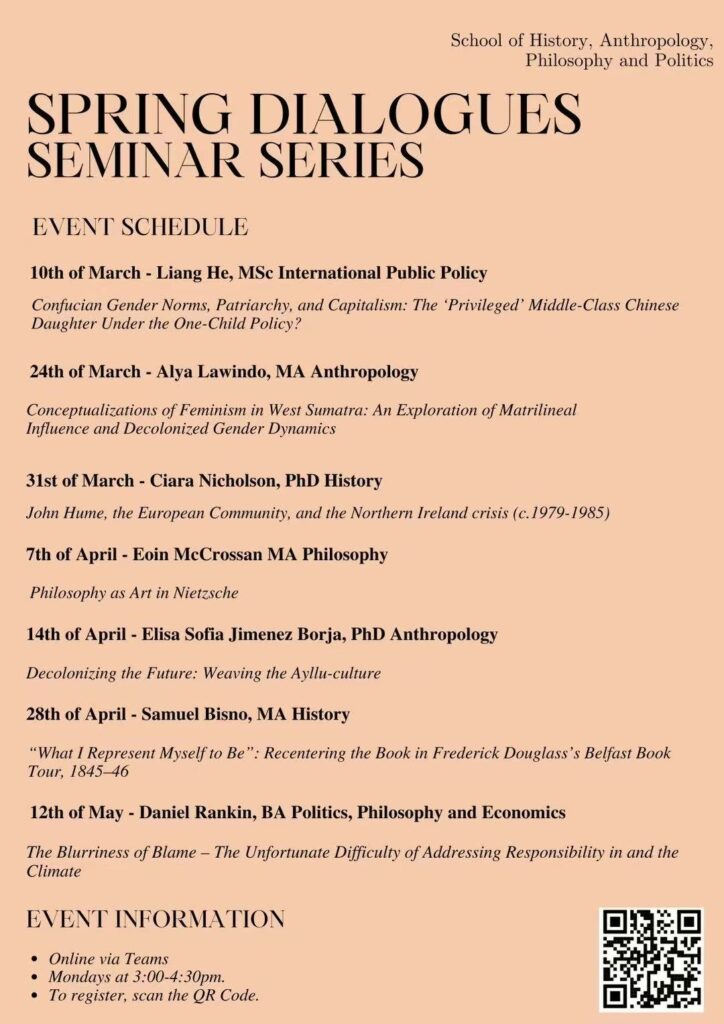
Liang has kindly shared her presentation information and abstract with our Chinese Culture Forum as below. She also would like to extend her invitation to all those who are interested in the topic.

Speaker: Liang HE, MSc International Public Policy
Abstract
Confucian Gender Norms, Patriarchy, and Capitalism: The ‘Privileged’ Middle-Class Chinese Daughter Under the One-Child Policy?
The one-child policy, enacted in China from the 1970s to 2015, has profoundly shaped the
experiences of urban women, particularly the daughters of the emerging middle class. Rooted in Confucian gender norms and reinforced by a patriarchal system, this policy has contributed to societal expectations that prioritize male offspring while simultaneously offering urban women increased access to resources and opportunities. As a result, these “privileged daughters” are often viewed as beneficiaries of urbanization and economic growth.
This paper employs Marxist feminist theory to explore the lives of Chinese middle-class daughters studying in the West. It examines the conflicting pressures they face between traditional gender roles – emphasizing marriage, motherhood, and filial piety – and the aspirations encouraged by a neoliberal environment. These women navigate a complex landscape where they must reconcile their pursuit of autonomy with societal expectations to provide for their families and uphold cultural traditions. By highlighting the experiences of these urban daughters, this research sheds light on how Confucian gender norms and capitalism intersect, revealing the challenges they encounter in balancing personal desires with familial obligations. Ultimately, this paper enhances our understanding of how the intersection of gender norms and capitalist structures shapes the experiences of urban middle-class daughters in contemporary China, revealing the complexities of their identities and the societal expectations they must navigate.