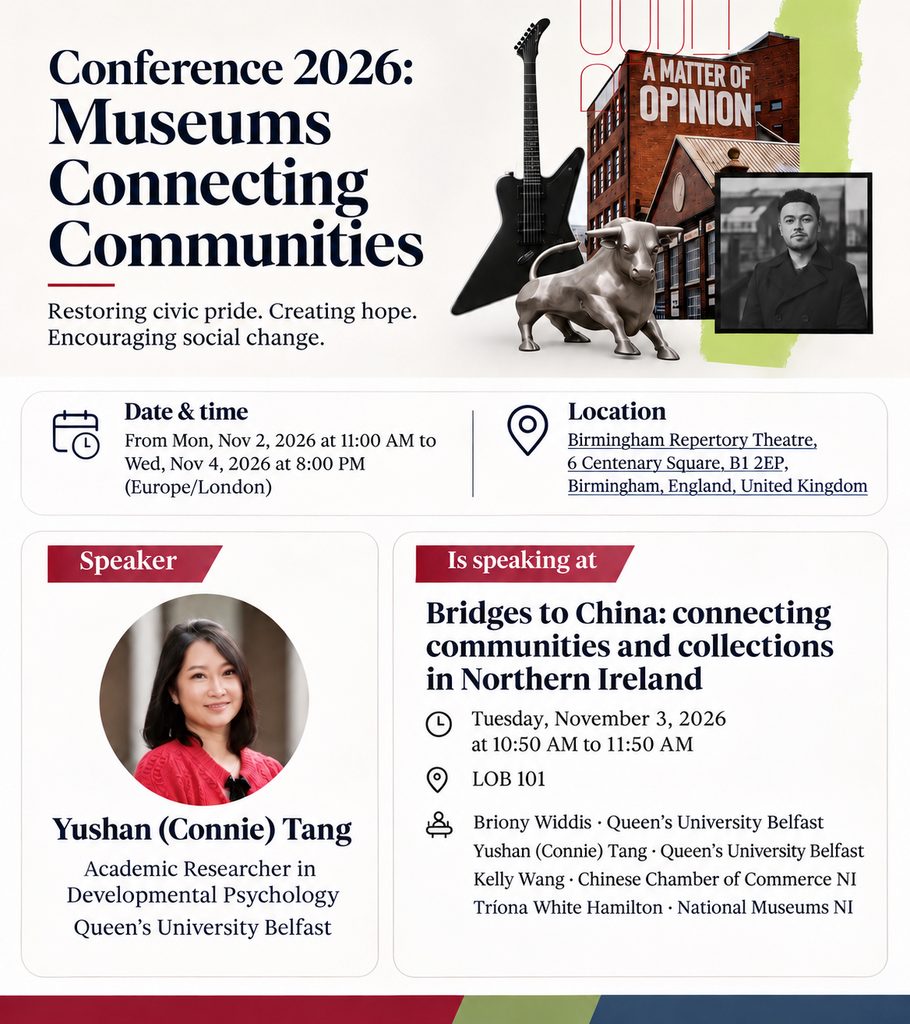
During 2025-26, researchers from Queen’s University Belfast worked with National Museums NI (NMNI), Chinese Welfare Association Northern Ireland (CWA NI) and Avila Media to deliver the Bridges to China project, generating meaningful social impact in Belfast and Dublin. At the beginning of November 2026, the project reached another milestone as the team shared its experiences and outcomes with an audience at the Museums Association’s annual conference in Birmingham.
Yushan (Connie) Tang, a PhD researcher in developmental psychology at Queen’s University Belfast, was among the project participants and contributors.
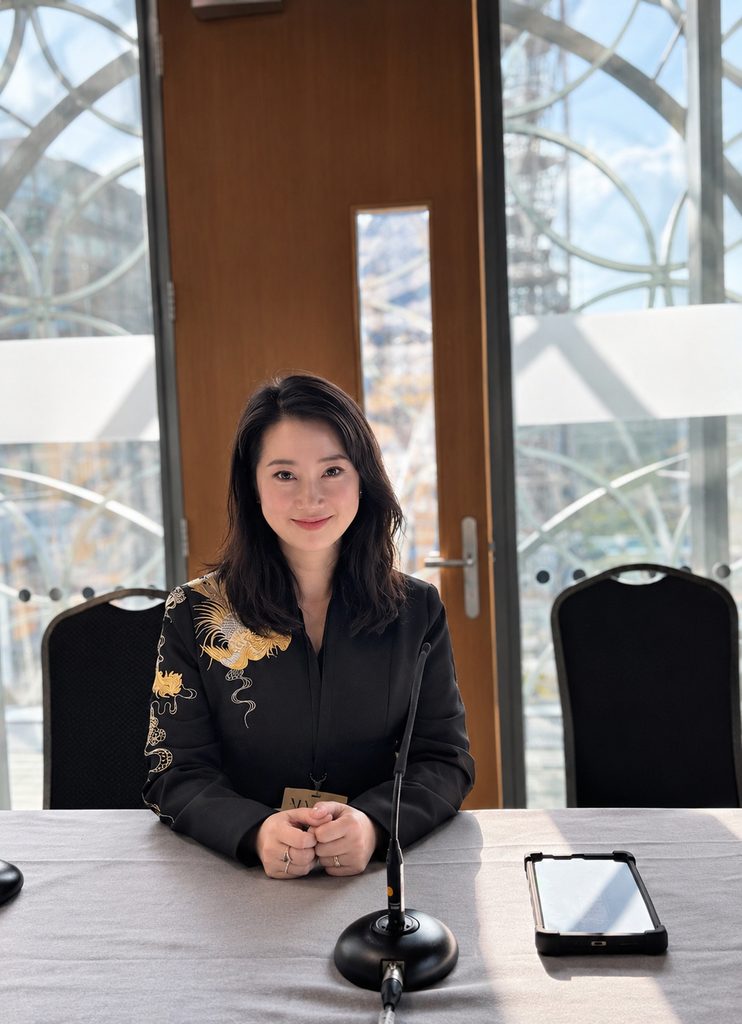
On 3 November, she joined a panel discussion at the conference to share her reflections on the project and her experience as a workshop participant. Yushan kindly shares her post-conference thoughts below.
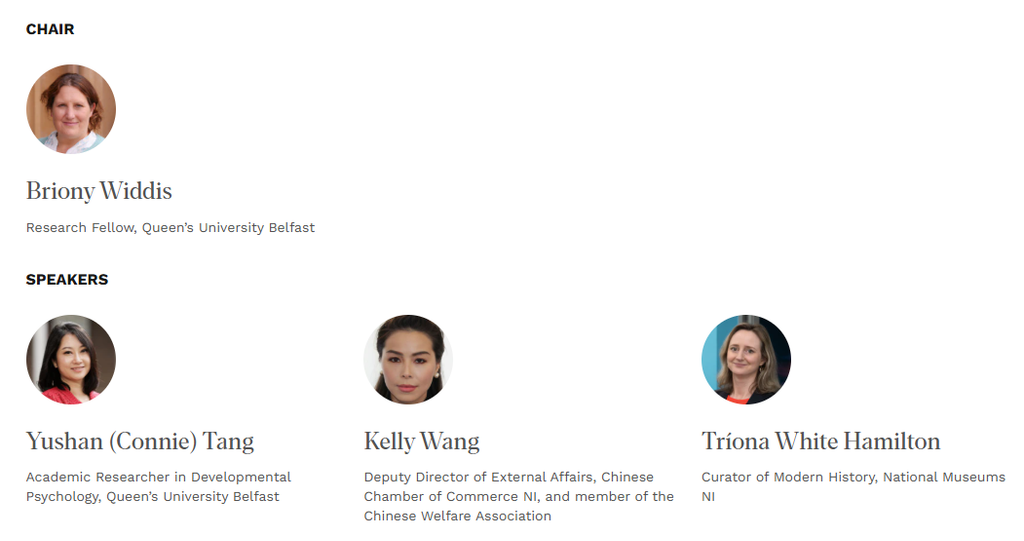
The panel, titled “Bridges to China: connecting communities and collections in Northern Ireland”, was chaired by Dr Briony Widdis (Research Fellow, Queen’s Centre for Public History). Yushan joined Kelly Wang (Board Member, CWA NI) and Tríona White Hamilton (Curator of Modern History, NMNI) to share her experience of the project.
The snapshot of Panel information on the Museums Association’s webpage
Connecting cultural objects with personal stories
For me, the workshops created space for conversations that rarely happen in everyday life. Participants from different regions and generations brought their own knowledge and memories. Something familiar to one person could be a discovery for another. I enjoyed getting to know people through these exchanges and discovering fresh perspectives on our shared cultural heritage.
One conversation during a workshop exploring the museum collections became especially personal. A pair of lotus shoes reminded me of my grandmother, who cared for me when I was little. A question raised during the workshop prompted me to reconsider the story I had grown up with about why her mother had stopped binding her feet. I began to recognise how my own need for a strong female role model had shaped my understanding of her life. Revisiting those memories helped me appreciate the strength she had shown in the way she lived and cared for our family. I felt closer to her, and more at ease with myself. I shared this reflection in my story for the project. The filming team’s response made me feel heard and understood. That moment stayed with me: an object had opened up a conversation through which people from different backgrounds could connect over a deeply personal experience.
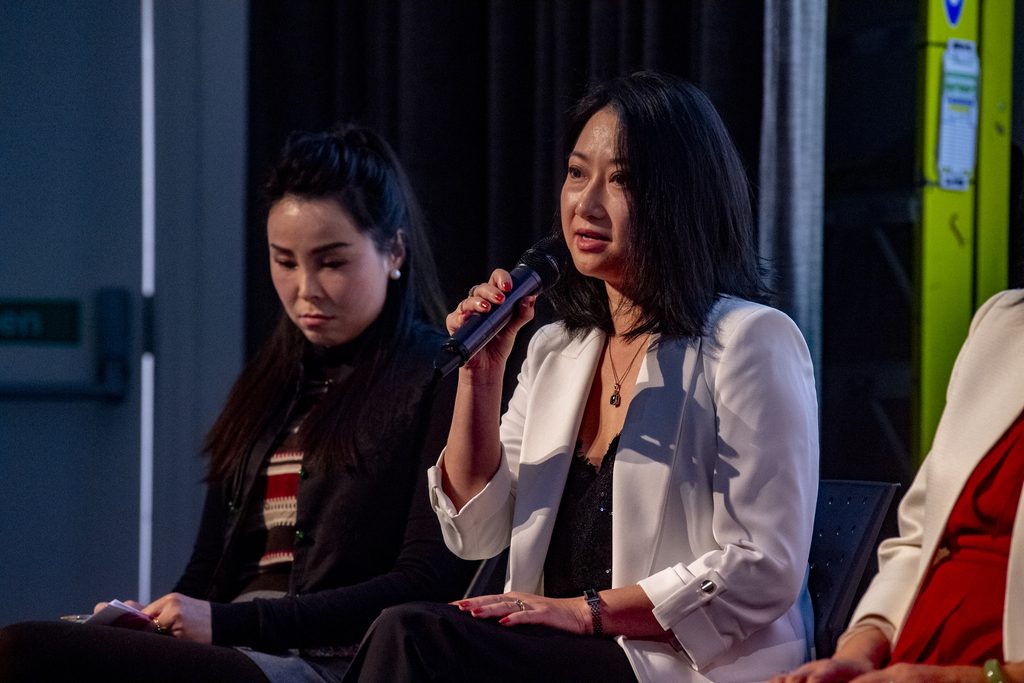
Yushan shared her thoughts at the Bridges to China Launch in March 2026. Photo credt: QUB
This was the experience I wanted to bring to Birmingham. Listening to the other panellists, I recognised a similar appreciation of the relationships and learning that had developed through the workshops. Museum colleagues were interested in how we had worked together and gathered knowledge from participants, and a few stayed afterwards to continue the conversation.
Making time for community
Balancing doctoral research, family life and running a business means that making time for activities outside my usual responsibilities takes some thought. I’m glad I made room for this project. It kept me connected with the Chinese community and gave me a meaningful way to contribute, while opening up conversations I might otherwise have missed.
The support of Queen’s colleagues, CWA, the museum and the filmmaking team created an opportunity to contribute, learn and build relationships that extended beyond the workshops.
The experience also deepened my appreciation of the people who helped bring the university and community together. Dr Liang Wang (Language Support Officer, Queen’s Language Centre) helped facilitate the project through his connections with CWA and the Ulster Museum. He also took part in person, sharing his own objects and memories alongside other community members. For me, this brought the relationship between the university and its neighbouring communities to life.
I hope fellow students who are curious about community projects will find something encouraging in my experience. I began with questions about what I could offer, but discovered that there was also room for my curiosity, my family memories and the things I was still trying to understand.
Being able to share these experiences in Birmingham felt like a valuable next step.
I’m grateful to everyone who helped make it possible, and pleased that this project has become part of my journey at Queen’s.
Author: Yushan (Connie) Tang (汤毓珊) Editor: Liang Wang (王亮)
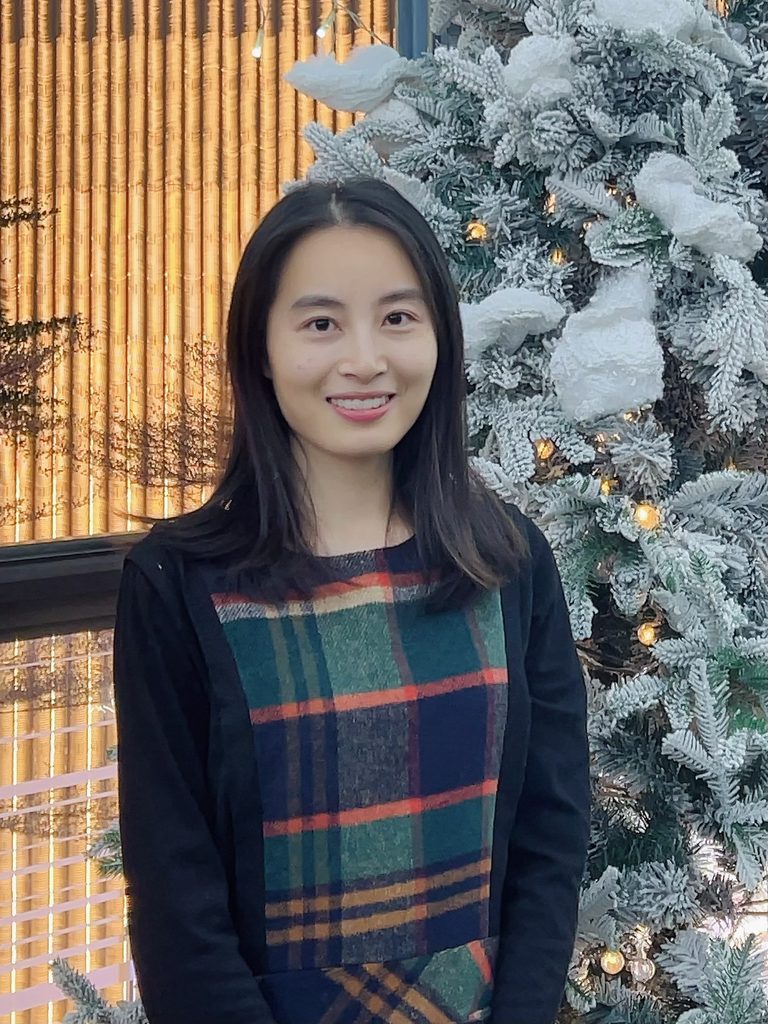
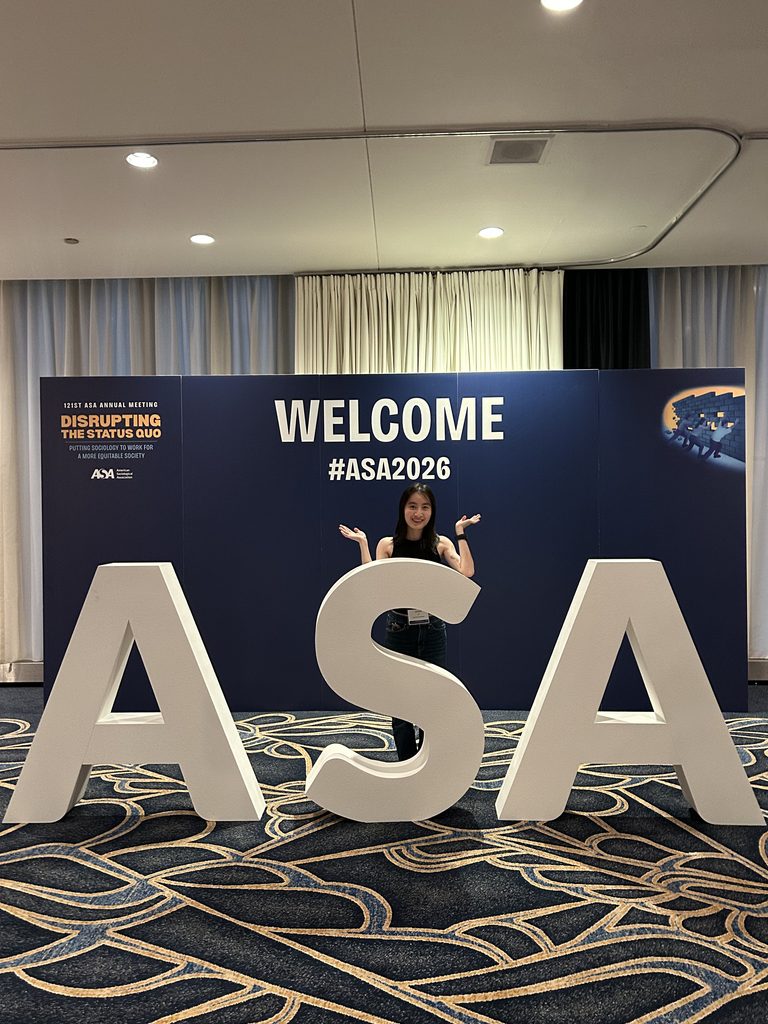
In August 2026, Junyue Li, a first-year PhD student from the School of Social Sciences, Education and Social Work, travelled from Belfast to New York City to attend the American Sociological Association (ASA) 121st Annual Conference. From presenting research and discovering new perspectives to witnessing political protests and exploring one of the world’s most vibrant cities, the experience offered much more than academic growth. We invited Junyue to reflect on the highlights, surprises, and lessons from this memorable trip.
In April 2026, I was delighted to learn that my abstract had been accepted for the ASA Annual Meeting, a major international conference in Sociology. As a first-year PhD student, I saw this as an exciting opportunity to discover what sociologists around the world were researching and to gain an initial understanding of academic networking.
Getting there involved a hectic period of visa applications, funding arrangements, travel bookings, and writing a full paper. Fortunately, I arrived in New York just one day before a severe thunderstorm caused widespread flight cancellations.
Big Conference, Lighter Moments
My first impression of the conference was its sheer scale. More than 4,000 people attended, with sessions starting as early as 8 am and multiple presentations running simultaneously. Over five days, I attended more than 15 sessions covering a wide range of sociological topics, yet I still felt I had missed plenty of interesting discussions, especially those taking place early in the morning. Apparently, I’m not much of a morning person, and I was happy to blame my hotel being a 25-minute walk from the conference venue! So, if your schedule is packed, I’d definitely recommend staying somewhere nearby.
Before attending the conference, I had imagined a more formal and serious atmosphere, but it turned out to be surprisingly relaxed. One plenary session explored how comedy can raise awareness of social issues, and the idea that humour can make a message more effective really stayed with me.
I also noticed presenters making jokes, audience members sharing spontaneous thoughts, and one graduate student using her presentation as an opportunity to showcase herself to established scholars in her field and potential employers in the academic job market. These moments reminded me that academia doesn’t always have to be so serious. We can take our research seriously without putting unnecessary pressure on ourselves.
From Presenting to Conversing
At the regular sessions, I was particularly impressed by the presenters’ storytelling skills. They used interview quotations, empirical examples, and quantitative data to build towards their findings in a natural and engaging way, making their arguments clear and accessible. Reflecting on my own previous presentations, I realised that I had sometimes focused too heavily on theories and findings, which could make my presentations feel rather dry and less engaging.
My paper was assigned to a roundtable session on Gender Roles and Ideologies within the Family. Five researchers, including me, presented our work, with audience members occasionally joining the discussion. We had an hour for presentations and Q&A, without the use of slides.
I found that this format encouraged a more conversational approach. Rather than trying to cover every detail, it was more effective to introduce the research briefly and engage with others’ ideas. I also took away two practical lessons: read other presenters’ papers beforehand whenever possible, and speak loudly enough to be heard in a room where several roundtable discussions are taking place simultaneously.
Across the Atlantic: US and UK Sociology
At the conference sessions, another striking observation concerned qualitative research. Several interview-based PhD projects involved 60-70 interviews, and I even encountered one with more than 160. In the UK, interview-based doctoral projects often involve around 25-35 interviews, as far as I am aware.
There may be several reasons for this difference, including variations in doctoral programme length, research design, and disciplinary expectations. US PhDs often take five to seven years to complete, compared with roughly three to four years in the UK, potentially allowing more time for data collection. Moreover, the strong quantitative orientation of American sociology may encourage qualitative researchers to demonstrate empirical breadth and rigour through larger interview samples.
However, I would be cautious about the assumption that “the bigger, the better” when it comes to qualitative research. When the aim is to understand meanings and experiences in depth, the quality and analytical richness of interviews matter as much as, if not more than, the number collected.
Another difference was the submission requirements. Unlike conferences across the UK and Europe, which usually require only a short abstract, the ASA required either a full paper or an extended abstract at the initial submission stage, followed by a full paper before the conference takes place. Although demanding, this requirement ultimately motivated me to turn my master’s dissertation into a paper and develop new perspectives on my previous research. Sometimes, a deadline is exactly what we need to drive a long-postponed project forward.
When Sociologists Disagree
Although we had been informed by email before the conference about potential protest activities, I was still shocked by the sudden disruption. During a plenary session, just as the ASA president was about to speak, protesters unfurled a banner and shouted, “Free Palestine.” Some also criticised the association for not taking a sufficiently clear position on the issue. The disruption lasted only a few minutes before the event resumed.
What struck me was that many of the protesters were sociologists or former ASA members. This was particularly interesting because it challenged the assumption that sociologists necessarily share similar political positions, even when they broadly share certain values.
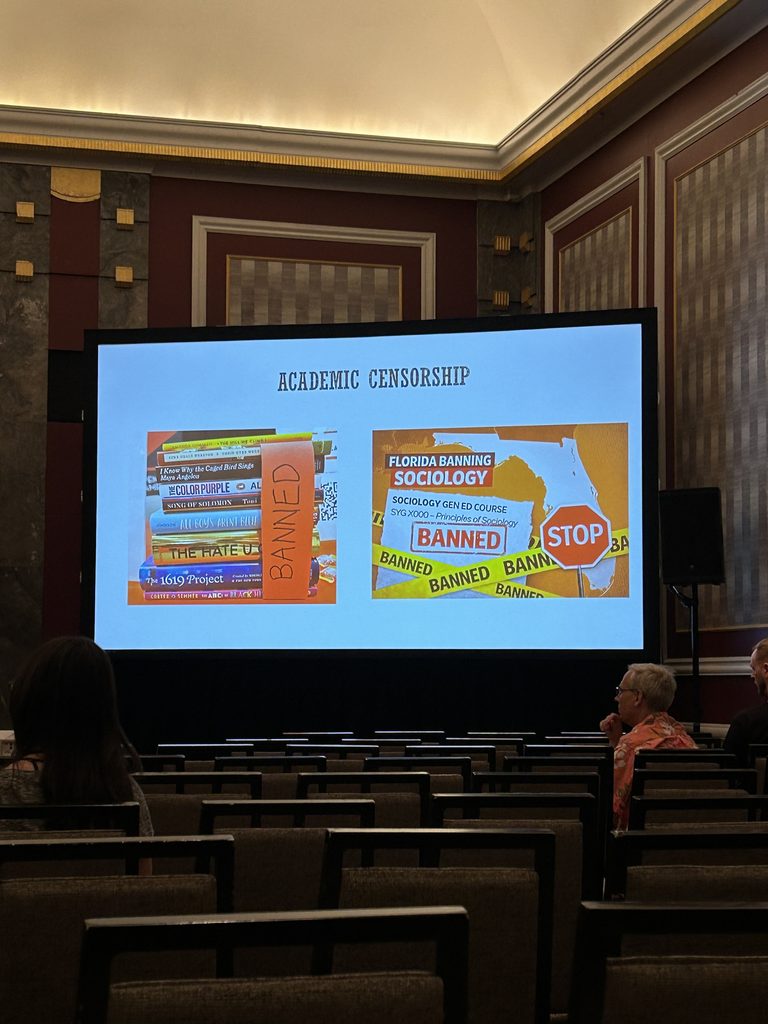
In a sense, the protest brought the conference theme, “Disrupting the Status Quo: Putting Sociology to Work for a More Equitable Society,” into the conference itself. I also learned that some sessions on sensitive topics, including immigration, had been relocated without wider notification.
These experiences reinforced my belief that academia is not an ivory tower detached from reality. Universities, professional associations, and academic conferences are embedded in the same political tensions and social inequalities that sociologists seek to understand.
New York, New Insights
Although I travelled alone from the UK, I experienced warmth, both literally and metaphorically, in New York City. Evening receptions at the conference provided valuable opportunities for networking. I was fortunate to meet two friendly researchers who were also working in Europe (one in the Netherlands and the other from Switzerland), and we explored the city together after the conference.
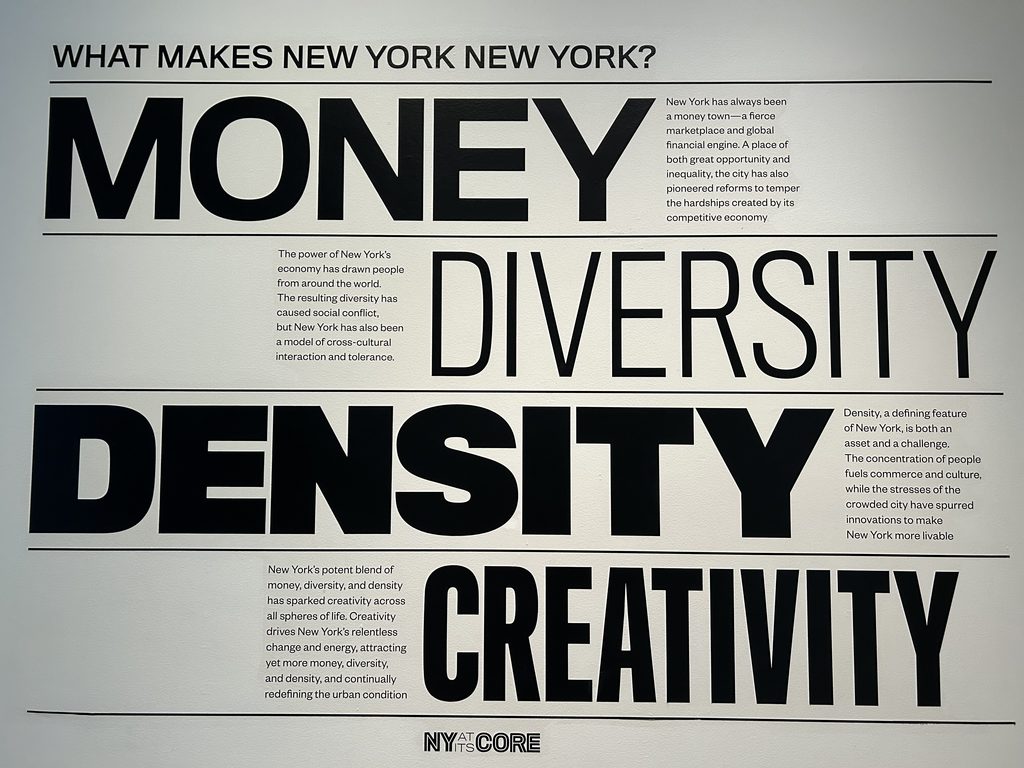
I must admit that one of my main motivations for submitting an abstract to the conference was its location. As a result, alongside immersing myself in the intellectual environment, I also made time to experience New York itself: Times Square, Central Park, the Statue of Liberty, Wall Street, the High Line, museums, and a Broadway musical. I could only scratch the surface of Manhattan, but the city’s energy and diversity left a lasting impression.
One particularly interesting observation concerned Asian American communities. Compared with everyday usage in the UK, where “Asian” often refers primarily to South Asian communities, the term in the US encompasses substantial and diverse East and Southeast Asian populations. I also noticed considerable differences between myself and some of the ethnic Chinese people I encountered, many of whom were second- or third-generation Chinese Americans with their own distinct cultural and national identities.
This made me reflect on the different migration histories and demographic contexts of the two countries. I was also struck by how well established Asian American studies is as an academic field in the US, whereas research on Asian communities in the UK can appear more dispersed. It made me wonder what further opportunities might exist for developing this area of research in the UK.
Overall, it was an incredibly absorbing and rewarding experience. Beyond listening, presenting, and engaging in discussion, I came away with something more: a clearer sense of sociology as a broad, diverse, and sometimes challenging intellectual community. Most importantly, I began to see my own place within this much larger academic world.
For an early-career researcher, a conference is not just a place to present a paper. It is an opportunity to discover new questions, challenge assumptions, build relationships, and better understand the wider world in which our research takes place.
Last but not least, I am grateful to my school, SSESW, and my funder, the DfE, for their financial support, which made my attendance at the conference possible.
Being an international student at Queen’s never means that one has to bury their heads into books and articles for their academic study. Instead, proactively partaking in a range of academic and social events can benefit them hugely.
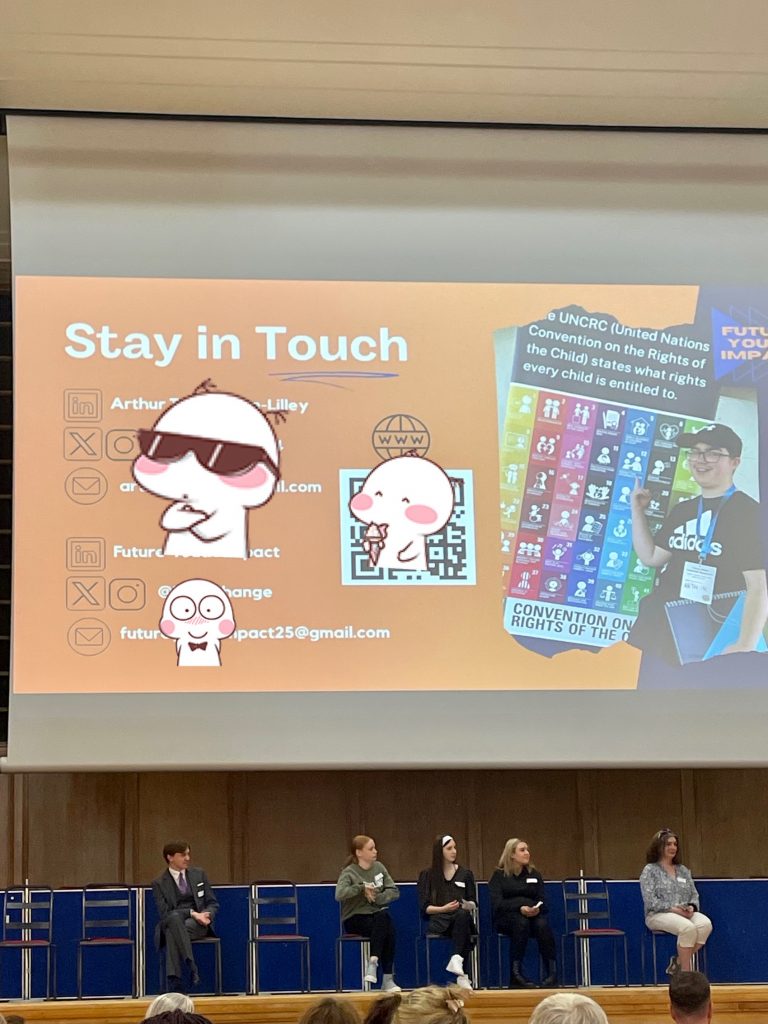
In this post, Yufei Yang (杨雨菲), a MA candidate in Children’s Rights, tells us how she felt about being an international conference assistant during her study at Queen’s.
“While assisting at the conference, this international event enabled me to connect with participants from around the world, representing diverse cultures and backgrounds.”
Yufei yang, pG student from school of social sciences, education and social work, qub
In September, as an international student assistant, I had the privilege of participating in the “CHILDREN’S RIGHTS PARTICIPATION & EDUCATION SYMPOSIUM,” marking one of the highlights of my inspiring cross-cultural (跨文化 kuàwénhuà) journey since I came to study at Queen’s. This conference brought together distinguished scholars and experts from Poland (波兰 Bōlán) , Ireland (爱尔兰 Ài’ěrlán) , China (中国 Zhōngguó) and many other nations, engaging deeply in discussions about children’s rights (儿童权利 értóng quánlì) and education (教育 jiàoyù).
Presentation at the conference | Photo: Yufei Yang
While assisting at the conference, this international event enabled me to connect with participants from around the world, representing diverse cultures and backgrounds. It was an enriching experience that highlighted the richness and excitement of cross-cultural communication (跨文化交际 kuàwénhuà jiāojì). Interacting with representatives from Poland, Ireland, and other countries provided insights into unique perspectives and practices regarding children’s rights and education.
Conference Panel | Photo: Yufei Yang
Through group discussions (小组讨论 xiǎozǔ tǎolùn) and workshops (工作坊 gōngzuòfǎng), I shared best practices from my home country alongside international participants, delving into the challenges within the realm of children’s rights and education. Scholars (学者 xuézhě) from various nations passionately presented their research progress and reports, not only enriching academia with new insights and innovations but also inspiring other professionals.
This collaborative effort fostered a better understanding of each other’s cultures and backgrounds, emphasizing the significance of respect (尊重 zūnzhòng) and understanding (理解 lījiě). Beyond academic exchange (学术交流 xuéshù jiāoliú), the symposium showcased the power of international cooperation (国际合作 guójì hézuò). Our collective focus on the future of children’s rights and education reinforced the understanding that these goals can be better achieved through global collaboration (全球协作 quánqiú xiézuò).
Overall, this symposium on children’s rights and education served as a vibrant cross-cultural adventure, underlining the value of international academic exchange. It opened doors to broader explorations for the future, igniting a passion for the continued pursuit of knowledge.
Author: Yufei YANG Editor: Lauren McShane and Liang WANG
Congratulations for Yiming HUANG (黄一鸣), a third-year PhD candidate, who recently won the Talks Prize 1 at the 73rd Irish Universities Chemistry Research Colloquium!
There were 72 second year PhD students who gave poster presentations and 40 third year PhD students who gave talks…
It was my first time speaking at an open conference. Therefore I felt very lucky and honoured to be the only Chinese person to win the prize.
All of the PhD candidates in attendance were excellent in their research and most were from local universities in Ireland. Queen’s University Belfast was the only participating university from the UK, according to Yiming.
I’m with Prof. Steven E.J. Bell’s group, based in the School of Chemistry and Chemical Engineering. The primary area of study for our group is the development of novel nanomaterials for surface-enhanced Raman spectroscopy (SERS). My talk at the conference focused on controlling nanoparticle aggregates for stable SERS, which is the project I worked on the entire previous year.
Yiming at the conference breakYiming at the conference break
Winning tips
I believe the award could not have been given to me without the following factors. Firstly, I would like to express my sincere gratitude to my supervisor, Prof. Bell, for his excellent guidance in the content of my presentation during the preparation stage. He pointed out that rather than a bunch of data, people prefer to hear a complete story, which was really inspired me. Secondly, to keep the audience interested and prevent them from becoming tired of listening, I used some videos, cartoons and real-life photos to better illustrate my stuff. For example, I made a comparison between my polymer network with nanoparticle aggregates and noodles network with meatballs. In addition, I paid attention to the pace of my presentation and established eye contact with the audience rather than just talking to myself, which enabled the audience to follow my thoughts.
The comparison between hydrogel network with nanoparticle aggregates and noodles network with meatballs.The comparison between hydrogel network with nanoparticle aggregates and noodles network with meatballs.
We hope that these tips will be of help to the new comers and also send our best wishes to Yiming for a great success in her PhD research and future career.
If you have similar stories to share with us your successes in study and work, you are very welcome to contact us by leaving your messages below in the comment box.
Manage Consent
To provide the best experiences, we use technologies like cookies to store and/or access device information. Consenting to these technologies will allow us to process data such as browsing behavior or unique IDs on this site. Not consenting or withdrawing consent, may adversely affect certain features and functions.
Functional
Always active
The technical storage or access is strictly necessary for the legitimate purpose of enabling the use of a specific service explicitly requested by the subscriber or user, or for the sole purpose of carrying out the transmission of a communication over an electronic communications network.
Preferences
The technical storage or access is necessary for the legitimate purpose of storing preferences that are not requested by the subscriber or user.
Statistics
The technical storage or access that is used exclusively for statistical purposes.The technical storage or access that is used exclusively for anonymous statistical purposes. Without a subpoena, voluntary compliance on the part of your Internet Service Provider, or additional records from a third party, information stored or retrieved for this purpose alone cannot usually be used to identify you.
Marketing
The technical storage or access is required to create user profiles to send advertising, or to track the user on a website or across several websites for similar marketing purposes.