We asked recruiters what are the stand-out traits they look for in graduates. Alongside the biggies like teamwork and leadership, they told us that a can-do attitude goes a long way. How many of these soft skills can you tick?
Communication
Communication is key
“Often times, it’s equally important that someone is able to communicate and has good presentation skills as it is the type of degree you have.”
Adrian McCarthy, For Purpose Ireland
Integrity
Would you be brave enough to call out the boss?
“Most industries are highly regulated. Can you think of a time when you have had to demonstrate discretion and integrity? Would you be able to challenge the authority of they were displaying questionable ethics?”
Jo Ferguson, CME Group Belfast
A good attitude
You got this.
“We’re looking for well-rounded individuals who have both the aptitude and attitude to thrive within their business.”
Kim McAllister, Almac
Passion
“We look for people who are enthusiastic, passionate and willing to learn. Attitude towards work is important, you should be willing to give tasks your all.”
Joelene Ridgill, Seagate
Commitment
The ideal candidate must be a team player and show commitment to the job and the firm.”
Sarah Fleming, Muldoon & Co
Adaptable
“We look for passion and enthusiasm for driving change. We need people who are quick to adapt and who are always learning.”
Birgitta Swanberg, Liberty IT
Ambitious
We look for candidates who are driven to succeed and motivated to achieve targets set for them.”
Clodagh Mckeefry, MRP
Creative
Think outside the box
“We are looking for individuals who are curious, creative, and have an interest in constantly developing. People who can take initiative, ask hard questions, and develop your skillset to be successful.”
Jared Kearney, Citi
Want more top tips from employers? Join our Employer Panel series starting Sept 30, designed to help you develop your professional network and get the inside track on getting hired after graduation.
How to create an online profile that will stand out to employers at the Graduate Recruitment and Placement Fair on 21 and 22 October
The Graduate Recruitment & Placement Fair on 21 and 22 October is the biggest Careers Fair at Queen’s. The fair will be a little different this year as we hosting it virtually on a digital platform called Graduateland. We like to think of this as Tinder, for jobs. Just like an online dating site, you can browse prospective employers to find your perfect match. You can even watch videos and live chat with recruiters. And, just like an online dating site, the more information you put on your online profile, the more you’ll stand out.
WATCH:
Completing your profile
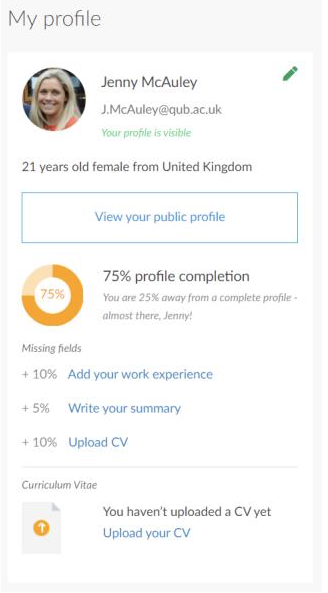
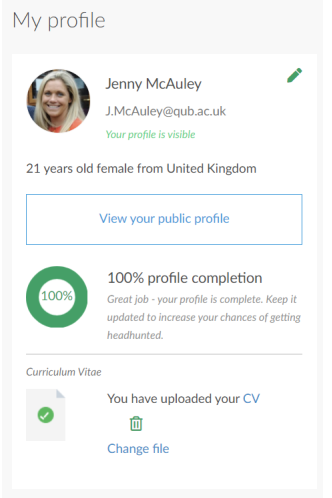
The platform indicates how complete your profile is by giving you a colour coded percentage. Make sure your profile displays as green and as close to 100% complete as possible (you can opt to leave the age and gender fields blank, if you prefer).
Your profile will show amber after you’ve registered -the goal is to get it to green.
Green profile = good to go
Get the basics right
This above video covers the basics of what you will be asked to fill in at registration: degree information, skills etc. The good news is, once you have done this for one event, you don’t need to do it again. So, for example, if you attend Go Global on 14 October, you will already have a Graduateland profile However, for the Graduate Recruitment and Placement Fair there are a few trickier elements to fill in
Nailing the tricky questions
You can upload your CV, fill in your job history and details of any exchanges or work-related learning you have done. So far, so standard application. Where it gets tricky is an innocuous little box called:
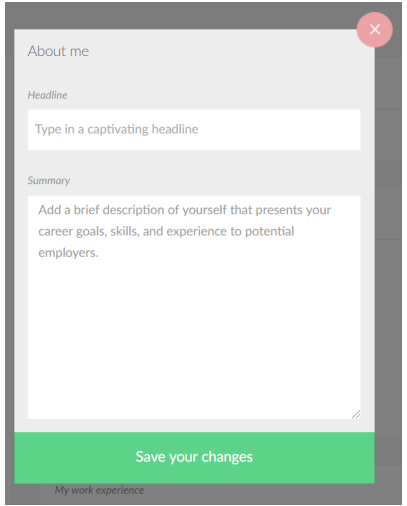
‘Type in a captivating headline’
Don’t panic when you see this box.
Describe yourself in a headline. You:….
This is followed by a small box asking you to ‘Add a brief description of yourself that presents your career goals, skills and experience to potential employers.’
We know it can be hard to articulate everything that is fabulous about you in 200 words, so we curated the best tips from across the internet. If you still need help, you can contact our careers team for expert advice on careers@qub.ac.uk.
Student blogger Dara O’Donnell from our MEDIA programme offers a crash course on MyFuture and her top tips for getting the most from Queen’s careers portal.
MyFuture is your very own online careers portal, which enables employers to advertise specific job opportunities, placements and internships relevant to you throughout your time at Queen’s. This platform promotes vacancies both on and off-campus, as well as advertising positions that are located further afield. This means you have access to life-changing opportunities abroad too.
The virtual presence and function of MyFuture provides you with invaluable access to work experience, careers advice and systems that can all help pave the way to you landing that dream career in the future. You simply use you Queen’s student ID to log in and get started!
Here are five ways to best utilise the platform:
You can upload and tailor your CV
The first step to landing your dream role through MyFuture is by creating your own profile, adding a charming personal statement, past employment history and any experience and skills that you possess that will make you a promising candidate. Noting the degree you are studying when signing up to the platform will enable the system to specify job opportunities that directly relate to your desired career. This is helpful in saving time scrolling through boundless unsuitable posts you would on regular job-seeking sites! Additionally, you can attach your own personal and professional CV to your profile, providing employers with further insight to your individual history and aspirations. Make sure you proofread your profile and CV or, alternatively utilise a MyFuture shortcut to the VMock CV Checker, located on the website’s main menu page, ensuring there are no silly mistakes that could stand between you and your desired future career.
2. You can find events relevant to you
MyFuture will help you gain further understanding of different pathways you can take to achieve your individual career goals. This is through providing a constantly updated calendar of different careers fairs and employer events that are taking place on and off- campus, as well as this, providing various links to upcoming careers workshops that you can attend. Being pro-active and attending these events will allow you to explore your options during your studies and may open your eyes to possible opportunities abroad that could enhance your employability skills and ultimately may transform your mindset on your future career journey.
3. You can practicse your interview skills.
By joining MyFuture you will have already shown a desire to begin your career journey and start finessing your future employability. Why not take this a step further and make use of the information resources and mock video interviews available on MyFuture? There are multiple practise interviews to take, ranging from general interview questions to graphic design and business management interview scenarios. Unlock your potential and learn how to best flex your skills in an interview, giving you a one up on your competition!
4. You can book a Careers Consultation.
Within MyFuture there is an option to book a one-to-one careers appointment with one of Queen’s own consultants, to help guide you in successfully managing your own future career path. During the pandemic, these meetings are being offered virtually through video call. If you are feeling lost, like many students often do, do not be afraid to ask for advice and guidance when it is free to you! This is an invaluable service offered to us by the University’s Careers Department and should be taken advantage of.
5. You’ll automatically be kept informed
Regular emails and job alerts will allow you to stay up to date on the opportunities that are available on MyFuture. Make sure to download the MyFuture mobile app so you have it readily accessible at all times to browse potential future careers, whether that be while passing the time on your daily commute or filling the minutes in between classes.
Lastly, it’s important to stay positive and remain optimistic in working towards your future career goals, especially throughout this unimaginable tough period for everyone. MyFuture is a reassuring platform for students and graduates alike and is here to help us progress and succeed. As a nearing graduate myself, now more than ever, the future seems daunting, however, being equipped with a system such as MyFuture, I feel confident and motivated in taking the steps towards my future career, while being supported by Careers at Queens through access to a system such as MyFuture.
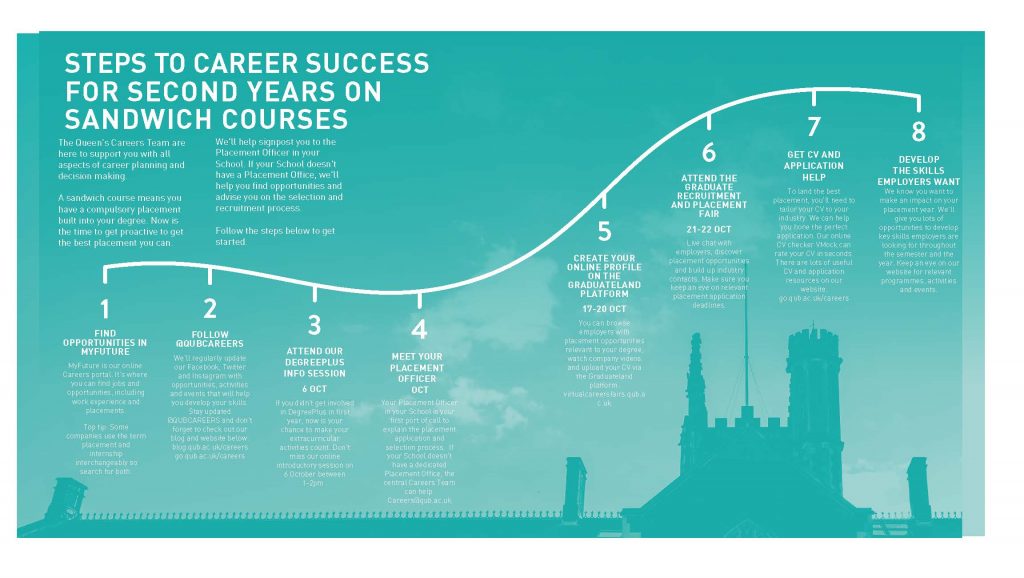
Not sure where to start with career planning? Overwhelmed with options? We’ve streamlined your journey for you so you can easily see where you need to be and what you need to do to stand the best possible chance of propelling your career forward.
To help inform your career-planning journey, we’ve created a snapshot of the steps to success for every study stage. You can download the guide relevant to you to remind you of key events and milestone dates.
Our Careers website is a great place to start planning your career. Whether you have no plan, a vague plan or a firm career plan in mind, we’ll help you set and achieve short and long-term goals.
Don’t forget, the Careers service are here to support you, so if you have a question feel free to get in touch!
Maths graduate Ben Devlin explains how the Graduate Recruitment and Placement Fair helped him realise the range of careers available to him.
Queen’s graduate Ben Devlin works as a Retirement Consultant at Willis Towers Watson in Dublin. He was taken on by the firm as a graduate actuarial consultant in late 2017. He may have made the transition from university to work look easy, but the reality was lots of applications, CV and cover letter submissions and interviews.
“I secured my graduate job after applying to many different actuarial roles,” says Ben.
Asking the right questions
Make the most of an employer chat by coming armed with questions
Ben was able to get a better understanding of the options open to him by asking the right questions at the Graduate Recruitment and Placement Fair: What positions at your company would be a good option for someone with my degree? What is it like to work at your company?
“I was able to get an insight into the range of careers that are available to me as a graduate. I was able to talk to people who worked for these firms and get an insight of what it is like to work for these firms on a day to day basis,” he says.
Building up skills
Build up your skills during your time at university
Ben built up relevant work experience during his time at Queen’s.
“I participated in the London Finance and Business tour where I was able to get an experience of what it is like to work in an environment such as London. This helped me understand the roles that existed in firms in the finance industry and understand the application process. This in turn helped me prepare better for interviews and to land a summer internship the following year.”
His advice to current students? “Make the most of the opportunities available at Queen’s. It is also important to get internship or graduate applications in as early as possible in order to become more familiar with the application process,” he says.
When Queen’s graduate Rachel Murphy (nee Hill) met her employer at a Queen’s Flagship Careers Fair, it took her career off in an exciting new direction.
Rachel at her graduation
Like many students, History graduate Rachel Murphy (nee Hill) chose her degree subject because of her passion for the subject, rather than because she has a particular career goal in mind.
“In terms of my career, I wasn’t sure what I wanted to do, which made deciding on a subject to study at university quite tricky. In the end, I decided to study History as it was a subject that I loved at school and the subject which I knew I would enjoy the most. Enjoying my time at university was very important to me and this was my main motivation to study at Queen’s and to study History,” she says.
Exploring my options
While at Queen’s, Rachel was keen to explore career options and to build up valuable skills that would make her more employable after graduation. She gained work experience at PwC and built up her confidence by sitting on the Students’ Union Council.
“This was great experience and built up my confidence for going forward into the working environment,” says Rachel.
She also booked a consultation with a Careers consultant at Queen’s Careers service to get CV and interview guidance.
Rachel booked a Careers consultation to get advice on her next move after graduation
She started the September following her graduation, moved through the Management Programme and was promoted to Management Assistant seven months later.
“The job had various roles and responsibilities which keep me very occupied throughout the day,” she says.
For more of an insight into the Graduate Management Programme at Enterprise, watch this video:
Career success
Four year on, Rachel is Projects Officer at the Young Farmers Clubs of Ulster, the largest rural youth organisation in Northern Ireland which aims to nurture and develop young people. She credits Queen’s Careers service for helping her develop the skills she needs to succeed and for giving her that crucial first employer introduction.
Rachel now works as a Project Officer for a youth organisation
If, like Rachel, you are unsure what you want to do after graduation, register today for our Graduate Recruitment and Placement Fair. You can meet employers who are looking to recruit graduates just like you.
But don’t take out word for it – here is what Rachel had to say:
“My advice for current students is get involved with Queen’s and all it has to offer. I would also advise to make use of the careers service as soon as possible and to really think about what their plans for after University,” she says.
From expert guidance to building your CV, our Careers Consultant Mary McLaughlin explains how to start planning your career at Queen’s – whatever your study stage.
1.Make an appointment with a Careers Consultant
The Careers Consultants are available to meet with you in a one-one appointment to help you navigate the job search for part-time and on-campus jobs as well as potential summer internships and placements related to your area of study. The Consultants are normally located in the Student Guidance Centre and are currently conducting appointments online. Make an appointment via MyFuture.
2. Log into MyFuture
MyFuture is the University’s online careers management system. In the system you will find on-campus jobs as well as other part-time student jobs, summer internships and placements, and full-time positions for graduates. This is a great place for you to start your search for an on-campus or part-time job as well as to find opportunities to go abroad and events to connect with local employers. You will also use MyFuture to book one-one meetings with Careers Consultants. Use your student ID to log in.
3. Fit job experience around your studies
Fancy working as a campus tour guide?
As you consider taking on a part-time job or getting involved in extracurricular activities, it’s important to make sure that you save plenty of your time for studying and all of the reading that many of your classes will require. This is particularly important in the first semester, when you are adjusting to University life and courses. The University policy for on-campus jobs allows for working only 15 hours per week during term-time to allow you enough time to focus on your studies. Search jobs on campus.
4. Access free online career planning tools and resources
Queen’s Careers website has a wealth of information for those of you searching for a job whether that be part-time, a placement, or a graduate position. Get tips on where to search for jobs, how to write a great CV and cover letter, and how to prepare for an interviews. Also, the website has information on international opportunities and programming with employers from Belfast and beyond! Visit the Careers website.
5. Make your extracurricular activities count
Many of you will work part-time jobs, volunteer, or take part in a student society or progamme offered by Careers, Employability and Skills during your time as a student. You can gain accreditation for completing extracurricular work-related learning alongside your degree through DegreePlus. The certification helps you to articulate your development and achievements to others, including potential future employers. You’ll also receive a certificate at graduation. Discover DegreePlus
For more information or to discover how Queen’s Careers Team can help you plan your future, get in touch.
Queen’s Graduate Placement and Recruitment Fair is going virtual on 21 and 22 October 2020. And while that means no campus buzz and no free cupcakes (sob!), there are plenty of advantages to going digital. Here are just five of them.
It’s fast and easy to set up
Forgot dressing a stall with company branding, Graduateland, our event host platform, will do all your selling for you. Once you’ve registered via MyFuture, you can set up your online stall with just a few easy clicks, preloading videos, company details and FAQs.
2.You can pre-record the most relevant info
With the online presentation function, you can record a presentation for candidates to watch in real time. Beats talking yourself hoarse on a stand all day. What’s more, candidates can upvote each other’s questions so you can ensure you are answering the most important FAQs.
3. You can hone in on the right candidates
Using filters to sort candidates, you can read student profiles and invite the candidates with the skills you are looking for to engage in a live chat or video call. This is arguably a much more efficient and strategic way to engage with our students.
4. There are no queues
The logistics of a traditional fair dictate that only a certain number of students can get near you at any one time. With our virtual fair, an unlimited number of students can see your online stall. Candidates can even view your profile in advance of the event, along with your relevant job opportunities. What’s more, the number of representatives at your stall is also unlimited, meaning you can select the right representative to speak to a candidate.
5. It’s cost effective
You don’t need to spend money on branded pens to compete for attention. Our virtual event means you have a captive audience of top talent at your fingertips. This generation have grown up with tech and are digitally savvy, so it’s easier than ever to communicate and engage with candidates. Meanwhile you’ll save time on branding, travel and time out of office.
To register for Queen’s Graduate Placement and Recruitment Fair on 21 and 22 of October, visit MyFuture today.
From August 31, you can set up your online stall via the GraduateIreland platform.
Sean, Florian, and Professor Cai wearing different prototype firefighter helmets.
Imagine you’re a firefighter entering a burning building. The room is so thick with smoke that you can’t see. How do you know which way to turn? This was the challenge set for Queen’s Electrical and Electronic Engineering graduate Sean Hackett before he helped design an award-winning fire fighters’ helmet that tells the wearer which way to turn with a simple buzz to the left or right of the head.
As an IAESTE (International Association for the Exchange of Students for Technical Experience intern), Sean is enjoying a year placement as an intern at the Visual Intelligence Studio in Carnegie Mellon University in the USA, where he is part of a research team exploring a safer communication tool for firefighters.
Under Senior Systems Scientist Dr. Yang Cai, the ‘Haptic Helmet’ prototype conceived by Sean’s team won the award for “most commercially viable” at the NIST Haptic Interface for Public Safety Challenge. The contest assessed the use of virtual reality environments as a development tool for creating safety technologies.
As part of the project, Sean and the team travelled to Denver, Colorado for live demos in a fire fighting training facility. This practical experience allowed them to understand how firefighters navigate unfamiliar paths through burned buildings filled with smoke and noise.
Sean said: “The experience of interacting with real-life firefighters and working independently on solutions has been very interesting for me.”
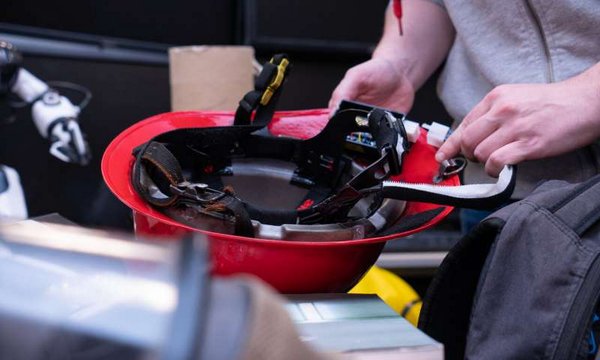
The prototype helmet
Dr Yang said: “We encourage engineers to find simple solutions that work in the real world. “Although I give them instructions to guide and get them started, I also encourage them to use their own knowledge and experiment because in the real world there is no textbook that tells you what to do and engineers have to work on a lot of problem-solving”.
Along with Dr Yang, Sean and the team worked to develop technology that successfully improves firefighter’s safety and efficiency of in the most challenging and hazardous environments.
Sean with fellow intern Florian Alber
During his internship, Sean has also been helping edit a research paper for presentation on “Indo-Navigation and Fire Fighters Activity Recognition”.
Dr Yang commented: “Students and participants from western Europe have a brilliant work ethic. Together, they produce research papers and work on innovative solutions, adding value to the lab. Some European interns have great writing style in addition to other talents and that is monumental when it comes to writing and editing research papers for conferences, which is great additional help.”
Sean works on drone projects for public safety alongside a fellow researcher
According to Sean, it wasn’t hard settling into the new environment thanks to the immense support offered at the lab. “Of course, it’s challenging to be away from friends, family, and home. It takes a little while for the initial adjustment of the processes and procedures but once that is done, it’s pretty smooth sailing.”
Sean and Florian check out the Grand Canyon
The year stateside has also given Sean the opportunity to experience American culture and interact with people from diverse backgrounds, participate in social activities and enjoy American adventure and sports.
Queen’s Chemistry student Anwin Robin has described a paid internship with the British Council’s IAESTE (International Association for the Exchange of Students for Technical Experience) programme as “the best year of my life.”
Like many Queen’s students, Anwin took the opportunity to gain international experience and boost his employability skills on a paid placement abroad.
Anwin, from Dromore in County Down, moved to Switzerland in June 2019 to work with Empa – Swiss Federal Laboratories for Materials Science and Technology.
Anwin said: “During my internship I drew on my background as a chemistry student to carry out research into making stronger materials. Knowing that they may be used in the future in structures ranging from airplanes to wind turbines made my work feel tangible and relevant.”
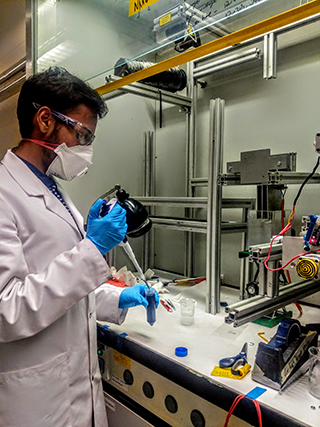
Anwin at work in Switzerland
The best year of my life
During his time in Switzerland, Anwin also had the opportunity to meet up other interns working across the country through weekend excursions organised by IAESTE, the largest global mobility programme for STEM students in the world.
Anwin added: “My time in Switzerland has been the best year of my life so far. My IAESTE placement showed me how international many companies are today and confirmed that I want to grow my work experience outside of the UK. I will forever be grateful to IAESTE for providing me with this opportunity.”
Adapting for Covid-19
Anwin enjoyed the experience so much that when Switzerland went into lockdown because of Covid-19, he chose to stay in the country and continue his internship from home. He also used this as an opportunity to develop his coding skills.
Anwin has remained in Switzerland since finishing his IAESTE placement in May. He is currently applying to further internships in the country and hopes to eventually study for a Masters in computer science.
Whilst Covid-19 has restricted much travel this summer, many IAESTE placements have shifted online in response.
Among the 15 students from Northern Ireland who are currently undertaking remote internships with organisations in the USA, India, Bangladesh and Poland, are several Queen’s students who are joining online seminars and discussions. Their subject areas include biomedical science, business and marketing, computer science, aerospace engineering and chemical engineering.
Life changing impact
Jonathan Stewart, Director of the British Council Northern Ireland, said: “It’s wonderful to hear about the lifechanging impact of Anwin’s IAESTE placement, and we wish him all the best as he starts out in his career. Despite Covid-19, the IAESTE programme has quickly adapted and continues to offer quality opportunities for our university students to gain international experience. The remote internships help to provide Northern Ireland students with new technical skills while also experiencing different cultures and ways of working.”
In Northern Ireland IAESTE is funded by the Department for the Economy and delivered by the British Council.
Queen’s STEM students interested in applying for the IAESTE programme can find more information here: