ParaGrapher: A Parallel and Distributed Graph Loading Library for Large-Scale Compressed Graphs – BigData’25 (Short Paper)


DOI:

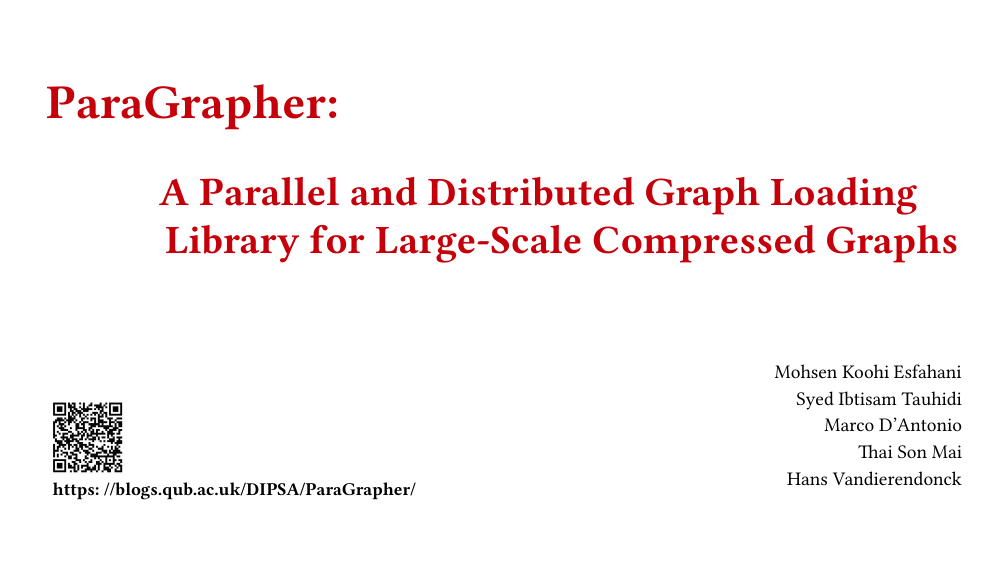
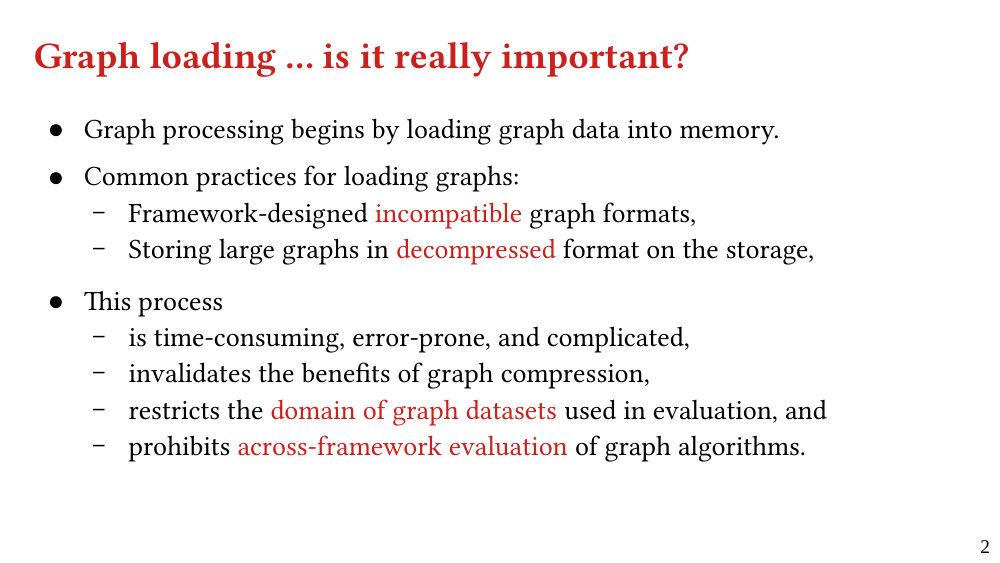
Whereas the literature describes an increasing number of graph algorithms, loading graphs remains a time-consuming component of the end-to-end execution time. Graph frameworks often rely on custom graph storage formats, that are not optimized for efficient loading of large-scale graph datasets. Furthermore, graph loading is often not optimized as it is time-consuming to implement.

This shows a demand for high-performance libraries capable of efficiently loading graphs to (i) accelerate designing new graph algorithms, (ii) to evaluate the contributions across a wide range of graph datasets, and (iii) to facilitate easy and fast comparisons across different graph frameworks.

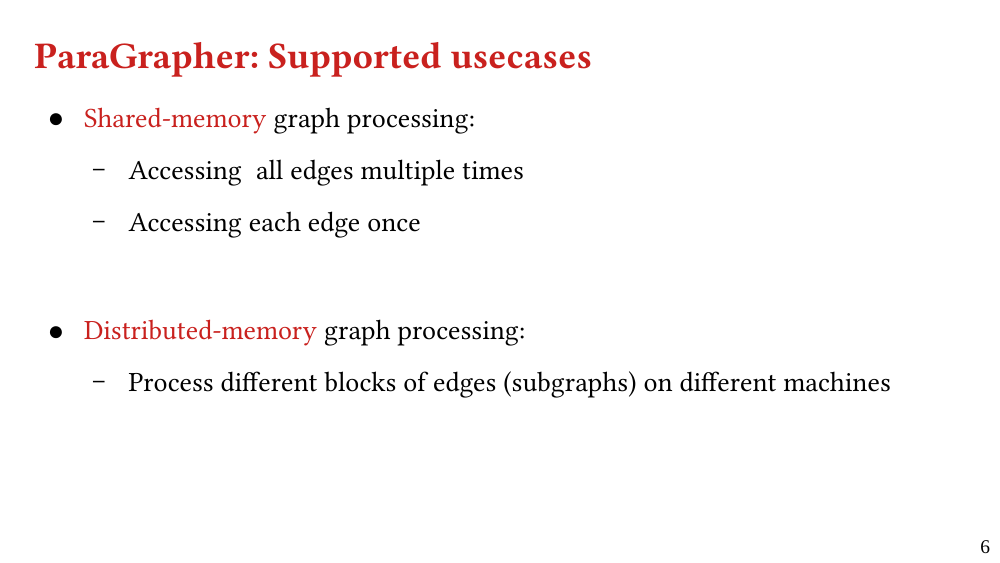
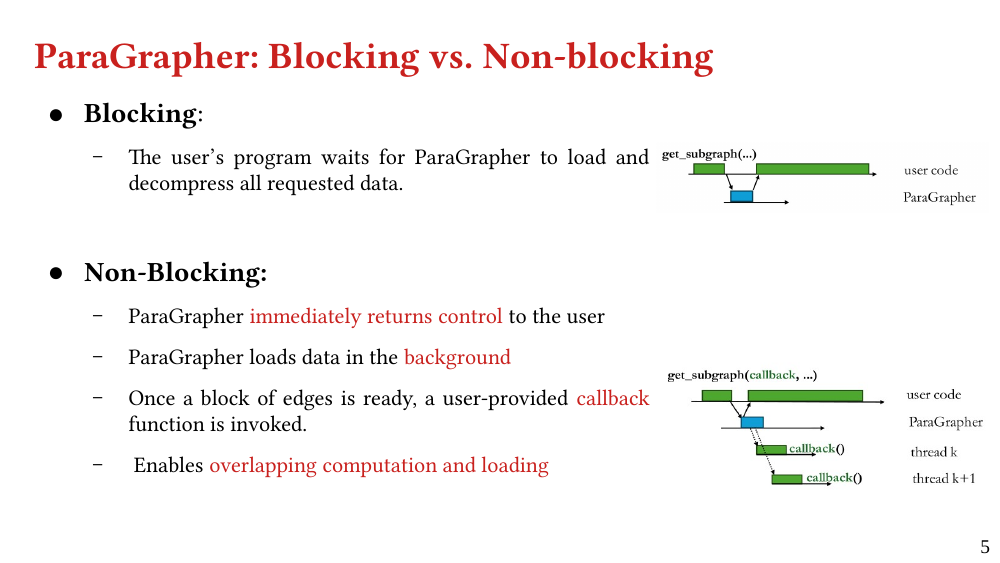
We present ParaGrapher, a library for loading large-scale compressed graphs in parallel and distributed graph frameworks. ParaGrapher supports (a) loading the graph while the caller is blocked and (b) interleaving graph loading with graph processing. ParaGrapher is designed to support loading graphs in shared-memory, distributed-memory, and out-of-core graph processing.

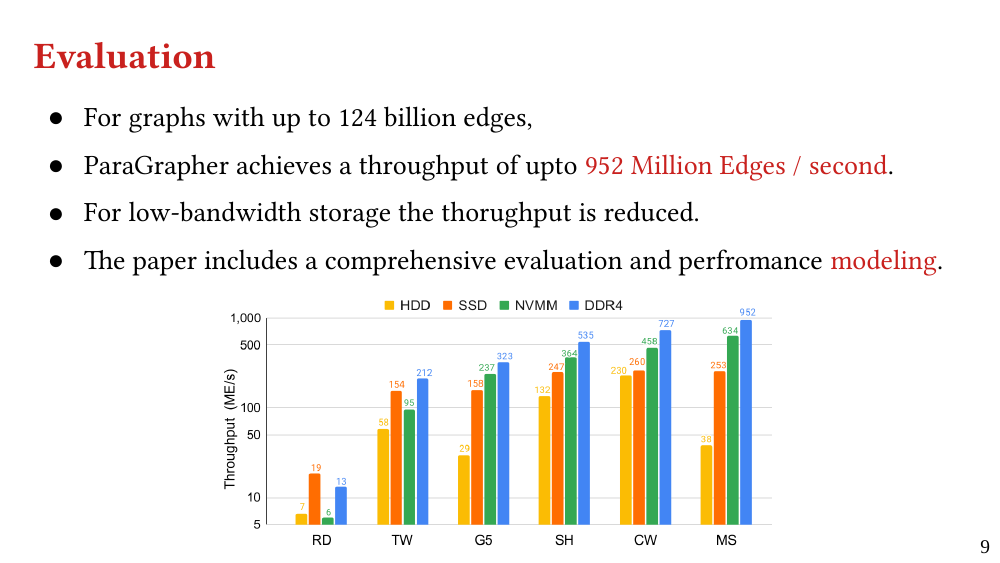
We explain the design of ParaGrapher and present a performance model of graph decompression. Our evaluation shows that ParaGrapher delivers up to 3.2 times speedup in loading and up to 5.2 times speedup in end-to-end execution (i.e., through interleaved loading and execution).

Source Code

https://github.com/DIPSA-QUB/ParaGrapher

API Documentation

Please refer to the Wiki, https://github.com/DIPSA-QUB/ParaGrapher/wiki/API-Documentation, or download the PDF file using https://github.com/DIPSA-QUB/ParaGrapher/raw/main/doc/api.pdf .
BibTex

@articel{paragrapher-bigdata,

}

Related Posts & Source Code

ParaGrapher Web Page

Wasp: Efficient Asynchronous Single-Source Shortest Path on Multicore Systems via Work Stealing – SC’25

We are happy to announce that Marco’s paper was accepted as Supercomputing 2025, taking place the 16-21 November in St. Louis. Marco will present its research paper on Thursday 20th at 3:30pm in the “Algorithms: Matching System Capabilities” session.

Abstract

The Single-Source Shortest Path (SSSP) problem is a fundamental graph problem with an extensive set of real-world applications. State-of-the-art parallel algorithms for SSSP, such as the ∆-stepping algorithm, create parallelism through priority coarsening. Priority coarsening results in redundant computations that diminish the benefits of parallelization and limit parallel scalability.

This paper introduces Wasp, a novel SSSP algorithm that reduces parallelism-induced redundant work by utilizing asynchrony and an efficient priority-aware work stealing scheme. Contrary to previous work, Wasp introduces redundant computations only when threads have no high-priority work locally available to execute. This is achieved by a novel priority-aware work stealing mechanism that controls the inefficiencies of indiscriminate priority coarsening.

Experimental evaluation shows competitive or better performance compared to GAP, GBBS, MultiQueues, Galois, ∆*-stepping, and ρ-stepping on 13 diverse graphs with geometric mean speedups of 2.2x on AMD Zen 3 and 2.1x on Intel Sapphire Rapids using 128 threads.

Source Code

The source code is available at: https://github.com/DIPSA-QUB/wasp
Paper available at: https://dl.acm.org/doi/10.1145/3712285.3759872

Accelerating Loading WebGraphs in ParaGrapher

PDF version
DOI: 10.48550/arXiv.2507.00716

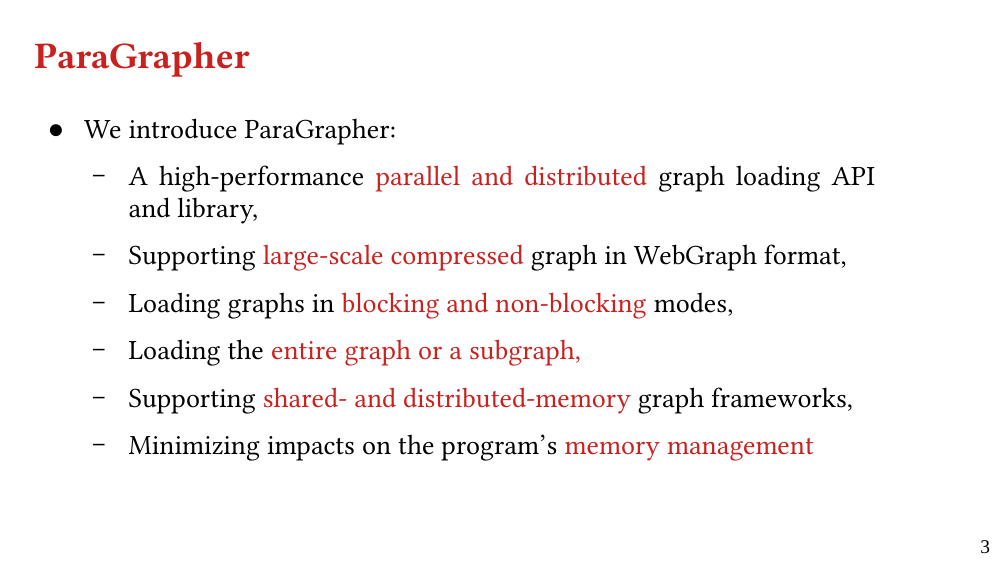
ParaGrapher is a graph loading API and library that enables graph processing frameworks to load large-scale compressed graphs with minimal overhead. This capability accelerates the design and implementation of new high-performance graph algorithms and their evaluation on a wide range of graphs and across different frameworks.

However, our previous study identified two major limitations in ParaGrapher: inefficient utilization of high-bandwidth storage and reduced decompression bandwidth due to increased compression ratios. To address these limitations, we present two optimizations for ParaGrapher in this paper.

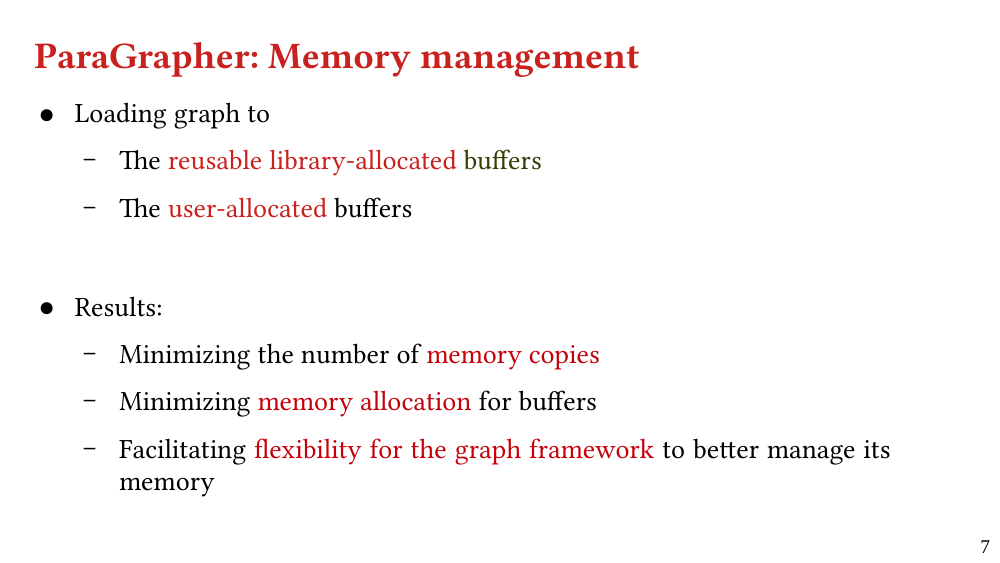
To improve storage utilization, particularly for high-bandwidth storage, we introduce ParaGrapher-FUSE (PG-Fuse) a filesystem based on the FUSE (Filesystem in User Space). PG-Fuse optimizes storage access by increasing the size of requested blocks, reducing the number of calls to the underlying filesystem, and caching the received blocks in memory for future calls.

To improve the decompression bandwidth, we introduce CompBin, a compact binary representation of the CSR format. CompBin facilitates direct accesses to neighbors while preventing storage usage for unused bytes.

Our evaluation on 12 real-world and synthetic graphs with up to 128 billion edges shows that PG-Fuse and CompBin achieve up to 7.6 and 21.8 times speedup, respectively.

Source Code

https://github.com/DIPSA-QUB/ParaGrapher

API Documentation

Please refer to the Wiki, https://github.com/DIPSA-QUB/ParaGrapher/wiki/API-Documentation, or download the PDF file using https://github.com/DIPSA-QUB/ParaGrapher/raw/main/doc/api.pdf .
BibTex

@misc{pg_fuse,
      title={Accelerating Loading WebGraphs in ParaGrapher}, 
      author={Mohsen {Koohi Esfahani}},
      year={2025},
      eprint={2507.00716},
      archivePrefix={arXiv},
      primaryClass={cs.DC},
      url={https://arxiv.org/abs/2507.00716}, 
}

Related Posts & Source Code

ParaGrapher Web Page

An (Incomplete) List of Publicly Available Graph Datasets/Generators

Short URL of this post: https://blogs.qub.ac.uk/DIPSA/graphs-list-2024

Real-World Graphs

Smaller Graphs

Synthetic Graph Generators

Technical Posts

QClique: Optimizing Performance and Accuracy in Maximum Weighted Clique – Euro-Par 2024

30th International European Conference on Parallel and Distributed Computing (Euro-Par 2024)

DOI: 10.1007/978-3-031-69583-4_7
PDF Version

Abstract

The Maximum Weighted Clique(MWC) problem remains challenging due to its unfavourable time complexity.In this paper, we analyze the execution of exact search-based MWC algorithms and show that high-accuracy weighted cliques can be discovered in the early stages of the execution if searching the combinatorial space is performed systematically.

Based on this observation, we introduce QClique as an approximate MWC algorithm that processes the search space as long as better cliques are expected. QClique uses a tunable parameter to trade-off between accuracy vs. execution time and delivers 4.7-$82.3 time speedup in comparison to previous state-of-the-art MWC algorithms while providing 91.4% accuracy and achieves a parallel speedup of up to 56x on 128 threads.

Additionally, QClique accelerates the exact MWC computation by replacing the initial clique of the exact algorithm. For WLMC, an exact state-of-the-art MWC algorithm, this results in 3.3x on average.

Code

https://github.com/DIPSA-QUB/QClique

Selective Parallel Loading of Large-Scale Compressed Graphs with ParaGrapher – arXiv Version

PDF version
DOI: 10.48550/arXiv.2404.19735

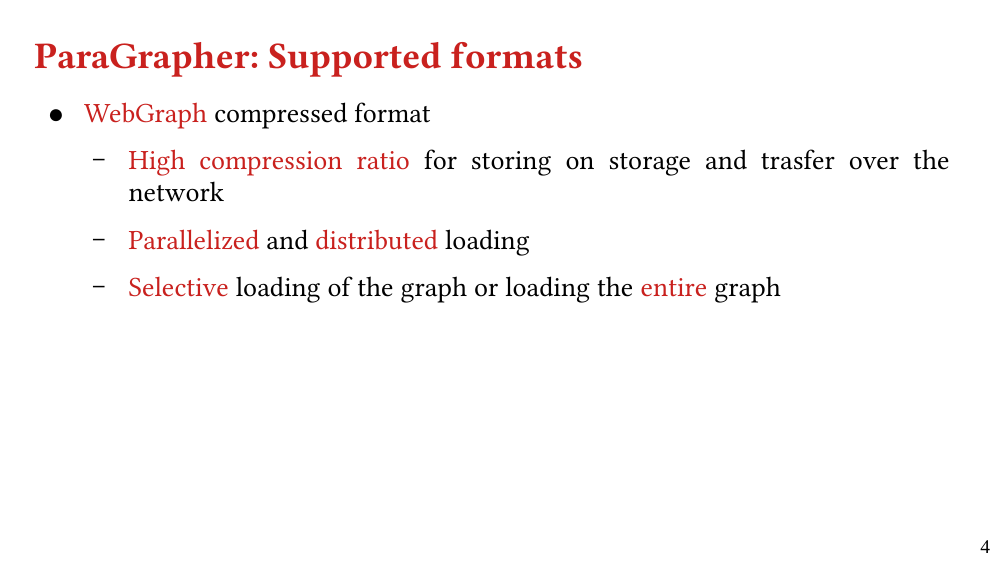
Comprehensive evaluation is one of the basis of experimental science. In High-Performance Graph Processing, a thorough evaluation of contributions becomes more achievable by supporting common input formats over different frameworks. However, each framework creates its specific format, which may not support reading large-scale real-world graph datasets. This shows a demand for high-performance libraries capable of loading graphs to (i) accelerate designing new graph algorithms, (ii) to evaluate the contributions on a wide range of graph algorithms, and (iii) to facilitate easy and fast comparison over different graph frameworks.

To that end, we present ParaGrapher, a high-performance API and library for loading large-scale and compressed graphs. ParaGrapher supports different types of requests for accessing graphs in shared- and distributed-memory and out-of-core graph processing. We explain the design of ParaGrapher and present a performance model of graph decompression, which is used for evaluation of ParaGrapher over three storage types.

Our evaluation shows that by decompressing compressed graphs in WebGraph format, ParaGrapher delivers up to 3.2 times speedup in loading and up to 5.2 times speedup in end-to-end execution in comparison to the binary and textual formats.

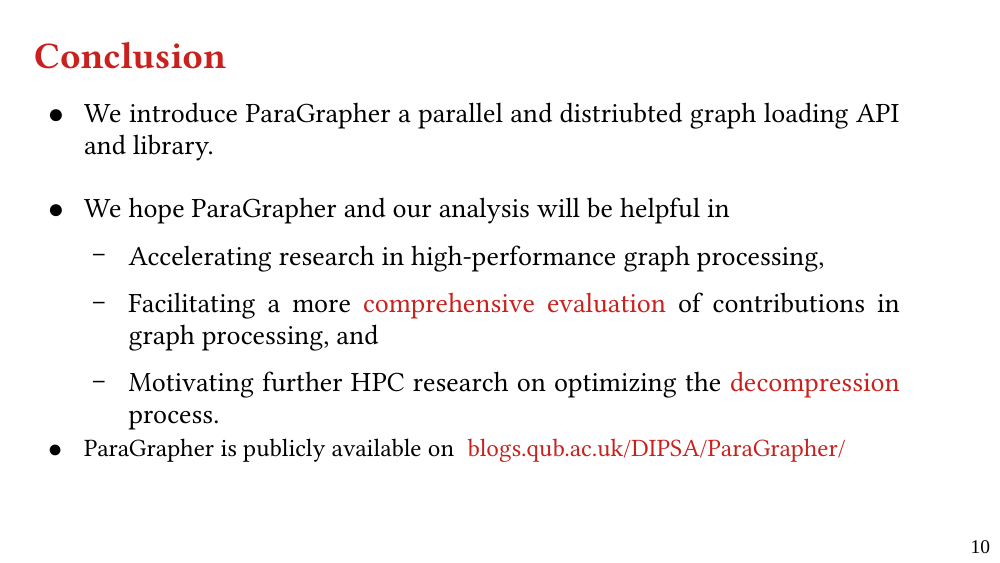
ParaGrapher is available online on https://blogs.qub.ac.uk/DIPSA/ParaGrapher/.

Source Code

https://github.com/DIPSA-QUB/ParaGrapher

API Documentation

Please refer to the Wiki, https://github.com/DIPSA-QUB/ParaGrapher/wiki/API-Documentation, or download the PDF file using https://github.com/DIPSA-QUB/ParaGrapher/raw/main/doc/api.pdf .
BibTex

@misc{paragrapher-arxiv,
  title = { Selective Parallel Loading of Large-Scale 
            Compressed Graphs with {ParaGrapher}}, 
  author = { {Mohsen} {Koohi Esfahani} and Marco D'Antonio and 
             Syed Ibtisam Tauhidi and Thai Son Mai and 
             Hans Vandierendonck},
  year = {2024},
  eprint = {2404.19735},
  archivePrefix = {arXiv},
  primaryClass = {cs.AR},
  doi = {10.48550/arXiv.2404.19735},
  url={https://arxiv.org/abs/2404.19735}, 
}

Related Posts & Source Code

ParaGrapher Web Page

MS-BioGraphs on IEEE DataPort

MS-BioGraph sequence similarity graph datasets are now publicly available on IEEE DataPort: https://doi.org/10.21227/gmd9-1534 .

To access the files, you need to register/login to IEEE DataPort and then visit the MS-BioGraphs page. By saving the page as an HTML file such as dp.html, you may download the datasets (as an example MS1) using the following script:

dsname="MS1"
html_file="dp.html"

urls=`cat $html_file  | sed  -e 's/\&/\&/g'  | grep -Eo "(http|https)://[a-zA-Z0-9./?&=_%:-]*" | grep amazonaws  | sort | uniq | grep -E "$dsname[-_\.]"`

for u in $urls; do
    wget $u
    if [ $? != 0 ]; then break; fi
done

# removing query strings
for f in $(find $1 -type f); do
    if [ $f = ${f%%\?*} ]; then continue; fi
    mv "${f}" "${f%%\?*}"
done

# liking offsets.bin to be found by ParaGrapher
ln -s ${dsname}_offsets.bin ${dsname}-underlying_offsets.bin

Instead of wget you may use axel -n 10 to use multiple connections (here, 10) for downloading each file (https://manpages.ubuntu.com/manpages/noble/en/man1/axel.1.html).

MS-BioGraphs

Related Posts

ParaGrapher Integrated to LaganLighter

ParaGrapher source code has been integrated to LaganLighter and access to different WebGraph formats are available in LaganLighter:

  • PARAGRAPHER_CSX_WG_400_AP
  • PARAGRAPHER_CSX_WG_404_AP
  • PARAGRAPHER_CSX_WG_800_AP

For further details, please refer to
– LaganLighter source coder Repository: https://github.com/DIPSA-QUB/LaganLighter, particularly, the graph.c file.
– ParaGrapher source code repository: https://github.com/DIPSA-QUB/ParaGrapher particularly, the src/webgraph.c and src/WG*.java files.

Read more about ParaGrapher and LaganLighter.

Related Posts

ParaGrapher


LaganLighter

ParaGrapher Source Code For WebGraph Types

ParaGrapher source code for accessing WebGraphs have been published. The supported graph types are:
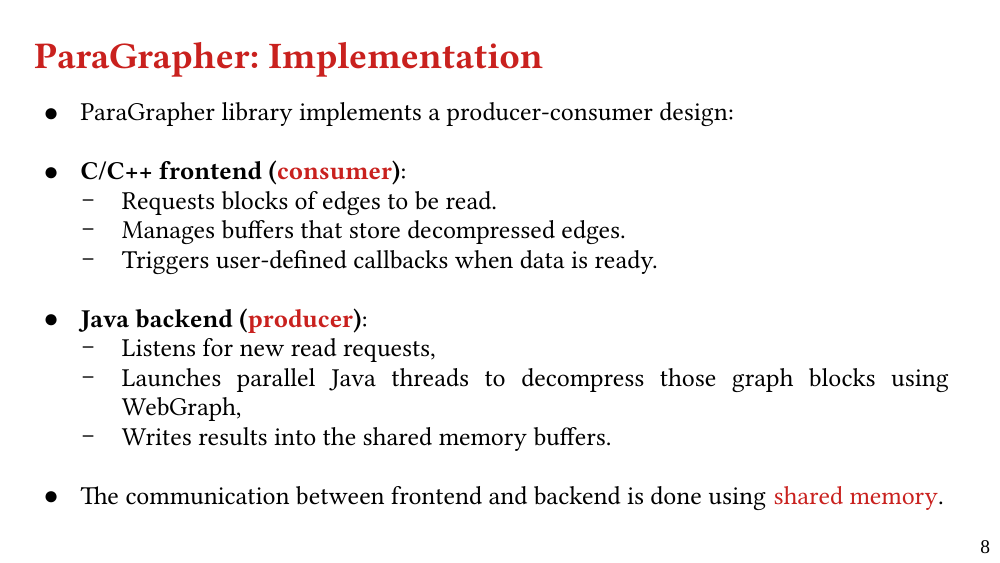
ParaGrapher uses its asynchronous and parallel API to implement these graph types. The user needs to implement a callback function that is called by the API upon completion of reading a block of edges. Poplar uses a shared memory for interaction between its C library and the Java library that deploys the WebGraph framework.
For further details, please refer to Poplar source code repository: https://github.com/DIPSA-QUB/ParaGrapher, particularly, src/webgraph.c and src/WG*.java files.

ParaGrapher

Related Posts

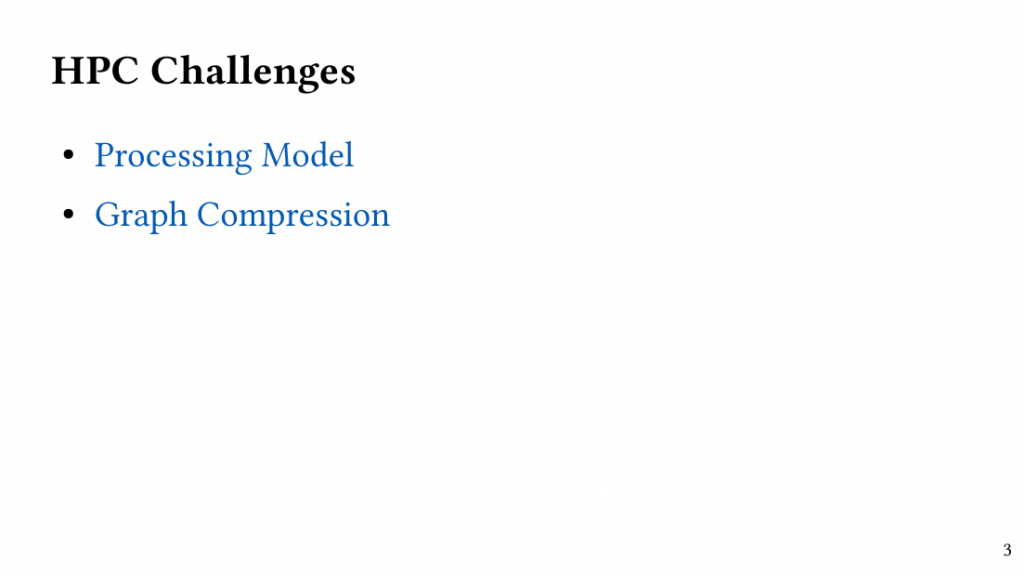
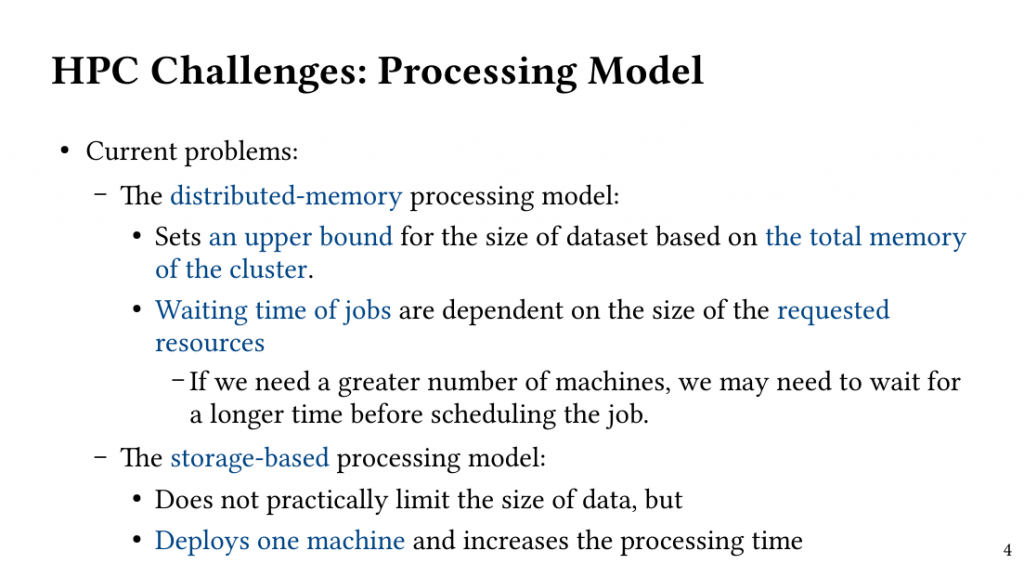
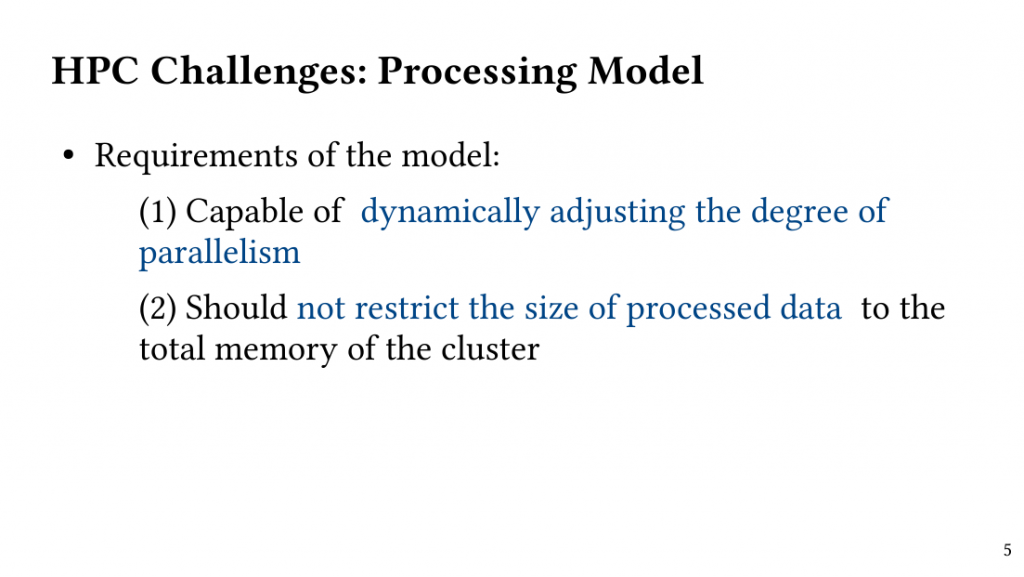
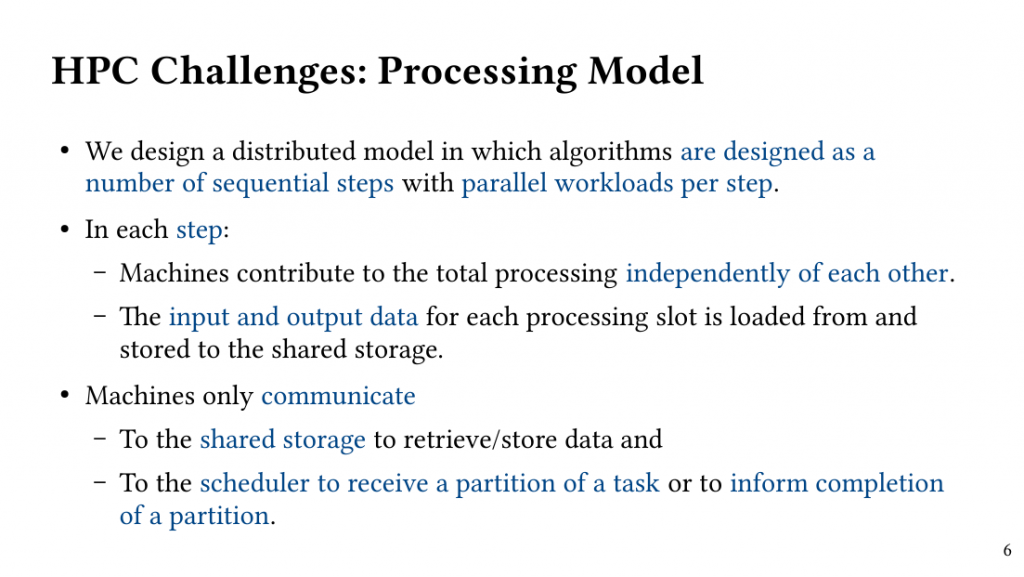
On Overcoming HPC Challenges of Trillion-Scale Real-World Graph Datasets – BigData’23 (Short Paper)

2023 IEEE International Conference on Big Data (BigData’23)
December 15-18, 2023, Sorrento, Italia

DOI: 10.1109/BigData59044.2023.10386309
PDF (Authors Copy)

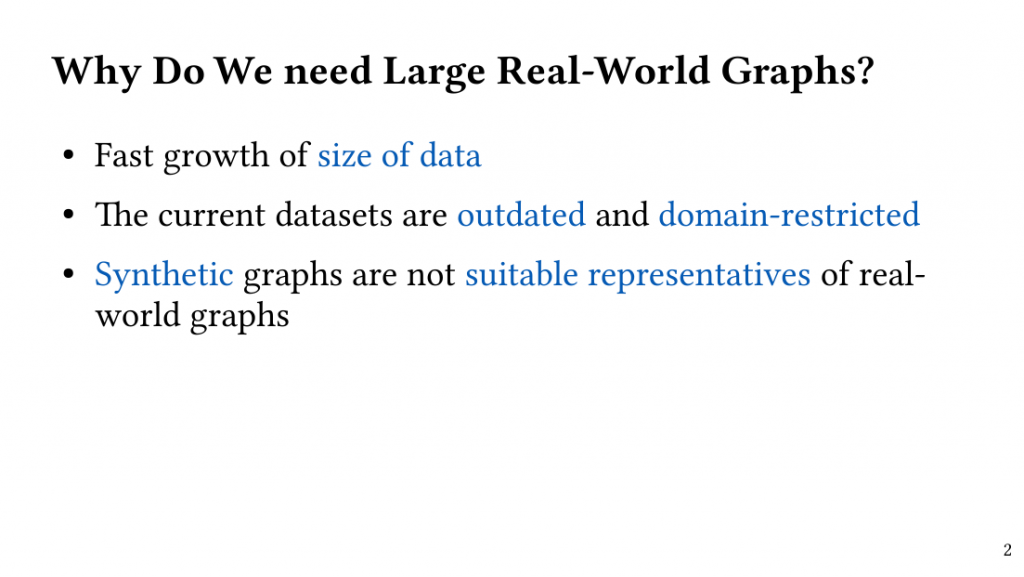
Progress in High-Performance Computing in general, and High-Performance Graph Processing in particular, is highly dependent on the availability of publicly-accessible, relevant, and realistic data sets.

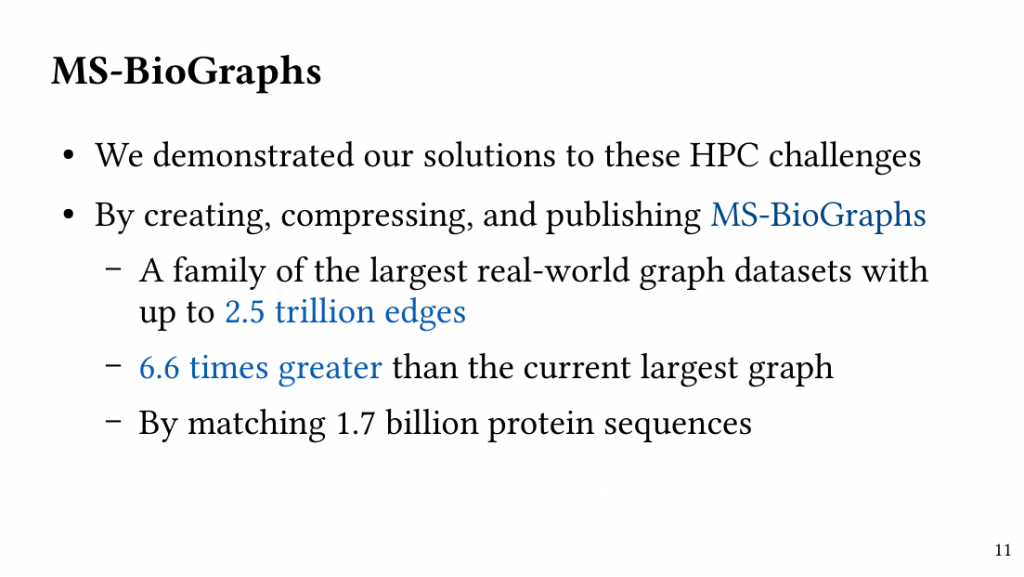
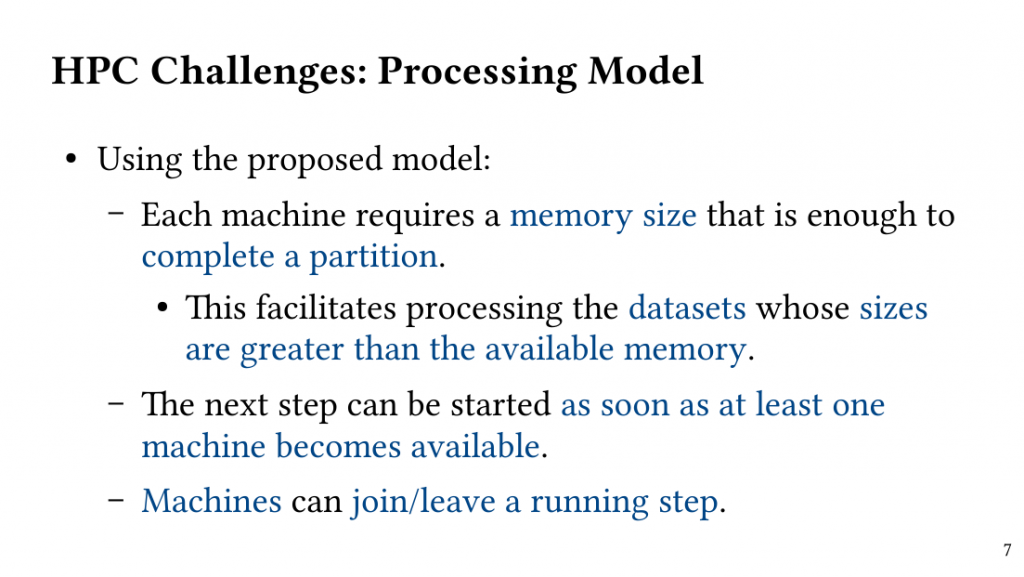
To ensure continuation of this progress, we (i) investigate and optimize the process of generating large sequence similarity graphs as an HPC challenge and (ii) demonstrate this process in creating MS-BioGraphs, a new family of publicly available real-world edge-weighted graph datasets with up to 2.5 trillion edges, that is, 6.6 times greater than the largest graph published recently. The largest graph is created by matching (i.e., all-to-all similarity aligning) 1.7 billion protein sequences. The MS-BioGraphs family includes also seven subgraphs with different sizes and direction types.

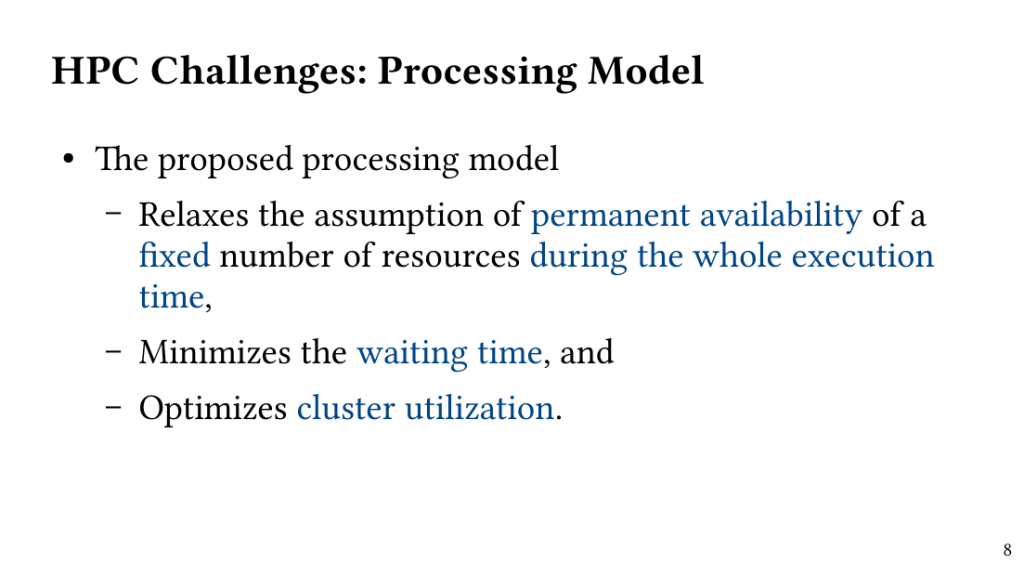
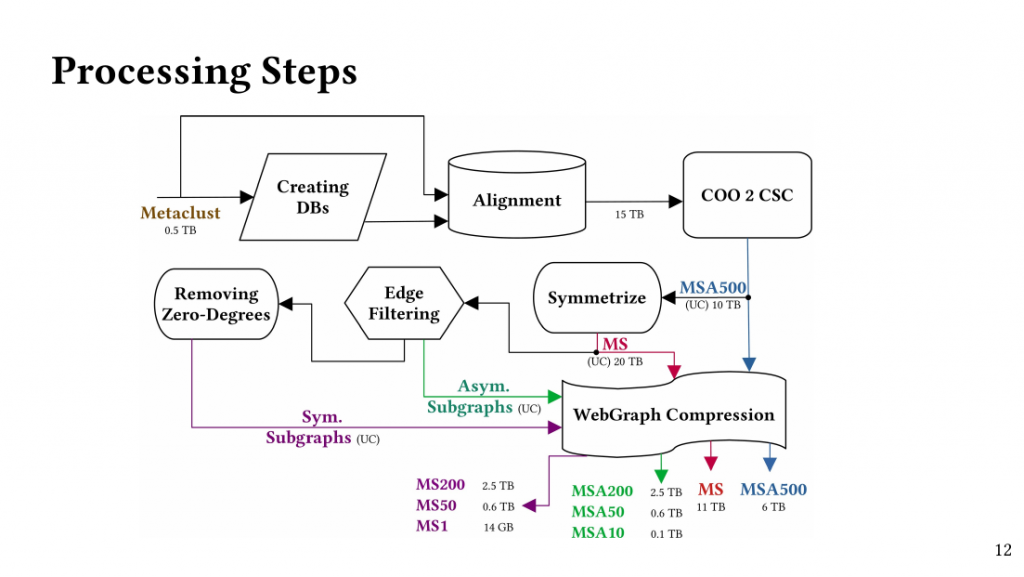
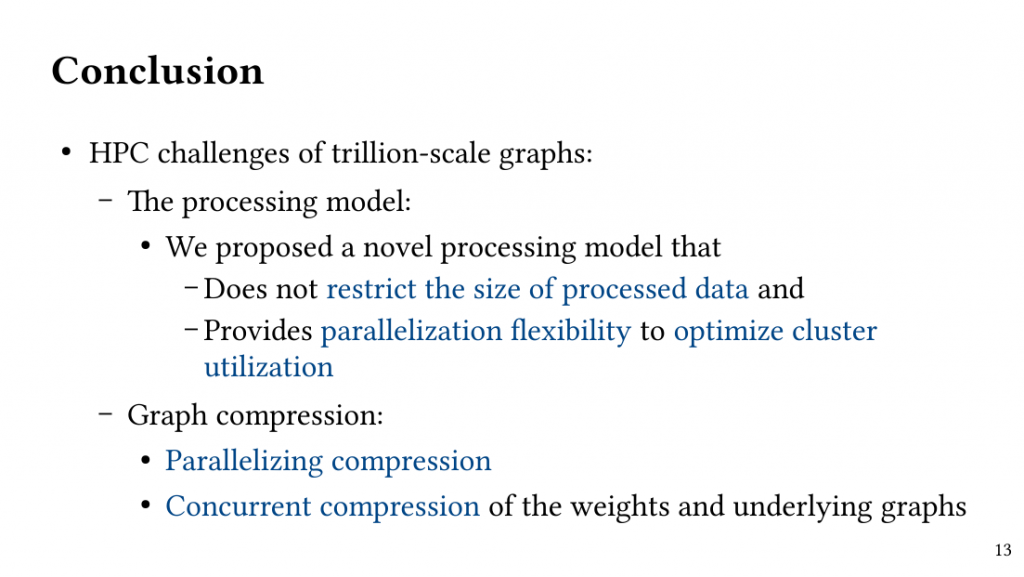
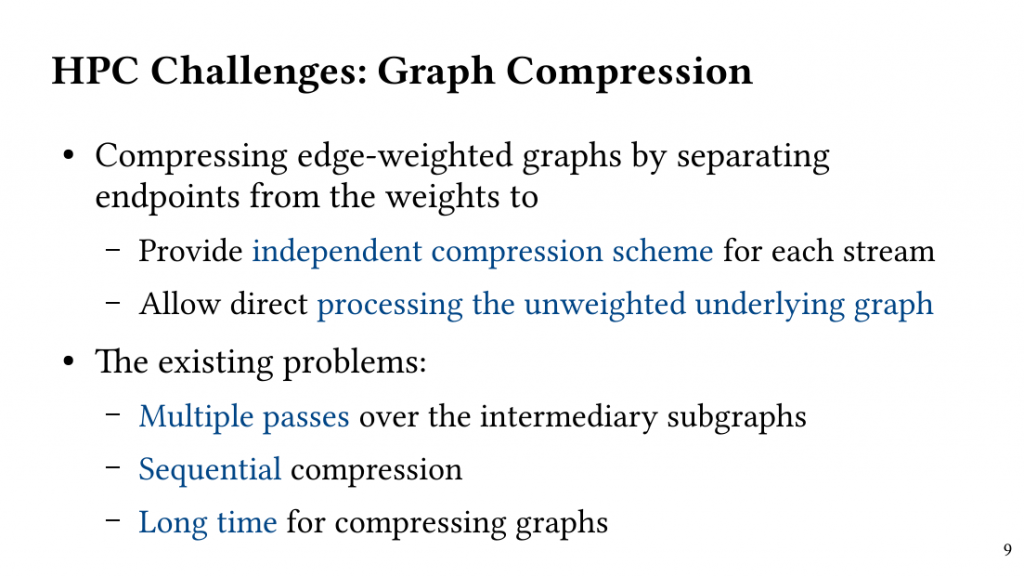
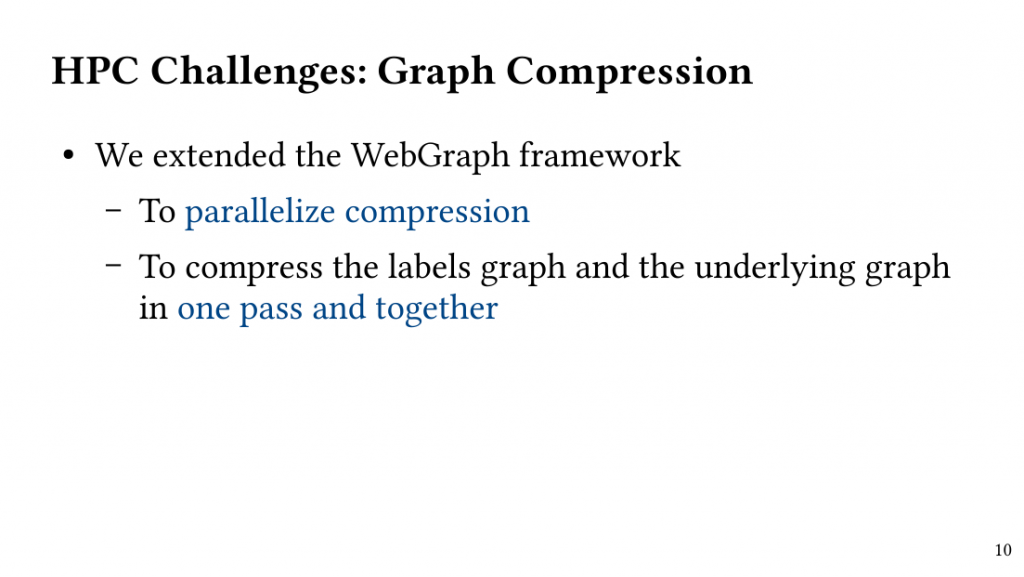
We describe two main challenges we faced in generating large graph datasets and our solutions, that are, (i) optimizing data structures and algorithms for this multi-step process and (ii) WebGraph parallel compression technique.

The datasets are available online on https://blogs.qub.ac.uk/DIPSA/MS-BioGraphs.

BibTex

@INPROCEEDINGS{10.1109/BigData59044.2023.10386309,
   author = {Koohi Esfahani, Mohsen and Boldi, Paolo and Vandierendonck, Hans and Kilpatrick,  Peter and  Vigna, Sebastiano},  
  booktitle={2023 IEEE International Conference on Big Data (BigData'23)},  
  title={On Overcoming {HPC} Challenges of  Trillion-Scale Real-World Graph Datasets}, 
  year={2023},
  volume={},
  number={},
  pages={},
  location={Italia, Sorrento},
  publisher={IEEE Computer Society},
  doi={10.1109/BigData59044.2023.10386309}
}

MS-BioGraphs

Related Posts