

Whereas the literature describes an increasing number of graph algorithms, loading graphs remains a time-consuming component of the end-to-end execution time. Graph frameworks often rely on custom graph storage formats, that are not optimized for efficient loading of large-scale graph datasets. Furthermore, graph loading is often not optimized as it […]
graph processing
37 posts

OrbitSI is an open-source Python framework designed to efficiently solve the subgraph isomorphism enumeration problem, i.e., identifying all subgraphs within a data graph that are structurally identical to a given pattern graph. The tool introduces an orbit-aware pruning and ordering strategy that significantly improves enumeration speed compared to classical algorithms. […]

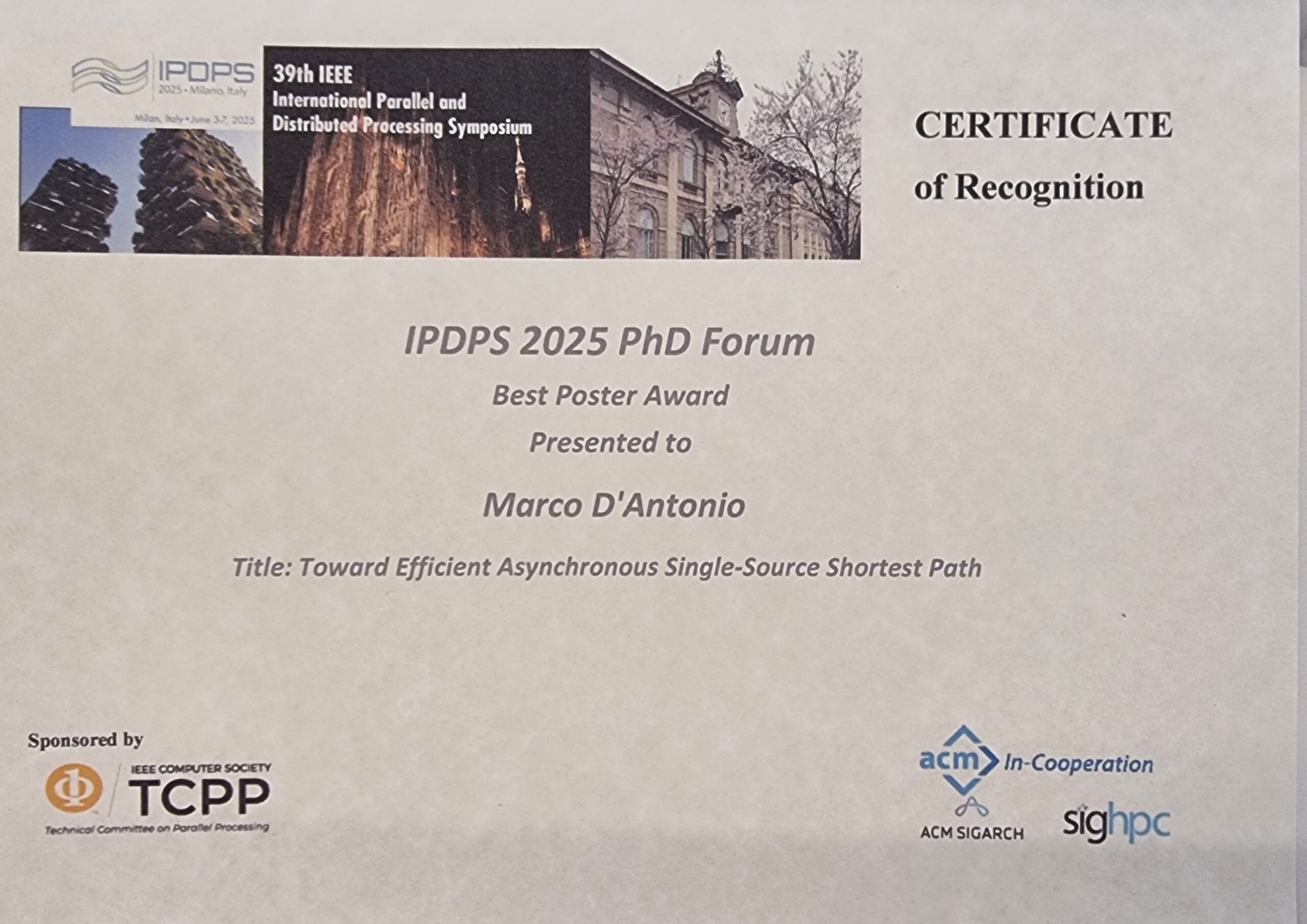
We’re excited to share that Marco has been awarded the Best Poster Award at the IPDPS 2025 PhD Forum! Marco’s winning poster, titled “Towards Efficient Asynchronous Single-Source Shortest Path”, presents Wasp, a novel algorithm that tackles the fundamental Single-Source Shortest Path problem. His approach addresses a key challenge in parallel […]

Two of our papers were accepted at IPDPS’25. Brian will present his work on improving the scalability of parallel molecular dynamics simulation. He has developed a novel way to reduce the scalability bottleneck that exists in the communication between those processes computing short-range forces vs those computing long-range forces. His […]

DOI: 10.48550/arXiv.2501.06872PDF version This paper investigates the shared-memory Graph Transposition (GT) problem, a fundamental graph algorithm that is widely used in graph analytics and scientific computing. Previous GT algorithms have significant memory requirements that are proportional to the number of vertices and threads which obstructs their use on large graphs. […]

PDF versionDOI: 10.48550/arXiv.2507.00716 ParaGrapher is a graph loading API and library that enables graph processing frameworks to load large-scale compressed graphs with minimal overhead. This capability accelerates the design and implementation of new high-performance graph algorithms and their evaluation on a wide range of graphs and across different frameworks. However, […]

To evaluate the impacts of locality-optimizing reordering algorithms, a baseline is required. To create the baseline a random assignment of IDs to vertices may be used to produce a representation of the graph with reduced locality [ DOI:10.1109/ISPASS57527.2023.00029, DOI:10.1109/IISWC53511.2021.00020 ]. To that end, we create the random_ordering() function in relabel.c […]
We use MASTIFF to compute the weight of Minimum Spanning Forest (MST) of MS-BioGraphs while ignoring self-edges of the graphs. – MS1 Using machine with 24 cores. MSF weight: 109,915,787,546 – MS50 Using machine with 128 cores. MSF weight: 416,318,200,808 MS-BioGraphsRelated Posts Technical Posts LaganLighter

In applications such as graph processing, it is important how threads are pinned on CPU cores as the threads that share resources (such as memory and cache) can accelerate the performance by processing consecutive blocks of input dataset, especially, when the dataset has a high-level of locality. In LaganLighter, we […]