Tag Archives: literature

Prizes for Spanish American Literature and the Changing Role of the Author in Society, Friday 11 February 2022 – Seminar Write-up

This post is part of our Research Initiation Scheme for 2021-2022.

On Friday 11th February, Dr Sarah Bowskill (Senior Lecturer in Latin American Studies, QUB) delivered a seminar entitled ‘Prizes for Spanish American Literature and the Changing Role of the Author in Society’ at the 2021-2022 Modern Languages Core Disciplinary Research Group Seminar Series. Dr Bowskill’s talk explored the link between power and literary prestige, focusing particularly on how politics underpins Spanish American literary prizes and award ceremonies, and the role of the author in society.
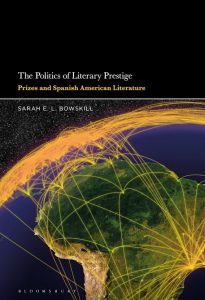
image: cover of Sarah Bowskill’s new monograph

The talk commenced with an overview of the intertwining of literature and politics in Latin America. Dr Bowskill drew on the work of Doris Sommer to explain that in the nineteenth century, post-independence Latin American nations were built by author statesmen, such as Domingo Faustino Sarmiento and Bartolomé Mitre. Writing formed an important part of their political work, and the texts written by these author statesmen were taught in schools, and intended to inspire love for the nation. By the early twentieth century, national prizes for literature were used by the state to further connect literary and political fields. Dr Bowskill highlighted the motivation behind introducing such prizes, since Latin American countries looked to prizes for science and literature as a way to establish international status and national pride.

Continue reading

Modern Languages CDRG Research Showcase 2021: Critical Interactions panel

This post is part of our Research Initiation Scheme for 2020-2021.

On the 25th of June 2021, Dr Dominique Jeannerod (PhD supervisor in French at Queen’s University), Dr Ashley Harris (former PhD student and departmental colleague until end of June 2021) and Ciara Gorman (current PhD supervisee) delivered a session entitled ‘Critical Interactions’ at the Modern Languages CDRG Research Showcase 2021. The trio of speakers aimed to highlight how their different respective research objects share structural and methodological affinities translating into common lines of enquiries. The overarching title for their collaborative paper, a preview of a joint panel at the (then) upcoming Society for French Studies conference 2021, was ‘Crime on the Margins: Peripheries, Alienation and Criminalisation of Women’. Whilst each of the three researchers is investigating different time periods and corpuses of French crime fiction, film and media, their papers incorporate many cross-cutting themes. These parallels include marginalization as well as space, place and liminality.

Continue reading

Modern Languages CDRG Research Showcase 2021: Lived Experiences Roundtable

This post is part of our Research Initiation Scheme for 2020-2021.

While the importance of research has been placed centre stage during the current Coronavirus crisis, it is often still valorised solely based on quantifiable impact. The Modern Languages Research Showcase, held on Friday 25 June 2021, emphasized how research undertaken in the Modern Languages Core Disciplinary Research Group goes beyond this reductive ideal to be informed by and interrogate real lived experiences, both that of researchers themselves and those of others. The Lived Experiences roundtable, chaired by Dr Rosalind Silvester and Dr. Steven Wilson, foregrounded this multi-directional focus through two PhD students’ work.

Kathryn Nelson defies research’s perceived narrow focus in her trans-disciplinary project examining the role of cultural intermediaries in distributing environmental artwork in Northern Ireland. A practising artist, informed by her MSc in Ecological Management and Conservation and by her childhood connection to nature in South Devon, she articulated her lived experience of its woods and coastline through video, an experience she fears will not be shared by children today. Her own installations have tackled what she called ‘regime shifts’ (Scheffer et. al. 2009), where the smallest details accumulate to form tipping points of irreversible damage, narrating the linear past, present and future life of our oceans, underlining how solutions to these problems are cultural. We must reimagine our culture/nature divide to forge a new eco-culture where all of us understand our unique place in the biome. This was brought to the forefront in the Tate Modern’s exposition of Damien Hirst’s In and Out of Love where curators culturally sanctioned the consumption of the lived experience of dying butterflies for aesthetic pleasure as ‘good art’ and led to our misunderstanding of the vital role these animals play. Far from art being for art’s sake, we depend on cultural intermediaries to influence our understanding of this new world through revaluations of the relationship between consumer and art.

Fig. 1 (left): Current Inshore Marine Life with Taxonomic Labels
Fig. 2 (right): Possible Future – Simplified Marine Life with No Labels… (Artwork by Kathryn and Roy Nelson)

Continue reading

Postgraduate student interviews: Laura Kennedy (PhD, French)

This post is part of our Research Initiation Scheme for 2020-2021.

From Paris to London to Queen’s, we caught up with Laura Kennedy to learn about her global PhD French project and her advice for undergraduates considering postgraduate study.

Q. What has your journey to PhD been like?

Laura Kennedy, personal archive

It’s been enjoyable, but unexpected. My B.A was in French studies at the University of London Institute in Paris. In my final year, I took a French colonialism class, and became really interested, particularly in Algeria. My interests have always been in literature and postcolonial literature was the perfect overlap. I did my final year dissertation on Kamel Daoud and his book Meursault, contre-enquête.  The next step for me was to get a theoretical base of postcolonial scholarship. Once I graduated, I worked for a year in Paris and researched Masters programs. I found SOAS University of London. They did a Masters in Comparative Literature of Africa and Asia which I completed in 2020. SOAS was a watershed moment for me academically; I could focus in on my interests which I came to realize were language politics and postcolonial novels. Once I realized this, I put PhD proposals together – I wasn’t going to stop after the Masters. I felt like I would be an outsider coming to Queen’s at PhD. I’m happy to be mistaken on that. Within weeks, I felt welcome and part of the community.

Continue reading