Tag Archives: French

Postgraduate student interviews: Jordan McCullough (PhD, French)

This post is part of our Research Initiation Scheme for 2020-2021.

Interview with Jordan McCullough, second year PhD student at QUB.

Jordan McCullough, personal archive

So, Jordan, what has been your university trajectory so far?

I studied French and Spanish at Queen’s, then continued on to do an MRes, with a dissertation examining end of life care in France, from the perspective of the patient and their family. While completing this, I felt like I would like to take things further and see where it might take me. I applied for PhD funding whilst I was still doing my MRes, got funded by Northern Bridge and here I am now, in the second year of my PhD!

What is the topic of your current research project?

My project looks at parental grief narratives, that is, writing by parents who have lost children for a variety of different causes, such as terminal illness, suicide, violent death, terrorist attacks or even accidental death. There are a wide range of causes of death but what I’m trying to do with that is to find out, first of all, what makes the parents write; what do they get out of it themselves, and what do they give to their children through this idea of continuing bonds and ongoing legacy, and secondly, what drives these parents to go beyond writing for themselves and their child and publish their text, and what changes when there’s a readership and an audience involved.

What has been the most interesting part of your research so far?

By far, the most interesting aspect of my research journey has been the short placement I undertook with the regional paediatric palliative care team in Brittany. It was wonderful to see how my research might have some sort of positive impact in the everyday lives of parents grieving the loss of their child. I learnt a lot from the staff at the unit and I think I was able to give something back in return. All being well, I hope to get back across to France next year to spend some more time with the team.

Continue reading

Postgraduate student interviews: Laura Kennedy (PhD, French)

This post is part of our Research Initiation Scheme for 2020-2021.

From Paris to London to Queen’s, we caught up with Laura Kennedy to learn about her global PhD French project and her advice for undergraduates considering postgraduate study.

Q. What has your journey to PhD been like?

Laura Kennedy, personal archive

It’s been enjoyable, but unexpected. My B.A was in French studies at the University of London Institute in Paris. In my final year, I took a French colonialism class, and became really interested, particularly in Algeria. My interests have always been in literature and postcolonial literature was the perfect overlap. I did my final year dissertation on Kamel Daoud and his book Meursault, contre-enquête.  The next step for me was to get a theoretical base of postcolonial scholarship. Once I graduated, I worked for a year in Paris and researched Masters programs. I found SOAS University of London. They did a Masters in Comparative Literature of Africa and Asia which I completed in 2020. SOAS was a watershed moment for me academically; I could focus in on my interests which I came to realize were language politics and postcolonial novels. Once I realized this, I put PhD proposals together – I wasn’t going to stop after the Masters. I felt like I would be an outsider coming to Queen’s at PhD. I’m happy to be mistaken on that. Within weeks, I felt welcome and part of the community.

Continue reading

The Contact Zones of Disease, 16 October 2020 – Seminar write-up

This post is part of our Research Initiation Scheme for 2020-2021.

On Friday 16th October 2020, Dr Steven Wilson (French, QUB) gave a talk on his research on ‘The Contact Zones of Disease: Sites of Infection and Contagion in the Nineteenth-Century French Syphilis Narrative’. This seminar talk was the first of the Semester 1 Modern Languages Core Disciplinary Research Group series. The talk centred on how we use the language of infection, infestation and warfare to talk about the diseased body, the concept of borders in our understanding of disease, and the representations of syphilis in 19th century French literature.

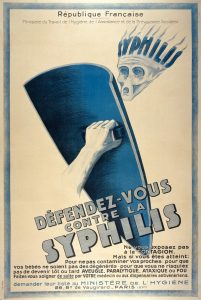
Credit: A shield to protect against syphilis represented as a skull. Lithograph, 1924/1930. Credit: Wellcome Collection. Attribution 4.0 International (CC BY 4.0)

I found the introduction of the talk to be particularly interesting as, using an example from Donald Trump, Dr Wilson described how the American President uses the language of infestation to talk about immigrants, saying that they ‘infest’ the country. This language would normally be used to describe a poisonous insect or animal, but Trump uses it to express his fear of immigrants crossing the border and, more importantly, to mark them as a threat to public health. Derogatory language like this is unpleasant to hear, but it is not a new concept. For centuries, we have been using the language of infectious diseases to describe the borders and boundaries that mediate human contact. Even now, amidst the coronavirus pandemic, travellers crossing borders must quarantine to prevent the spread of the disease, and positive cases are forced to isolate. All of this causes us to regard the diseased body as the dangerous body, something that must be contained in order to protect the lives of others, and a border as something that keeps us safe. Moreover, Western societies are obsessed with the image of disease-carrying immigrants and feel threatened by the idea of the ‘contact zone’, or the spaces where cultures meet. The deadliest pandemic of the 20th century was called the Spanish influenza as the first cases were diagnosed in Spain, and even today, we have the ‘Chinese virus’, as labelled by Trump. These examples highlight how the language of borders is deeply ingrained in how diseases are represented and understood.

Continue reading