This post is part of our Research Initiation Scheme for 2023-2024.
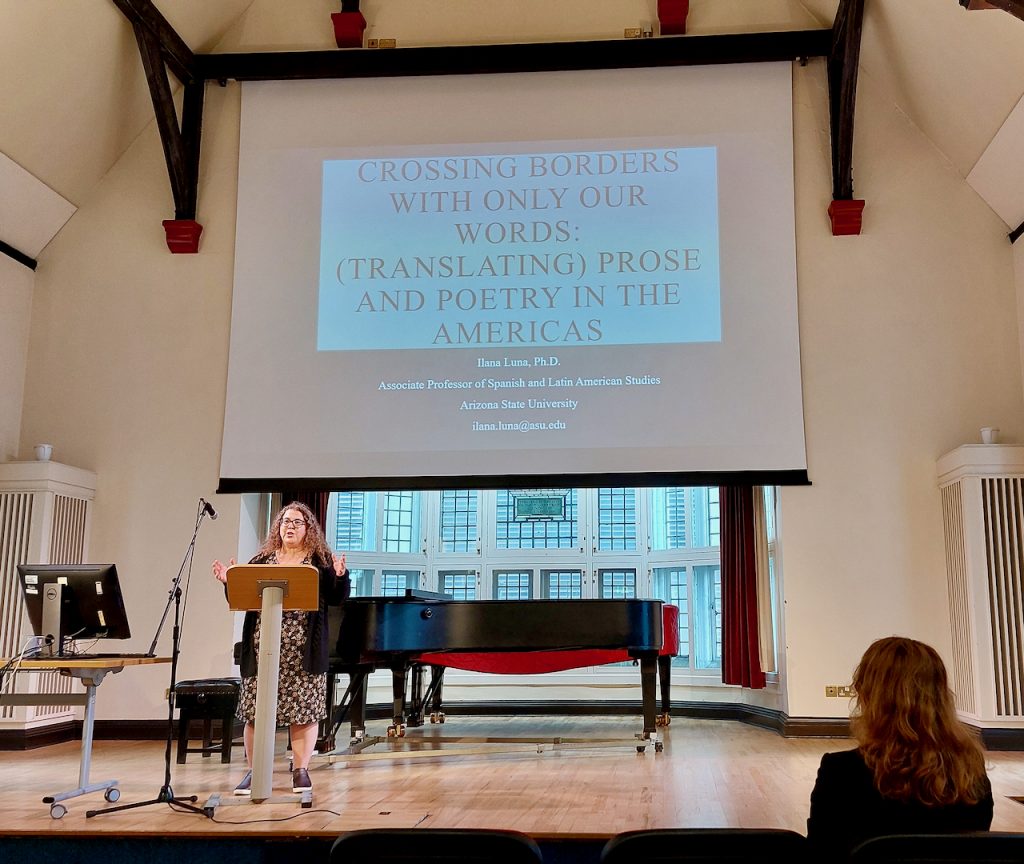
On Friday 24th May 2024, Dr Ilana Luna, Associate Professor of Spanish and Latin American Studies at Arizona State University, delivered the keynote speech at the 2024 Modern Languages Core Disciplinary Research Group Showcase on the importance of translation in human understanding of our global neighbours. Her interdisciplinary approach brought together her interest in Latin American studies, feminist writing, poetry and translation. In her paper Dr Luna drew on her extensive experience as a translator (she was shortlisted for the inaugural Sarah Maguire Prize for Poetry in Translation in 2021 for her edition of Judith Santopietro’s Tiawanaku) and her work as an Associate Editor for Cardboard House Press in Phoenix, Arizona. She noted the importance of small presses to the literary landscape of today especially when it comes to the role they play in supporting texts in translation.
In her paper, as in her book Adapting Gender: Mexican Feminisms from Literature to Film (SUNY Press, 2018), which looks at the historical role of women in the Mexican film industry and how this ruptures stereotypes in the broader socio-political context of Mexico, Dr Luna sought to build bridges by creating conversations among people and texts prompting them to think about what it means to cross borders with only our words.
In her keynote speech, Dr Luna rejected the idea of a pristine, pure translation which as linguists we all grapple with. She described the process of translation as being simultaneously in oneself and outside oneself as it is a radical act of listening and interpretation. Throughout her presentation she drew on many examples of her translation of poetry, including Una vez que la leña se hubiera terminado [Once the firewood had finally burned out] by Cristián Gómez Olivares and Independencia del apátrida [Independence for the stateless] by Mauricio Espinoza. These poems reflect the touching reality of thousands of people who struggle to feel a sense of belonging to a nation because of their borderland experience.
A key element of the talk focused on Dr Luna’s collaboration with Norma Klahn in their translated edition of Carlos Monsiváis’ collection of essays Misógino feminista – recently published in English as Fatefully, Faithfully, Feminist: A Critical History of Women, Patriarchy, and Mexican National Discourse (Vanderbilt University Press, 2024). Dr Luna revealed the details of her collaborative process with Norma Klahn and how they worked through each essay line by line. She noted the challenges that came with maintaining the voice and spirit of Monsiváis’ prose as well as trying to make it meaningful for those who may not be familiar with cultural references in the text. Although they date from the 1970s to the 2000s, the essays in the collection still speak to contemporary issues in present-day Mexico such as women’s fight for bodily autonomy and freedom from violence as well as the inequity of indigenous people and the hierarchy of languages. On her reflection about Monsiváis’ work, she expressed her sadness at what is happening in the United States currently with the undermining of human rights and how this motivated her to translate this work as she believes rights can be gained by representation.
Dr Luna also reflected on her experience growing up as a grandchild of immigrants and being raised on the East Coast of the United States. She is now living in Phoenix, Arizona, where Spanish is spoken everywhere. She noted the fact that on the United States border English and Spanish are spoken, making them entirely intertwined. Therefore, she concluded that no language is an island in itself – they all contain other languages.
Dr Luna’s keynote speech brought attention to how translation acts as a mode and how we use language as a daily political practice and even a form of opposition. Dr Luna argued for the strength of alliances that come from the radical act of listening that is translation. This is something all linguists should consider.
I would like to take this opportunity to think Dr Luna for her informative and thought-provoking keynote speech.
Write-up by Erin Nelson, final-year undergraduate in Anthropology and Spanish