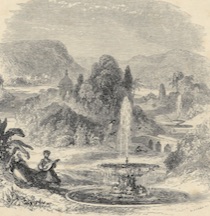
The ERIN radio documentary “An oriental romance: Thomas Moore’s Lalla Rookh” will be broadcast on the Lyric Feature on Sunday 10 September at 6pm on RTÉ Lyric fm. The documentary outlines the story of Moore’s Lalla Rookh and focuses on the variety of musical works it inspired. The documentary, which was produced in collaboration with Dublin-based Rockfinch Ltd., has been in preparation since June 2016. Contributors to the programme include the following:
Spoken Contributors: Dr Daniel Roberts (QUB), Dr Sarah McCleave (QUB), Dr Tríona O’Hanlon (QUB), Siobhán Fitzpatrick (RIA Library), Gerry Long (National Library of Ireland), Aoife O’Sullivan (DIT), Martha O’Brien (DIT), Sinéad Campbell-Wallace (DIT), Helen Aiken (QUB), Anja Bunzel (NUIM)
Artistic Contributors: Dr Sarah McCleave (QUB), Dr Tríona O’Hanlon (QUB), Sinéad Campbell-Wallace (DIT)
Image courtesy of Special Collections and Archives, Queen’s University Belfast
A collection of no fewer than forty-one sound files from three performance events, promoted by and supported by project ERIN, will be made available soon through our project website. The first was a Lalla Rookh bi-cententary concert performed (and also recorded) by year 3 students in the BMus of Queen’s University Belfast, which took place in the Harty Room on 11 May 2017. We re-told the story of Lalla Rookh through a selection of songs and pieces taken from larger works inspired by, or based on, Moore’s oriental romance. The selected recording is an arrangement of the ‘Slow March’ from Frederic Clay’s 1877 cantata Lalla Rookh, performed here by flautists Ciara Jackson and Poppy Wheeler, violinist Linzi Jones, and clarinettist Gerard Mullay. The recording engineer is Jason Jackson.
Further audio files from this concert feature the music of Félicien David, Robert Schumann, Thomas Attwood, Charles Villiers Stanford, and Sir John Stevenson, among others.
The second sound file is taken from the second concert to mark the bi-centenary of Lalla Rookh, at the Sonic Lab in SARC, Queen’s University Belfast, on 17 June 2017. Performers Helen Aiken (mezzo), Martha O’Brien (mezzo), and Aoife O’Sullivan (piano) performed music by Schumann, Stanford, John Francis Barnett and George Kiallmark, among others. Fiddle player Conor Caldwell provided a medley of his own arrangements and those of Tommy Potts to tunes associated with Thomas Moore. In the sample provided here, Helen Aiken and Aoife O’Sullivan (as recorded by David Bird) perform Danish composer George Gerson’s “Tell me not of joys above”. The lyrics are derived from an episode near the end of Thomas Moore’s Lalla Rookh: the princess and her beloved poet are estranged; he sings this touching song to her whilst hidden in a tree.
Over thirty additional tracks — many of music that is rarely heard — will be available on the project website soon. We will also offer some recordings of favorite Irish Melodies in distinct settings or editions.
Project ERIN is participating in a number of events in spring 2017 to mark the publishing bicentenary of Thomas Moore’s Lalla Rookh. These include:
10 May, 13:00-14:00. ‘Moore’s influence on Europe’s music networks through the Irish Melodies and Lalla Rookh’. Seminar by Triona O’Hanlon and Sarah McCleave. Venue: McMordie Hall, Music, Queen’s University Belfast, University Square. Open to the public; no tickets required.
11 May, 13:10-14:25. A concert of Lalla Rookh-inspired music by composers such as Charles Villiers Stanford, Robert Schumann, Félicien David, and Sir John Stevenson. Venue: Harty Room, Music, Queen’s University Belfast, University Square. Open to the public; no tickets required.
15 May, 16:30-17:30. ‘Dublin publications and stage representations: a survey of Moore’s Irish Melodies and Lalla Rookh’. Seminar by Triona O’Hanlon and Sarah McCleave. Venue: Seminar room, Institute of Irish Studies, Queen’s University Belfast, 6-8 Fitzwilliam Street. Open to the public; no tickets required.
27 May, 10:00. ‘Spontini’s Lalla Rûkh and the subsequent response of European composers to Thomas Moore’s Lalla Rookh’. Conference paper by Triona O’Hanlon and Sarah McCleave, for the ‘Lalla Rookh Bicentenary Symposium’, organised by Justin Tonra. Venue: Marsh’s Library, Dublin. For tickets see “Event Brite”.
17 June, 14:00-16:00. ‘The European Response to Thomas Moore’s Lalla Rookh’, plenary lecture by Triona O’Hanlon and Sarah McCleave, for the annual conference of the Society for Musicology in Ireland. To be followed by a concert of works inspired by Lalla Rookh, by cmposers such as Henry Bishop, Frederic Clay, John G. Klemm and Robert Schumann, featuring mezzo sopranos Helen Aiken and Martha O’Brien, as well as pianist Aoife O’Sullivan. Venue: Music, Queen’s University Belfast. Open to conference delegates only; for further details see: http://qub.ac.uk/sites/smi2017/
During summer 2017 a radio documentary on Moore’s Lalla Rookh, produced by Rockfinch productions, will be produced on RTÉ Lyric. This will feature some material from the 17 June concert, as well as contributions by speakers including Anja Bunzel, Siobhan Fitzpatrick, Sarah McCleave, Triona O’Hanlon, and Daniel Roberts.
The Department of Music at Queen’s University Belfast is running a new module in spring 2017, called ‘A Night at the Opera’. For this module, final-year BMUS students collaborate on a concert for their assessed project. The core text for this year’s cohort of sixteen students is none other than Moore’s ‘Lalla Rookh’ (1817), which inspired numerous songs (for the domestic market), cantatas (for choral societies of the time), and operas (for opera houses in Dublin, Paris, London, Dresden, etc.) from the early romantic period through to the Edwardian era. With two sopranos, a mezzo, one tenor, one bass, two pianists, two violins, and one each playing flute, clarinet, and oboe, we will have to arrange some of the existing music to suit our forces. So some of the students are performing, some are arranging music, and others will be acting as presenters to provide a narrative as well as some visual display to support the selection of music. One of the students, who has taken sound engineering modules in our BSc, will record the event to add to the ERIN project website. At our planning meeting last week we came up with a provisional list of repertory, which will be refined further over the next couple of weeks as we begin rehearsals.
Cover, Lalla Rookh: an oriental romance, illustrated by John Tenniel
Provisional Programme
Part I. Lalla Rookh and Feramors
Ballet music from Anton Rubinstein’s opera Feramors (Dresden, 1863)
“Sous le feuillage” from Félicien David’s comic opera Lalla Roukh (Paris, 1862)
“I’ll sing thee songs of Araby” from Frederic Clay’s cantata Lalla Rookh (Brighton, 1877)
Part II. The Veiled Prophet
‘Bendermeer’s Stream’ from Charles Villiers Stanford’s opera The Veiled Prophet of Khorassan (Hanover, 1881).
Part III. Paradise and the Peri
“Vom Eden’s Thor”, from Robert Schumann’s oratorio, Das Paradies und die Peri (Leipzig, 1843)
“The glorious Angel” (recit.) > “Nymph of a fair but erring race” (aria)
“Sweet said the Angel” (arietta)
“True was the maiden” (recit and arietta), from John Barnett’s cantata, Paradise and the Peri (pub. London, 1870)
“Schumcket die Stufen zu Allahs Thron”, from Schumann, Das Paradies und die Peri
The Peri Pardon’d, cantata by John Clarke (pub. London, 1818)
Part IV. The Fire Worshippers
“Her hands were clasped”, a recit.-aria by Thomas Attwood (pub. London, 1818)
“’Twas his own Voice”, recit.-aria by Sir John Stevenson (pub. London, 1817)
“Farewell to thee Araby’s Daughter”, duet for soprano and tenor by Lady Flint, Five Songs from Lalla Rookh (pub. London, 1818)
Part V. The Light of the Harem
‘Namouna’s Song’ “I know where the winged visions dwell”, from Lady Flint, Five Songs.
“Fly to the Desert”, song by George Kiallmark (pub. London, 1817)
Image courtesy of Special Collections, McClay Library, Queen’s University Belfast
NB: Future blog posts may be written by some of the students enrolled in ‘A Night at the Opera’.
Manage Consent
To provide the best experiences, we use technologies like cookies to store and/or access device information. Consenting to these technologies will allow us to process data such as browsing behavior or unique IDs on this site. Not consenting or withdrawing consent, may adversely affect certain features and functions.
Functional
Always active
The technical storage or access is strictly necessary for the legitimate purpose of enabling the use of a specific service explicitly requested by the subscriber or user, or for the sole purpose of carrying out the transmission of a communication over an electronic communications network.
Preferences
The technical storage or access is necessary for the legitimate purpose of storing preferences that are not requested by the subscriber or user.
Statistics
The technical storage or access that is used exclusively for statistical purposes.The technical storage or access that is used exclusively for anonymous statistical purposes. Without a subpoena, voluntary compliance on the part of your Internet Service Provider, or additional records from a third party, information stored or retrieved for this purpose alone cannot usually be used to identify you.
Marketing
The technical storage or access is required to create user profiles to send advertising, or to track the user on a website or across several websites for similar marketing purposes.