
Whereas the literature describes an increasing number of graph algorithms, loading graphs remains a time-consuming component of the end-to-end execution time. Graph frameworks often rely on custom graph storage formats, that are not optimized for efficient loading of large-scale graph datasets. Furthermore, graph loading is often not optimized as it […]
Yearly archives: 2025
18 posts
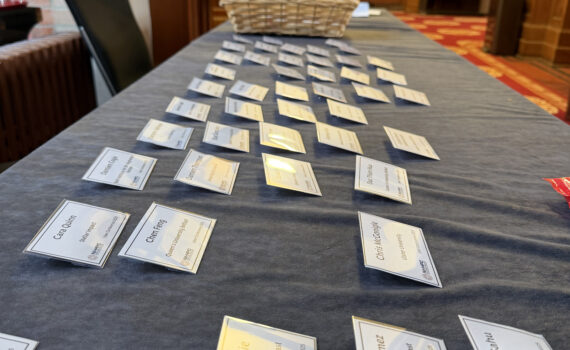
We attended the NI-HPC conference held on 4 November 2025 at Riddel Hall, Queen’s University, Belfast. Hans Vandierendonck presented and talked about the Kelvin Living Lab and aspects of sustainable computing, and Giuliana Cabrera, a summer intern from Massachusetts Institute of Technology, USA, presented the initial studies on URJA. The […]

OrbitSI is an open-source Python framework designed to efficiently solve the subgraph isomorphism enumeration problem, i.e., identifying all subgraphs within a data graph that are structurally identical to a given pattern graph. The tool introduces an orbit-aware pruning and ordering strategy that significantly improves enumeration speed compared to classical algorithms. […]


The “black box” nature of many AI models causes hesitation in trusting their predictions, especially in sensitive fields like medicine and finance, where interpretability and accountability are essential. Overcoming this challenge has become a central focus in AI development. Time series classification (TSC) is a critical task with numerous real-world […]
21 February 2024 Abstract Numerical software is being reinvented to provide opportunities to tune dynamically the accuracy of computation to the requirements of the application, resulting in savings of memory, time, and energy. Floating point computation in science and engineering has a history of “oversolving” relative to expectations for many models. So often are real datatypes defaulted to double […]
9 May 2025 Abstract As computing power demands continue to grow, achieving energy efficiency in high-performance systems has become a key challenge. One of the most promising software techniques for energy efficiency is Dynamic Voltage and Frequency Scaling (DVFS) which optimize the energy-performance trade-off by changing hardware frequencies. This presentation […]
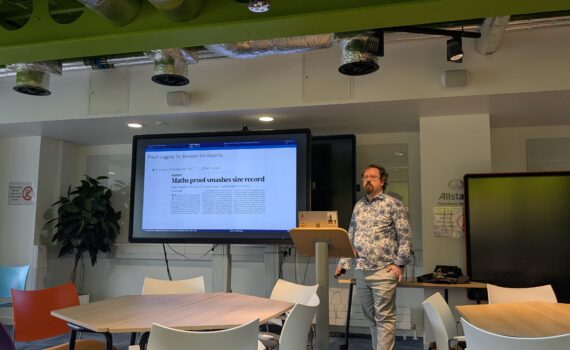
28 August 2025 Abstract Constraint programming is a declarative way of solving hard combinatorial, scheduling, resource allocation, and logistics problems. We specify a problem in a high-level language, give it to a solver, and the solver thinks for a while and then gives us the optimal answer. Unfortunately, even the […]

We attended the CLUSTER 2025 conference organised at the University of Edinburgh, Scotland, United Kingdom, between 2 and 5 September 2025. Syed Tauhidi presented a poster on NI-ORCA, a parallel algorithm designed for multi-core processors to efficiently count non-induced graphlet orbits up to four-clique (K4). Extending the existing ORCA framework, […]

The FERNS project is an MSCA Doctoral Network aiming to design eco-friendly electronics and accelerate their uptake. This multi-disciplinary project spans across the fields of material science, engineering, social science and business to acquire a holistic perspective of the field of sustainable electronics. In DIPSA, we will investigate the system […]