
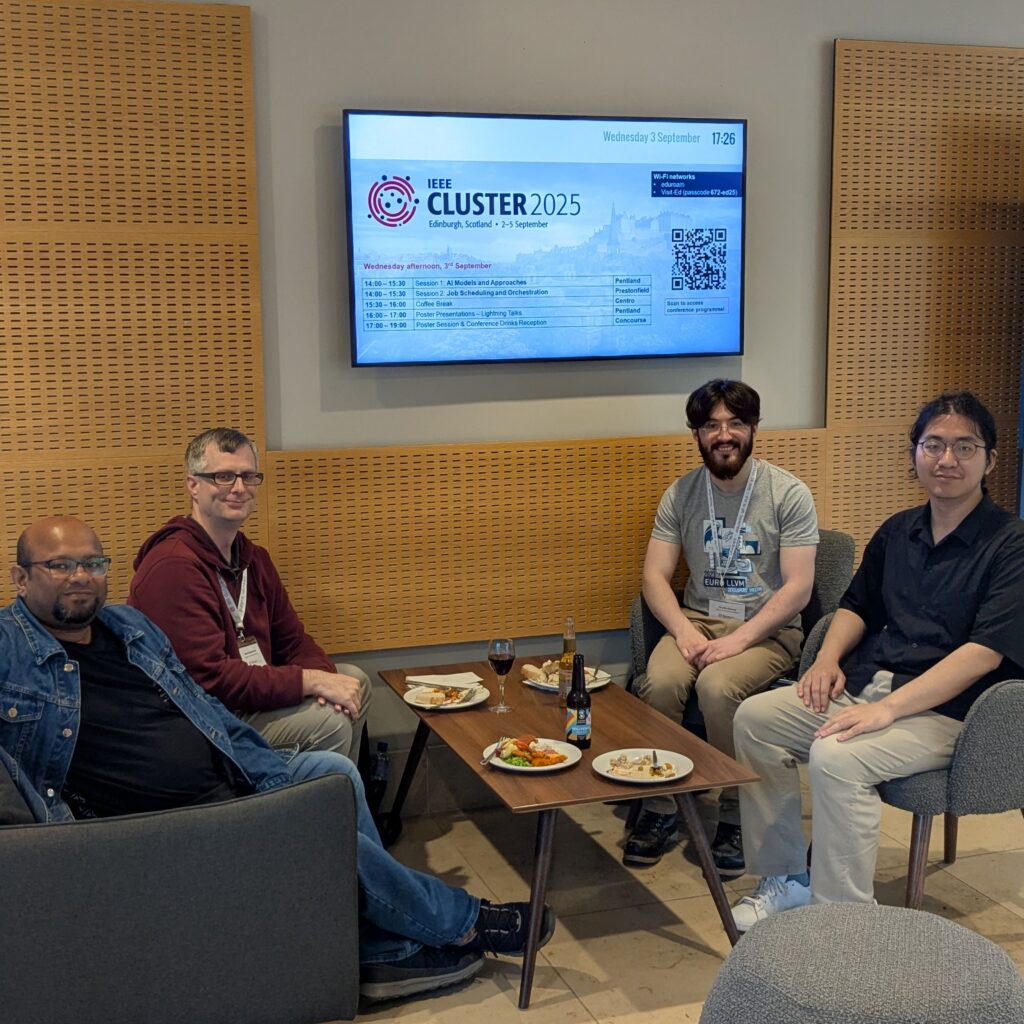

We attended the CLUSTER 2025 conference organised at the University of Edinburgh, Scotland, United Kingdom, between 2 and 5 September 2025.
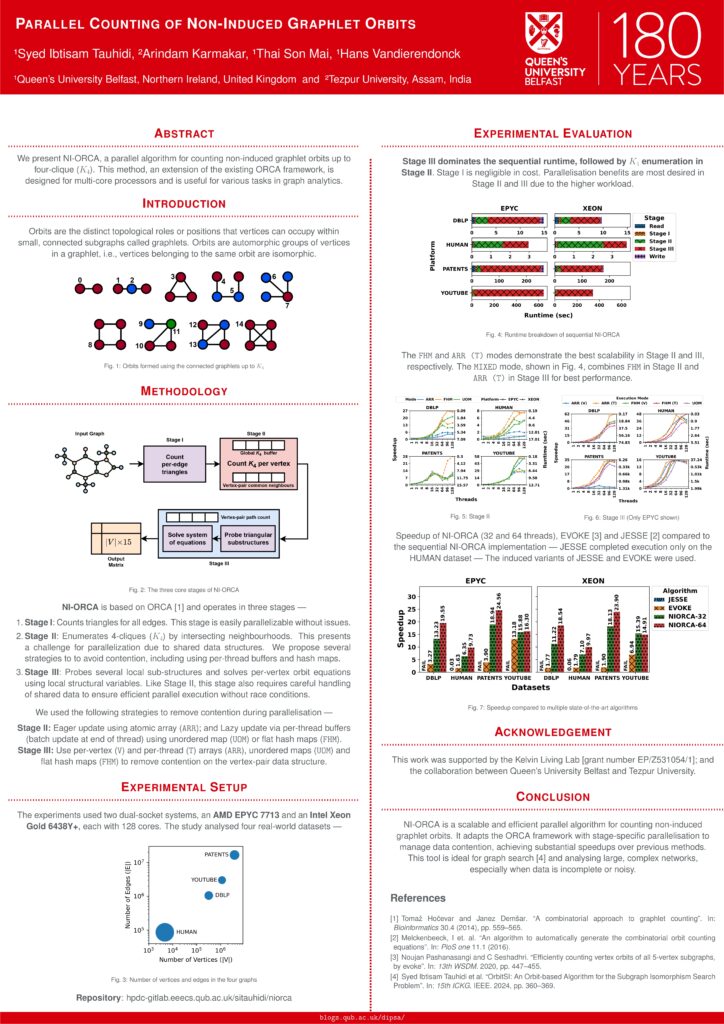
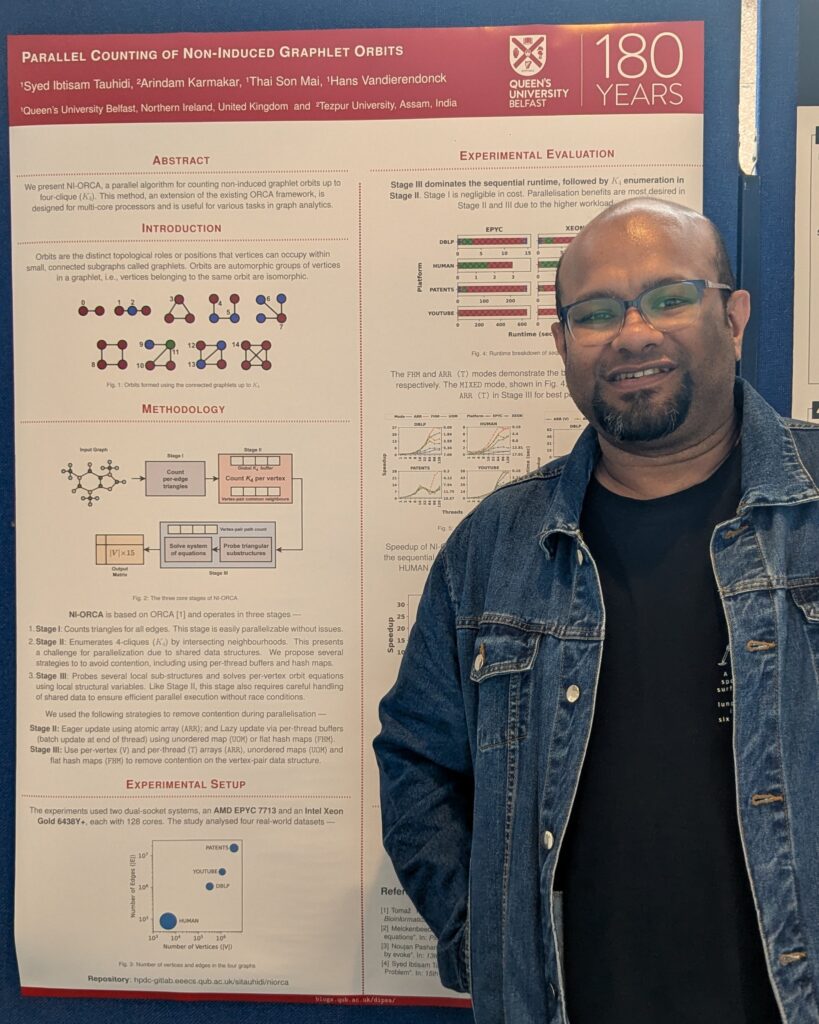
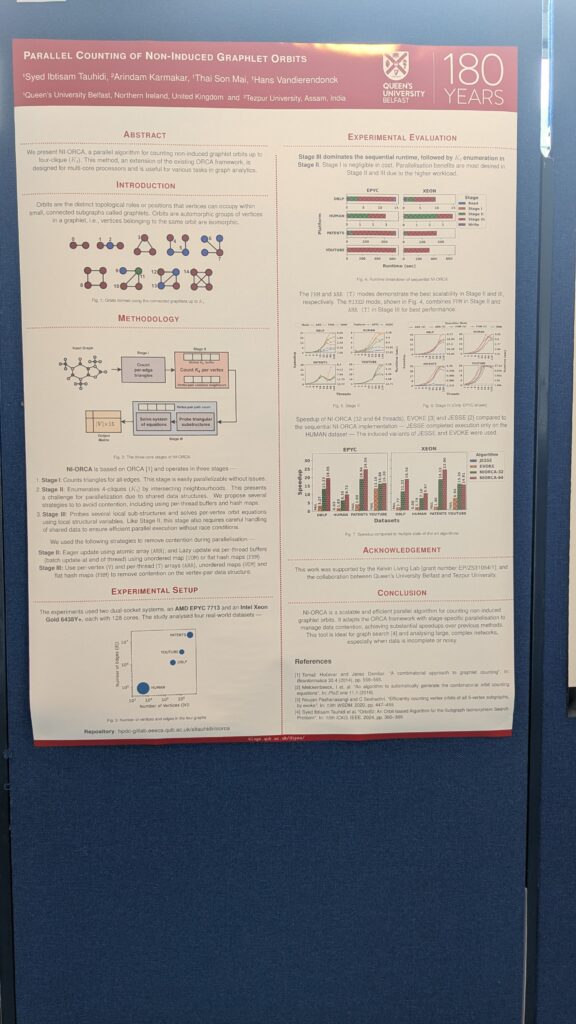
Syed Tauhidi presented a poster on NI-ORCA, a parallel algorithm designed for multi-core processors to efficiently count non-induced graphlet orbits up to four-clique (K4). Extending the existing ORCA framework, the algorithm operates in three main stages: counting per-edge triangles, enumerating 4-cliques by intersecting neighbourhoods, and probing local substructures to solve per-vertex orbit equations. To overcome the challenge of data contention in shared structures during the computationally heavy second and third stages, NI-ORCA employs several parallelisation strategies, including the use of per-thread buffers, atomic arrays, and hash maps. Experimental evaluations conducted on AMD EPYC and Intel Xeon systems across four real-world datasets (DBLP, HUMAN, PATENTS, and YOUTUBE) demonstrate that NI-ORCA achieves substantial speedups over prior state-of-the-art methods like EVOKE and JESSE, making it a highly effective tool for graph search and the analysis of large, complex networks.
The abstract for the poster is available here:
S. I. Tauhidi, A. Karmakar, T. S. Mai and H. Vandierendonck, “Parallel Counting of Non-Induced Graphlet Orbits,” 2025 IEEE International Conference on Cluster Computing Workshops (CLUSTER Workshops), Edinburgh, United Kingdom, 2025, pp. 1-2, doi: 10.1109/CLUSTERWorkshops65972.2025.11164209.
The poster is given below: