
Syed Tauhidi participated in the HPC Days 2026 conference at the beautiful Durham University, representing the Kelvin Living Lab. It was an incredible week for the UK supercomputing community, and an amazing chance to catch up on what colleagues across the UK are working on. During the event, Syed presented […]
Syed Tauhidi
17 posts
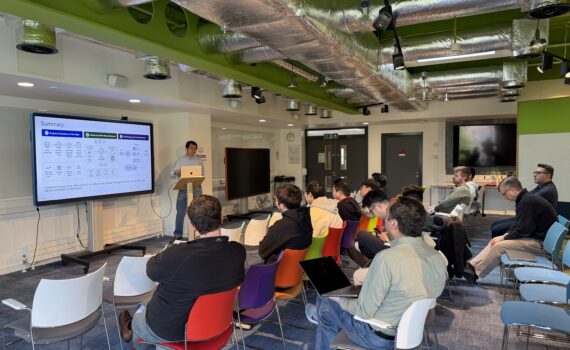
Abstract Agentic AI systems that can reason, plan, and act with tools are becoming a promising paradigm for real world applications, especially at the edge where low latency, privacy, and resilience are critical. However, edge environments impose strict constraints on compute, memory, and reliability, making it challenging to achieve high […]

1. User Job Distribution: A Heavy-Tailed Workload The cluster’s workload is heavily concentrated among a very small fraction of the total user base. The data exhibits an extreme version of the Pareto principle (80/20 rule). This indicates that a vast majority of users submit relatively few jobs, while a core […]

1. What predicts the waiting time? The factors that best predict how long a job will wait in the queue vary significantly depending on the specific cluster partition. 2. What is the utilisation of the various nodes? Node utilisation across the cluster is highly uneven, with some resources heavily saturated […]
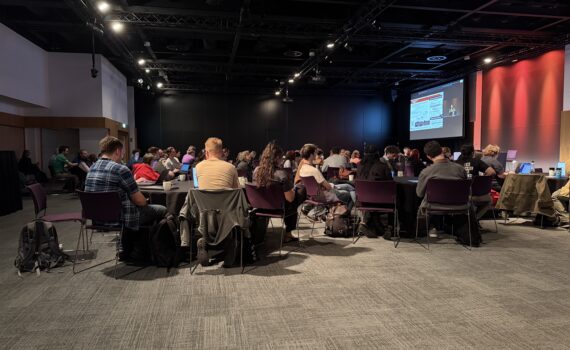
On 29 April 2026, during the Software Sustainability Institute’s (SSI) Collaborations Workshop 2026 (CW26) organised at ICC, Belfast, Syed Tauhidi and Hans Vandierendonck organised a workshop exploring the role of research software in sustainable computing. High-performance computing (HPC) carries a massive environmental footprint, driving up both capital and operational costs. […]

Abstract Emerging AI accelerators increasingly adopt wafer-scale integration, combining hundreds of thousands of cores with massive on-chip memory and ultra-high bandwidth. Yet, existing LLM inference systems—designed primarily for GPUs—cannot fully exploit this architecture. In this talk, I will present WaferLLM, the first LLM inference system designed specifically for wafer-scale accelerators. WaferLLM […]

In the world of high-performance computing, we often prioritise speed above all else. But as our applications grow more complex, they consume massive amounts of power—often more than they actually need. To bridge the gap between peak performance and energy efficiency, I’ve developed URJA: The Unified Runtime Job Analyser. What […]

We attended the NI-HPC conference held on 4 November 2025 at Riddel Hall, Queen’s University, Belfast. Hans Vandierendonck presented and talked about the Kelvin Living Lab and aspects of sustainable computing, and Giuliana Cabrera, a summer intern from Massachusetts Institute of Technology, USA, presented the initial studies on URJA. The […]

OrbitSI is an open-source Python framework designed to efficiently solve the subgraph isomorphism enumeration problem, i.e., identifying all subgraphs within a data graph that are structurally identical to a given pattern graph. The tool introduces an orbit-aware pruning and ordering strategy that significantly improves enumeration speed compared to classical algorithms. […]

We attended the CLUSTER 2025 conference organised at the University of Edinburgh, Scotland, United Kingdom, between 2 and 5 September 2025. Syed Tauhidi presented a poster on NI-ORCA, a parallel algorithm designed for multi-core processors to efficiently count non-induced graphlet orbits up to four-clique (K4). Extending the existing ORCA framework, […]