

We are please to announce that Zohreh Moradinia has won the Best Poster Award at SIMULTECH 2025 for her work on “Machine Learning-Driven Framework for Identifying Parameter-Driven Anomalies in Multiphysics Simulations”. This work investigates whether errors in scientific simulations can be detected using machine learning. Zohreh assumes errors resulting from […]
Yearly archives: 2025
18 posts
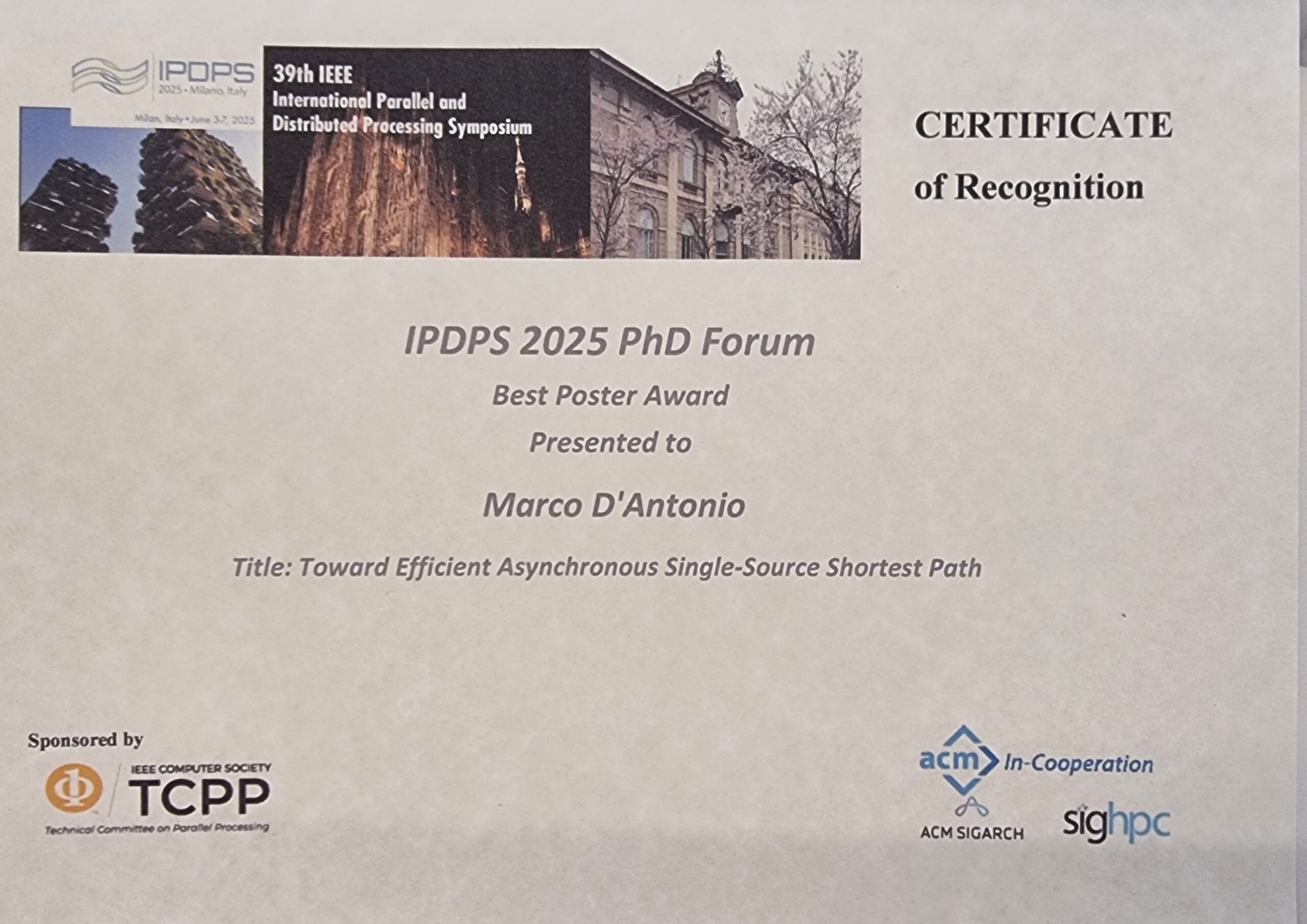
We’re excited to share that Marco has been awarded the Best Poster Award at the IPDPS 2025 PhD Forum! Marco’s winning poster, titled “Towards Efficient Asynchronous Single-Source Shortest Path”, presents Wasp, a novel algorithm that tackles the fundamental Single-Source Shortest Path problem. His approach addresses a key challenge in parallel […]
The SOFTNUM project, funded by the European Union’s Horizon 2020 research and innovation programme under the Marie Skłodowska-Curie grant agreement No. 101031148, has introduced a novel paradigm where number formats are software-defined rather than hardwired. This advancement moves beyond traditional computing, which relies on conventional hardware-supported floating-point number formats. In […]
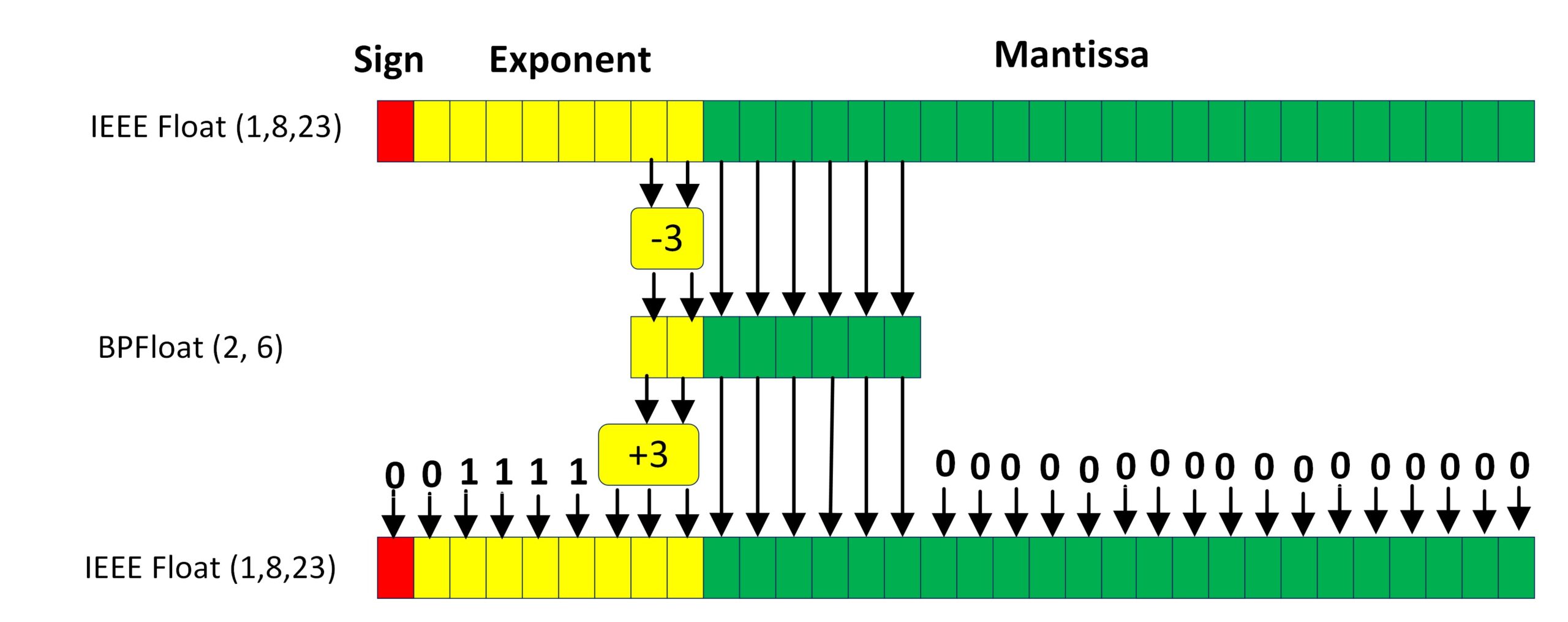
Our group has published a new paper in the IEEE Transactions on Emerging Topics in Computing. In this study, we introduced Software-Defined Floating-Point (SDF) number formats designed to enhance the performance of the Belief Propagation (BP) algorithm, which is widely used in fields like machine learning, communications, and robotics. Traditional […]

Two of our papers were accepted at IPDPS’25. Brian will present his work on improving the scalability of parallel molecular dynamics simulation. He has developed a novel way to reduce the scalability bottleneck that exists in the communication between those processes computing short-range forces vs those computing long-range forces. His […]

We have been fortunate to have 3 papers accepted at AAAI’25. Hung and colleagues will present their work on explainability of time series classification. InteDisUX aims to create explanations that are accessible and meaningful to users (real people) by identifying subsequences of the time series that provide positive or negative […]

DOI: 10.48550/arXiv.2501.06872PDF version This paper investigates the shared-memory Graph Transposition (GT) problem, a fundamental graph algorithm that is widely used in graph analytics and scientific computing. Previous GT algorithms have significant memory requirements that are proportional to the number of vertices and threads which obstructs their use on large graphs. […]