Tag Archives: Spanish

Postgraduate student interviews: Aislin Kearney (PhD, Spanish)

This post is part of our Research Initiation Scheme for 2020-2021.

On the 20th of April I interviewed recent Queen’s PhD graduate Aislin Kearney to discuss her research. In February 2021, Aislin successfully passed her viva for a PhD in Spanish with a thesis entitled ‘’The Ambition of Melancholy: The Aesthetics of Heroism in the Lyric poetry of Juan Boscán and Fernando de Herrera’.

Aislin began her studies at Queen’s as a drama student, where she started a beginner’s course in Spanish. She enjoyed the course so much that she decided to change pathways, majoring in Spanish with a minor in Drama. In her final year she described how she was (begrudgingly) enrolled on a Renaissance module. Unexpectedly, however, the module caught her interest, and when she went on to an MA in Spanish at Queen’s, she devoted her Master’s dissertation, and later PhD, to further examining the poetry of the period.

Portada de Las obras de Boscán y algunas de Garcilaso de la Vega repartidas en cuatro libros, Barcelona, Carlos Amorós, 1543.

Her Master’s dissertation focused on the work of Spanish poet Juan Boscán, a lesser-known contemporary of Garcilaso de la Vega. Central to her study of Boscán’s poetry was the emerging idea of melancholic heroism, which Aislin explained was particularly interesting when considering the historical context in which the poetry was being written. During a period in which the country was rising to become somewhat of a superpower, much of its most prominent literature was characterized by lovesick, introspective, and melancholic figures.

Aislin described her PhD as a natural progression from her Master’s research, in which she further explored this melancholic aesthetic, and Spain’s attachment to it, by examining not only the work of Boscán but also his successor, Fernando de Herrera. Aislin explained that her choice in poets was influenced by a number of factors. First, the consecutive periods in which these poets were writing allowed for a better understanding of the historical trajectory of Spanish literature during this time. Second, these two lesser-known poets’ peripheral positions in relation to the extensively studied Garcilaso de le Vega allowed for a more expansive understanding of Spanish poetry of the period. Finally, the fact that both of these poets produced theoretical works alongside poetry, where they discussed their methods and approaches, made them interesting subjects on which to focus research.

Continue reading
Postgraduate student interviews: Ciaran Harty (PhD, Spanish)

This post is part of our Research Initiation Scheme for 2020-2021.

Ciaran Harty, personal archive

On Wednesday 14th April 2021, I had the pleasure of interviewing Queen’s PhD student in Spanish, Ciaran Harty. Ciaran completed his undergraduate degree in French and Spanish at QUB and then proceeded to do an MRes on the Representation of Madrid in the Artículos de Costumbre by the 19th century Spanish writer, Mariano José de Larra. Whilst undertaking a PhD was not initially on the cards, Ciaran discovered a true passion for this particular area of studies, and so, in 2018 he began his PhD with the QUB Spanish department. The current working title of his thesis is: Precursors of Costumbrismo: The creation of a genre at the end of Spanish Enlightenment.

Ciaran described the Masters as a “stepping-stone” to the PhD, because although there are many similarities, the PhD unsurprisingly involves considerably more reading, researching and writing. I was particularly interested in finding out how his writing style had changed over time. Many undergraduate students believe the common misconception that in order to be successful in your degree, you must produce work with a high-brow, overly-academic style of writing. He assured me that while feeling this pressure was normal, and indeed something that he had experienced too, it was ultimately unnecessary. The most important thing is finding your own writing style and this is something that the PhD has allowed him to do. Through extensive reading, constructive feedback from peers and supervisors and consistently practising writing, he found that he was able to develop his own style and allow it to flow more naturally. This made the process more enjoyable for him and the content more digestible for his readers.  

Continue reading

Postgraduate student interviews: Jordan Hamilton (MRes)

This post is part of our Research Initiation Scheme for 2020-2021.

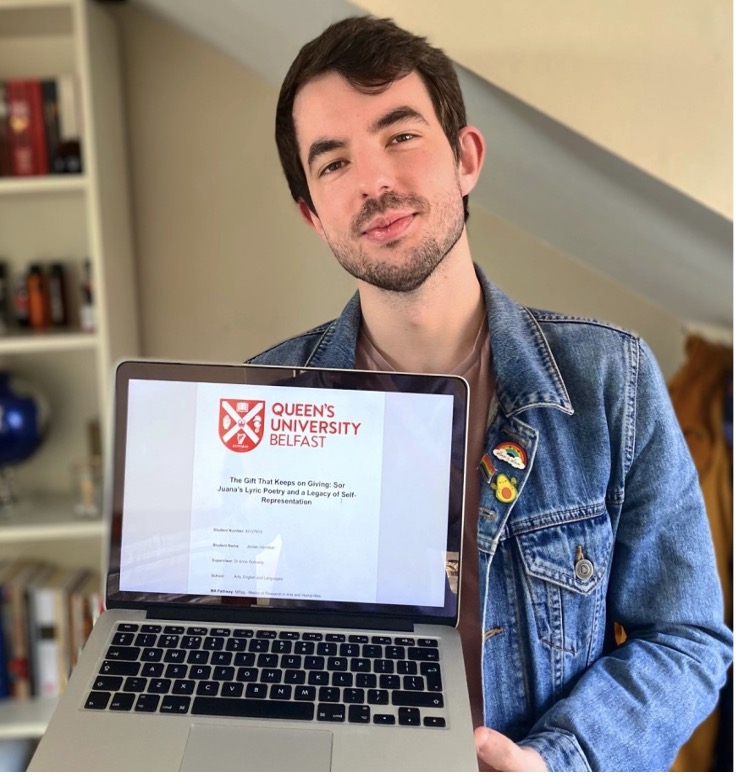
Jordan Hamilton began his higher education trajectory with a BA Hons degree in English and Spanish at Queen’s University Belfast. Looking ahead to potential postgraduate study, Jordan decided to pursue his interests in Golden Age Spanish literature. Subsequently, he applied to do the MRes in Arts and Humanities. Jordan went on to successfully complete the MRes on a part-time basis under the supervision of Dr Anne Holloway.

In the following interview, Jordan reflects on his research project and methodologies. He also offers advice for undergraduate students who are considering following a similar academic pathway.

Jordan Hamilton, personal archive

The key focus of Jordan’s MRes project was the New Spanish poet and Hieronymite nun Sor Juana Inés de la Cruz (1648-1695). His interest in this figure was sparked during the third year cultural cursillo (mini-module) on ‘Foreign Correspondents’, when he was allocated her love poetry as the theme for his class presentation. It was precisely the preparatory research that Jordan carried out for this presentation, which inspired his interest in Sor Juana’s poem Romance 51. This newfound passion served as the catalyst for his MRes proposal. Initially, his proposal included Sor Juana’s Renaissance love poetry and her self-representation.

Continue reading