Category Archives: Postgraduate student interviews

Postgraduate student interviews: Evie Domingue (MRes)

This post is part of our Research Initiation Scheme for 2020-2021.

Evie Domingue is an MRes in Arts and Humanities candidate, whose research focuses on representations of Afro-Brazilian women in the media and the ways they represent themselves in their own media productions. In this interview, I speak with Evie about, amongst other things, her reasons for pursuing research on this topic, the strong sense of urgency it holds in Brazil’s current socio-political context, and her advice for those thinking of doing an MRes.

Prior to postgraduate study, Evie completed her BA Hons in Spanish and Portuguese at Queen’s University Belfast. She cites the ‘Brazilian Digital Culture’ module that she completed in her final year, taught by her MRes supervisor Dr Tori Holmes, as having sparked her interests for both media and Brazilian studies. It also gave her the opportunity to incorporate her passion for race studies into the aforementioned topics. She notes that the independent study she completed as part of this module gave her insight as to what was to come for the MRes.
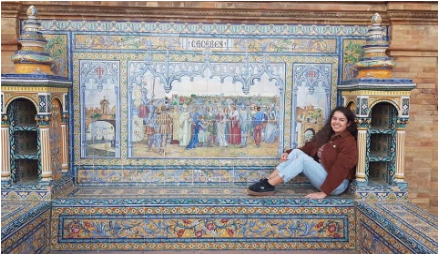
Evie Domingue, personal archive

In terms of methodology, Evie is analysing various forms of media – a YouTube channel, music, a film, a streaming platform and a telenovela (serial drama) – and picking up on the most prominent themes within this material. She notes that whilst her project is still developing and evolving, so far she has found recurring topics in her research material to be issues of identity, black aesthetic standards in the realm of self-representation, and black female protagonism.

Continue reading
Postgraduate student interviews: Ciaran Harty (PhD, Spanish)

This post is part of our Research Initiation Scheme for 2020-2021.

Ciaran Harty, personal archive

On Wednesday 14th April 2021, I had the pleasure of interviewing Queen’s PhD student in Spanish, Ciaran Harty. Ciaran completed his undergraduate degree in French and Spanish at QUB and then proceeded to do an MRes on the Representation of Madrid in the Artículos de Costumbre by the 19th century Spanish writer, Mariano José de Larra. Whilst undertaking a PhD was not initially on the cards, Ciaran discovered a true passion for this particular area of studies, and so, in 2018 he began his PhD with the QUB Spanish department. The current working title of his thesis is: Precursors of Costumbrismo: The creation of a genre at the end of Spanish Enlightenment.

Ciaran described the Masters as a “stepping-stone” to the PhD, because although there are many similarities, the PhD unsurprisingly involves considerably more reading, researching and writing. I was particularly interested in finding out how his writing style had changed over time. Many undergraduate students believe the common misconception that in order to be successful in your degree, you must produce work with a high-brow, overly-academic style of writing. He assured me that while feeling this pressure was normal, and indeed something that he had experienced too, it was ultimately unnecessary. The most important thing is finding your own writing style and this is something that the PhD has allowed him to do. Through extensive reading, constructive feedback from peers and supervisors and consistently practising writing, he found that he was able to develop his own style and allow it to flow more naturally. This made the process more enjoyable for him and the content more digestible for his readers.  

Continue reading

Postgraduate student interviews: Laura Kennedy (PhD, French)

This post is part of our Research Initiation Scheme for 2020-2021.

From Paris to London to Queen’s, we caught up with Laura Kennedy to learn about her global PhD French project and her advice for undergraduates considering postgraduate study.

Q. What has your journey to PhD been like?

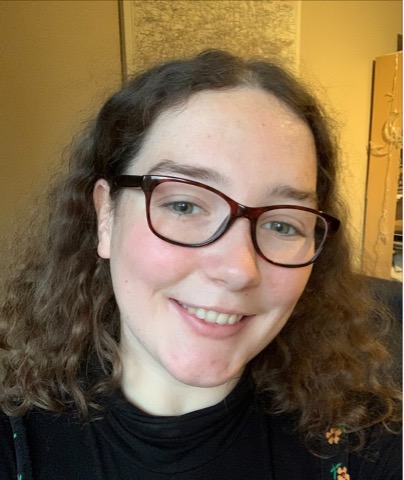
Laura Kennedy, personal archive

It’s been enjoyable, but unexpected. My B.A was in French studies at the University of London Institute in Paris. In my final year, I took a French colonialism class, and became really interested, particularly in Algeria. My interests have always been in literature and postcolonial literature was the perfect overlap. I did my final year dissertation on Kamel Daoud and his book Meursault, contre-enquête.  The next step for me was to get a theoretical base of postcolonial scholarship. Once I graduated, I worked for a year in Paris and researched Masters programs. I found SOAS University of London. They did a Masters in Comparative Literature of Africa and Asia which I completed in 2020. SOAS was a watershed moment for me academically; I could focus in on my interests which I came to realize were language politics and postcolonial novels. Once I realized this, I put PhD proposals together – I wasn’t going to stop after the Masters. I felt like I would be an outsider coming to Queen’s at PhD. I’m happy to be mistaken on that. Within weeks, I felt welcome and part of the community.

Continue reading

Postgraduate student interviews: Jordan Hamilton (MRes)

This post is part of our Research Initiation Scheme for 2020-2021.

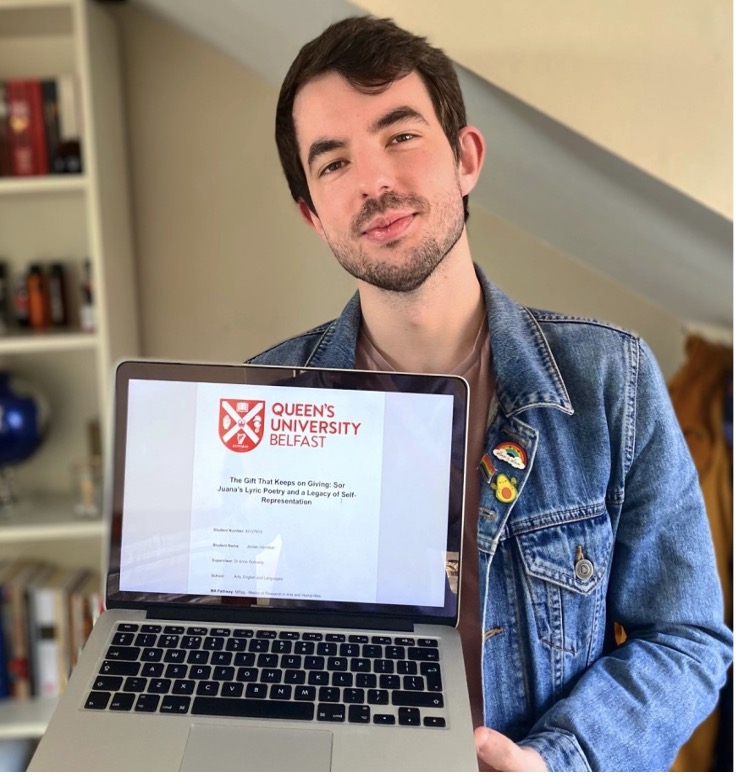
Jordan Hamilton began his higher education trajectory with a BA Hons degree in English and Spanish at Queen’s University Belfast. Looking ahead to potential postgraduate study, Jordan decided to pursue his interests in Golden Age Spanish literature. Subsequently, he applied to do the MRes in Arts and Humanities. Jordan went on to successfully complete the MRes on a part-time basis under the supervision of Dr Anne Holloway.

In the following interview, Jordan reflects on his research project and methodologies. He also offers advice for undergraduate students who are considering following a similar academic pathway.

Jordan Hamilton, personal archive

The key focus of Jordan’s MRes project was the New Spanish poet and Hieronymite nun Sor Juana Inés de la Cruz (1648-1695). His interest in this figure was sparked during the third year cultural cursillo (mini-module) on ‘Foreign Correspondents’, when he was allocated her love poetry as the theme for his class presentation. It was precisely the preparatory research that Jordan carried out for this presentation, which inspired his interest in Sor Juana’s poem Romance 51. This newfound passion served as the catalyst for his MRes proposal. Initially, his proposal included Sor Juana’s Renaissance love poetry and her self-representation.

Continue reading