

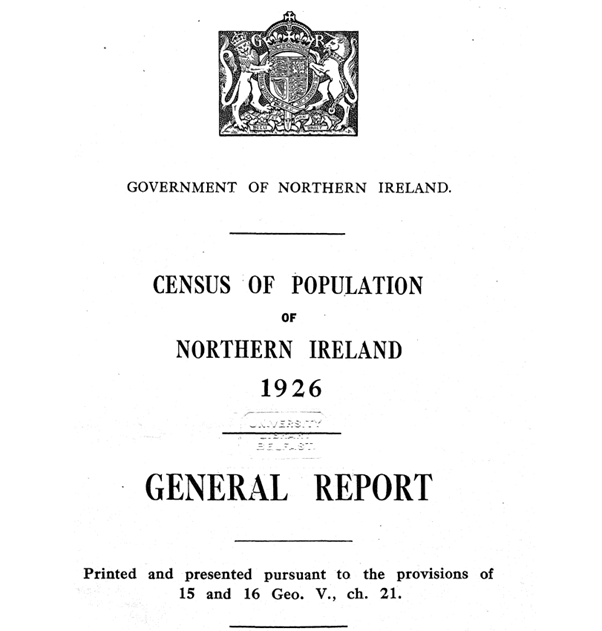
On 18 April this year the National Archives of Ireland (NAI) and the Irish Central Statistics Office (CSO) will release the household returns of the 1926 Irish Free State census, the first census of population held after independence. These will be made freely available to researchers on the NAI’s dedicated census website, which currently hosts the previously digitised returns of the all-Ireland censuses of 1901 and 1911.
The first census of population in Northern Ireland was also conducted on 18 April 1926. The reports of both the Free State and Northern Ireland censuses, compiled from the data extracted from the returns, have been available for a number of years and can be accessed via the websites of the Central Statistics Office and the CSO and the Northern Ireland Statistics and Research Agency (NISRA).
With 1,256,561 people resident in Northern Ireland and 2,971,992 in the Free State, the population of the island overall had declined by 3.5 per cent from the previous census of 1911. Population decline was a standard feature of post-Famine Ireland but the decrease between these two censuses was considerably greater than that between 1901 and 1911, when it was only 1.5 per cent. Between 1911 and 1926 this trend was reversed for the six-county area which shows an increase in population of 6,030 people.
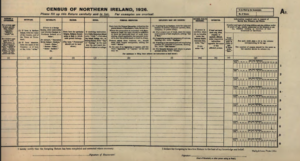
Household return for for the 1926 Northern Ireland census
After 18 April these statistics for the Free State will take on a human dimension as the personal details of individuals’ names, ages, genders, occupations and many more characteristics will be searchable. Unfortunately, we will never be able to uncover these details about the people who lived in Northern Ireland at the same time. There will be no corresponding public release of the returns of the 1926 Northern Ireland census because they are no longer extant. It appears that they were pulped during the Second World War due to paper shortages.
This was not an unusual fate for historic Irish census records. The returns for 1861 and 1871 were destroyed deliberately following the extraction of the data so that they could ‘not be used for the gratification of curiosity’. A subsequent recognition of the historical significance of census returns led to a reprieve for the returns from 1881 and 1891, but only until 1918 when a shortage of paper during the First World War led to them being pulped. Four years later the vast bulk of the returns from 1821 thorough to 1851 were destroyed when the Irish Public Record Office was blown up at the start of the Civil War in June 1922. 1901 and 1911 survived because they had not at that stage been transferred to the Record Office.
Even if the 1926 Northern Ireland census records had been preserved, they could not be released. In the Republic of Ireland the 1993 Statistics Act allows for release of census records ‘100 years after the date of the relevant Census’. By contrast, the relevant Northern Ireland legislation – the Census (Northern Ireland) Act of 1969 – decrees the indefinite closure of such records; the custodian of the records ‘shall not permit any other person without lawful authority to have access thereto’.
This legislative prohibition puts Northern Ireland out of sync with both the Republic of Ireland and the rest of the United Kingdom, where access to historic census returns for England, Wales and Scotland is available up to the census of 1921. A significant aspect of the upcoming Irish census release is that it will be freely accessible, whereas access to the records for Scotland, England and Wales require payment of a fee or a subscription to a commercial genealogy website, in spite of the fact that these are public records.
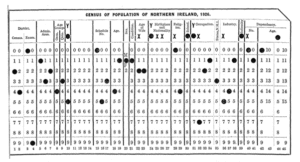
Machine cards used for tabulation of the 1926 Northern Ireland census returns
The next census for Northern Ireland, which was less detailed than that of 1926, was taken in 1937 and its returns are the first extant records of any Northern Ireland census. Now is the time to consider three important questions about the fate of these records. Is there a political will to bring Northern Ireland into line with the rest of the UK by amending the 1969 Census Act to allow for their public release in 2037? In view of the access currently available to all Irish and British censuses taken up to 100 years ago the public here will expect the same level of access to our census records.
In the event of a decision to allow the release of these records, in what format will they be made available? Due to volume and concerns about conservation and preservation it is highly unlikely that the hard copies of the returns will be made available to researchers in the Public Record Office of Northern Ireland (PRONI). That suggests that they should be digitised in the way that all historic Irish and British census are to date.
If these records are to be made available in a digitised format, will there be any restrictions on access? Given that the Irish census records, including the all-island ones of 1901 and 1911, are free to access, that is likely to be the public expectation here also. This will require funding; the Irish government provided €5 million for the 1926 Free State census project.
If there is a desire to see the historic records of the first surviving Northern Ireland census made available to the public on 1 March 2037 discussions about these questions need to start now to enable legislative changes, identification of funding sources, and appropriate conservation, preservation and digitisation to take place.
About the Author
Professor Marie Coleman is Professor of Twentieth Century Irish History at Queen’s University Belfast. Her essay on ‘The 1926 census and the impact of war and revolution’ will be published on 18 April in Orlaith McBride & John Gibney (eds), The Story of Us: Independent Ireland and the 1926 Census.


Leave a Reply