

QUB Digital Scholarship Librarian Awarded LIRG Research Award for Student Partnership AI Project
The Library and Information Research Group (LIRG), a special interest group of CILIP, supports research to develop evidence-based practice across the library, information and knowledge sector. The LIRG Research Award provides funding for innovative research projects that address current challenges and opportunities for libraries and information professionals.
In 2026, Kath Stevenson, Digital Scholarship Librarian at Queen’s University Belfast, was awarded funding for her project, Co-Creating an Ethical and Epistemically Robust AI Literacy Framework with Students: A Partnership Model for Higher Education. The project explores how students and staff can work together to develop approaches to AI literacy that are ethical, critical and responsive to disciplinary contexts.
The blog post below introduces the project, outlines its aims and methodology, and explains how the research will contribute to the growing conversation about responsible and effective AI literacy in higher education
Co-Creating an Ethical and Epistemically Robust AI Literacy Framework with Students
What does AI literacy look like when students are not simply recipients of training, but active partners in its design?
This is the question at the heart of my LIRG-funded research project, Co-Creating an Ethical and Epistemically Robust AI Literacy Framework with Students: A Partnership Model for Higher Education, which will begin in Autumn 2026 and run until December 2027.
Artificial intelligence is becoming an increasingly significant part of students’ academic lives. From brainstorming ideas and summarising literature to supporting coding and drafting, generative AI tools are already shaping how students learn, research, and create knowledge. While many universities have responded by developing guidance, policies, and training, much of this work has been designed for students rather than with them.
This project starts from a different premise: students are not simply users of AI technologies, nor are they a problem to be managed. They are active participants in knowledge creation and can offer valuable insights into the opportunities, challenges, and ethical questions that AI raises within higher education.
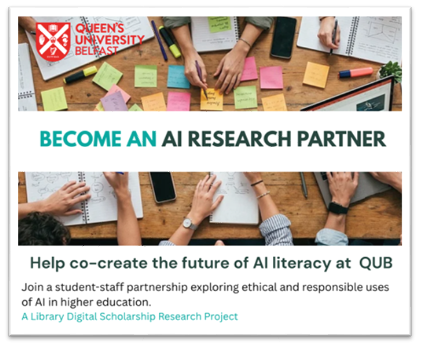
Using a Students as Partners approach, the research will bring together a diverse group of undergraduate and postgraduate students to work collaboratively on the development of a new AI literacy framework. Through workshops, student-led inquiry projects, collaborative analysis, and framework design activities, participants will help shape both the research process and its outcomes. The project is informed by Participatory Action Research principles, placing collaboration, reflection, and co-creation at its centre.
Together, these activities will help identify gaps in existing provision, explore disciplinary perspectives on AI, and co-create a framework that supports ethical, critical and reflective engagement with AI technologies.
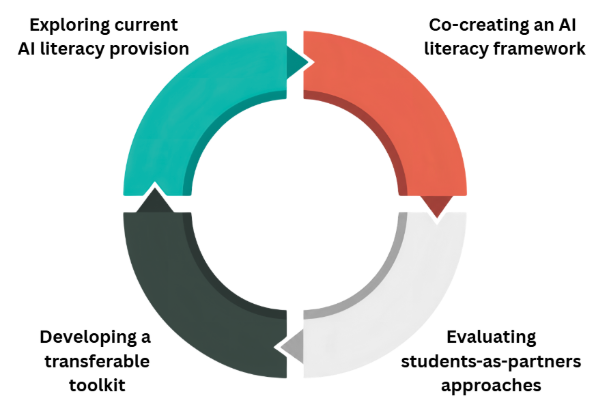
For libraries, the project addresses an important question: what should AI literacy look like when it moves beyond learning how to use tools and instead focuses on understanding how knowledge is created, evaluated, and trusted? The resulting framework will explore themes such as critical evaluation of AI-generated information, transparency, bias, disciplinary differences, and responsible scholarly practice.
Alongside the framework itself, the project will produce an openly licensed toolkit containing teaching activities, facilitation guidance, case studies, evaluation resources, and documentation of the co-creation process. While developed within a higher education context, the intention is that both the framework and the methodology will be transferable to other sectors interested in supporting AI literacy and critical digital skills.
A key output of the research will be an open-access article for Library and Information Research, sharing findings with the wider library and information community. Additional dissemination activities will include webinars, conference presentations, blog posts, and practical resources designed to support knowledge exchange and professional practice
Over the coming months, I look forward to working with student partners to explore how AI literacy can be developed in ways that are not only practical and effective, but also collaborative, critical, and ethically grounded. Finally, I would like to thank LIRG for its generous support of this project. I am delighted to receive the award and excited to begin this research collaboration, sharing lessons learned and findings with the wider library and information community as the project develops