
Áine Poland, ‘Reading Between the Lines: The Emotional and Social World of
Hester Bredon Hart in Late Qing China’, Robert Hart Project Working Papers, no. 3 (2026), pp. 1-28. http://go.qub.ac.uk/rhpwp3
ISSN: 2514-9296
Full text: Poland, ‘Reading Between the Lines’, RHPWP 3 (2026)
Abstract:
Sir Robert Hart, Inspector General of the Chinese Imperial Maritime Customs Service (IMCS) for nearly half a century, has generated an extensive and distinguished body of scholarship. His wife, Hester Jane Bredon Hart (1848–1928), has not. She appears only fleetingly in the existing literature – a footnote in monographs devoted to Hart’s professional and diplomatic career – despite enduring a life of remarkable complexity, sacrifice, and constrained agency. This paper seeks to recover Hester’s experience by placing it at the centre of historical attention, and in doing so, to situate it within the broader scholarly framework of Anglophone foreign women’s lives in late Qing China.
Drawing primarily on Hart’s letters to Hester held at the University of Hong Kong Special Collections, Hester’s own 1872 travel notebook held at Queen’s University Belfast, and the statutory declarations examined by Li and Wildy, this paper argues that Hester’s story represents a limit case within the category of the ‘incorporated wife’: a woman whose social world, emotional life, and capacity for female solidarity were constrained to an unusual degree by her husband’s professional dominance and controlling character. Her departure for London in 1882 – and Hart’s failure to promptly follow – is read as the culminating expression of the structural inequality that defined their marriage from its very beginning.
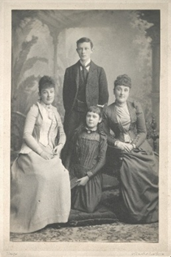
Image: Hester Hart and her three children (Sir Robert Hart collection, MS 15/6/1D/002a, Special Collections and Archives, Queen’s University Belfast)
Keywords:
Western women, China, Lady Hester Hart, Sir Robert Hart, history of emotions, marriage, duty.