
The St. Patrick’s Day festivities at the White House can usually be relied upon for political soundbites and this year was no exception. Behind the rhetoric over conflict in Iran and the US’ fragile alliances, it was the brief exchange between President Trump and Taoiseach Micheál Martin over Sir Winston Churchill’s legacy which was particularly interesting.
In response to Trump’s timeworn phrase that the Prime Minister, Sir Keir Starmer, is “no Churchill”, Martin was quick off the mark in the Oval Office to reference the “difficulties” Churchill created for Ireland. Martin was arguably not speaking for just one political tradition in Ireland. All hues of political opinion had, at one time or another, axes to grind with Mr. Churchill.
It is in that contested context that Churchill’s visit to Queen’s University in March 1926 can be reflected upon. A century ago, Churchill returned to Belfast as Chancellor of the Exchequer. This was at a time when the fragile constitutional settlement of two new States on the island, which he was instrumental in creating, was still in its infancy.
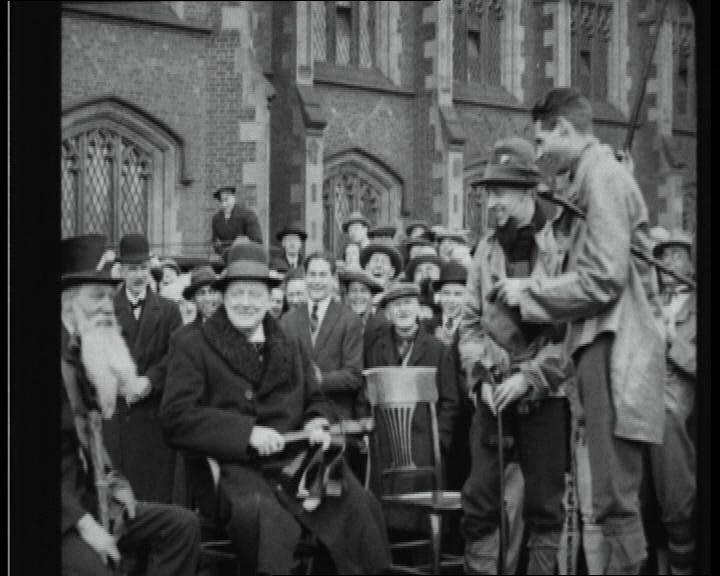
Churchill’s first engagement in Belfast was at the University where he was awarded the distinction of an honorary Doctor of Laws. Footage of the visit shows him feted at Queen’s and given a hero’s homecoming, on the cusp of his wilderness years. A report in The Irish News from the time records that Churchill, seated in front of the Lanyon building, ‘was made the central figure in a student’s rag’ where the students presented him with ‘a soft hat (or “Paddy hat” to add to his collection), a dudheen and a shillelagh’ before being carried in procession to the Ulster Hall aboard a jaunting car. (The Irish News, 3 March 1926). These are not the traditional images associated with Churchill, and they stand in marked contrast to his last reception in the city.
Some fourteen years previously at the height of the third home rule bill crisis in 1912, Churchill travelled to the Ulster Hall to deliver a speech in support of Home Rule, placing him firmly within one of the most fraught constitutional debates of the early twentieth century. There was scarcely anything more volatile than his close shave from a rowdy crowd of Unionist protestors who prevented him from delivering his speech in the Ulster Hall in support of the Home Rule policy. It is one of countless ironic twists of Irish history that the safest quarters for him to speak were at Celtic Park on the Falls Road to a receptive Nationalist audience.
In contrast, in 1926 he was welcomed by the upper echelons of the new Northern Ireland State, including one of the fiercest opponents of home rule and now Northern Premier, Sir James Craig and his cabinet colleague and Chancellor of the University Lord Londonderry, who stated that Queen’s had the dignity of enrolling Churchill “as one of our members.”
Yet such shifts in political mood were not new to Churchill. His parliamentary career, defined by his criss-crossing of the political aisle, did little to quell suspicions that he was one of the Commons’ chameleons. Indeed, Churchill’s views on Ireland spanned the entire panoply of positions. From a staunch upholder of the Union, opposing self-government for Ireland as a Conservative, he later formed part of a Liberal cabinet determined that Ireland would have Home Rule. After all, he spent around four years of his childhood in Dublin, where his grandfather was Lord Lieutenant, later recalling that his “earliest memories” were of Ireland.
For those gathered at Queen’s in 1926, Churchill was a difficult man to measure. In conferring the honorary degree, the Dean of the Faculty of Law, Professor J. S. Baxter, captured that variety:
‘the Right Hon. Winston Spencer Churchill, a man so varied that it is difficult to select, without inexactitude, the particular ground of distinction which should first be mentioned… a statesman who has already held almost every Cabinet office… an orator… a writer… a soldier.” (Belfast News Letter, 3 March 1926)
Times past appeared, at least momentarily, to have been glossed over at Queen’s. However, Churchill’s Irish career is not to be dismissed. He was part and parcel of the crucial milestones in Ireland’s constitutional wrangling. During the War of Independence, he was an advocate of strongly repressive measures to quell republican activity — one of the more controversial aspects of his Irish record, and one which continues to inform how he is remembered today.
However, it is the Treaty negotiations which are crucial when evaluating Churchill and Ireland. As Colonial Secretary, Churchill was at the forefront of negotiations leading to the Anglo-Irish Treaty of 1921 and the foundation of the Irish Free State, as well as the Craig–Collins pacts aimed at ending sectarian violence in Northern Ireland. In this context, he cultivated a close working relationship with Michael Collins, whom he saw as a strongman figure with whom he could do business as an emerging Dominion statesman, akin to the South African model of Smuts and Botha.
In light of this experience, Churchill’s 1926 visit to Queen’s can be read as a moment of reflection – a return to a city and an island which had so often intersected with his life and where the consequences of decisions in which he had participated were still unfolding, whether he fully appreciated their consequences or not.
He used the occasion of his Belfast visit to hold out hope for his formulation of a reconciled Ireland:
“I may cherish the hope that some day all Ireland will be loyal, will be loyal because it is free, will be united because it is loyal, and will be united within itself and united to the British Empire.”
The contrasting and sometimes contradictory views of Churchill, under the various guises Professor Baxter referenced in his 1926 speech at Queen’s, resists Churchill and his Irish legacy being neatly characterised. What is clear is that Churchill saw Ireland in different lights, sometimes as an expedient vehicle for his own political career but always concerned about its future political relationship with Britain, with strategic and security considerations at the forefront.
It is perhaps for this reason that Churchill continues to prompt divided comment in 2026. As the exchange in the Oval Office suggests, Winston Churchill’s role in Ireland remains part of a wider and ongoing conversation about history; a conversation about which Ireland rarely lets go.
Further Reading
Paul Bew, Churchill & Ireland (2016, OUP)
Winston Churchill, My Early Life (1930, Thornton Butterworth)
About the Author
Peter Donnelly is a tutor at the Law School at Queen’s University Belfast and completed his LLB and LLM degrees there from 2018 and 2022.
Leave a Reply