

Exhibition: Molly St George – Lacemaking and Irish Traditional Music
We are pleased to announce our exhibition, Molly St George: Lacemaking and Irish Traditional Music – a collaboration between Headford Lace Project and QUB Special Collections. The exhibition is on display on the ground floor McClay Library and runs from 2nd June until 31st August 2026.
Development of this exhibition can be traced to Summer 2024 when Headford Lace Project contacted us after consulting the Bunting Collection through Digital Special Collections. Their research focused on the harp tune and song Molly St George, its connections to the town of Headford, County Galway, and its links to the history of lacemaking. A year later, we decided to collaborate, bringing together material from Headford Lace Project and the Bunting Collection for display in an exhibition that sets manuscript sources alongside lacemaking traditions and contemporary musical reimaginings. It includes dedicated listening stations for Toss the Bobbin by The Whileaways and a new recording of Molly St George sung by Breda Keville and played by Kathleen Loughnane.
The following blog was written by Ger Henry Hassett, committee member of Headford Lace Project. Ger traces the journey behind the exhibition, drawing on archival sources, musical revival and community responses to tell the story of a tune and song closely connected to Headford and its lacemaking heritage.
Background
I am a committee member of Headford Lace Project which was established in 2016. Our aims are to research, revive and reimagine the forgotten history of Headford lacemaking. The lace industry was established by Mary (Molly) St George c1765. When historian and committee member Norma Owens discovered that there is an early harp tune and song called Molly St George linked to Molly St George, Headford, I was intrigued.
Inspiration
The first time I heard the song was while watching the programme Róisín Reimagined on RTÉ1, featuring singer Muireann Nic Amhlaoibh with the Irish Chamber Orchestra. It was so beautiful, it entered my heart and stayed with me. This was my inspiration to bring both the song and tune back to Headford. I began to research its origins.
Research
The music of Molly St George was first published in 1724 in A Collection of the Most Celebrated Irish Tunes proper for the Violin, German Flute or Hautboy by John & William Neal. I purchased the facsimile edition by Nicholas Carolan.
Then I discovered that Special Collections at Queen’s University housed the Edward Bunting Collection and to my great delight I found that selections were digitised. It was exciting to find Special Collection’s digital Edward Bunting Collection Exhibition which included some images of music notation of Molly St George.
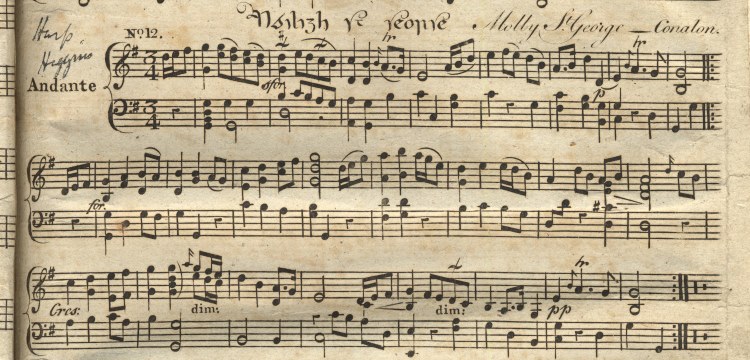
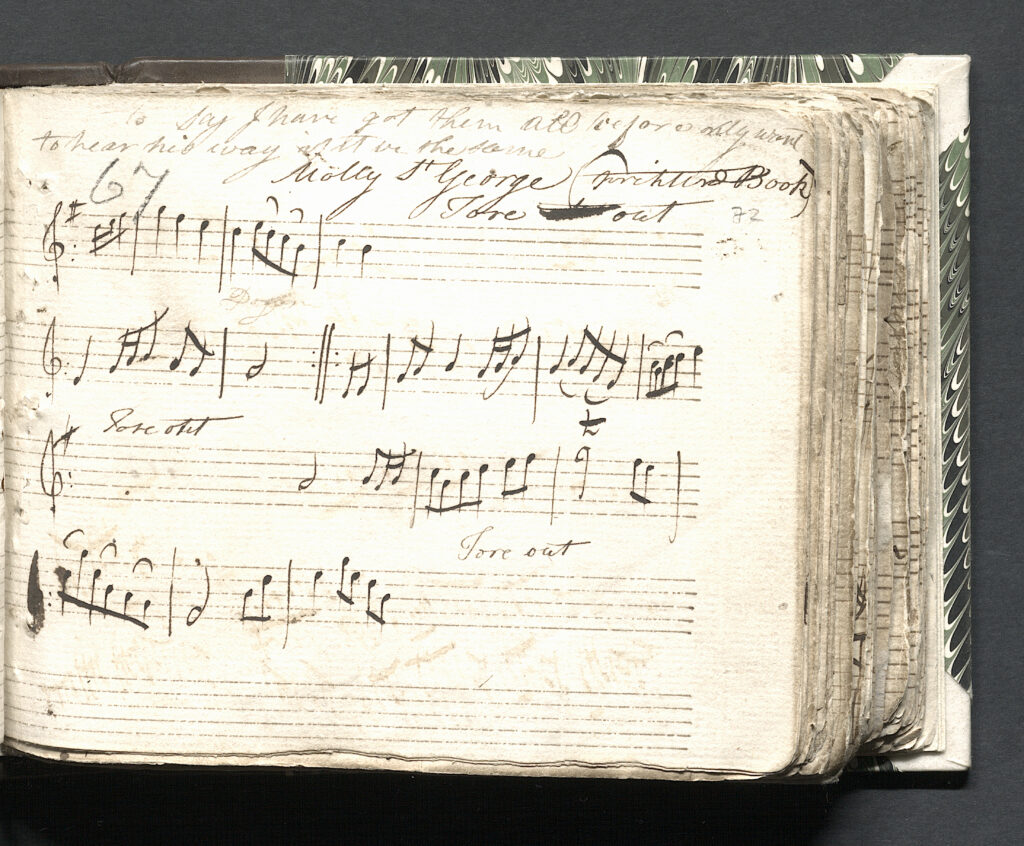
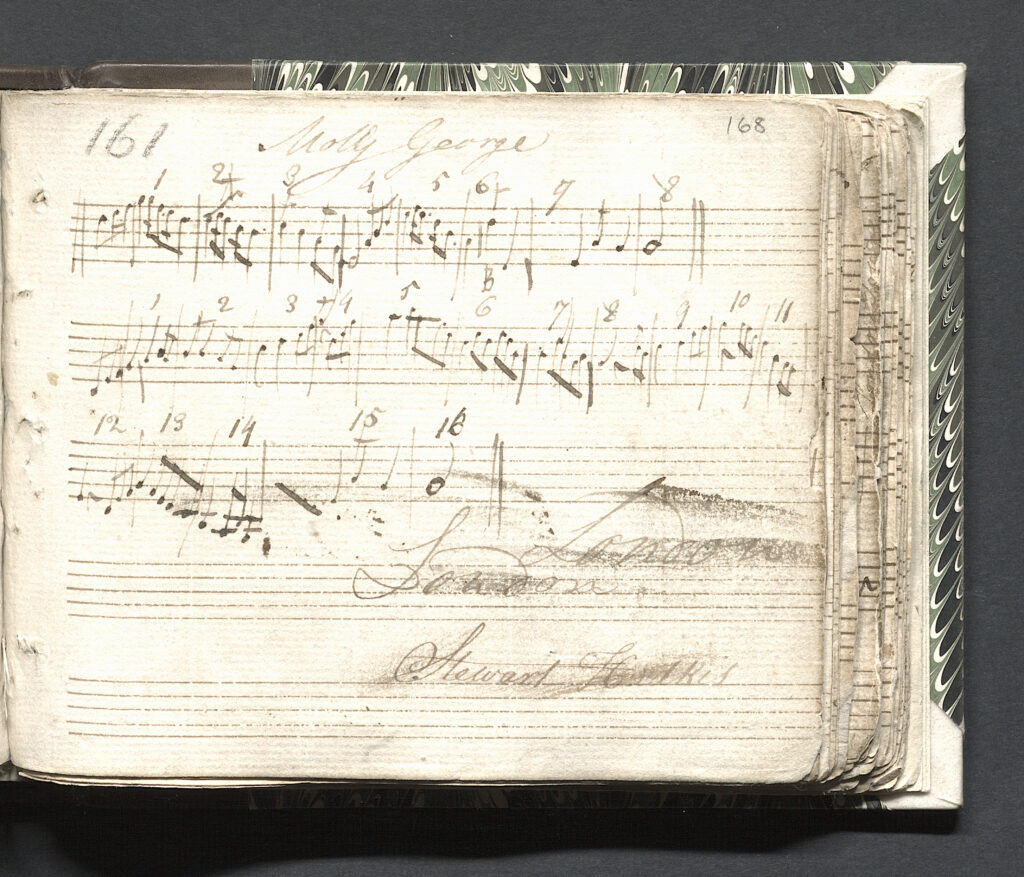
The tune appears again, MS 4/29, p168
We can see in the top image of MS 4/41 that Bunting had noted “Harp Higgins” on the left, suggesting that he may have collected the tune from the Mayo harper Hugh Higgins. Higgins did indeed perform at the Belfast Harp Festival in 1792, however, the tune Molly St George was not among the tunes played. In the same image we see that Bunting attributes the tune to Conalan – Thomas Connellan (c1640-1720), harper and composer from Cloonmahon, Co. Sligo.
I learned that Bunting travelled in Connaught with Richard Kirwan in 1792 to collect native Irish music. Without Bunting’s dedication and passion to preserve this music, much of it would have been lost.
In the Irish Traditional Music Archive’s Edward Bunting Digital Harp Collection, I found Eilís Lavelle’s beautiful harp recording of the tune.
Next, I found Galway based harper Kathleen Loughnane’s publication, The Harpers Connellan, and her CD with the recording of the tune/song. Her publication documented the historical background to the Connellan brothers and their music. Kathleen told me she had recently performed this song with Breda Keville. This was a pivotal moment for me, as Breda is a Headford native and a traditional musician and singer. I felt that the tune and song had come full circle.
Song Lyrics
In 1802, Edward Bunting engaged the scholar and scribe Patrick Lynch (c1756-1838) to collect song lyrics in Connaught in both Irish and English.
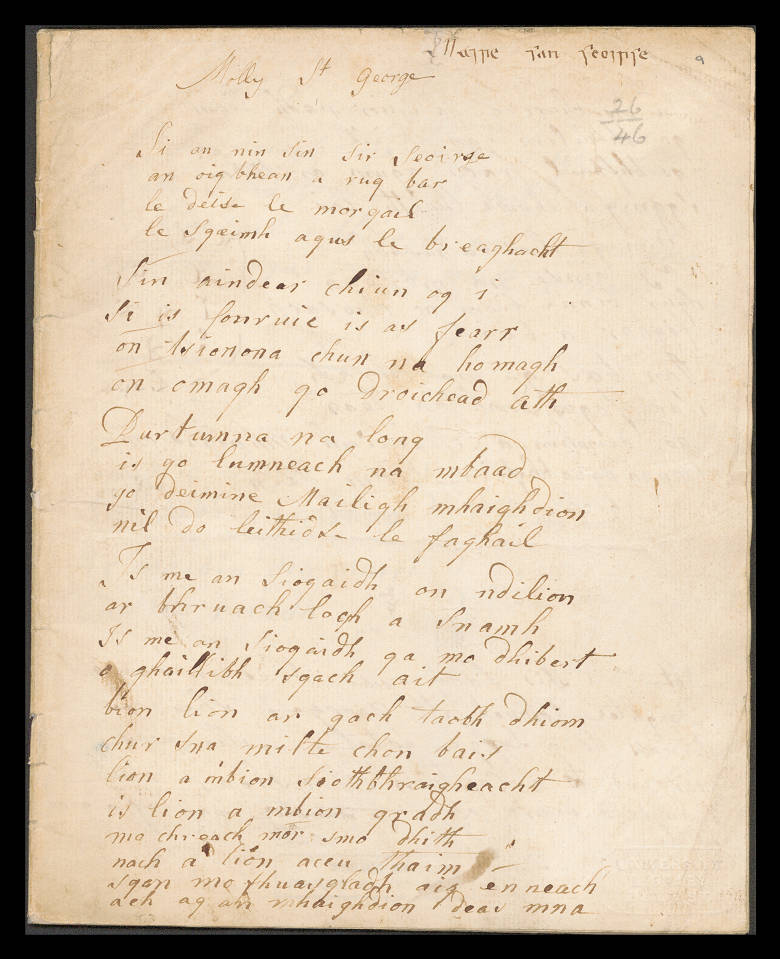
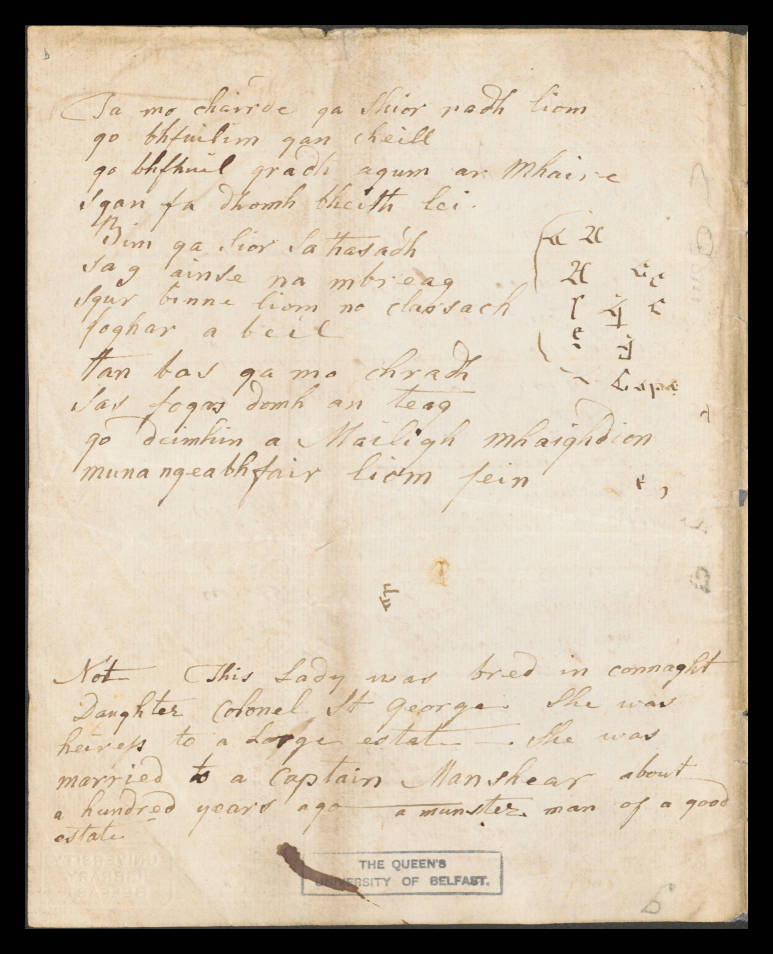
The above images show Lynch’s handwritten Molly St George lyrics in Irish, and at the end the following note is included:
Note this lady was bred in connaght
Daughter Colonel St george She was
heiress to a large estate She was
married to a Captain Manshear about
100 years ago, a munster man of a good
estate.
This was a very exciting find as it linked the song to Headford. Molly was the daughter of General Richard St George (1670-1755), her date of birth is unknown. She inherited the estate at Headford on her marriage in 1749 to Captain James Mansergh and died in 1795. So the lyrics could have been written about her. It is worth noting that Lord St. George (1658-1735) who lived at Headford Castle played the Uilleann Pipes. While examining the St George Family Tree I concluded then that perhaps the tune could have been written about his daughter Mary St George (1693-1741) or Mary St George daughter of Sir George St George who died in 1701.
On the Gaelic script version of the lyrics, Lynch notes that he collected it from harper Denis Hampsey (Hempson) from Magilligan, County Derry.
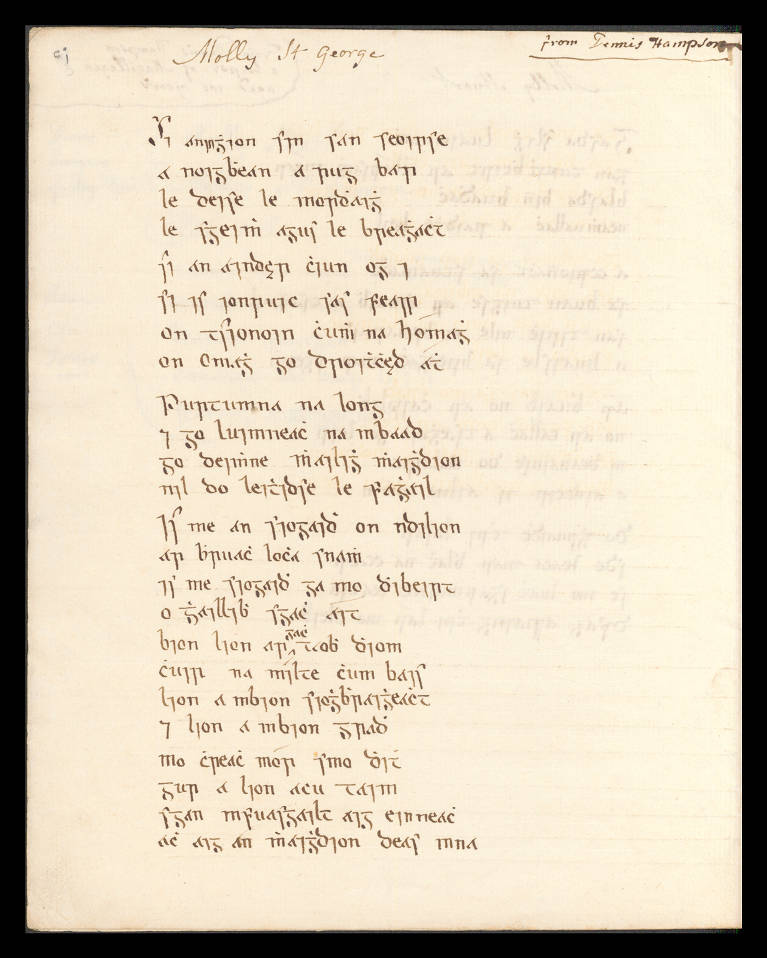
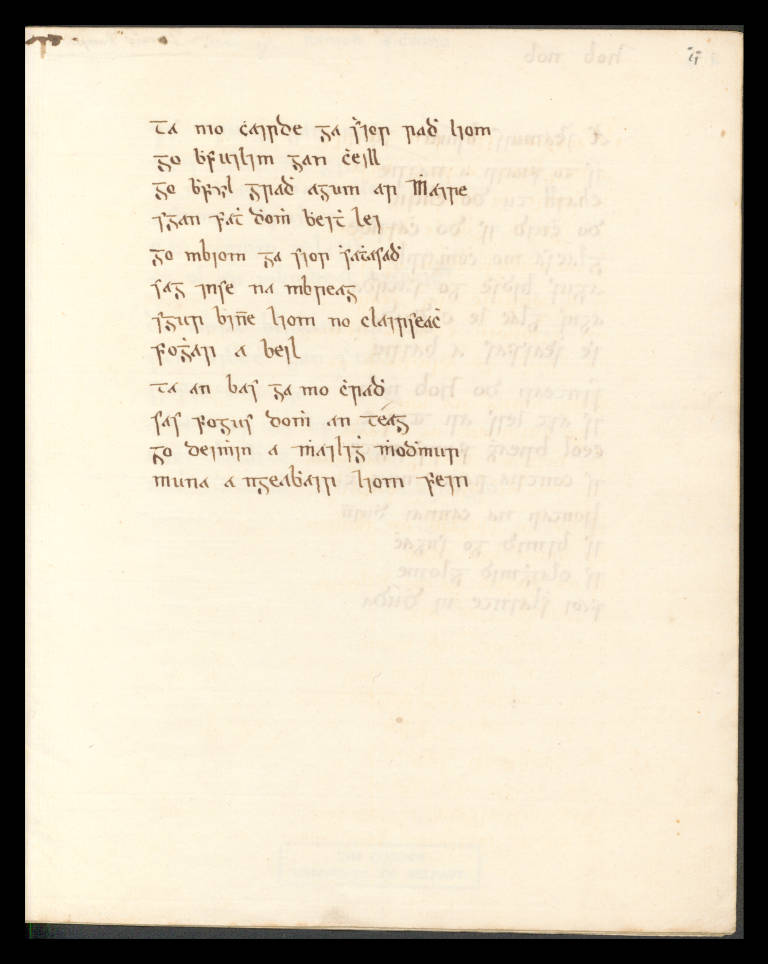
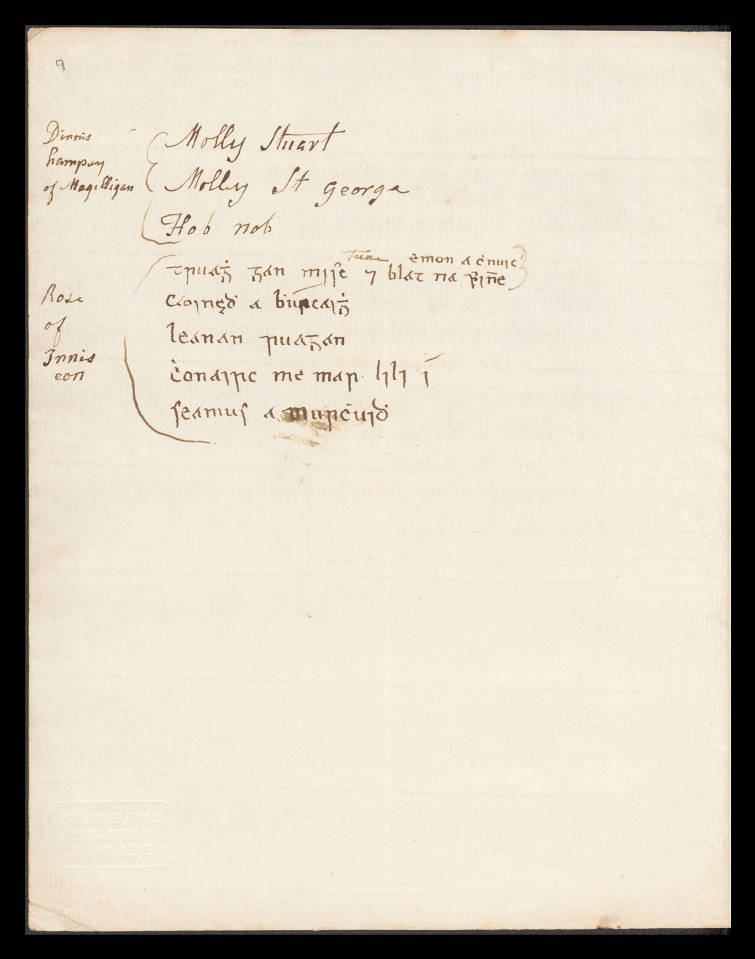
The lyrics mention Galway:
Is mé an síogaí ón ndíleann
ar bhruach loch a’snámh
Is mé an síogaí ga mo dhíbirt
ó Ghaillimh ‘s gach áit
The handwritten lyrics in English are also recorded by Lynch in MS4/36/48:
Molly St George
The Daughter of St George / a young maid who bears the Sway / for neatness and gracefulness / for beauty and for elegance / This mild young damsel / is the best and most virtuous / from the Shannon unto Omagh / and from Omagh to Drogheda / To Portumna of Ships / And to Limrick of boats / truly virgin Molly / your fellow can’t be found / I am a fairy from the flood / that swims along the banks for the lake / I am a fairy who am on banishment / from Galway and from every place / Nets are set on each side of me / which have dragg’d thousands todeath/ nets of enchantment on one side / and nets of love on the other / Alas! Now I grieve / it is in one of these I am taken / and none living can release me/ but the charming virgin Lady / My friends are always saying / that I have lost my reason / for being in love with Mary / and that it is all in vain / ‘tho I am always pleasing her / and telling flattering tales / That I think her voice sweeter / than the sound of the harp / Death is now oppressing me / my dissolution is at hand / truly modest molly / if you do not accept of me
Patrick Lynch’s diary was really interesting, detailing his journey from Westport, County Mayo to Headford, County Galway on 22 July 1802. Lynch noted ‘and by the abbey of Ross to headford 12 miles from Balinrobe where I took Breakfast between 12 and one and to Cahermorris wher I found Mr. B’. This was an exciting find and resonated strongly with the local community. Regrettably, this was his last diary entry. However looking at Taylor and Skinner’s maps of roads of Ireland: surveyed in 1777 and corrected down to 1783, Cahermorris was then on the main route from Headford to Galway. Cregg Castle, home of Richard Kirwan is very close to the route, so perhaps that was where Patrick met Mr. B. (Bunting).
The idea of bringing the tune and song back to Headford was met with great enthusiasm so Headford Lace Project applied to Galway County Council Creative Ireland for funding in 2024. The application was successful and the project A Meitheal for Molly began. It resulted in a joyful cross-generational coming together of over 200 local people in a performance celebrating the tune and song Molly St George through music, song and dance and bring it back to the town.
This could not have been achieved without the talented local musical directors, Nicola Joyce, Mairead Berrill, Peter Berrill, Matt Cunningham, Ita Cunningham and music therapist Fabian Joyce, as well as dance teacher Amanda O’Connell, musician Colm Henry and world champion dancer Evan O’Brien. The performance was opened by Ability West Headford Hub. A Meitheal for Molly was showcased at Something in the Water Festival 2024 in Headford.
Headford Lace Project also wishes to acknowledge the support of Galway County Council Creative Ireland for the video made by Búlabosca Films. A big thank you to Steve Cooney, who generously allowed his beautiful, ethereal guitar version of Molly St George (CD Ceol Ársa Cláirsí) to be used on the soundtrack of the video. Thanks also to Matt Berrill for his permission to use his arrangement of Molly St George for bass clarinets and clarinets. HLP is grateful to Dónal O’Connor and Muireann Nic Amhlaoibh for the use of their recording for the dance sequence, to Colm Henry for his arrangement of Molly St George as a slip jig for traditional dancer Evan O’Brien, and to harper Kathleen Loughnane and Breda Keville for their performance on the day and for sharing their recording of Molly St George for the exhibition. Composer Nicola Joyce of The Whileaways has also made her song Toss the Bobbin available, which was inspired by Headford lacemakers.
In 2024, I contacted Special Collections Librarian Louisa Costelloe, shared the video A Meitheal for Molly and explained how valuable the Bunting Collection online resources were to me. Her enthusiasm for A Meitheal for Molly led the library team to explore the possibility of an exhibition combining Headford Lace history, artefacts and documents from the Bunting Collection. Little did I think that hearing Molly St George for the first time sung by Muireann Nic Amhlaoibh would result in this exhibition.
Headford Lace Project wishes to acknowledge the support of Design & Crafts Council Ireland for enabling us to attend the exhibition Molly St George: Lacemaking and Irish Traditional Music at Queen’s University Belfast 2026. This cross-border collaboration promotes the role of heritage crafts and traditional music, while strengthening links with the academic and broader arts community.