
By Professor Marie Coleman, Professor of Twentieth Century Irish History, QUB
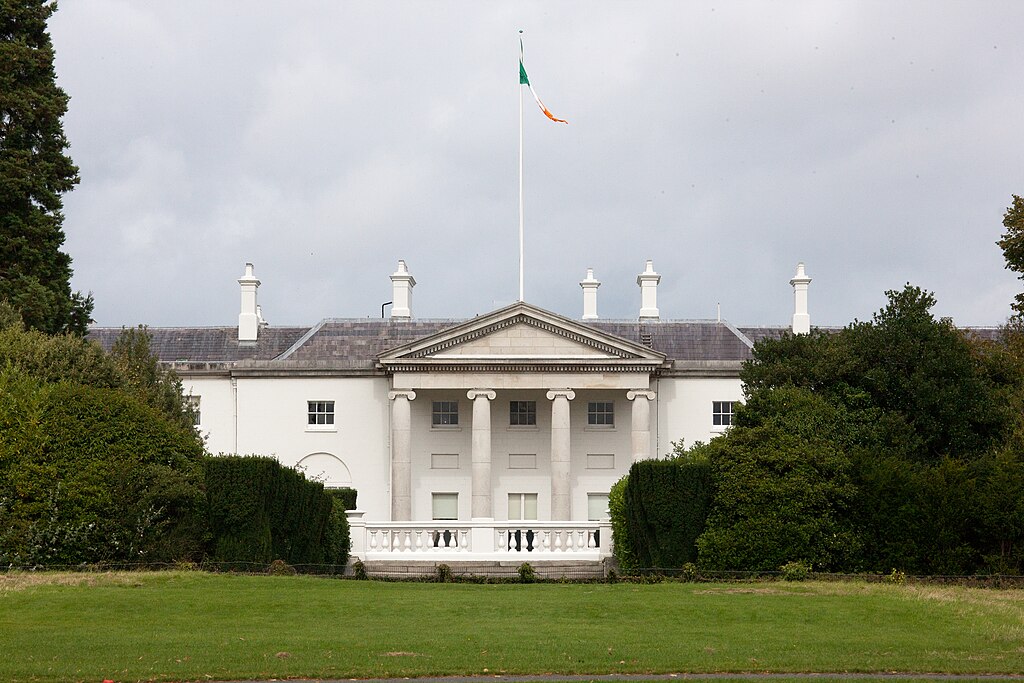
A: is for Áras an Uachtaráin, the official residence of the President in Dublin’s Phoenix Park. It was built by Nathaniel Clements in the 1750s and has been in use continually since the 1820s as the official residence of the head of state’s representative (Lords Lieutenant until 1922 and Governors General between 1922 and 1938) and the Irish head of state (Uachtaráin/President) since 1938.
B: is for Brian Lenihan Sr, whose 1990 election campaign floundered amid allegations that he had in 1982 sought to influence then President, Patrick Hillery, to refuse a dissolution of the Dáil following the Fianna Fáil government’s loss of a confidence vote.
C: if for Cearbhaill Ó Dálaigh, a former Chief Justice, who was appointed as fifth President in December 1974 following the sudden death in office of Erskine H. Childers (see E below). Ó Dálaigh became the first President to resign (Mary Robinson also resigned two months before the end of her term to take the role of UN High Commissioner for Human Rights), following a row with the Fine-Gael-Labour coalition government over his decision to refer an Emergency Powers Bill to the Supreme Court to test its constitutionality (see R below). Ó Dálaigh resigned in October 1976 in response to being called a ‘thundering disgrace’ (see X below) by the Minister for Defence, Patrick Donegan.
D: is for Dubhghlas de hÍde / Douglas Hyde an agreed candidate inaugurated in June 1938 as the first President under the new 1937 constitution. In 1893 Hyde had been the co-founder of Conradh na Gaeilge / the Gaelic League along with Professor Eoin MacNeill and had a distinguished academic career as first Professor of Irish at University College Dublin. He was one of two members of the Church of Ireland (along with Erskine Childers) to serve as President and the GAA stadium in his native County Roscommon is named Dr Hyde Park in his honour.
E: is for Erskine Hamilton Childers, a former Fianna Fáil minister elected as fourth President in 1973. Sharing the name of his father, [Robert] Erskine Childers – author of the spy novel The riddle of the sands who was executed by the Provisional (pro-Treaty) Government in October 1922 – Childers is the only President to have died in office. His tenure (June 1973 to November 1974) remains the shortest of any President.
F: is for Fianna Fáil, whose candidates held the office continually from 1945 until 1974, 1976 until 1990, and 1997 until 2004 (Mary McAleese was the party’s nominee in 1997 though stood again in her own right in 2004 and was returned unopposed); and for Fine Gael, which has, to date, never won a presidential election.
G: is for Governor General of Saorstát Éireann/Irish Free State, an office under the Irish Free State constitution between 1922 and 1937 which preceded the modern-day Presidency.
H: is for Hyde (Douglas), Hillery (Patrick) and Higgins (Michael D.). Surnames beginning with ‘H’ have been lucky omens for presidential candidates, at least until 2025.
I: is for Irish language, in which Presidents and candidates have had varying degrees of proficiency (see D above).
J: is for Jim Gavin, the only candidate to have withdrawn from an election after nominations had closed.
K: is for a knitted Michael Tea Higgins tea cosy, among a number of novelty gifts based on the ninth President.
L: is for Lord Lieutenant, the monarch’s representative in Ireland between 1801 and 1922 and the previous occupant of the Vice Regal Lodge (now Áras an Uachtaráin, see A above).
M: is for Mary – Robinson, McAleese, Banotti and Davis – the most popular first name among all candidates for President, followed by three Seáns (T. Ó Ceallaigh in 1945 and 1952; MacEoin in 1945 and 1959; and Gallagher in 2011 and 2018).
N: if for Nicholas Robinson, the first ‘first gentleman’ between 1990 and 1997.
O: is for Oireachtas (Irish Parliament). To date no president has exercised their powers under Article 13.2 of Bunreacht na hÉireann to convene a sitting of both Houses of the Oireachtas.
P: is for Patrick Hillery, the sixth President who served two terms between 1976 and 1990 without ever contesting an election, having been chosen as an agreed successor to Cearbhaill Ó Dálagh in 1976 and returned unopposed in 1983.
Q: is for Queen Elizabeth II, the first British monarch to meet officially with an incumbent Irish President (when Mary Robinson visited Buckingham Palace in 1993) and to be hosted for an official state visit by an Irish President (Mary McAleese in 2011).
R: is for Reference of Bills to the Supreme Court under article 26 of Bunreacht na hÉireann. This is one of the few absolute discretionary powers of the President who, after consultation with the Council of State, can refer a bill to the Supreme Court to test its constitutionality prior to signing it into law. To date this has happened on fifteen occasions (see C above).
S: is for Seán T. Ó Ceallaigh, the first person to win the presidency in a popular election in 1945.
T: is for Tom O’Higgins, the defeated Fine Gael candidate for the presidency in 1966 and 1973. In 1974, as Chief Justice, he was part of the three-person Presidential Commission (along with the Ceann Comhairle of Dáil Éireann and Cathaoirleach of Seanad Éireann) which deputised for the head of state between the death of Erskine Childers and the inauguration of Cearbhaill Ó Dálaigh.
U: is for Uachtaráin na hÉireann the title of the head of state in the constitutionally recognised first official language of the Irish state.
V: is for Vice Regal Lodge, the former name of Áras an Uachtaráin (see A above).
W: is for Roll Royce Silver Wraith, the official state car (registration number ZJ 5000) used since 1947 by Presidents on ceremonial occasions only, including inaugurations.
X: is for x-rated, widely believed to have been the true nature of Minister for Defence Patrick Donegan’s remarks (reported as ‘thundering disgrace) about Cearbhaill Ó Dálaigh (see C above).
Y: is for Yugoslavia, whose football team did not receive the traditional welcome from President Seán T. Ó Ceallaigh when they visited Dublin in 1955 for an international friendly against the Republic of Ireland. In response to pressure from the Catholic Archbishop of Dublin, John Charles McQuaid, a staunch opponent of Tito’s communist regime, the Taoiseach John A. Costello advised Ó Ceallaigh not to attend as originally planned. The game went ahead with Yugoslavia, one of the top European sides of the day, winning 4-1.
Z: is for Dublin Zoo, located in the Phoenix Park close to Áras an Uachtaráin and to which in 1980 President Patrick Hillery donated ‘Mimi’, a female elephant which had been given to him as a gift by Tanzanian President Julius Nyrere when Hillery visited Dar es Salaam in 1979.
Featured image courtesy of William Murphy, CC BY-SA 2.0 https://creativecommons.org/licenses/by-sa/2.0, via Wikimedia Commons
Leave a Reply