About this resource
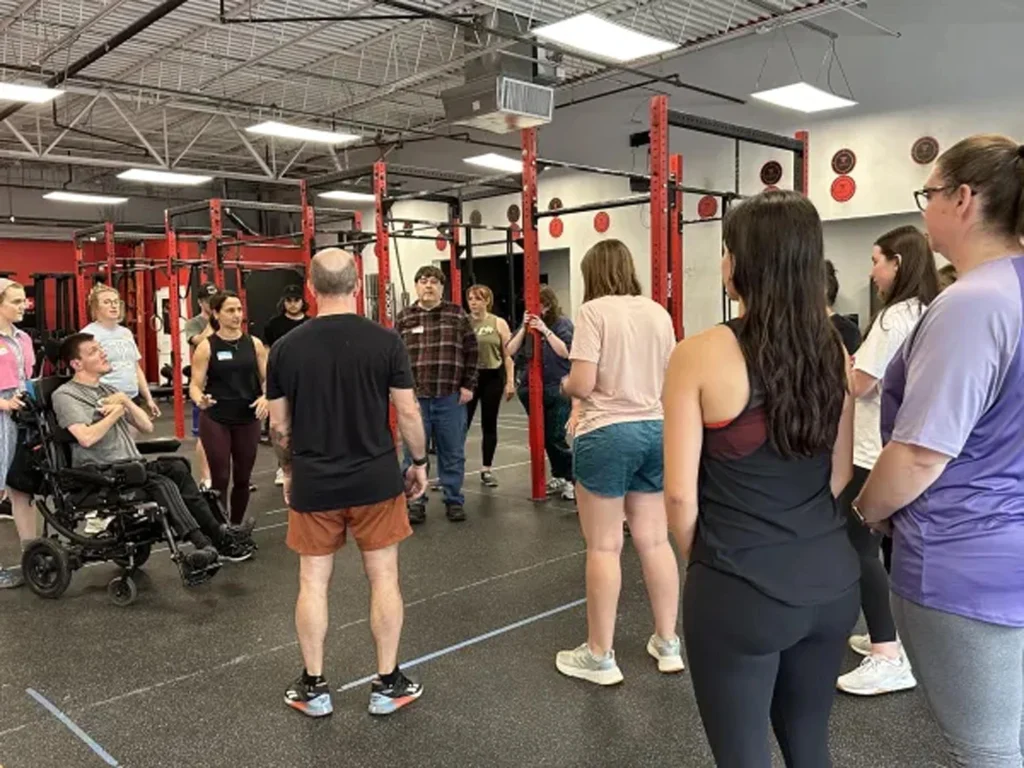
This resource was co-designed with a diverse group of stakeholders, including gym users, exercise and healthcare professionals, researchers, and representatives of community organisations, and includes disabled people across those roles. It was informed by workshops exploring how gyms can be inclusive and welcoming to all.
Why this resource exists
Many gyms want to be inclusive but are unsure where to start or worry about getting things wrong. Some have not had the chance to learn from disabled people.
To use this resource you can:
- Use as needed for quick guidance
- Review materials before a session
- Reflect on your current practice
- Share ideas with colleagues
There is no single ‘right way’. Inclusion means listening, learning, and adapting over time.
Exercise professionals need to know
Support goes beyond qualifications. It's important to understand people's individual needs, communicate clearly, and when to adapt the environment and to involve others.
01
Understanding individual differences
Knowledge and qualifications are necessary, but lived experience and adaptability matter just as much. People’s needs can change day-to-day due to fatigue, pain, confidence, and the environment.
02
Communication is key
Not everyone uses spoken communication. Speak to the person, not the carer. Explain things in different ways (spoken, visual, demonstration).
03
Environment matters
Noise, lighting, layout, accessibility, and busy times can affect the gym experience. Let people know if access features (e.g. lifts/elevators) are out of order.
04
Boundaries and referrals
You are NOT the one-stop solution. Know when and how to refer to other services.
05
Offer information in advance
Be clear about what is available and what is not (e.g. parking, toilet facilities, equipment, classes with seated options). It is ok not to offer everything, but this should be clearly explained.
06
Do NOT assume
Not everyone needs or wants help. People prefer different types of support. Be available without being intrusive.
07
Prepare and problem-solve
Adapt equipment and exercises with the person. Involve others (e.g. support worker / carer / healthcare professional) if needed. Set up spaces in advance.
08
Check in and get feedback
Check in before during and after sessions. Give people chances to share feedback or concerns.
09
Plan for safety
Make sure your emergency and evacuation planning includes everyone.
Five principles for inclusive environments
The ADAPT framework, developed by Northern Ireland charity Mae Murray Foundation, is a simple way to support inclusion in different environments. The principles have been used in settings such as beaches and play parks, and are currently being developed for gyms.
A
Access
Can people physically get into the space and use what is available?
D
Dignity
Are people treated with respect and given choice?
A
All‑Ability
Are different ways of moving welcomed and valued?
P
Participation
Can people take part in ways that suit them?
T
Transformation
Are you willing to listen, learn, and improve?
Co-design group
- Alexandra McDonnell
- Alix Crawford
- Cheryl Murphy
- Daniel Lightheart
- Deborah Thorpe
- Jennie Burrowes
- Kara Hume (UNC Research Partner)
- Karen McConnell (QUB Research Partner)
- Mary-Elaine McCavert
- Pauline Hunter-Graham
- Shawn Waitt
- Shona Pryde