
A History of Knowing: Encyclopedias Through the Ages
As the library celebrates Dr Moses Li’s extraordinarily generous donation of the Siku Quanshu—the monumental eighteenth‑century compendium of Chinese scholarship—to the McClay Library, Special Collections is delighted to launch the first in a new series of blog posts exploring the history of encyclopaedias and the many ways humanity has sought to capture and codify knowledge. Guest‑written by sinologist Dr Aglaia De Angeli (HAPP), this opening instalment turns to the classical and European traditions that shaped some of the earliest attempts to organise the world on the page.

Encyclopaedia
The word ‘encyclopaedia’ comes from the Greek ‘enkyklios paideia’, meaning ‘all-round instruction’. The term first appeared in its modern sense in Johann Heinrich Alsted’s Encyclopaedia, Septem Tomis Distincta (1630), which held a long-standing reputation. Divided into 35 books, it contained 48 synoptical tables and an index. This work stemmed from the Encyclopaedia Cursus Philosophici (1608).
In Antiquity and the Middle Ages
The concept is derived from Plato’s theory that in order to think better, one must know all. The origins of this classification can be traced back to Aristotle, who divided the sciences into three categories: theoretical (e.g. philosophy, physics and mathematics), practical (e.g. ethics and politics) and poetic/creative (e.g. the arts). These categories subsequently became the fundamentals of medieval categorisation. In ancient Rome, there was a strong emphasis on the importance of acquiring knowledge to ensure effective performance in one’s professional duties.
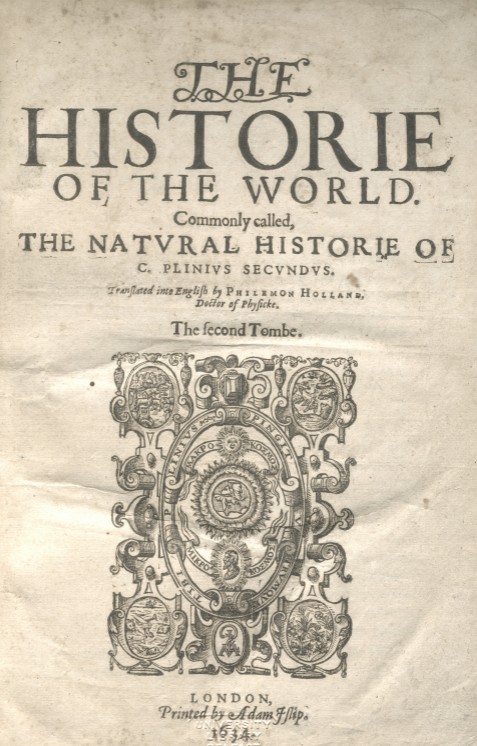
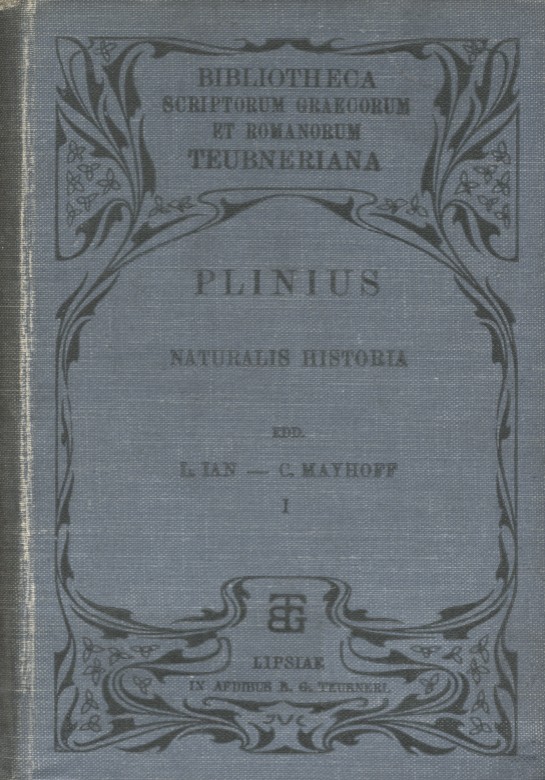
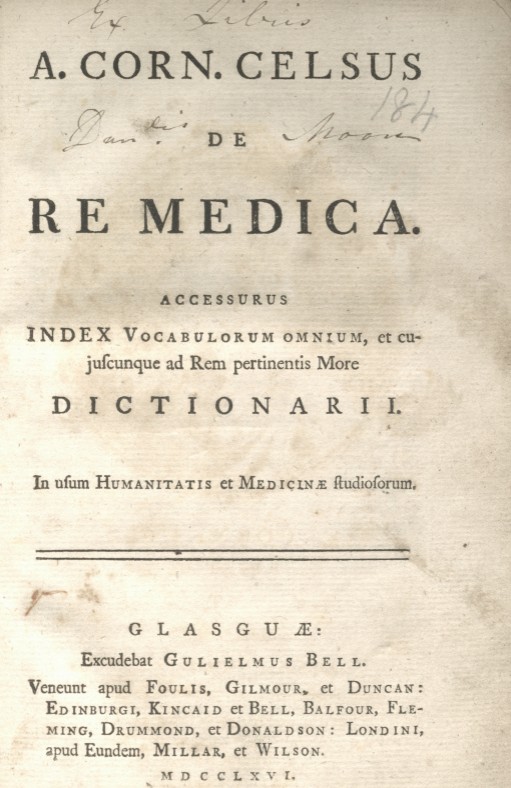
In classical times, the most significant examples were Libri ad Marcum filium by Cato (2nd c. BCE), which focused on the practical knowledge of the Roman citizen; Disciplinae in vols. 9 by Varro (2nd-1st c. BCE), which was a compendium of literary, philosophical, and technological notions; Naturalis Historia in vols. 37 by Pliny the Elder (1st c. CE); and Artes by Celso, whose remains are De medicina, a compendium on medicine in imperial Rome.


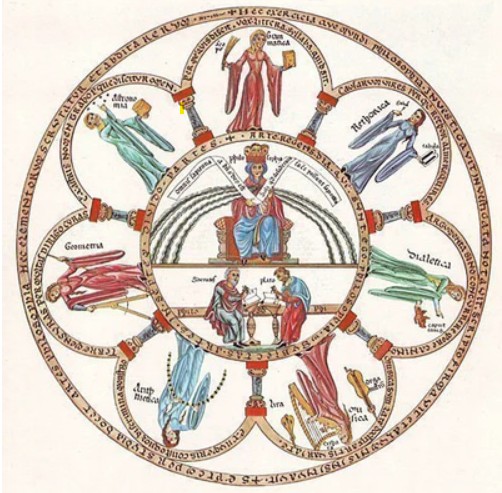
During the transition period between antiquity and the Middle Ages, in the 5th century CE, the allegorical work De nuptiis Philologiae et Mercurii by Marcianus Capella established the liberal arts into seven typologies: grammar, logic, rhetoric, arithmetic, geometry, music and astronomy. These were later distinguished as the Trivium (grammar, logic and rhetoric) and the Quadrivium (arithmetic, geometry, music and astronomy).
In the 7th century, Isidore of Seville compiled the Origines, establishing the vocabulary we know today, where each word is accompanied by a definition or etymology and a historical synthesis of literature on the topic. The Suda lexicon, a Greek-Byzantine dictionary and encyclopaedia compiled in the 10th century, was instrumental in establishing the model for the modern encyclopaedic dictionary. The glossary was compiled in alphabetical order, with each entry accompanied by historical, geographical and biographical information.
Modernity
With the advent of the Renaissance and the spread of humanism, culture became more anti-dogmatic and oriented towards specialist branches of knowledge. Therefore, monumental works conceived as syntheses based on universal principles and compiled from an encyclopaedic perspective were less common. Nonetheless, new encyclopaedias were compiled, such as De expetendis et fugiendis rebus by Giorgio Valla in 49 volumes, which were edited posthumously by his adopted son Giovanni Pietro Valla and published by Aldo Manuzio in 1501 in Venice. Another example is Commentarii Urbani by Raffaele Maffei, published in 1506 and containing 38 volumes of translations and adaptations of medieval works.
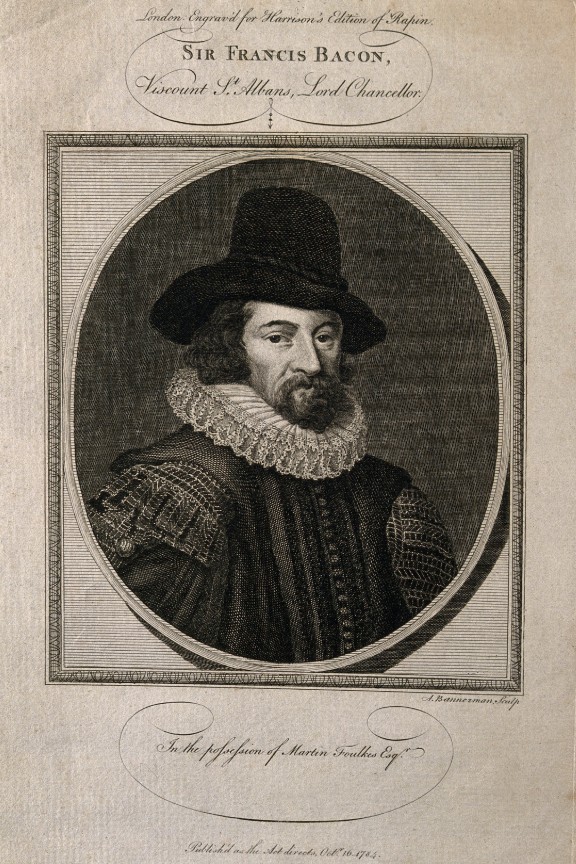
Interest in encyclopaedias increased during the 17th century when the crisis of Aristotelianism and the advancement of the experimental sciences prompted a reorganization of knowledge. In 1620, Francis Bacon’s Instauratio Magna became the first encyclopaedia to adopt a three-part structure, categorising knowledge into three sections: external nature, man, and man’s action on nature. This provided encyclopaedists with a comprehensive outline of the scope of human knowledge, acting as a checklist to ensure no fields of thought or endeavour were omitted. Bacon’s model was later used by Diderot. In this context, it is also worth mentioning Francis Bacon’s De dignitate et augmentis scientiarum (1623), in which he presented a tripartite classification of knowledge as the ‘tree of science’. Here, he categorised human knowledge into mnemonics, imagination, and reason, ascribing each to a different discipline or notion. We should also mention Pierre Bayle’s Dictionnnaire historique et critique (1697), which paved the way for the critical approach of the Enlightenment by demolishing traditional trappings and prejudices.
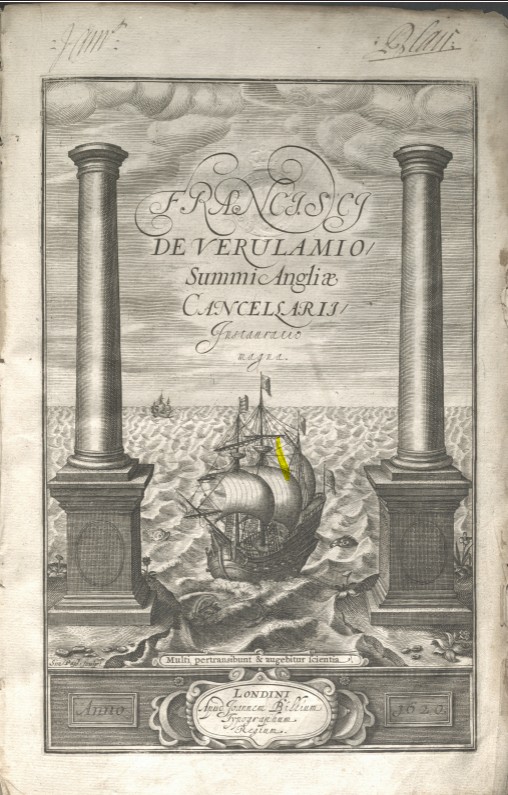
Frontispiece to Francis Bacon’s Instauratio Magna (1620). It features Bacon’s famous emblem of a ship sailing between two classical pillars (often interpreted as the Pillars of Hercules), symbolising the expansion of knowledge beyond traditional boundaries. The Latin motto at the bottom reads, “Multi pertransibunt & augebitur scientia” (“Many will pass through and knowledge will be increased”) 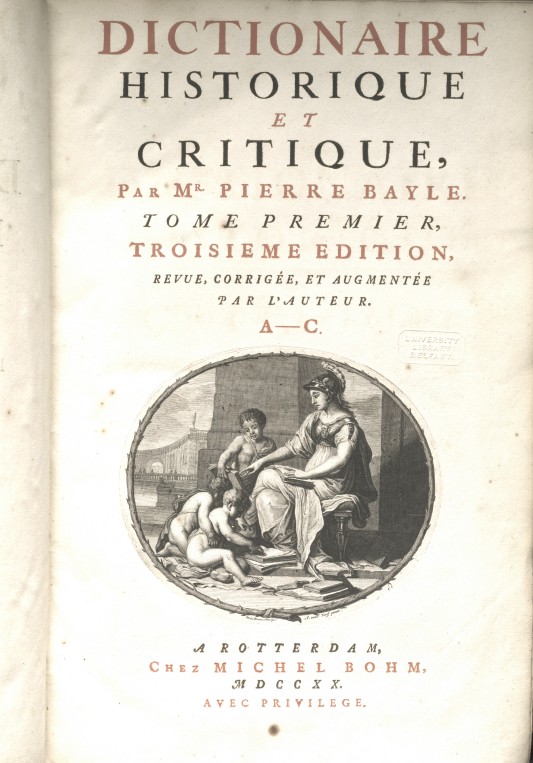
Title page of the Dictionaire Historique et Critique by Pierre Bayle, third edition, volume I (A–C), published in Rotterdam by Michel Böhm in 1720.
The 17th century was characterised by a rational approach that embraced experience, in contrast to eschatological tendencies. The ultimate goal was the dissemination of knowledge. The transition from modernity to the Enlightenment saw the creation of significant works, including the Biblioteca universale sacro-profana by Vincenzo Coronelli. This seven-volume work, published between 1701 and 1706, was the first to be organised alphabetically in the language of the time. This was followed by Ephraim Chambers’ two-volume Cyclopaedia; or An Universal Dictionary of Arts and Sciences in 1728 and Johann Heinrich Zedler’s monumental Universal-Lexicon, which took over 30 years to compile from 1731 to 1754 and consisted of 68 volumes.
Enlightenment
The Encyclopédie, ou Dictionnaire raisonné des sciences, des arts et des métiers, par une Société des gens de lettres (The Encyclopaedia, or A Reasoned Dictionary of the Sciences, Arts and Trades, by a Society of Literary Men) is widely regarded as the first modern encyclopaedia. The original plan, inspired by Chambers’ success, was to publish an updated translation of his Cyclopedia in five volumes.
When the initial project collapsed, its intended publisher, André Le Breton decided to start on an extended encyclopaedic project, and so in 1746 he secured the services of while Jean-Baptiste Le Rond d’Alembert, a prominent mathematician of his time, and Denis Diderot. In 1747 Diderot was the designated general director of the work except for its mathematical pars, d’Alembert was the editor for those. Other illustrious scholars contributed to the work, including Voltaire and Montesquieu in the field of literature, Jean-Jacques Rousseau in music, Georges Louis Leclerc de Buffon and Paul Henri Thiry d’Holbach in science, and François Quesnay and Richard Cantillon in economics. Diderot and d’Alembert assembled a group of writers for the production of the Encyclopédie. At first, the majority of these writers were relatively unknown, with the exception of Jean-Jacques Rousseau and Baron d’Holbach. The attack to the Encyclopédie was met with opposition. The Encyclopédists’ fame grew. Many distinguished and expert contributors joined, such as Anne Robert Jacques Turgot, Voltaire, Jean-François Marmontel and Jacques Necker. Diderot’s own contributions included the entries on philosophy, social theory and trade. As well as being an enthusiastic general editor, he was responsible for surveying the countless problems before their publication. In addition, he was responsible for the compilation and supervision of the preparation of between three and four thousand tables, the majority of which were illustrative of industrial arts and processes. Technically, it is also a first, as it was the first encyclopaedia not to be compiled by a single author, but rather the collective effort of a society of scholars not connected to the powers that be.


The first volume, entitled Discours préliminaire and written by D’Alembert, was published in 1751, followed by the second the following year. Between 1753 and 1756, volumes three to six were published. Initially, the work was ostracized. Nevertheless, Diderot and a small group of other scholars were still able to semi-clandestinely accomplish the publication. By the time the first 28-volume edition of the Encyclopédie was completed in 1772, it consisted of 17 volumes of text compiled between 1751 and 1765 and 11 volumes of plates published between 1762 and 1772. It contained 60,000 entries in tables covering various aspects of human activities and knowledge, and it had a specific technical character. Between 1776 and 1777, it was supplemented by a further five volumes: four of text and one of illustration plates. By 1780, two volumes of indices had also been added, all of which were compiled under the direction of other editors since Diderot had refused to edit the supplementary materials himself. These seven volumes, plus the 28 prepared by Diderot, constitute the first edition of the Encyclopédie, comprising 35 folio volumes in total.
The Encyclopédie encountered strong opposition from the outset, from institutions as well as religious orders and movements such as the Jesuits and the Jansenists. It was even condemned by Pope Clement XIII. Besides Jesuit censorship and the suppression of several volumes by the French Council of State in 1752, it was finally condemned and denied permission to be published in 1759, a ban that would last several years. In 1764, Diderot discovered that Le Breton and a compositor had secretly removed around 300 pages of liberal or controversial material from the proof sheets of approximately ten folio volumes.
In 1782, the Encyclopédie’s enlarged edition was published. The original alphabetic order was substituted. The work was arranged by topic. It was published under the title Encyclopédie méthodique ou par ordre de matières (or ‘Systematic Encyclopaedia or Arranged by Subject’). Even during the French Revolution, work on the compilation of this new version continued, and it was not until 1832 that the 166th volume was published and the project was completed.
The Encyclopaedists’ purpose was not only to collect and transmit knowledge. Belonging to the empiricism and pragmatism promoted by 17th-century thinkers such as Francis Bacon, Isaac Newton and John Locke, and inspired by science, they aimed to promote critical thinking and use it as a weapon against the Ancien Régime. The Encyclopédie’s main features were tolerance and liberalism, advocating coverage of trades and mechanical arts, scepticism with an emphasis on scientific determinism, and criticism of the abuses perpetrated by contemporary legal, judicial and clerical institutions. With their progressive thinking, the Encyclopaedists created the intellectual climate that led to the French Revolution.
The 19th century encyclopaedia
The French Encyclopédie paved the way for the publication of other famous encyclopaedias, such as the Encyclopaedia Britannica, which was originally compiled in three volumes between 1768 and 1771 and arranged according to short but rigorous scientific coverage of subjects.
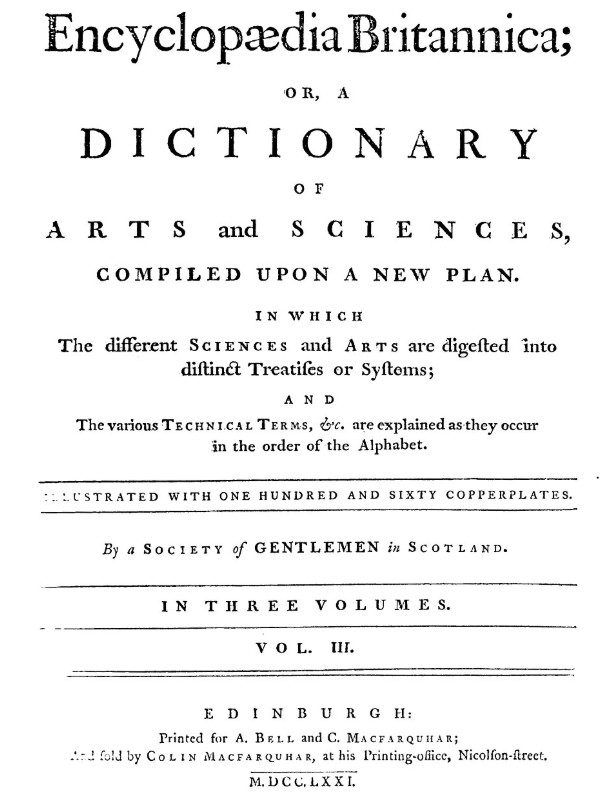
During the long 19th century, two types of encyclopaedia appeared: those aimed at an average, educated readership according to Romanticist standards, and those inspired by positivism and August Comte’s theory. An example of the former is the German Konversations-Lexicon, published by Brockhaus in six volumes and supplements between 1796 and 1811. Aimed at an average readership, it provided brief answers to questions that might arise during conversation, setting trends for encyclopaedias published during the Romantic period, such as the Allgemeine Encyclopädie der Wissenschaften und Künste (167 volumes, 1813–1889) and the Meyers grosses Konversations-Lexicon (52 volumes, 1840–1852), the latter being the first to include illustrations alongside the text. Another notable example is the Italian Nuova enciclopedia popolare, a twelve-volume work published by G. Pomba between 1841 and 1848.
Works belonging to the positivist trend were opposed to romantic idealism. Positivism was a method based on scientific facts and a vision of philosophy as a synthesis of the sciences. Works in the positivist tradition include the Grande encyclopédie, inventaire raisonné des sciences, des lettres et des arts, edited by H. Lamirault, and the Grand dictionnaire universel du XIXe siècle, edited by P. Larousse (17 volumes, 1864–90). The latter includes both lexicographic and encyclopaedic entries arranged in alphabetical order.