City of Culture? Bradford’s parallel communities and divided drug service provision by David Tebbet
MSc in Substance Use
Introduction:
A northern English country village exemplified the characteristics of its location and the 1980s era; a tight-knit, white community with deep-rooted connections across multiple generations. The locally owned shops, public houses, and small businesses, many of which have been family-run for decades, played a vital role in supporting the local economy while nurturing a strong sense of community and belonging. In the late 1980s a small number of South Asian families moved into the village, 20 miles from the City of Bradford, they settled and significantly contributed to the local community. Rich cultural traditions, diverse culinary delights, and vibrant celebratory festivals enriched the community, playing a crucial role in boosting the local economy by opening new businesses, participating in community events, and fostering a newfound sense of multiculturalism. Families became friends, many for life and despite the differing cultural traditions and values, the socioeconomic disparities, and the racist and colonial attitudes of some members of the white communities in the English countryside, a secret network of mutuality was formed in the distribution and consumption of illegal substances.
This study examines the sociocultural dynamics of substance use and the specific challenges encountered by South Asian communities in the Bradford district. The aim is to explore and develop new and improved services, ultimately leading to a more effective and inclusive social support structure, particularly for individuals who use substances residing within parallel communities.
In the United Kingdom (UK), the term ‘South Asian minorities’ refers to persons from the Indian subcontinent such as Pakistan, India, and Bangladesh. The history of South Asian migration to the UK is thought to span over four hundred years (Visram, 2002). Migration ranged from transitory to permanent during the 17th century as some attempted to survive on the fringes of British society, living and dying a life of destitution whilst others lived a life of opposing prosperity. From the nursemaids, sailors, travelling nannies, and soldiers who fought in the two world wars to the aristocratic families, doctors, merchants, lawyers, civil servants, and elected MPs in the middle of the nineteenth century (Anitha, and Pearson, 2013).
Striking Women (2012) state the considerable rise in South Asian migration to the UK post 1947 can be attributed to several key factors; escape from the civil war following the partition of India, to fill the labour shortages in Britain, the pursuit of enhanced economic opportunities, and the intention to reunite with or marry into families who had established residence in the country. Following the Second World War, South Asian migrants who arrived in Britain found employment across multiple sectors, with a substantial number working in the textile industries in Bradford and the surrounding areas of Yorkshire.
In England and Wales, every ten years, the census conducted by the Office for National Statistics (ONS), helps to create a comprehensive illustration of the nation. According to the 2021 census, the population of England and Wales was 59.6 million with the Asian community representing the largest minority group. Almost 82%identified as White, 9.3% as Asian, 4.% as Black, 2.9% as Mixed, and 2.1% as Other (Population of England and Wales, 2022). The population of the Bradford district was recorded at 546,400, with a more recent estimate indicating an increase to 560,200 as of June 2023 (City of Bradford Metropolitan District Council, 2022a). The data reveals that 56.7% of respondents identified as White British, 25.5% as Pakistani, 2.6% as Indian, 2.3% as Bangladeshi, 2.7% as belonging to Mixed or Multiple ethnic groups, and 2% as Black. Compared to the 2011 Census, the proportion of the Asian or British Asian population rose from 26.8% to 32.1%. Additionally, when considering other ethnic minority groups, the percentage of the non-White British population has increased from 36.1% in 2011 to 43.3% in 2021 (City of Bradford Metropolitan District Council, 2022b). Overall, statistics on ethnic groupings, religion, language spoken, and nationality suggest the region has become increasingly diverse regarding its ethnic composition. This data is essential for government and local authorities for future planning and allocation of resources for both public sector and non-statutory services. Additionally, it is valuable for voluntary organisations as it enhances understanding of the communities they serve, assisting in securing funding through applications informed by local demographics. (About the Census – Office for National Statistics, 2022).
Exploring local income deprivation (2021) state that In 2021, Bradford ranked as the 27th most deprived out of the 316 local authorities in England, with 133 of the 310 neighbourhoods amongst the 20% most deprived in England. Poverty, inadequate housing, low levels of educational attainment, and a lack of employment or social opportunities are all examples of deprivation, typically concentrated in inner cities, but also present in small towns and rural areas. Numerous studies have emphasised the connections between deprivation and problematic alcohol and other drug use (British Medical Association, 2024, Townsend, Phillimore, and Beattie, 2023). However, problematic drug use is also prevalent among the lower socioeconomic strata and whilst ethnic minority communities experience significant levels of poverty, deprivation, and unemployment, the correlation with problematic drug use is unclear compared to the general population (Shaw et al., 2007). In 2021, The Home Office and the Department of Health commissioned Dame Carol Black to conduct a two-part review of drug use, to provide the government with recommendations for additional measures to mitigate the potential negative effects associated with drugs. Part two found national and local statistics regarding the prevalence of drug use and misuse in Black, Asian, and Minority Ethnic (BAME) communities remained insufficient. National treatment data indicated that these communities are underrepresented in treatment programs. While this may suggest a lower level of drug use among these communities, The Dame Carol Black Review, part 2 (2021) suggests it may also be indicative of unmet needs in certain areas, attributed to heightened stigma surrounding drug use and the absence of culturally tailored services, which create barriers to accessing treatment. This report provided a list of consultees however, no organisation listed specifically represented the members of ethnic minorities (Stevens, 2024).
Statistics from the National Drug Evidence Centre (NDEC) at the University of Manchester (2024a) indicate between April 2022 and March 2023, 290,635 adults accessed voluntary drug treatment services in England, with 4% identifying as Asian or Asian British. Of the 3,500 adults accessing treatment in the Bradford district, 12% identified as Asian or Asian British, 2% as Mixed, 1% as Black African/Caribbean/Black British, and 1% from other ethnic groups.
The statistics illustrated in the accompanying graph outline the substance groupings and numbers of Asian males and females receiving treatment within the Bradford district.
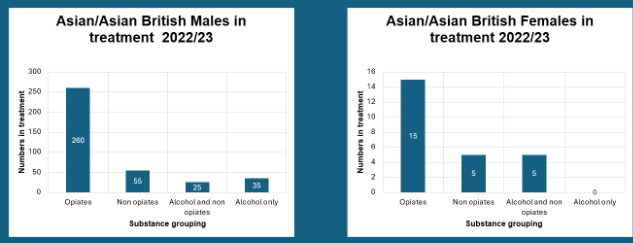
(NDEC – University of Manchester, 2024b)
According to the NDEC (2024c), of the four hundred individuals identifying as Asian or Asian British, 94% (375) were male and 6% (25) were female, with the opiate substance group being highest across both genders but notably no women were in treatment for alcohol only.
It has been recognised that there has been an underrepresentation of South Asian communities in alcohol and other drug services in the UK for some time (Gray and Ralphs, 2017). Intersectional stigmas occur, not only for South Asian individuals who use alcohol and other drugs but also with their families and wider communities. These contributing factors may lead to an underreporting of the extent of South Asian community drug use and an undervaluation of the prevalence and severity of drug-related issues within these communities (UKDPC, 2010). Decades ago, these unmet needs, under-representation, and gaps in mainstream drug and alcohol support services served as the impetus for the founding of BAC-IN in 2003, grassroots, peer-led service based in the Midlands. Settings are sensitive to cultural differences so that users of the service can interact, connect, and share experiences with others who have comparable racial, cultural, and spiritual backgrounds. T
Their life experiences and cultural heritage are acknowledged and reflected in this welcoming environment (Sahota et al., 2021).
South Asian cultures, which fight to uphold tradition in the face of changing circumstances and cultural norms, are even more harshly condemned. Patriarchal institutions play a significant role in shaping South Asian societies. Key elements such as domesticity, marriage, modesty, and the preservation of ‘Izzat’, escribed as the complex and evolving aspects of male family identity, including family pride, honour, and self-respect (Ramnath, 1979). Consequently, South Asian women’s social interactions and public conduct are often subject to scrutiny, both externally and internally, and are often faced with additional disadvantages including lack of education and skills, language barriers, unemployment, and particular forms of violence associated with cultural and religious practices. These can define identity, leading to further victimisation and marginalisation (Ganeshpanchan and Masson, 2021). Across societies, there are differences in the treatment of males and females who drink alcohol according to gendered roles and experiences. The treatment service statistics for Bradford indicate gender differences, which suggest the possible impact of cultural norms and women accessing services. In Western cultures, the stigmatisation of women who drink excessively is not unusual (Dawson et al., 2005), however, alcohol is considered ‘haram’ or forbidden in the Islamic faith, and the Muslim holy book, The Quran, calls intoxicants the ‘work of Satan’ (Michalak, Trocki and Katz, 2009).
The Galvani et al. (2023) study ‘Keep it to yourself’ focuses on the lived experiences of South Asian women, living in the UK, who use alcohol and other drugs. This research explored alcohol use and help-seeking from the perspectives of South Asian women, how non-alcohol-using women from these communities responded to the women’s problematic use of alcohol, and how and if, different practitioners offer support to women from South Asian communities. The authors reviewed the existing literature, combined with contributions from all three participant groups, and found a distinct lack of informed and specialised service offerings for South Asian women experiencing problematic alcohol use. It recommended the need for culturally literate and gender-sensitive services as essential, services that acknowledge women’s unique cultural pressures without requiring explanation, and are safe, confidential, trauma-informed, and educational across various formats. These services should address the common issues of domestic and sexual abuse, mental health, and family conflict experienced by South Asian women. Additionally, they must be discreetly located in accessible community spaces beyond just alcohol support, while recognising that not all women need clandestine options; some may prefer mainstream services that also cater to their cultural needs.
The Bradford District Council commissioned a local service and the Race Equality Network (REN) to gather information on the experiences, hurdles, and other issues that South Asian community members face while seeking alcohol and other drug treatment and support. This research entitled ‘The Belonging Project’ sought to get a better knowledge of drug use in South Asian communities, any associated harms to individuals and families, and whether present service provision reflects and serves the needs of South Asian ethnic minority groups. It sought to provide public health, alcohol and other drug treatment services with insight into barriers to treatment access, ways in which to overcome them, and to aid in the future development of local services that meet the needs of these identified gaps (City of Bradford Metropolitan District Council, Project 6, and Race Equality Network (REN), 2024).
By using a mixed methods approach to provide context and identify data gaps the study started with a literature review, followed by quantitative data collection using online and paper anonymous surveys, and qualitative insights were obtained using ‘Community Champions’ facilitating focus groups and structured interviews with professionals. The report found a vast majority (91%) of respondents indicated that drugs are either a significant or incredibly significant issue in their community. The most used substances were identified as cannabis and alcohol, with stimulants like cocaine also reported to be frequently consumed. Additional substances of concern included Naswaar, nitrous oxide, and electronic cigarettes. Stress relief, mental health, and peer pressure are primary factors influencing substance use. 57% of individuals reported being unaware of local drug treatment services. 22% of those who have accessed support believe that services adequately address the needs of South Asian communities. 26% of respondents consider racism a barrier to South Asian individuals accessing support. 75% of individuals consider community outreach a key priority. 78% indicated that collaboration between Public Health, service providers, and community leaders would have the greatest impact (Shahid and Best, 2024).
Drug use in ethnic minorities: call for evidence (2023) was initiated by The Advisory Council on the Misuse of Drugs (ACMD) to examine drug use within ethnic minority groups. This review aims to assess the prevalence of drug consumption, the challenges associated with reporting, and the engagement with and accessibility of treatment services. A Home Office survey, Drug use in ethnic minorities (2024) included in the ACMD inquiry will investigate various ethnic minority groups, the consequences of drug use within these populations, the treatment services available to them, the barriers they encounter, potential improvements to be made, family or community interventions, and any pertinent evidence of collaborative or local approaches that relate to ethnic minority groups.
Collective Voice, a national charity aimed at improving England’s alcohol and other drug treatment and recovery systems, engaged with mainstream services and organisations led by and for individuals from ethnic minorities in response to The ACMD. The summary and key findings recommended that the UK government review the commissioning process for services targeting ethnic minorities, consider ring-fencing grant funding, and develop guidance for commissioners. Doherty (2023) suggests this guidance, co-produced with organisations led by and for individuals from ethnic minorities, should support the engagement of specialist organisations throughout the entire commissioning cycle. Furthermore, it places responsibility for ‘market stewardship’ with commissioners, ensuring that partnership arrangements with specialist organisations in bidding processes and contract delivery are fair and equitable. According to Needham et al. (2022) Institutional racism can be defined as policies, procedures, and practices that regularly feature in how organisations operate and that cause or encourage the continuation of certain people’s unfair advantage and the damaging or unjust treatment of others depending on their race. This is the elephant in the UK’s room of alcohol and other drug treatment: Of the twenty-three members of the ACMD, twenty-two are white; every CEO of the six largest alcohol and drug treatment services is white, and of the eight trustees on the board for Collective Voice there is only one person of colour (Reappointments to the Advisory Council on the Misuse of Drugs, 2024; Change Grow live, 2024; Cranstoun, 2024; Turning point, 2023; Waythrough, 2025; WithYou, 2023; Via, 2023; Collective Voice, 2025).
Conclusion
Research on substance use within South Asian communities residing in the UK is currently limited. NDTMS datasets suggest a potential underreporting of substance use and the under-representation of South Asian people receiving support. This may stem not only from the cultural, religious, and traditional differences but also from systemic barriers created by commissioning processes and the inflexibility of treatment service providers in addressing the specific needs of South Asian communities. Racism has a detrimental effect on the lives of individuals, and families of South Asian communities and their pasts, with evidence revealing that racism still permeates their lives now (Simela, Ahmadzadeh and Abdinasir, 2024). Institutional racism continues to feature in the lives of people using substances, resulting in a general reluctance to interact with or follow the advice these services offer, as well as a lack of faith in mainstream “White” service providers (Sahota et al., 2021b).
Recommendations from individuals, peer-led organisations, collective charities, and government advisors demonstrate persistent thematic consistency. Local, regional, and national service providers must prioritise the unmet needs of their respective communities through cultural adaptation and understanding to address the barriers that predominantly impact minority populations, alongside barriers faced by the general white population, which consequently results in often isolated and unsupported problematic substance use, stigma, further marginalisation, and feelings of shame.
Reference List
Ajayi, O. (2021); A perspective on health inequalities in BAME communities and how to improve access to primary; Future Healthcare Journal, 8(1), pp. 36–39
Anitha, S. and Pearson, R. (2013) Striking Women. Lincoln: University of Lincoln.
British Medical Association. (2024) Substance misuse harms impact the vulnerable and disadvantaged most and are not inevitable. Available at: https://www.bma.org.uk/news-and-opinion/substance-misuse-harms-impact-the-vulnerable-and-disadvantaged-most-and-are-not-inevitable#:~:text=The%20evidence%20shows%20that%20those,example%20from%20alcoholic%20liver%20disease.
Change Grow Live. (2024) Our People. Available at: https://www.changegrowlive.org/about-us/our-people.
City of Bradford Metropolitan District Council, Project 6, and Race Equality Network. (2024) The belonging project EXECUTIVE SUMMARY. Unpublished manuscript.
City of Bradford Metropolitan District Council. (2022a) Intelligence Bulletin, City of Bradford Metropolitan District Council.
City of Bradford Metropolitan District Council. (2022b) Intelligence Bulletin, City of Bradford Metropolitan District Council.
Collective Voice. (2025) Our trustees. Available at: https://www.collectivevoice.org.uk/about-us/our-trustees/
Council, B.M.D. (2021) Census: Bradford District. Available at: https://ubd.bradford.gov.uk/about-us/2021-census/
Cranstoun (2024) Our organisation. Available at: https://cranstoun.org/who-we-are/our-organisation/#:~:text=Charlie%20Mack&text=Charlie%20has%20worked%20in%20the,charities%20holding%20CEO%20and
Doherty, L. (2023) Collective Voice responds to the ACMD on Drug Use in Ethnic Minority Groups. Available at: https://www.collectivevoice.org.uk/cv-response/response-to-acmd-race-and-ethnicity/
Galvani, S. et al. (2023) “Keep it to yourself”. Supporting solutions for South Asian women: Developing models for alcohol support. Available at: https://s3.eu-west-2.amazonaws.com/sr-acuk-craft/documents/Galvani-et-al-SA-womens-alcohol-support-needs-Full-Final-Report-updated-14th-August-2023.pdf
Ganeshpanchan, Z. and Masson, I. (2021); Harmful social and cultural practices that exist within South Asian communities in the UK and their impact on women. In Policy Press eBooks, pp. 35–56.
Garlick, S. (2022) Ethnic group, England and Wales – Office for National Statistics. Available at: https://www.ons.gov.uk/peoplepopulationandcommunity/culturalidentity/ethnicity/bulletins/ethnicgroupenglandandwales/census2021
GOV.UK. (2022) Population of England and Wales. Available at: https://www.ethnicity-facts-figures.service.gov.uk/uk-population-by-ethnicity/national-and-regional-populations/population-of-england-and-wales/latest/
Gray, P. and Ralphs, R. (2017) Confidentiality and cultural competence? The realities of engaging young British Pakistanis and Bangladeshis into substance use services; Drugs Education Prevention and Policy, 26(2), pp. 133–139.
Home Office. (2024) Drug use in ethnic minority groups. Available at: https://www.homeofficesurveys.homeoffice.gov.uk/s/0L4OV1/
MEAM. (2021) Dame Carol Black Review part 2: Call for evidence report. Available at: https://meam.org.uk/wp-content/uploads/2020/09/MEAM-Carol-Black-Submission-Final-Draft-6.08.2020.pdf
Michalak, L., Trocki, K. and Katz, K. (2009) I Am a Muslim and My Dad is an Alcoholic—What Should I Do? Internet-Based Advice for Muslims About Alcohol; Journal of Muslim Mental Health, 4(1), pp. 47–66.
NDEC – University of Manchester. (2024 a) NDTMS – ViewIt – Adult. Available at: https://www.ndtms.net/ViewIt/Adult.
NDEC – University of Manchester. (2024 b) NDTMS – ViewIt – Adult. Available at: https://www.ndtms.net/ViewIt/Adult.
Needham, B.L. et al. (2022) ‘Institutional Racism and Health: a Framework for Conceptualization, Measurement, and Analysis,’ Journal of Racial and Ethnic Health Disparities, 10(4), pp. 1997–2019.
Office for Health Improvement and Disparities. (2023) Adult substance misuse treatment statistics 2022 to 2023: report.
Office for National Statistics. (2021) EXPLORING LOCAL INCOME DEPRIVATION. A detailed picture of disparities within English local authorities to a neighbourhood level (2021).
Office for National Statistics. (2022) About the census.
Office for National Statistics. (2024) Quality and methodology information (QMI) for Census 2021
Office, H. (2023) Drug use in ethnic minority groups: call for evidence.
Ramnath, U. (1979a) Review, Third World Quarterly. Taylor & Francis, Ltd., pp. 176–178.
Reappointments to the Advisory Council on the Misuse of Drugs | GovWire News. (2024) Available at: http://www.govwire.co.uk/news/advisory-council-on-the-misuse-of-drugs/reappointments-to-the-advisory-council-on-the-misuse-of-drugs-61888
Sahota, S. et al. (2021a) Out of sight, out of mind: A Black, Asian & Ethnic Minority case for reform to ensure no one is left behind in their search of recovery.
Sahota, S. et al. (2021b) Out of sight, out of mind: A Black, Asian & Ethnic Minority case for reform to ensure no one is left behind in their search of recovery.
Shahid, S. and Best, D. (2024); Exploring cultural dynamics of Black Asian Minority Ethnic (BAME) women in addiction recovery: a comparison of three women from different ethnic backgrounds; Drugs Education Prevention and Policy, pp. 1–12.
Shaw, A. et al. (2007) Drugs and poverty: A literature review. Available at: https://www.sdf.org.uk/wp-content/uploads/2017/03/Drugs Poverty_Literature_Review_2007.pdf
Simela, E., Ahmadzadeh, Y. and Abdinasir, K., 2024. Intergenerational consequences of racism in the United Kingdom: A qualitative investigation into parents’ exposure to racism and offspring mental health and well‐being. Child and Adolescent Mental Health
Stevens, A. (2024) Drug policy constellations, Policy Press.
Striking Women. (2012) Post 1947 migration to the UK – from India, Bangladesh, Pakistan and Sri Lanka.
Striking Women. (2012). Pre 1947 direct migration to the UK from South Asia). Available at: https://www.striking-women.org/module/map-major-south-asian-migration-flows/pre-1947-direct-migration-uk-south-asia (Accessed: 13 January 2024)
Townsend, P., Phillimore, P. and Beattie, A. (2023) Health and deprivation. Available at: https://doi.org/10.4324/9781003368885
Turning point. (2023) Available at: https://www.turning-point.co.uk/story-detail/tp-responds-to-autumn-statement.
UKDPC (no date) Drugs and Diversity: Ethnic minority groups, Drugs and Diversity: Ethnic Minority Groups.
Via (2023) Executive Team Archives – via. Available at: https://www.viaorg.uk/people_cat/executive-team/
Visram. (2002) A South-Asian history of Britain: four centuries of peoples from the Indian subcontinent. Available at: https://muse.jhu.edu/article/377240/pdf
Waythrough. (2025) Our executive team Available at: https://www.waythrough.org.uk/who-we-are/our-executive-team/
WithYou. (2023) Available at: https://www.wearewithyou.org.uk/about-us/leadership-and-governance/our-executiveteam#:~:text=In%20his%20role%20as%20Chief,Executive%20and%20Board%20level%20roles)