Interpreting the Rise in Reported Sexual Offences in London (2015–2025): Crime Trends, and the Impact of Institutional and Media Dynamics by Tara Francis
Degree programme: Joint Honours BA Sociology & Criminology
Year of study: First year
Introduction
In the last ten years, London has seen a steady increase in the number of police reported sexual offences. The official term of ‘sexual assault’ refers to rape, assault by penetration, indecent exposure, or unwanted touching, including attempts (Office for National Statistics, 2023). The Office for National Statistics (ONS) (2024), using data derived from the Crime Survey for England and Wales, found that the number of reported sexual offences has been gradually increasing over the span of 2015-2025, with 2015 showing 16,147 reported cases, and 2025 showing 26,803 cases. This rise in reports is significant and appears to imply that sexual assault has become increasingly prevalent over the last 10 years. However, further inspection of the data suggests that the increase in reported sexual offences may not directly point towards a rise in offending behaviour but rather changes in how such crimes are socially constructed, recorded, and reported.
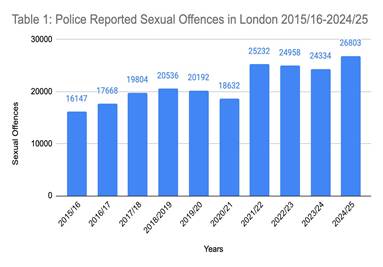
Source: Office for National Statistics (UK)
Trends in Recorded Sexual Offences
The data shown in Table 1 shows a distinct rise in reported sexual assault cases. This could point towards a change in recording practices by the Metropolitan Police Services (MPS). Following a 2014 inspection of all police forces by His Majesty’s Inspectorate of Constabulary and Fire & Rescue Services, a substantial under-reporting of crime was discovered, and a rolling programme of crime data integrity inspections was introduced (Office for Statistics Regulation, 2024). The HMICFRS estimated that in 2014, 80.5% of all crimes reported to the MPS were being recorded. By 2022, they estimated that this number had increased to 92.4% (HMICFRS, 2023). This could explain the gradual rise in recorded sexual offences from 2015 onwards, as the MPS faced pressure to record a greater number of sexual offences reported to them, whereas in the past they may have been disregarded. In the short term, these changes create noticeable rises in recorded offences, but in the longer term they help to establish more reliable, consistent and transparent crime data.
The Impact of Crime Recording Practices
The Home Office currently states that an incident must be recorded as a crime if, on the balance of probability, the circumstances amount to a crime defined by law and there is no credible evidence to the contrary (Home Office, 2025). If these conditions are fulfilled, police are required to record a crime even when the victim declines to provide personal details or does not want to take the matter further (Lovett et al., 2024). This means that if allegations involving rape are disclosed to the MPS, they are obligated to record it as a crime, even without any further information provided. Counting rule changes such as this will naturally lead to an increase of sexual offences being recorded, inflating recorded figures.
Challenges in Measuring Sexual Offences
Spence and Crivatu (2025) argue that police crime data is shaped by methodological limitations and institutional biases, influencing what is officially recorded. Factors such as classification ambiguity and victim willingness to report can distort data, meaning recorded crime figures represent negotiated outcomes rather than an objective measure of offending (Spence and Crivatu, 2025). For example, an incident in which there is insufficient evidence to prove a sexual element is classified as ‘common assault.’ Classification ambiguity could occur when incidents involving unwanted physical contact are reported with limited information. Depending on how police interpret the available evidence, the same incident may be classified as sexual assault or common assault. When viewed through this lens, the rising number of sexual offence reports could be indicative of shifting institutional practices and social understandings of crime, rather than a simple reflection of growing criminality.
Social Construction of Crime Statistics
This pattern aligns with social constructivism, a theory that argues reality is continuously created and re-created by human beings and institutions (Berger and Luckmann, 1966). It can be argued from a social constructivist perspective that crime statistics stray from being neutral reflections of behaviour and become socially constructed outcomes shaped by institutions such as the MPS. The improved recording procedures implemented by the HMICFRS redefined what was being counted as crime. Hence, the apparent rise in sexual offences does not necessarily point towards an increase in crime, but more likely a change in the social and institutional construction of sexual offences.
The 2021-2022 Spike in Recorded Sexual Offences
In the data, there is an apparent spike in crime from 2020/21 to 2021/22, with the number of recorded sexual offences rising from 18,632 to 25,232. This drastic spike in sexual offences could be explained by high profile sexual offence cases coming to light in 2021. In March 2021, a thirty-three-year-old woman, Sarah Everard, was abducted, raped, and murdered by a serving Metropolitan Police officer (Solace Women’s Aid, 2024). This high-profile case led to widespread outrage directed at the MPS to urgently address the culture of sexism that exists within the UK, and to ensure that they tackle the issues of sexual violence perpetrated against women (Milton, 2021). Police found “notable increases” in reported sexual offences in April 2021, just one month after Sarah Everard’s murder. It was theorised that “the impact of high-profile incidents, media coverage and campaigns on people’s willingness to report incidents to the police, as well as a potential increase in the number of victims” (BBC News, 2022). While media attention can drive short-term spikes in reporting, its longer-term impact may involve sustained changes in public awareness and attitudes towards reporting sexual violence.
Public Trust in the Metropolitan Police
This surge in reports also reflected a deepening crisis of trust between women and the police. Women in London exhibit significantly lower levels of trust in the Metropolitan Police compared to both men and women in other regions of England, particularly following high-profile scandals such as the Everard case. (Pickering et al., 2024) Lower levels of trust in the MPS may discourage some women from reporting sexual offenses due to reduced confidence in both personal safety and the likelihood of justice being achieved. Conversely, diminished trust may also contribute to increased public scrutiny and criticism of police behaviour. Overall, reduced trust, combined with heightened public awareness and extensive media coverage, likely intensified public discourse surrounding sexual violence and reporting practices.
Applying Moral Panic Theory
The drastic spike in sexual offense reports in 2021/22 could be explained through the lens of Stanley Cohen’s theory of moral panic. Cohen’s moral panic theory describes how exaggerated social reactions, often fuelled by media, can create a sense of crisis over a perceived threat to societal values (Cohen, 1972). Moral panic theory can sometimes overstate media exaggeration, especially when concerns about violence against women are based on genuine social problems. Nonetheless, the concept of moral panic helps explain how the intense media coverage and public outrage following Sarah Everard’s murder could have amplified concern about sexual offences, leading to increased reporting and action from the MPS. The surge in reports following the Everard case reflects a change in social awareness and reporting behaviour driven by emotional reactions, rather than purely being a sudden escalation in offending itself.
Conclusion
The rise in reported sexual offences in London over the span of the last 10 years reflects a combination of institutional practices, social awareness, and public reaction. The evidence suggests that improved crime recording procedures and greater accountability within the MPS have played a significant role in redefining crime, demonstrating how crime statistics are produced through shared understandings rather than objective representations. Furthermore, intense media attention and public outrage reshaped perceptions of sexual violence and encouraged higher levels of reporting. These patterns highlight the need for policy approaches that enhance consistent recording practices, improve public communication, and rebuild trust between the police and communities. Strengthening these areas may help ensure that future crime trends reflect genuine patterns of victimisation rather than fluctuations driven by procedural or media-led change. Combined, these theories reveal that the increase in recorded sexual offences is not solely indicative of rising crime rates, but also the evolution of societal attitudes towards sexual violence and reporting within London and the greater United Kingdom.
Reference List
BBC News (2022). Covid: Rape Reports Surge After Sarah Everard Murder. BBC News.
Berger, P.L. and Luckmann, T. (1966). The Social Construction of reality: a Treatise in the Sociology of Knowledge. New York: Open Road Media.
Cohen, S. (1972). Folk Devils and Moral Panics: The Creation of the Mods and Rockers. 3rd ed. London: Routledge, Taylor & Francis Group.
HMICFRS (2023). Police Performance: Getting a grip. [online] His Majesty’s Inspectorate of Constabulary and Fire & Rescue Services.
Home Office (2025). Crime Recording Rules for Front Line Officers and Staff.
Lovett, J., Kelly, L. and Vera-Gray, F. (2024). The Unintended Consequences of Improving Police Recording of Rape in England and Wales. Policing: a Journal of Policy and Practice, 18.
Milton, J. (2021). Women’s Aid Responds to the Sentencing of Sarah Everard’s Perpetrator.
Office for National Statistics (2023). Sexual Offences in England and Wales Overview – Office for National Statistics.
Office for National Statistics (2024). Crime in England and Wales: Police Force Area Data Tables – Office for National Statistics.
Office for Statistics Regulation (2024). The Quality of Police Recorded Crime Statistics for England and Wales.
Pickering, S., Dorussen, H., Hansen, M.E., Reifler, J., Scotto, T., Sunahara, Y. and Yen, D. (2024). London, you have a problem with women: trust towards the police in England. Policing & Society, 34(8), pp.747–762.
Solace Women’s Aid (2024). Sarah Everard – Three Years On – Solace Womens Aid.
Spence, R. and Crivatu, I. (2025). Issues with Using Police Data to Investigate Offending: a Research Perspective. The Police Journal: Theory, Practice and Principles, 98(3).