When Existence is Political: Autonomy, Squatting, Material Resistance, and the Limits of New Social Movement Theory By Chris Beaumont O’Connor
Degree Programme: Sociology and Social Policy
Year of Study: Third Year
Introduction
Feminist scholar Carol Hanisch’s (1969) foundational assertion that the “personal is political” provides a critical lens for examining the modern squatting movement. This article employs Hanisch’s concept to test the analytical boundaries of New Social Movement (NSM) theory. Post-Marxist NSMs (Melucci, 1989; 1985) are typically defined by a shift away from binary class politics, focusing instead on cultural recognition, identity, and lifestyle. At first glance, the modern anarchist and autonomist wave of squatting appears to align perfectly with this definition, utilising alternative lifestyles and Do-It-Yourself (DIY) prefigurative politics (Boggs, 1977) to achieve autonomy.
Categorising squatting solely as a cultural NSM is a theoretical understatement. Squatting bridges the gap between identity politics and class war; it operates simultaneously as a cultural practice and a direct material challenge to property relations, landlordism, and state power. For the squatter, the repertoire of occupying a building is not merely a performative lifestyle choice; existence and survival are intrinsically political.
To analyse how these dynamics intersect, an illustrative synthesized heuristic will be presented to assist with visualisation. In bridging Alberto Melucci’s (1989) phases of social movements with foundational materialist critiques, this New Social Materialist Dialectics (NSMD) demonstrates how squatters and other NSMs seek social change through everyday cultural behaviours, while the success of their movement and friction with the state, are determined by their direct challenge to the materialist base.
Literature Review
NSM Theory and The Personal
To understand the relationship of friction between squatting and the state, one must first navigate the evolutionary theoretical shift from materialist class war to the politics of identity. Alberto Melucci (1985) provides a foundational framework for this transition. Habermas (1984) theorises that in a post-industrial society, the conflict has shifted from the factory floor to his conceptual “lifeworld”, the body, sexuality and interpersonal relationships. Capitalism for Melucci, has evolved from dominating the means of production to creating cultural patterns that individuals have internalised. Consequently, resistance must begin at a personal level for the actor if they wish to reclaim these codes of identity.
Melucci (1989; 1985) identifies two states of a movement, a latent phase and the visible phase. He critiques the “myopia of the visible” in sociology, which focuses solely on the grand public displays of mobilisation in the visible phase. Instead, Melucci argues the true work of a movement occurs in the latent phase, where activists construct new meanings within their hidden networks or “laboratories of experience”. It is here that the concept of prefigurative politics attributed to Marxist Carl Boggs (1977a; 1977b) becomes imperative. Prefiguration (Boggs 1977a; 1977b) collapses the difference between means and ends; rather than waiting for a post-revolutionary socialist utopia (as in classical Marxism), actors and activists enact the future society in the present through their everyday behaviour. Yates (2014) investigates micro-politics and that prefiguration requires active experimentation, here squatted ‘social centres’ become cultural laboratories.
A Theoretical Bridge: Lifestyle of Resistance
Anarchist Theorist Laura Portwood-Stacer (2013, pp. 1-24) expands on prefigurative politics by developing Lifestyle Politics and how it can effectively act as a tool of resistance. For the squatter, living communally without rent is not merely an aesthetic choice or an act of performativity. It is a repertoire of contention that creates a Temporary Autonomous Zone (TAZ) (Bey, 1985) within the present capitalist system. By rejecting the commodification of housing, the squatter uses their lifestyle to prefigure a post-capitalist reality. However, viewing squatting through solely a Meluccian (1985) lens of cultural resistance provides a partial view.
The Materialist Void
Pichardo (1997) argues that NSM theory over-prioritises meta-physical symbolic struggles at the expense of material necessities. Social movements require tangible assets to function and survive (financial capital, facilities, and labour). For squatters, the building is not just a symbol of autonomy; it is a critical material resource seized from the market. Furthermore, Nick Crossley (2002, pp. 142-168) criticises NSM for treating movements as if they exist in a vacuum. He argues that all movements operate within cycles of contention dominated by state power. Habermas’ (1984) lifeworld of the individual, however, overlooks how external state institutions can influence and shape the boundaries of that world.
An Argument for Synthesis
This theoretical tension between meta-physical cultural lifestyle of the NSM (Melucci, 1985) and the material reality of RMT (McCarthy and Zald, 1977) is where current literature fractures when applied to squatting. If squatting were solely an act of identity expression, the state would be less likely to intervene. However, the state’s intervention through the Legal Aid, Sentencing and Punishment of Offenders Act (LASPO) 2012 implies that squatting is perceived not as a cultural performance, but as a structural threat to capitalism. By overlooking core Marxist philosophy, NSM theory cannot account for the structural violence that meets the personal act. Consequently, a synthesis is required. To fully understand squatting, analysis must move beyond the binary of culture versus class. By adopting a New Social Materialist Dialectics heuristic model, an illustration of how a movement’s cultural/ideological aims intersect with and are constrained by the materialist base will serve as a practical tool.
Case Study Analysis: Squatting
To understand squatting not only as a form of direct action but as a movement that encounters political friction, a map of its temporal evolution is required. Squatting as an act is not static; it evolves as a point of friction within the capitalistic dialectic. As the reasons for NSMs to form along the MB (e.g. housing market) and CS (identity) have evolved, so too has the act of squatting. Sociologically, squatting in the UK can be categorised into four distinct phases, each representing an escalation within this dialectical conflict.
Phase 1: The Lumpenproletariat (19th Century – 1945)
In this initial phase, squatting was a pre-political act of survival. The actors seeking refuge were often disabled or criminalised, with no relations to the labour market; they align with Marx’s definition of the lumpenproletariat (2012 [1848]; 1965 [1845]). In dialectical terms, this appears as a subliminal contradiction. Symbolic interactionist Becker’s (1963) labelling theory assists in understanding the impact of the state labelling these social actors as individually criminal or deviant. While Marxian theory of deviance (Spitzer, 1975, pp. 638-651) highlights their label as structurally relevant, they are contained and as such, pose minimal threat to capitalism. They do not challenge the ideology of property (CS), only their personal lack of access to it.
Phase 2: Post-War Necessity (1945 – 1960s)
The socially constructed nature of the act changed dramatically following the victory over fascism (Watson, 2016). Servicemen returning to a bombed Britain face a severe housing shortage. This initiated a mass movement of material necessity. Crucially, the CS reinforced the practice of squatting, viewing it as a path for heroes to return to family stability. Consequently, the state did not crush squatting as an act but listened to the material resonance of the Ideological Aim (IA), which travelled frictionlessly through the system. The state absorbed the movement by accelerating social house construction to stabilise the MB and prevent long-term discontent.
Phase 3: The Counter-Culture Experiment (1960s – 2012)
Here, Melucci’s (1985) NSM theory comes directly operational. As the welfare state stabilised material needs of wider society, the battlefield shifts towards Habermas’ (1984) lifeworld. Squatting becomes a crucible of conversion across Europe (Ballesteros-Quilez, Rivera-Vargas and Jacovkis, 2022), transforming raw material of empty buildings into complex anti-capitalist cultural codes:
- Communal Living: An absolute rejection of the capitalist nuclear family.
- Consensus politics: Rejecting hierarchical governance in favour of horizontal democracy.
- A DIY Ethos: Rejecting commodified labour and living essentials (“skipping”).

By adopting the label “squatter”, activists reframe their existence as a rational critique of the wasteful capitalist system. In established Temporary Autonomous Zones (TAZ) (Bey, 1985), they seek to exist while simultaneously bypassing and combating capitalist imposed requirements.
“Getting the TAZ started may involve tactics of violence and defence, but its greatest strength lies in its invisibility — the State cannot recognise it because History has no definition of it.” (Bey,1985).
Bey (1985) may view these temporary autonomous zones (TAZ) as invisible spaces that are anti-ideology. However, Marxist Spitzer’s (1975, pp. 645-646) concepts of social dynamite and social junk within his Marxian theory of deviance highlight that capitalism’s structures, are not only able to observe squats and other TAZ (Bey, 1985) but contain them also.
Phase 4: The post-LASPO Era (2012 – Present)
This phase marks the structural influence of the state. NSMs like squatting began growing in a frictionless manner, prompting the state to intervene with a legislative ‘circuit breaker’: Legal Aid, Sentencing, and Punishment of Offenders Act (2012). This labelling (Bey, 1985; Becker, 1963) criminalisation forces the wider UK squatting movement into a hybrid state. Squatting residential properties was outlawed, stripping away the civil protection once held by squatters; however, the squatting of non-residential properties remains protected. And in-turn, the section 6 notice becomes a section 144 (See Appendix). Under Section 144 (See Appendix), the squatting movement can now only legally occupy vacant commercial premises to retain civil protections against eviction, and it is here cultural and materialist conflict continues.
The Hotspur Press: An Autoethnographic Presentation
To validate this dialectical tension, the case of Hotspur Press (formerly Medlock Mill) in Manchester offers a moment of significant (yet unorthodox) sociological reflexivity. In The Condition of the Working Class in England (2009 [1845]), Friedrich Engels describes the mills surrounding the River Medlock as “towers of slavery”, where the Irish proletariat were crushed by the weight of the materialist base.
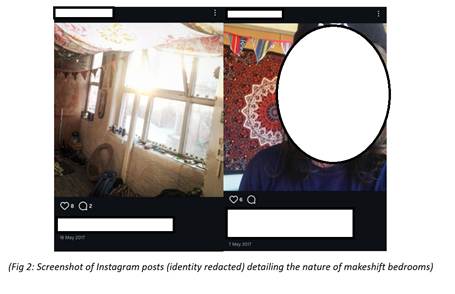
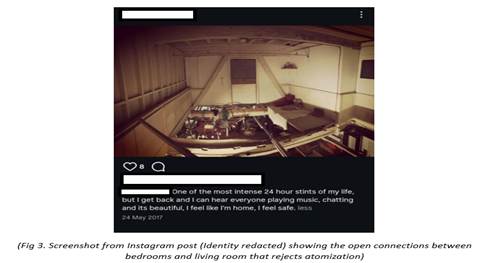
Centuries later, in 2017, that very same building was occupied by squatters, it became TAZ (Bey, 1985). The Irish lumpenproletariat surrounding Medlock Mill of Engels’ analysis in Phase 1, returned as the Irish Activist and Squatter of Phase 4. However, this is not highlighted merely as a historical coincidence; it is a structural reclamation. Primary visual evidence from the interior of the occupation reveals how the NSMD cycle functions in practice.
Makeshift Bedrooms (Use Value vs. Exchange Value)
An image of a makeshift bedroom constructed within the remnants of industrial infrastructure challenges the state’s criminal definition of the squatter. These are not chaotic shelters, but organised, private spaces. By constructing a bedroom within these derelict industrial spaces, however, the squatter generates use value (shelter) from dead capital. The bedroom proves that the squatter is not homeless, but un-housed by the market. They solve the housing crisis not through petition, but through direct action.
Communal Living Room (Rejecting Atomisation)
Visual evidence of a birds-eye view of a communal living room offers a stark contrast to the surrounding luxury apartments. Where a property developer seeks to partition space to maximise rent (atomisation), the squatters instead opt to open space to maximise connection (collectivism). This spatial arrangement is the physical embodiment of prefigurative politics. Squatters do not just talk about community as a performative act; they have seized a physical environment that forces communal interaction, rewriting the code of the building from historical profit-extraction to contemporary cultural and social connection.
Event Space and Graffiti (Cultural Production)
The empty events space and internal graffiti demonstrate that the squat is a site of cultural production, not just survival. Events, lectures, art galleries and performances show the CS in action. As art contributes to the squat’s self-sustainable nature, it produces transmissions of identity that challenge the dominant capitalist narrative.

The Structural Circuit Breaker
It is at this point where NSM theory appears to fail, and a materialist analysis is required. If squatting were solely a cultural movement (like an art project, or fashion brand), the state might tolerate it. However, the occupation of Hotspur occurred during a critical rise in Land Banking (a practice where properties are purchased, not for development, but to hold empty as their value inflates) in a post-LASPO (2012) era.
In this context, the internal reconfigurations, the bedrooms, the art, represent a contaminant. The squatter’s everyday behaviour highlights a market failure of the empty property and wider social problem. The squatter’s Ideological Aim (IA) was materially resonant and moving frictionlessly through the cycle, growing significantly in size. This threatened the material base in which class war conflicts and movements are situated.
The state’s response when this occurs is a “circuit breaker”. Evictions add friction to the squatter’s IA that hampers momentum and material resonance, however implementation of LASPO (2012) differs as it acts as a hard reset. Resources are mobilised to crush the movement before it can input its IA into the CS once again, drain the resources of NSMs, or change the political opportunity structures. The state systematically removes the physical manifestations of NSM identity shown in the photos, imposing a criminal class identity upon the occupier upon their attempt to return.
Although the squatters were evicted in 2017, the final years of the historic mill illustrate the ultimate material resolution of this spatial conflict. Following the eviction, the building sat empty once again. The previous makeshift internal configurations were dismantled, and any material residue was disposed of. Subsequently, a campaign to have the 200-year-old structure listed for its cultural and historical value was declined by the state. Six months later, the building was destroyed by a fire (Simpson and Holt, 2025). Regardless of its cause, the material outcome of the fire is sociologically significant, the definitive removal of the building as a site for occupation, preservation or alternative use. The trajectory of the site can be summarised through these final material shifts:
- Squatters (Use Value): Attempted to repurpose the derelict building into a communal home, resulting in eviction.
- The State (Law): Declined to grant heritage protections to the structure.
- The Fire (Material Outcome): Cleared the historic structure, removing practical obstacles to future profitable development.
The fire ends the space’s capacity to host any further cultural or material disputes, abruptly paving the way for traditional capital accumulation (Davies, 2025).
Evaluation and Discussion
Biographical Impact and Resocialisation
Assessing the success of squatting as an act or NSM requires looking beyond legal defeats. As even when bailiffs return the squat to its legal owner, the movement succeeds through what Doug McAdam (1986) deems Radical Resocialisation. For the individual, the transition from tenant to occupier creates a permanent activist habitus. The latent phase as described by Melucci (1989; 1985) succeeds because it produces activists that are fundamentally alienated from capitalist norms.
Theoretical Synthesis: Applying the NSMD Heuristic
NSM theory’s (Melucci, 1989; 1985) overemphasis on identity fails to fully account for the mechanics of state influence and structural repression. To address this blind spot, the analysis applies a synthesised NSMD heuristic. By combining these theoretical frameworks, the model illustrates how Ideological Aims (IA) circulate between the Materialist Base (MB) and Cultural Superstructure (CS), with the intensity of state conflict determined by the material resonance of those aims.
Low Resonance (Negative Feedback): Movements with inadequate resources or niche appeal (e.g. lifestyle veganism) circulate within the CS without disrupting the means of production. Although they engage in culture wars, they pose no threat to capital, allowing the state to remain passive. The idea returns to the NSM at the MB diminished.
High Resonance (Positive Feedback): Squatting generates high returns because its IA (housing) resonates with the wider MB and working class. By physically seizing assets, the squatter’s cultural behaviours directly attack capitalism.
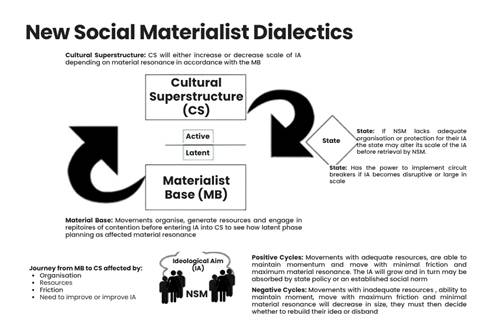
(Fig 5: New Social Materialist Dialectics heuristic model)
Because the decentralised organisational structure of the wider squatting movement is often loose, it struggles to manage the IA when it returns to the CS. During this window of NSM retrieving the IA in which it’s left unattended the state has a chance to adjust its return. However, once the IA threatens the housing market, the state implements an intervention. The LASPO Act (2012) was not just a moral correction, but a systematic reset designed to maintain and protect the dominance of material and the MB. Squatting demonstrates that while the CS can absorb an infinite number of cultural identities, the system jams when NSMs submit individualised IA’s instead of resonant IAs. This systematic friction can trigger rapid, reactive policy shifts and interventions, preventing the state from absorbing IAs that it supports.
Conclusion
Categorising squatting purely as a New Social Movement (NSM) is a theoretical understatement. While the movement aligns with Melucci’s (1989; 1985) criteria of autonomy and cultural coding, this framework alone is insufficient to explain the state’s ability to influence NSMs efforts, or structurally violent interventions. Squatting demonstrates that while prefigurative politics is a powerful tool for identity construction, it inevitably collides with the hard realities of the materialist class system.
The trajectory of the movement, from the post-war necessity to the post-LASPO (2012) criminalisation, reveals that the squatter’s everyday behaviour is not just a lifestyle choice, but a primary seizure of capital. As the proposed NSMD heuristic demonstrates, the culture war is merely the visible spectrum of the class war. A squatter cannot eat in their living room without taking a political stance, nor can they sleep without remaining alert to structural violence from state agents.
When the cultural signal of the movement resonated during an austerity-fuelled housing crisis, the state felt compelled to intervene, creating the conditions for fire to erase history. Hanisch’s (1969) assertion that ‘the personal is political’ is thus, in the context of squatting, revealed to be a concept bounded by material privilege. For the squatter, facing criminalisation of their sleep, the choice is removed. Their lifestyle is their protest, their home is their battlefield, and their existence is political.
References
Ballesteros-Quilez, J., Rivera-Vargas, P. and Jacovkis, J. (2022) ‘Counter hegemony, popular education, and resistances: A systematic literature review on the squatters’ movement’, Frontiers in Psychology, 13. DOI: https://doi.org/10.3389/fpsyg.2022.1030379.
Becker, H.S. (1963) Outsiders: studies in the sociology of deviance / Howard S. Becker. New York: Free Press.
Bey, H. (1985) T.A.Z.: The Temporary Autonomous Zone, ontological anarchy, poetic terrorism.
Boggs, C. (1977a) ‘Marxism, prefigurative communism and the problem of workers’ control’, Radical America, 6 (Winter), pp. 99–122.
Boggs, C. (1977b) ‘Revolutionary process, political strategy, and the dilemma of power’, Theory and Society, 4(3), pp. 359–393.
Crossley, N. (2002), Making Sense of Social Movements, McGraw-Hill Education, Milton Keynes
Davies, E. (2025) ‘Hotspur Press WILL rise from the ashes as developers issue promise for fire-ravaged mill’, Manchester Evening News, 21 November.
Engels, F. (2009[1845]) The condition of the working class in England / Friedrich Engels; edited by Victor Kiernan; with an introduction by Tristram Hunt. Edited by V.G. Kiernan. London: Penguin.
Habermas, J. (1984) The theory of communicative action/Jürgen Habermas; translated by Thomas McCarthy. Vol.1, Reason and the rationalization of society. London: Heinemann.
Hanisch, C. (1969) ‘The personal is political’, in Firestone, S. and Koedt, A. (eds.) Notes from the second year. New York, NY: Radical Feminism.
Hanisch, C. (2006) Introduction. The personal is political: The original feminist theory paper. Available at: https://www.carolhanisch.org/CHwritings/PIP.html (Accessed: 01 December 2025).
Legal Aid, Sentencing and Punishment of Offenders Act 2012, c. 10. London: The Stationery Office.
Marx, K. and Engels, F. (1965 [1845]) The German ideology / (by) Karl Marx (and) Frederick Engels. (Translated from the German. Edited by S. Ryazanskaya). London: Lawrence & Wishart.
Marx, K. and Engels, F. (2012 [1848]) The Communist manifesto / Karl Marx and Friedrich Engels; edited and with an introduction by Jeffrey C. Isaac; with essays by Steven Lukes … [et al.]. 1st ed. New Haven: Yale University Press.
McAdam, D., Tarrow, S. and Tilly, C. (2001) ‘Contents’, in Dynamics of Contention. Cambridge: Cambridge University Press.
McAdam, D. (1986). Recruitment to High-Risk Activism: The Case of Freedom Summer. American Journal of Sociology, 92(1), pp. 64–90.
McCarthy, J.D. and Zald, M.N. (1977) ‘Resource mobilization and social movements: A partial theory’, The American Journal of Sociology, 82(6), pp. 1212–1241.
Melucci, A. (1985) ‘The symbolic challenge of contemporary movements’, Social Research, 52(4), pp. 789–816.
Melucci, A. (1989) Nomads of the present: social movements and individual needs in contemporary society. Edited by J. Keane and P. Mier. London: Hutchinson Radius.
Pichardo, N.A. (1997) ‘New social movements: A critical review’, Annual Review of Sociology, 23, pp. 411–430.
Portwood-Stacer, L. (2013) Lifestyle politics and radical activism / Laura Portwood-Stacer. New York: Bloomsbury. DOI: https://doi.org/10.5040/9781501306792.
Reeve, K. (2018). Squatting in Britain 1945-1955: housing, politics and direct action. Housing Studies, 33 (1), pp. 141-143. DOI: https://doi.org/10.1080/02673037.2017.1384162.
Simpson, G. and Holt, J. (2025) ‘The haunting aftermath as part of Manchester’s history is destroyed in a raging inferno’, Manchester Evening News, 23 June.
Steinmetz, G. (1994). ‘Regulation Theory, Post-Marxism, and the New Social Movements.’ Studies in Society and History, 36(1), pp. 176–212.
Spitzer, S. (1975). ‘Toward a Marxian Theory of Deviance.’ Social Problems, 22(5), pp. 638–651. Doi: https://doi.org/10.2307/799696.
Watson, D., (2016) ‘Squatting in Britain: 1945-1955-Housing, Politics and Direct Action’. Merlin Press Limited.
Yates, L. (2015). Rethinking Prefiguration: Alternatives, Micropolitics and Goals in Social Movements. Social Movement Studies, 14(1), pp. 1– 21. DOI: https://doi.org/10.1080/14742837.2013.870883.