
Audré Lorde’s The Master’s Tools Will Never Dismantle the Master’s House is a stunning Black feminist critique. I include some of my favorite quotes from the book below – but, Dear Reader, please remember that Lorde’s critique extends far beyond Black, queer, and feminist critique. Lorde was a critical observer of the world – as colonized as it is – around us; her words offered an interpretation intended to engage thinking and action. That’s what inspires me so much about Lorde’s work – and with other Black feminists – is that their critique lends action: it is designed to think with you, challenge and encourage your logic, inspire activism and change, and light a fire in you that you, perhaps, had not felt before. That is the beauty of Black studies and Black scholarship, particularly from Black scholars and thinkers who challenge the colonial system of knowledge that still dictates our teaching and learning in Euro-American contexts today.
I am quite vocal about my critique of academic history. I find that history (which is always written by the victor) is far too concerned with PRAW (people who are racialized as white) Western ways of thinking and knowing. Knowledge and our practice of acquiring knowledge is deemed legitimate through the lens and the order of operations that is developed and upheld by PRAW.
In such a way that only Lorde can, she writes that she became “less willing to accept powerlessness or those other stupid states of being which are not native to me,” lamenting the Euro-American colonization of being, of existing, of seeking and gaining satisfaction. In her poem, “Uses of the Erotic,” Lorde connects the concepts of the erotic and humanity – one’s natural feelings and their existence – in such a way that more thorough analysis of her words realizes that the ‘erotic’ can be replaced by ‘knowledge.’ For me, the erotic works as a metaphor for knowledge because both express a kind of inner knowing that predates and outlasts colonial rules of understanding.
Lorde’s approach to thinking and being are reminiscent of personal icon bell hooks – whose sobering All About Love (which post-dates Lorde’s TMT) reminds readers of the purpose and power of our scholarship. hooks’ works reflect on being and thinking and love as inextricably linked. She viewed the process and sharing of thinking and knowledge to be equally meaningful and valid; but warned that these acts are for the deliverance of good and spreading love. Lorde bemoans (largely indirectly) the “horror of any system which defines the good in terms of profit rather than in terms of human need, or which defines human need to the exclusion of the psychic and emotional components of that need…”. (Lorde, 12)
I feel that my early experience in academic history has not only violated my humanity but revealed to me a devastating aspect of contemporary empiricist practicing Euro-American historians. This experience made it impossible for me to ignore how deeply Euro-American empiricism shapes who gets to be seen and who gets to be believed.
If the purpose of scholarship – if the research, conceptualization, analysis, and sharing of knowledge – is to empower, then how does academic Euro-American history deliver on that promise? I ask because I find that PRAW Euro-American historians are reluctant to embrace alternative means of knowledge production and knowledge sharing; whereas one might envision history to include humanist research and ethical documentation into human experiences and stories, Euro-American history is so staunchly conservative that it absolves itself of criticism and demands that stories must only be told and researched and processed in such a way that PRAW have determined it to be. Black lives are dependent upon the Euro-American white voice and way of speaking and knowing in order to be deemed valid. This means that the stories of my people and my ancestors are no more than soap operatic narratives told not in their voices but made ‘their’ voices only on the condition that the academy deems them acceptable and palatable. It is a form of literature but with constraints. When I engage with other scholars and researchers about this, there is a tacit sense of defeat; ‘this kind of history isn’t for me.’ It is no wonder that less than 1% of historians are Black, we agreed. I asked, ‘If this discipline is to belong to the humanities, then whose humanity?’ As I do not like to critique without offering potential solutions or an alternative lens, I reflect on novel approaches to history such as critical fabulation or the centering of ethics in historical research.
Historians treat academic history and scholarship as static. Take one walk through the Smithsonian African American Museum; the individuals highlighted in that museum were once repudiated by white Euro-American historians, the former primary keepers of their historical narratives in the state and public institutions. This proves that what counts as ‘history’ is shaped less by truth and more by institutional comfort, which is exactly why ethics must guide our work. Ethics must drive historians’ approach to scholarship and teaching: what impact does their research and affiliated work have on their subjects/objects and themselves? Sociologists and anthropologists take great care in their ethical considerations of the communities in which they work and engage. Historians treat extraction for the purpose of observation as a casual and normalized act of justified harm. Exploitation is permitted if it unveils a new or alternative understanding of the world for scholarship. Historians engage concepts like feminism, queer theory, Said’s ‘Othering,’ and more without fruitfully engaging the meaning or the purpose of those theories.
‘Think like me, tell their stories like me, process like me, sense like me. Or else.’
I refuse to twist myself or my people’s stories to fit a standard never meant for us. The ‘H’ in history is most certainly not for humanity; not if you aren’t committed to upholding the status-quo.
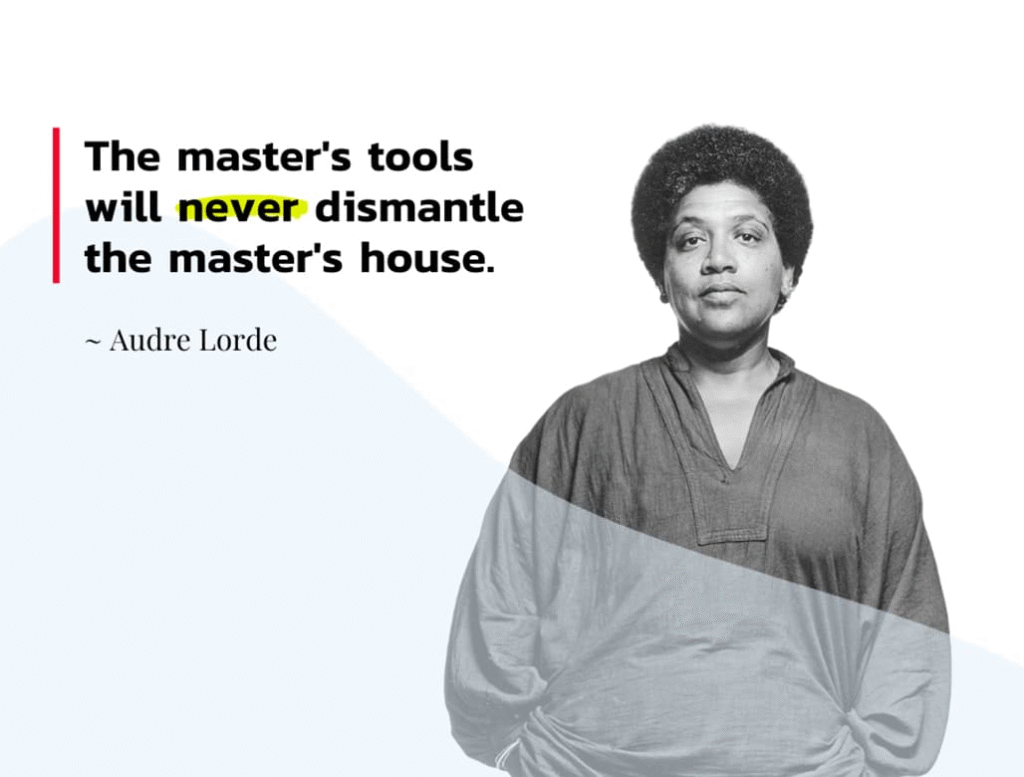
Quotes for reflection from The Master’s Tools Will Never Dismantle the Master’s House:
“My response to racism is anger. I have lived with that anger, ignoring it, feeding upon it, learning to use it before it laid my visions to waste, for most of my life. Once I did it in silence, afraid of the weight. My fear of anger taught me nothing. Your fear of that anger will teach you nothing, also.”
“If women in the academy truly want a dialogue about racism, it will require recognizing the needs and the living contexts of other women. When an academic woman says, ‘I can’t afford it,’ she may mean she is making a choice about how to spend her available money. But when a woman on welfare says ‘I can’t afford it’ she means she is surviving on an amount of money that was barely subsistence in 1972, and she often does not have enough to eat. Yet the National Women’s Studies Association here in 1981 holds a conference in which it commits itself to responding to racism, yet refuses to waive the registration fee for poor women and women of color who wished to present and conduct workshops. This has made it impossible for many women of color – for instance, Wilmette Brown, of Black Women for Wages for Housework – to participate in this conference. Is this to be merely another case of the academy discussing life within the closed circuits of the academy?”
“There is no such thing as a single-issue struggle because we do not live single-issue lives. Malcolm knew this. Martin Luther King, Jr, knew this. Our struggles are particular, but we are not alone. We are not perfect, but we are stronger and wiser than the sum of our errors. Black people have been here before us and survived. We can read their lives like signposts on the road and find, as Bernice Reagon says so poignantly, that each one of us is here because somebody before us did something to make it possible. To learn from their mistakes is not to lessen our debt to them, nor to the hard work of becoming ourselves, and effective.”
“Over and over again in the 1960s I was asked to justify my existence and my work, because I was a woman, because I was a lesbian, because I was not a separatist, because some piece of me was not acceptable. Not because of my work but because of my identity. I had to learn to hold on to all the parts of me that served me, in spite of the pressure to express only one to the exclusion of all others.”