Due to bank holidays and unexpected staff absence the Library at Craigavon will be closed:
Wed 9th – Mon 14th and Wed 16th – Fri 18th July
Open Tuesday 15th 9.00-5.00
The computer rooms and reading room are open 24/7 as normal.
Please contact the Healthcare Library at the RVH if you need any help . Library staff will still be available to answer queries via email , telephone 028 90978906.or Healthcare Library Chatbot. Access to e-resources is still available at https://healthcarelibrary.qub.ac.uk/
We apologise for any inconvenience this may cause.
I have known Dawn since her student days in the Southern Area College of Nursing, when I was the Nursing Librarian. Dawn has held many interesting posts throughout her nursing career, and she is currently Director of Nursing, Midwifery, AHPs, FSS & IPC in SHSCT. My job has evolved throughout my career, but one element has remained consistent: managing the Healthcare Library in Craigavon and providing support for any staff in the SHSCT who need help sourcing the information they need to enable them to carry out their job or for study etc. Recently I took the opportunity to chat with Dawn about the library service as we have been on this journey together for over 30 years!
Dawn, what do you remember about using the library in the SACN during your training?
Borrowing lots of books and having to fill out a book slip for every single one! The journal room was full of magazine files full of journals. It took time to find relevant references for articles using the printed bibliographies, then you had to find the journal box, and hope the issue wasn’t missing, or the article pages torn out. Then finally queuing to get it photocopied with cash or photocopy card in hand. Having access to online databases and e-journals certainly makes that so much quicker and easier now.
You have been a library member throughout your nursing career and you are now one of the Directors in SHSCT – how has the Library supported you?
Obviously when I was studying for various courses access to the library was essential. I have also used the library when preparing for interviews, working on various projects, and for CPD etc. It has been a constant throughout my career with the staff at the heart of the Library providing the services we need. Whether that is identifying a book or article, perhaps sourcing it from another library, or helping with literature searches to support work based projects etc.
Can you highlight one service that has brought you joy?
I think I have made use of every library service available over the years, but one that brings me joy is being able to request an article or book that I cannot access. In the past I had to fill out a form and either bring it to the library or put it in the internal mail and it could have taken a week or more for the article or book to arrive in the post. Now I can request an article online, and it arrives by email, sometimes within a few hours!
Is there something in particular that you found really helpful?
I can honestly say, I don’t think I could have completed my masters without the library. The support of the staff in getting the articles and resources I needed was invaluable. Anyone who has studied while also working knows there are various challenges, including the many demands on a finite amount of time. Having someone to guide you through the process of setting up a literature search and knowing you can ask for help at any time maximized my use of time and enabled my success.
There have been many changes in nursing and healthcare education and practice over the years, what do you think is one of the biggest changes?
The need to access information has remained consistent, whether for patient care, academic study, CPD, or just the desire for knowledge. The challenge now is the information explosion. There are many more articles published and we have access to information from across the world, mostly at our fingertips. Staff need the academic skills to identify the good from the bad, what is the best evidence. They need to have a mindset of continual enquiry and professional curiosity to ensure all care and practice has a secure evidence base. This necessitates having access to the best evidence to inform practice, and the best place to get that, is the Library.
With thanks to Dawn for taking time out of her very busy schedule to talk with me.
This database is particularly useful if you need to find UK based social work research, examples of good practice or reports on service developments etc. It has links to many reports that are published online but would not be discoverable through the usual library search or other databases such as SocIndex, which concentrate more on academic journal content.
Contact Hazel.Neale@HealthcareLibrary.qub.ac.uk, the Specialist Librarian for Social Work if you have any questions or want to arrange some training on using this resource.
Due to unforeseen circumstances, the Healthcare Library at Craigavon will be closed today Wednesday 22 until Friday 24 June. Apologies for any inconvenience.
Please contact the Healthcare Library at RVH on 028 9097 6021 for any assistance.
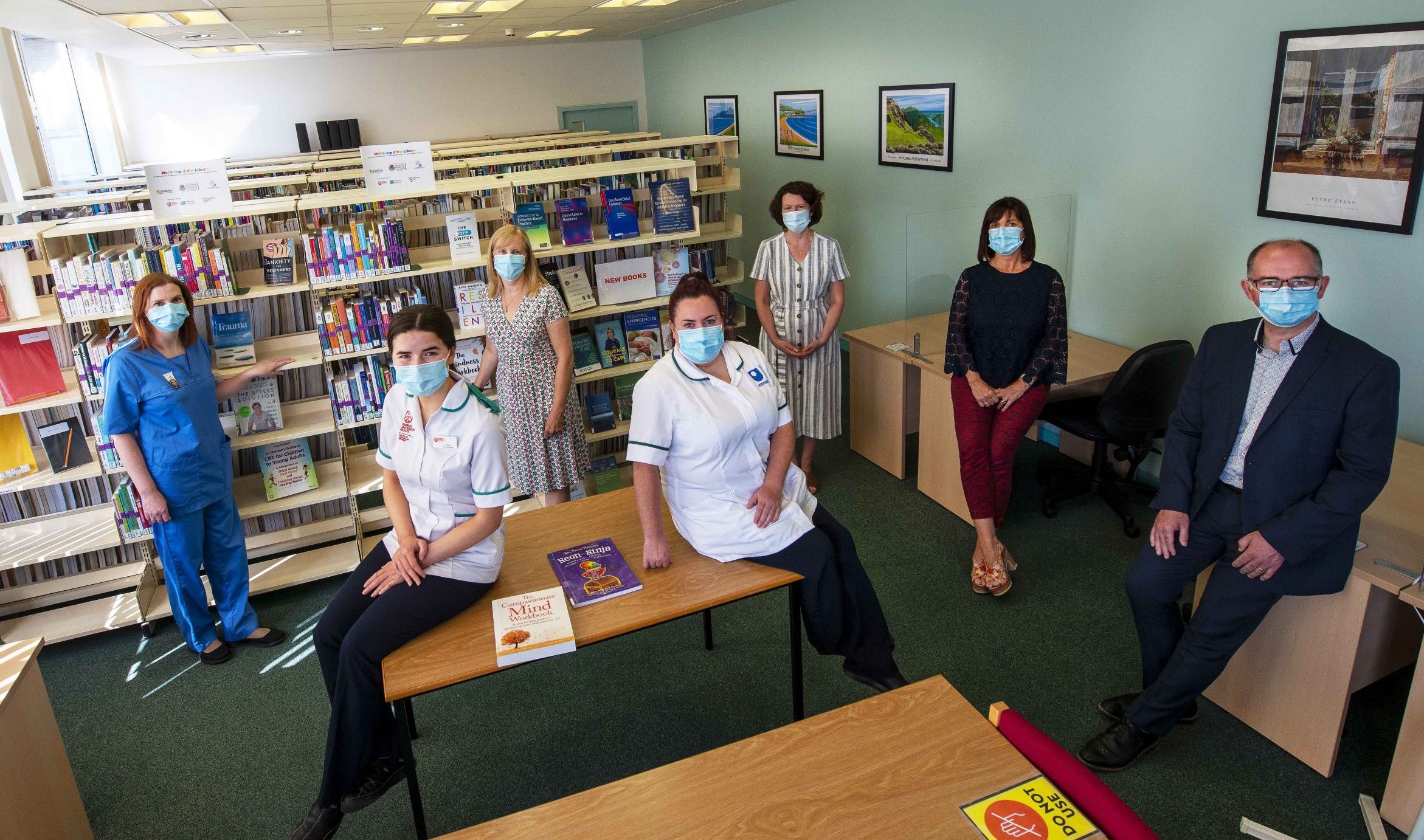
The project was launched 22nd June 2021 with the aim of promoting the benefits of reading for health and wellbeing to HSC staff and students on placement in the Southern Health and Social Care Trust. It was initiated by the SHSCT Promoting Wellbeing Division in partnership with the staff in the Healthcare Library in Craigavon Area Hospital and with the support of the Trust’s Psychology Department. The project was funded by the Staff Health and Wellbeing Steering Group and the Southern Area Mental Health Implementation Plan.
The scheme is endorsed by health professionals and has three main objectives:
To support the health & wellbeing of the staff & placement students in the Southern Health & Social care Trust
To inform & support the professional development of staff & placement students
To improve the aesthetics of the healthcare library for staff & its users.
The stock is available to all SHSCT staff and students on placement. To borrow any of the books, you need to be a registered member of The Healthcare Library of Northern Ireland – registration is free and can be completed online at: www.healthcarelibrary.qub.ac.uk/signup. For staff who cannot visit the library in person, books can be posted to their work address within the Trust.
Library staff are happy to help so please call in, phone or email if you need assistance.
Some of the titles are also available as e-books, including: Your guide to understanding and dealing with dementia; Can I tell you about cerebral palsy; The sleep solution: Why Your Sleep Is Broken and How to Fix It; The Pursuit of Perfect: How to Stop Chasing Perfection and Start Living a Richer, Happier Life.
The Wellbeing Collection in the SHSCT is the second collection to be established in a Healthcare Library of Northern Ireland branch, the other is in the Healthcare Library of Northern Ireland at the Royal Victoria Hospital.
Healthcare Library of Northern Ireland at Craigavon
Level 1, Medical Education Centre, Craigavon Area Hospital.
Current opening hours 9.30-4.30 Monday – Friday
Access to the library is via the Maternity doors only. Please contact the library (3756 2108) in advance for directions. It is not necessary to book a study space at present, but this will be kept under review.
The Library has implemented guidelines to provide a safe work and study environment.
These include:
Reduced study spaces to facilitate social distancing
Cleaning stations to enable all users to clean down work station / study area before & after use
Hand sanitiser available
Masks to be worn from the point of entry into the hospital.
Services available include:
Study space
Book loans
Access to e-resources
Book collection service
Support
Although it is not possible to provide face to face training and literature search support at present, these are still provided either by phone or online using either Microsoft Teams or Zoom. To discuss you specific needs please contact: hazel.neale@healthcarelibrary.qub.ac.uk
Many full text articles and books are available to read online. You can search for both articles and books using the library search box, simply enter a few key words or the title of the article or book you are looking for. The results will then be displayed and you can either identify the source you want or refine the search using the “refine options” on the left hand side. You need to Login to read the full text.
For a more detailed article search use the advanced search
or one of the many databases available – (Medline, CINAHL etc. follow the link for databases a-z)
If you need help with searching for articles please contact
one of the specialist librarians or your local trust based librarian as we can also provide
telephone help and support.
Don’t
forget library members also have access to 100’s of e-books that are freely
available to read day or night (Internet access required). E-Books are clearly
identified in the library catalogue, all you need to do is logon with your
library number & password you can read the book online.
To
find what e-books are available, enter your keyword search as normal in the
library search box. You can limit or
refine the search results to only display e-books by selecting resource type,
and e-books, (please note you may need to click on show more to see the e-books option – this only displays if there
are e-books )
It is generally possible to
copy and print sections or a chapter from an e-book (within copyright
restrictions), and most e-books identify how much can be printed.
if the book you want
to read isn’t available as an e-book, please contact your trust or specialist librarian and we will endeavour to order an electronic
copy.
The
Healthcare Library of Northern Ireland has collated some useful links and
resources on Coronavirus (COVID-19) including advice and guidance from National
and local Government, NHS and scientific resources and links.
Most of this information is freely available online,
however, some articles may be only accessible to library members, register
online today to have fulltext access to books, journals and
databases.
To provide the best experiences, we use technologies like cookies to store and/or access device information. Consenting to these technologies will allow us to process data such as browsing behavior or unique IDs on this site. Not consenting or withdrawing consent, may adversely affect certain features and functions.
Functional
Always active
The technical storage or access is strictly necessary for the legitimate purpose of enabling the use of a specific service explicitly requested by the subscriber or user, or for the sole purpose of carrying out the transmission of a communication over an electronic communications network.
Preferences
The technical storage or access is necessary for the legitimate purpose of storing preferences that are not requested by the subscriber or user.
Statistics
The technical storage or access that is used exclusively for statistical purposes.The technical storage or access that is used exclusively for anonymous statistical purposes. Without a subpoena, voluntary compliance on the part of your Internet Service Provider, or additional records from a third party, information stored or retrieved for this purpose alone cannot usually be used to identify you.
Marketing
The technical storage or access is required to create user profiles to send advertising, or to track the user on a website or across several websites for similar marketing purposes.