

Critical Thinking and AI
Think Before You Trust
AI tools can be useful for exploring ideas, explaining concepts, generating suggestions and supporting different stages of your learning. However, using AI effectively requires you to think critically about the information it provides.
AI-generated responses can sound confident and convincing, but this does not necessarily mean that the information is accurate, complete or appropriate for your particular context. When using AI, it is important to remain curious and questioning, and to apply your own knowledge, judgement and critical thinking.

Building Your AI Skills
Working effectively with AI involves more than knowing how to use a tool. Two particularly important skills are effective prompting and critical thinking. Together, they help you communicate what you need, assess the quality and relevance of AI-generated information, and make informed decisions about when and how AI can be used appropriately.
AI-generated responses can sound confident and convincing, but they may not always be accurate, complete or suitable for your purpose. Developing your critical thinking means asking questions such as: Does this make sense? Is it accurate? What might be missing? Can I verify it using a reliable source? Most importantly, you remain responsible for deciding what information to trust and how you use it.
By developing both prompting and critical thinking skills, you can become a more confident, thoughtful and responsible user of AI. These skills form an important part of AI literacy and will be increasingly valuable throughout your studies, future career and everyday life.
Effective Prompting
The way you communicate with an AI tool can influence the relevance and usefulness of the response you receive. A clear and specific prompt can help the AI better understand what you are asking it to do.
When creating a prompt, think about:
- Your purpose: What do you want the AI to help you with?
- Context: What information does the AI need to understand your request?
- Specificity: Have you clearly explained what you are looking for?
- Format: Would it help to specify how you would like the information presented?
Prompting can also be an iterative process. You may need to refine your question, provide additional context or ask follow-up questions to get a more useful response.
Good prompting can help you generate more relevant outputs, but it is only one part of using AI effectively. Once you receive a response, it is important to evaluate the information critically before deciding how or whether to use it.
Why Critically Evaluating AI Matters
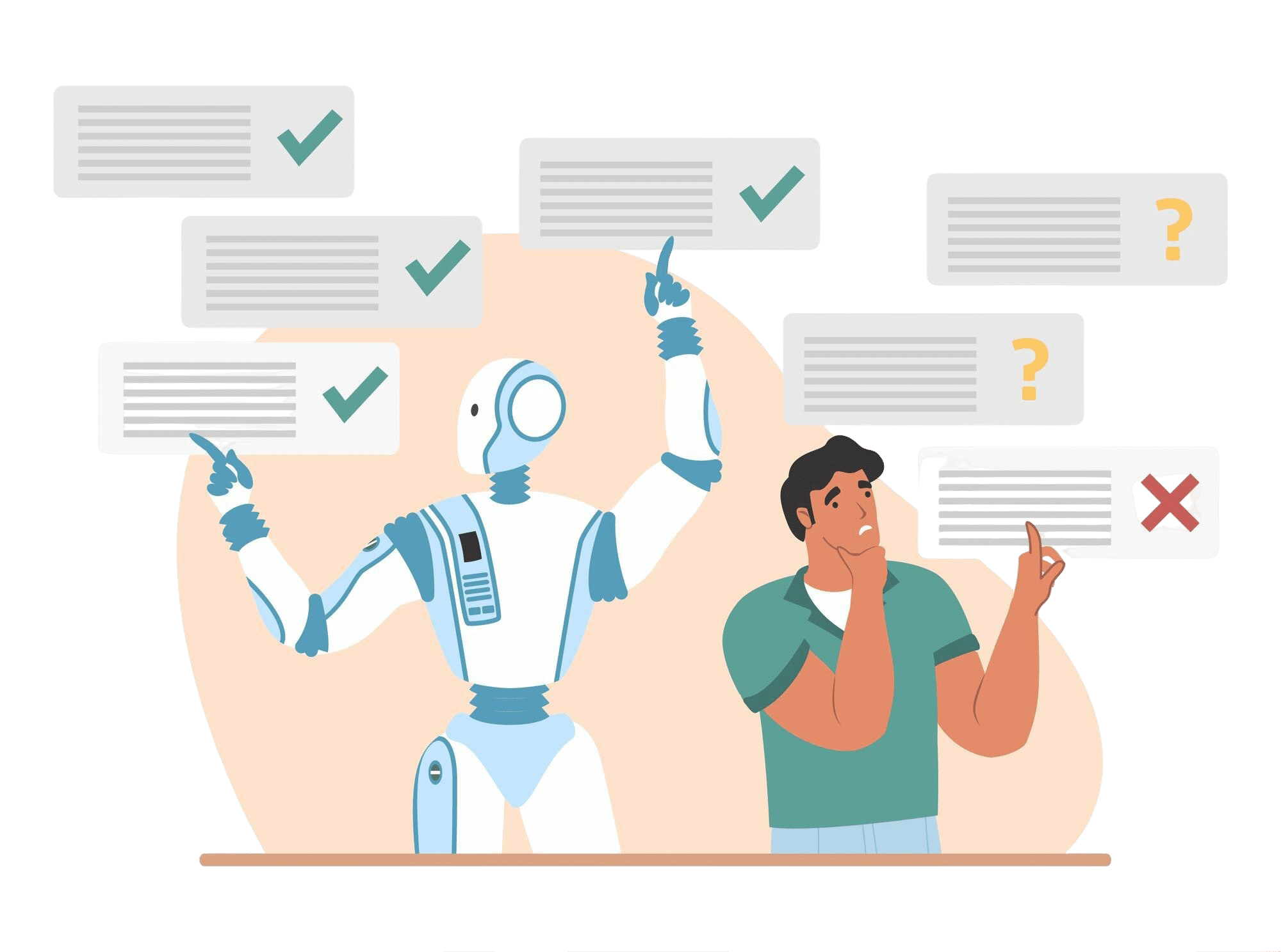
Receiving a response from an AI tool is not the end of the process. AI-generated content can sound confident and persuasive, but that does not mean it is always accurate, complete or appropriate for your needs.
Critical thinking helps you evaluate the quality, reliability and relevance of AI-generated information.
By taking a thoughtful and questioning approach, you can make more informed decisions about when and how to use AI in your studies.
What Are AI Hallucinations?
An AI hallucination occurs when an AI tool generates information that appears plausible but is inaccurate, misleading or entirely fabricated.
Examples include:
- Inventing academic references or sources
- Creating incorrect facts or statistics
- Misrepresenting information or providing inaccurate details
AI tools generate responses by identifying patterns and predicting likely outputs rather than “knowing” facts in the way humans do. As a result, incorrect information can sometimes appear highly believable.
Understanding that AI can make mistakes helps you approach AI-generated information with appropriate caution and reinforces the importance of checking information before relying on it.
This is why critically evaluating and verifying AI-generated information is an essential part of using AI responsibly.
💡 Critical Thinking Checklist
When an AI tool gives you a response, pause before accepting or using it. Consider the quality of the information and whether it is appropriate for what you are trying to do.
Don’t just accept AI outputs – evaluate them.
When using AI, remember to:
-
Check the facts AI can make mistakes or provide outdated information. Does the information match what you already know? Are there claims, facts or statistics that you should check? Are there claims, facts or statistics that you should check?
-
Verify important information Use trusted sources such as academic journals, books, library resources, or reputable websites.
-
Look for evidence Consider whether claims are supported by reliable references or sources. If the AI provides references, citations or links, check that they actually exist and that they support the claims being made.
-
Watch for bias AI outputs can reflect biases present in training data. Think about how particular perspectives, assumptions or viewpoints are represented. Are some voices or perspectives missing?
-
Use your own judgement Compare AI responses with your existing knowledge and understanding.
-
Think before you use Would you feel confident including this information in an assignment, presentation, or professional setting?
-
Remember AI can support your thinking, but it should never replace critical thinking.
Keep Thinking Critically
AI can support your learning, but it should not replace your own thinking and judgement.
Use AI as something to question, explore and evaluate, rather than as a source that automatically has the right answer. Consider what you have learned, what evidence supports the information, what might be missing and whether the response is appropriate for your particular context.
Ultimately, you remain responsible for the work you produce and for how you use AI. If you use AI to support your studies, make sure that your use is consistent with the guidance provided for your module or assessment.
Additional Resources
Continue developing your AI literacy with these trusted resources. They provide practical guidance, expert insights and strategies to help you use AI effectively, think critically about AI-generated content and become a confident, responsible user of AI throughout your studies and beyond.
Jisc – AI Literacy
Explore practical guidance on AI literacy, responsible use, critical evaluation and the skills needed to use AI effectively in higher education. Although many resources are designed for educators, the principles and guidance are equally valuable for students developing AI literacy.
Learn moreOne Useful Thing – Ethan Mollick
A highly regarded blog from Professor Ethan Mollick (Wharton School, University of Pennsylvania) exploring how to work effectively with AI. The articles encourage readers to question AI outputs, understand its limitations and use AI as a partner for learning rather than a replacement for thinking
Learn moreChatGPT Study Mode
Learn how to use AI as a study partner through guided questions, step-by-step explanations and knowledge checks. Study Mode is designed to strengthen understanding, encourage reflection and develop independent reasoning rather than simply providing answers
Learn more