


The Patients of GenAI? Using QAIRx to Train Future Pharmacists

Dan Corbett1, Lezley-Anne Hanna1, Maurice Hall1, and Matthew Collins2
1School of Pharmacy
2School of Electronics, Electrical Engineering, and Computer Science
Simulation forms a cornerstone of pedagogical practice in the initial education and training of student pharmacists, and student healthcare professionals more generally. To emulate real-life interactions, simulation often takes the form of role play-based scenarios (with educators playing the role of the patient or other healthcare professional) intended to be authentic to what a student can expect to encounter when working with real patients and colleagues. The benefits are undeniable; students can make mistakes, gain confidence and hone key skills related to practice, all whilst doing so in a safe space. In addition, educators can place students in more challenging, niche, or forward-looking situations to further develop and broaden their skillset, making them future ready1,2. However, embedding simulation in healthcare education is not without challenges. There are significant resource implications, including having adequate physical teaching spaces and high densities of highly trained staff, coupled with timetabling challenges. This can mean that the offer of greater levels of simulated training to students, despite that unquestionable benefit, simply isn’t possible3.
Pharmacy educators are constantly ruminating over how they can introduce efficiency in the delivery of simulated practice activities, facilitating the enhancement in volume of delivery. The utilisation of digital technologies sits front and centre as a potential answer to related roadblocks, including enabling asynchronous student engagement. Browser-based, and virtual/augmented-reality tools have all shown success, however barriers still remain. These again involve resourcing shortfalls, including those related to hardware availability. Perhaps one of the largest issues, however, centres on the inability of many of those tools to deliver authentic patient interaction4. All of this begs the question – can GenAI help to bridge that gap, and enable us to deliver effective simulation-based learning opportunities to students which complement and fully reflect in-person activities?
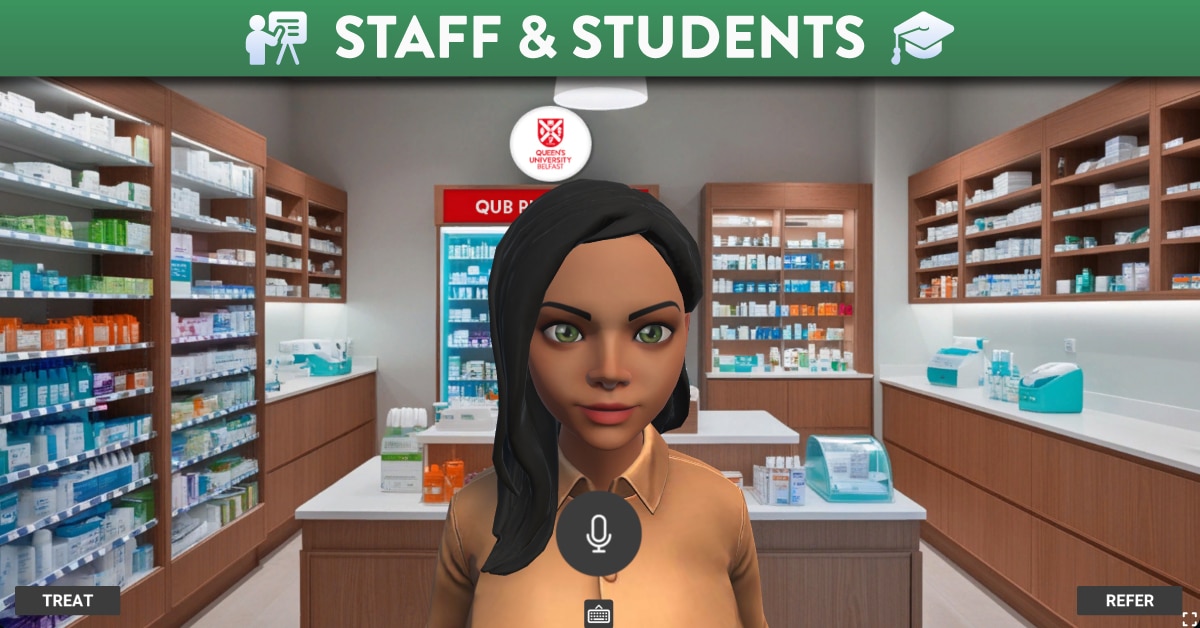
With that question in mind, a collaborative team from the Schools of Pharmacy and Electronics, Electrical Engineering and Computer Science (EEECS) at Queen’s has developed QAIRx, which seeks to provide students with the opportunity to engage with virtual, GenAI-driven patients, enabling greater degrees of authenticity and variability within interactions, just as would be experienced in-person, and in-practice.
To do all of this, QAIRx needed to:
- Offer effective speech to text functionality, allowing students to speak naturally with their AI patient as they would normally
- Use GenAI models to interpret what students say, and generate authentic patient responses based on educator-designed scenarios and supporting information
- Deliver authentic and text to speech, enabling immersive engagement with the AI patient avatar, and allowing for interactions to be widely varied in a number of ways, reflecting the diversity of patient populations
- Make specific use of information from a key set of pharmacy training resources related to the clinical topics, and support materials centred on effective consultation with patients
Further to this, it was crucial that QAIRx allowed students to make clinical decisions based on their interaction with a patient, and to receive immediate feedback on their selected outcome and the handling of the overall consultation, which again made use of provided parameters within the platform’s reference set. This closes the loop on the activity in a way which fully reflects the equivalent in-person activities and offers significant formative benefit. These needs, coupled with those related to the requirement to create a straightforward interface for both students and educators, led to the delivery of a comprehensive and challenging workplan that involved the development of frontend, backend, and GenAI solutions all of which have culminated in the platform which we use with students today. You’ll be able to see examples of key aspects of QAIRx below.
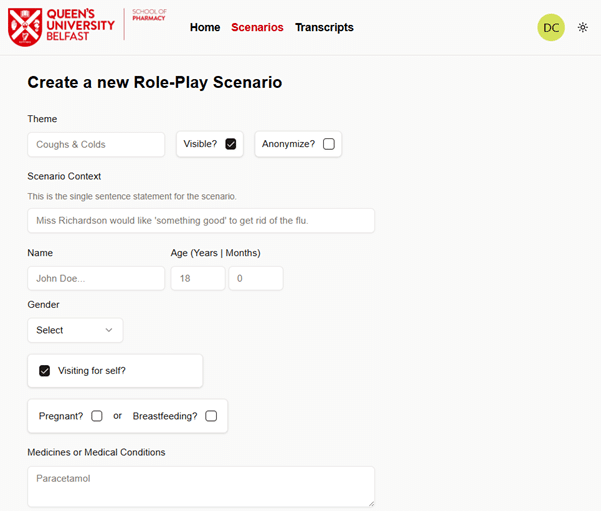
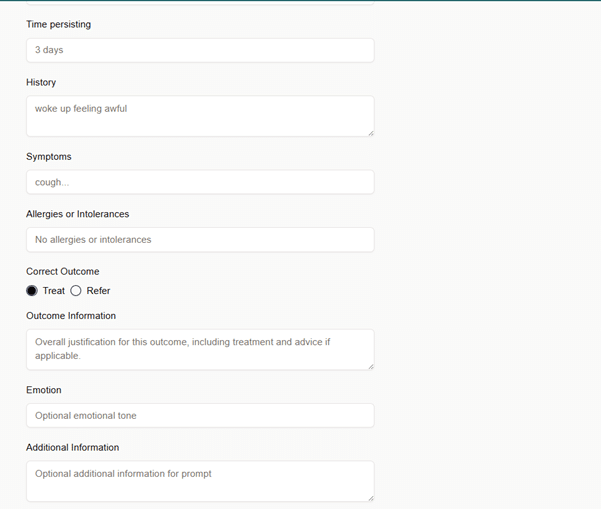
The scenario setup menu in QAIRx allows educators to create bespoke clinical situations which students can engage in as simulated consultations.
An (abridged!) example of an interaction with a GenAI-driven patient using the QAIRx platform.
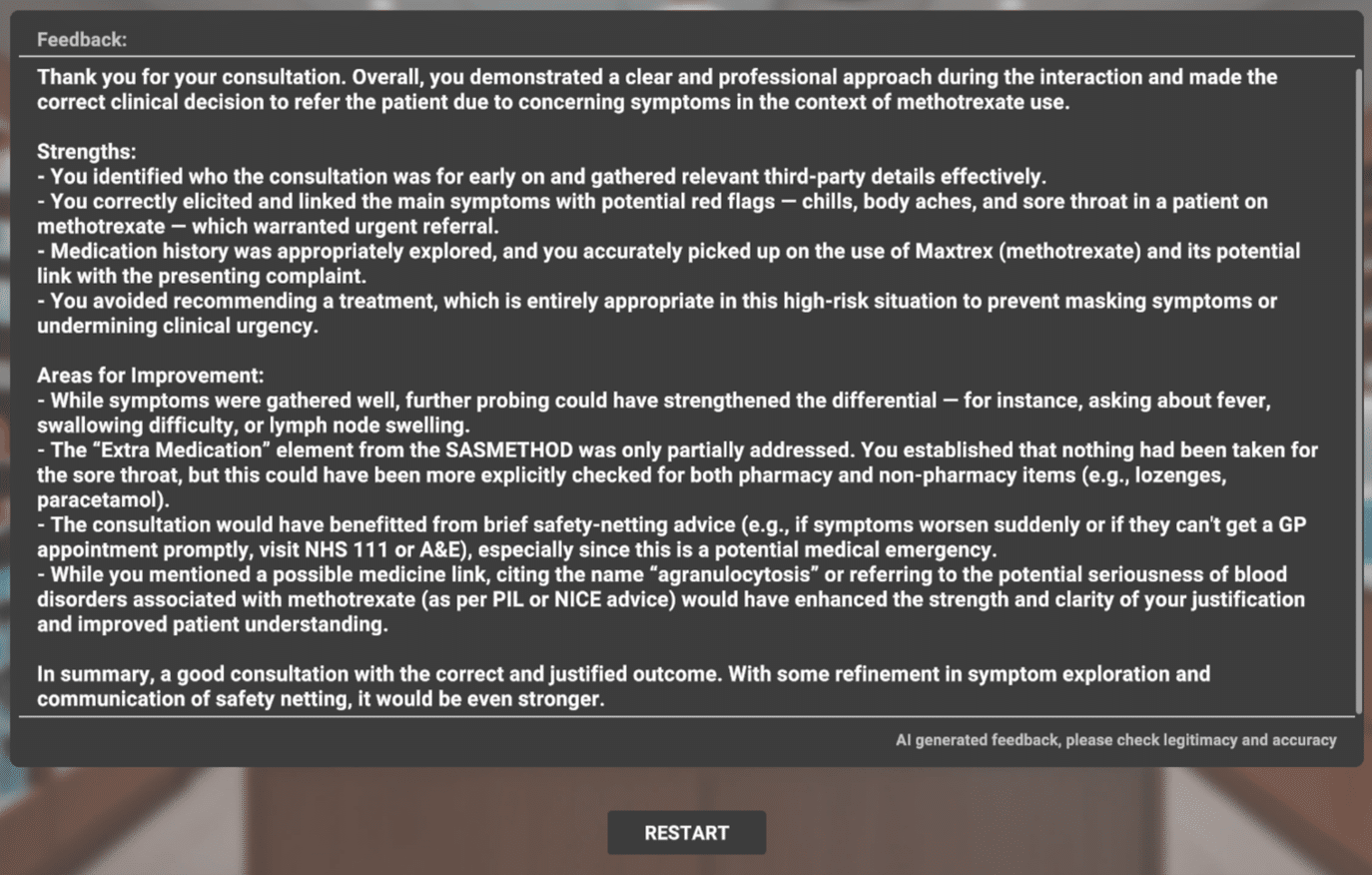
In addition to the patient interaction itself, students are provided with immediate and bespoke GenAI-generated feedback on their consultation and clinical decision making following their conclusion of the scenario, reflective of the in-person teaching experience, and which allows them to further review their own performance, develop their skills, and should they so wish, reattempt the scenario, maximising formative value. This feedback is based on relevant training and other resources included in QAIRx’s codebase, ensuring that feedback is clinically correct.
User testing of QAIRx has generated highly positive feedback to date, with students indicating that the use of the platform to complement in-person simulated classes will reduce nervousness and anxiety related to those activities whilst also helping students to prepare for them, and see better outcomes. Students have also indicated that they are keen to make use of QAIRx as part of their studies, enabling them to prepare more effectively for related teaching and assessment, suggesting that there is appetite for the use of GenAI-supported tools within teaching delivery where these are employed to support performance in more traditional approaches to teaching and assessment, rather than replacing them.
QAIRx has now been integrated into teaching within the School of Pharmacy, and more specifically, within the “Managing Conditions in the Pharmacy” module which forms part of the final level of the MPharm programme. Students have been provided with access to a large number of engaging virtual scenarios which complement the in-person sessions they experience each week in relation to topics such as gastrointestinal conditions, central nervous system issues such as insomnia, children’s health, and others, giving them access to what we believe is a hugely valuable tool to assist their learning, and which also tackles some of the key challenges in the delivery of effective simulated learning.
Looking ahead, we hope to extend the use of QAIRx across other key aspects of the pharmacy programme, allowing us to maximise its value as a tool in supporting students’ skills development ahead of in-person simulated activities, as well as to explore its use as an interprofessional learning tool, assisting with their communication with patients and other health professionals.
References
- Simulation-based education [Internet]. HEIW. 2024. Available from: https://heiw.nhs.wales/education-and-training/simulation-based-education/
- Leiphrakpam PD, Armijo PR, Are C. Incorporation of simulation in graduate medical education: historical perspectives, current status, and future directions. Journal of medical education and curricular development. 2024 May;11:23821205241257329.
- Elendu C, Amaechi DC, Okatta AU, Amaechi EC, Elendu TC, Ezeh CP, Elendu ID. The impact of simulation-based training in medical education: A review. Medicine. 2024 Jul 5;103(27):e38813.
- Mergen M, Graf N, Meyerheim M. Reviewing the current state of virtual reality integration in medical education-a scoping review. BMC Medical Education. 2024 Jul 23;24(1):788.