

Nobody likes to wait. Especially when an outcome is uncertain. Unfortunately, it is a part of life that there will be decisions, processes and outcomes outside of our control. Very often, these will not be immediate, and we must wait before being presented with a set of options. It is completely normal to feel uneasy, uncomfortable or unsettled when dealing with uncertainty. Student Wellbeing and Accessible Learning Drop-in are seeing students who are concerned about the outcome of exams. We have had students asking if they can receive results earlier because they are unsure how they performed. Whether it is waiting to hear back about a job, medical investigation or appointment, uncertainty is a part of life. Realistically, we deal with uncertainty daily as there is so little within our control. We don’t know if the weather will be agreeable for plans that have been made, or whether the bus will be on time. We don’t know what will happen with the interest rates, inflation or the cost of fuel. Leaving the house involves uncertainty. It is important to recognise that people already have skills and strategies to cope with these daily uncertainties. Sometimes, however, uncertainties can have a bigger impact.
Uncertainty means that mental and emotional processing cannot begin to reach acceptance. It means plans cannot be made as we are unsure what the options will be. This can have an impact on levels of stress, physically and mentally. Students often talk about getting stuck in the ‘What ifs’. Catastrophising is another common reaction. As the outcome is uncertain, it is difficult for the brain to find evidence that contradicts the worst-case scenario running through your mind. This can lead to rumination which can impact daily life.
It is important at this stage to recognise that dealing with uncertainty is difficult and a stress response is normal. Exercising self-compassion is helpful to reduce shame and judgement which could further complicate your response. Students often tell us that it is not just the future that they are worried about, but the things they ‘should’ have done to improve their outcome. The regret itself can be debilitating. It is in the past though, and no longer within their control. Worrying about past behaviour only burdens the body and mind, reducing the chances of being at your best when it comes to dealing with the awaited outcome. It is therefore unhelpful and decreases the chances of success. We need to be gentle with ourselves and identify what is in our control with regards to the outcome, as well as how we maintain our health while we wait. We can also trust in ourselves to be able to handle whatever the outcome is. Life presents regular challenges, and it is unlikely that you have never overcome one. Reflect on times when you have succeeded and have confidence that you will cope with whatever comes your way.
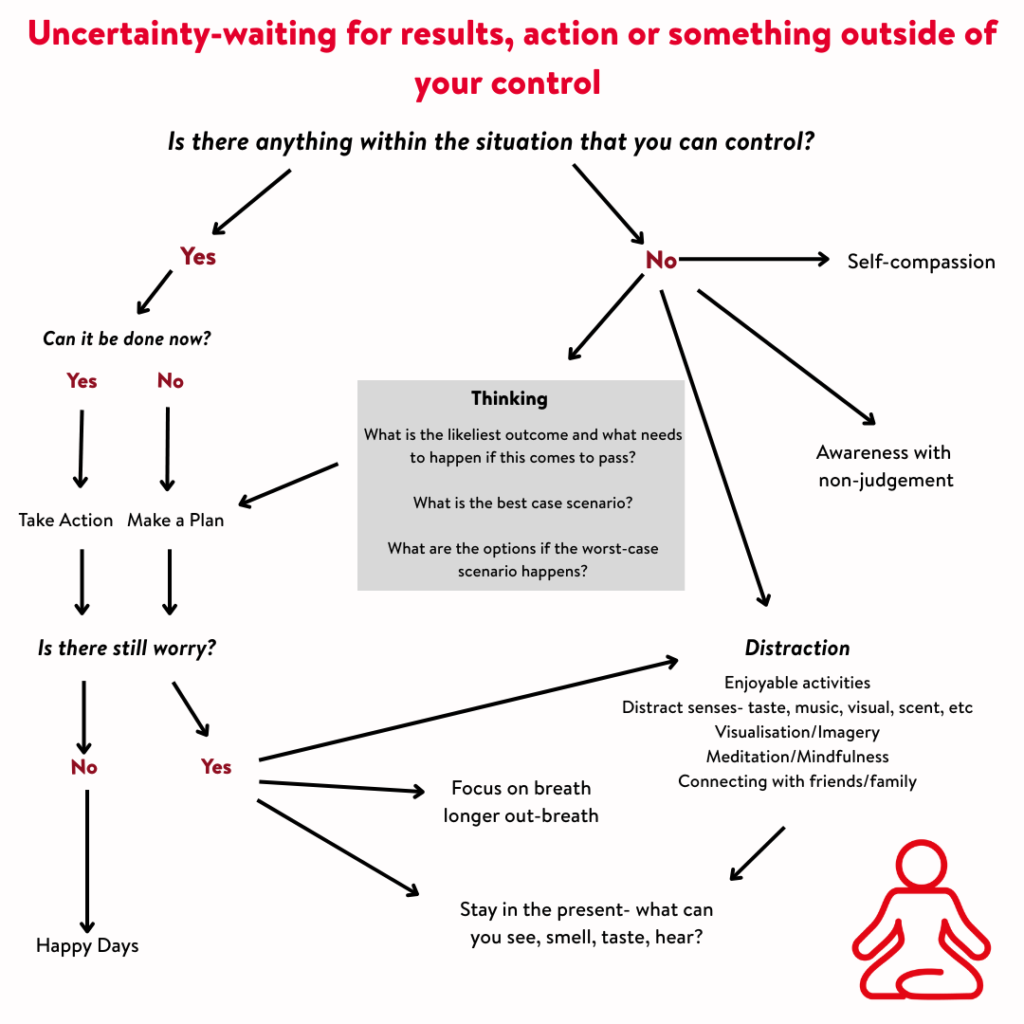
The diagram above offers questions to ask yourself when struggling to deal with uncertainty. It boils down to 2 things- do what you can that is in your control; and then let go of the unhelpful worry of what isn’t. Easier said than done. Staying in the present is a skill which takes practice.
- Notice and focus on your senses and breath.
- Identify what you can see, hear, feel, smell and taste.
- Distract yourself with things you enjoy. It is incredibly difficult to have any kind of thoughts when you are humming to your favourite song. Focusing on a task or activity also halts negative thinking. This can vary from contemplating a puzzle to the next crochet stitch. It also adds a sense of achievement when completed.
- Organising your time with healthy strategies can be helpful. For many of us, organising and planning is an attempt to take control of a situation. Uncertainty makes this more difficult as we don’t know what the future options are. Time can still be planned however, but with the purpose of managing health and wellbeing.
If you are finding it difficult to cope, reach out for support. Talking to other students who have similar experiences can be helpful, especially in a safe space with no judgment. Talk Campus is a platform that allows this to happen. Links to resources are below for self-compassion, challenging negative thinking, managing stress and shame.
Stress Control NI- HSCNI Stress Control online classes/webinars –Home – Stress Control
Self Compassion: Self-Compassion | Action for Happiness
TED Talk: Listening to Shame – Brené Brown