


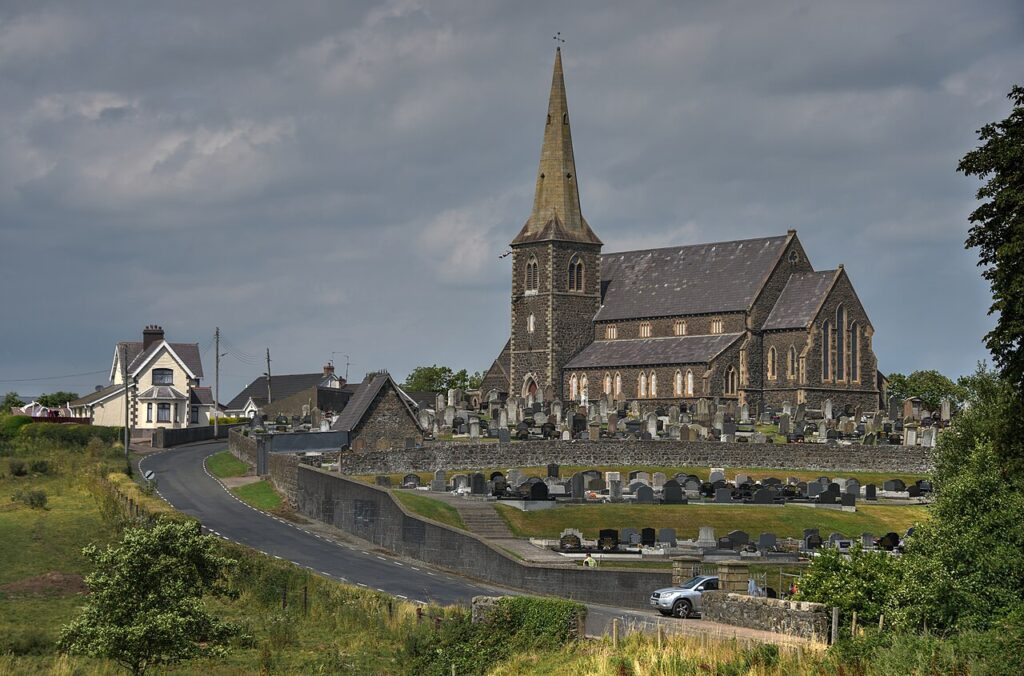
By Peter Donnell, School of Law at Queen’s University Belfast.
‘The plain, the undeniable truth is that there are two antagonistic populations, two different nations on Irish soil. To speak of one of them … is a mischievous fallacy, a political and social untruth … There is no community of feeling and therefore no common citizenship between the two sections of the Irish people.’
These were the words of the journalist Thomas MacKnight writing in 1896. 130 years on, his framing of the Irish Question, or more specifically the Ulster problem, remains stark, extreme even and perhaps deliberately so. What is particularly interesting is that MacKnight wrote from the perspective of an outsider. Born in County Durham, MacKnight moved to Ireland in 1866 to become editor of the Belfast-based, Northern Whig. MacKnight eventually set down his observations in two volumes of ‘Ulster As It Is: Twenty-Eight Years’ Experience as an Irish Editor’ (1896). The work was both an account of his experience of Ulster politics and an unapologetic statement of the Liberal Unionist case against Home Rule. Throughout it runs a recurring concern with the existence of two communities in Ulster, their relations with one another and their markedly different political outlooks and allegiances.
MacKnight, although adamant that he was unsympathetic to ‘the evil spirit of sectarian and party intolerance,’ was evidently not optimistic about the prospect of reconciling those differences. His assessment belonged to a particular political time and place, appearing three years after the defeat of Gladstone’s 1893 Home Rule bill and amid a constitutional controversy which has echoes in the Northern Ireland of today. However, viewed from the political and constitutional framework created in 1998, MacKnight’s diagnosis ought, in an ideal world, to seem as dated as the Victorian period in which he wrote. Recent events surrounding the resurrection of the Drumcree parading dispute make it difficult to entirely dismiss the premise which underwrote his analysis. For many Drumcree belonged to another era. The name itself evokes some of the most incendiary memories of the 1990s – a by-word for sectarian grievance and competing claims of identity and territory and the fear that a parochial dispute could have consequences far beyond Portadown. Indeed, Drumcree provided the backdrop to sectarian division as the peace process was in its nascent stage.
For twenty-eight years the Orange Order was prevented from completing the return leg of its parade from Drumcree Church in County Armagh along the mainly nationalist Garvaghy Road. In September 2026, however, the Parades Commission determined that a restricted procession could proceed, limited to 35 participants without bands or supporters. The decision, the subsequent protests and legal challenges have returned Drumcree to the political foreground in a manner few anticipated. Perhaps that is precisely why its resurrection has been so unsettling. Drumcree was an issue which, in the minds of many, was not in need of resurrection.
Its return raises questions beyond Drumcree itself. Parading was among the most explosive issues of the late 1990s and early post-Agreement years. It was also one of the areas in which a mixture of local engagement and compromise produced local accommodations which, although imperfect, removed many individual disputes from the main political arena. What Drumcree has thrown into the spotlight once again is not merely disagreement about a parade. Instead, it has brought into the spotlight Northern Ireland’s deeply divided society.
Northern Ireland in 2026 is plainly not the Ulster MacKnight described in 1896, nor is it the society of 1996 and 1997. The Good Friday Agreement largely ended the thirty-year period of violent sectarian conflict and transformed the political architecture within which our disagreements take place. It recognised the legitimacy of different national aspirations and created finely balanced institutions through which those differences could be accommodated, in the form of the Northern Ireland Assembly and Executive. But 1998 is sometimes treated simultaneously as an ending and a beginning: the ending of one period of conflict and the beginning of a new political order. Importantly, that order did not require Northern Ireland’s competing identities to disappear. To a considerable extent it institutionalised their coexistence. The years since the Agreement have also seen honourable efforts by individuals, communities and institutions, including Queen’s University, to bring people together, build relationships and create that much-needed trust across the divide. Much trust has undoubtedly been built on the ground. Yet recent events suggest that it remains in short supply.
This prompts a broader question: was one of the purposes of the institutions created in 1998 not precisely to ensure that deeply contentious issues such as Drumcree could be managed politically, without being permitted to destabilise the wider political settlement?
There has been much in the past decade which has undermined political progress in the region. For instance, the advent of Brexit is one of the obvious factors. Brexit can be placed within a broader trajectory of difficult political experiences which have afflicted Northern Ireland over the past decade. The loud arguments surrounding allegiance, borders, consent, sovereignty and the constitutional future of Northern Ireland have been at the fore of political debate, often at the expense of any advancement toward the hard yards of reconciliation. The Stormont institutions have endured lengthy periods of suspension, falling into abeyance for most of the crucial period from the referendum until the UK’s official withdrawal. To that unsettled landscape Drumcree can now be added to the list of grievances threatening to upend the institutions. That possibility should matter even to those with little interest in the merits of the Drumcree dispute. The danger is not simply the revival of one controversy, but the possibility that accommodations beyond Portadown are to be questioned and unravelled.
We might be reminded of the words of another outsider who grappled with the divergences across our politics and society. Like MacKnight before him, Dr Richard Haass came to Northern Ireland from elsewhere and attempted to make sense of some of its most difficult divisions. The American diplomat and mediator was tasked in 2013 with attempting to find an agreed framework on some of the most fraught issues in the region: parades, flags, emblems and dealing with the Troubles’ legacy.
Although his work continues to gather dust, Haass drew a critical distinction. The 1998 Agreement had, he said, “ended the conflict.” The task which remained was “to build the peace.” It is a deceptively simple observation but one which speaks directly to the re-emergence of Drumcree. His recent intervention on the dispute saw him suggest that Northern Ireland has “failed” to come to terms with its past and is struggling to build that peace he talked of thirteen years ago. Ending violence, creating institutions and reaching political accommodations are one thing. Building sufficient trust between people is something much more challenging. Even more difficult is ensuring influences from more malign quarters in our politics are halted and do not step into the void where progress falters.
There are often-cited parallels with other societies emerging from deep division and conflict, not least South Africa and Bosnia and Herzegovina. None offers a simple template for Northern Ireland, just as Northern Ireland cannot offer a simple template for elsewhere. Nor is there one international politician, diplomat, mediator or indeed any ‘outsider’ capable of providing a single solution to the problem of how divided societies ultimately reconcile themselves – not Thomas MacKnight in his day or Richard Haas in the present. If there were, they would be doing us all a great service.
About the Author
Peter Donnelly is a tutor at the Law School at Queen’s University Belfast and completed his LLB and LLM degrees there from 2018 and 2022.
The featured image is licensed under the Creative Commons Attribution 4.0 International license.