

An audience of over 200 academics, agri-food specialists and scientists, farmers, rural development representatives, government departments and politicians gathered at Queen’s University Belfast on Europe Day, the 9th May, to listen to the EU Commissioner for Agriculture and Rural Development, Mr Phil Hogan, deliver this year’s Gibson Lecture. The Minister of State Ben Wallis MP was present and spoke afterwards at the dinner hosted by The Gibson Trust.
Entitled “Effect of Brexit on Irish Agriculture: North and South,” the Commissioner began his lecture by emphasising the importance of the work of research centres such as the Gibson Institute at Queen’s University as:
“research, development and innovation are more vital than ever, due to the acceleration in global population growth, the changing nature of consumer demands, and the threats posed by climate change.”
Commissioner Hogan went on to highlight how the EU is responding to these challenges by increasing the overall EU budget from €50 billion to €80 billion for research and innovation up to 2020 and by aligning Horizon 2020 more closely with the Common Agriculture Policy (CAP) via support under the Rural Development Programme and a concept called “EIP-AGRI“. The EIP-AGRI network will share and disseminate research and innovation knowledge across the 28 EU Member States with a budget of €1.6bn for 2014-2020. The Northern Ireland Rural Development Programme aims to support 49 EIP projects under this priority.
According to Commissioner Hogan, the challenge before us in the 21st Century is to build sustainable food security for the citizens of Northern Ireland, the EU and the rest of the world. He went on to state that he believes that the Common Agricultural Policy remains the best hope to collectively rise to this challenge.
Commissioner Hogan pointed out that the agri-food sector in Northern Ireland produces a quarter of all manufactured goods in the region. As a result, farmers and agri-businesses are now at the epicentre of Northern Ireland’s growth and job creation potential.
The Brexit Debate and Agriculture
It was at this point of the evening that the Commissioner referenced the “monumental” referendum on the UK’s membership of the EU. As he pointed out, he was not advising anyone how to vote. His contribution was to present the facts regarding the EU’s relationship with Northern Ireland, particularly as regards agriculture and rural development and how Northern Ireland farmers benefit from EU membership.
As regards the Brexit debate, he stated that while agriculture has not featured heavily in referendum debates in London, it is of critical importance to the debate here in Northern Ireland for the following reasons:
- CAP Single Farm Payments to farmers in Northern Ireland are worth in excess of £2.3 billion from 2014-2020
- Annual payments from the EU account for 87% of annual farm incomes, compared to 53% in the UK as a whole
- For every £10 sterling that Northern Ireland farmers earn, CAP accounts for £8.70 of that total
- CAP has helped to underpin the rural economy in Northern Ireland for many decades
- Under the 2007-2013 European budget period, 9% of Northern Ireland GDP was attributable to EU support. Of that, two thirds was accounted for by agriculture
- Northern Ireland drew down £144 million in EU structural funds in 2015 alone, to invest in crucial infrastructure such as rural broadband and water
- CAP is not only important from an economic point of view; it also provides consumers with safe, high-quality food to feed their families, and Northern Ireland is leading the field thanks to standards for traceability and quality in Northern Ireland being among the highest in the world
- The EU is the world’s largest agricultural trader. It offers the world’s largest agri-food markets, with exports exceeding €129 billion in 2015. By being part of this market, farmers in Northern Ireland have the opportunity to capitalise on over 53 trade agreements across the world, which allow for agri-produce to be exported and imported without any red tape
- CAP helps ensure the sufficient supply of safe, quality and sustainably produced food and helps farmers to face the traditional uncertainties of weather, animal disease and fluctuations in market prices
- Trade flows of food produce between the UK and Ireland are larger than bilateral flows that either EU Member State has with any other country in the entire world – accounting for almost £4 billion on a yearly basis. On a national level, the UK exports more to Ireland than it does to China, Japan, Canada, Russia, Saudi Arabia and South Korea combined
The Commissioner also posed the following questions regarding aspects of free movement in the case of a Brexit:
- How will the movement of people, goods, services and capital between Northern Ireland/UK and the Republic of Ireland be affected in the event of a Brexit? Over 600,000 Irish citizens travel back and forth on a regular basis for work in the UK and approximately 400,000 British citizens are resident in Ireland.
- If any form of land border is re-introduced, how will this disrupt the substantial cross-border trade in agri-food products? And will Irish farmers lose tariff-free access to the UK market and vice versa?
- How would the UK – including Northern Ireland – with a population of 64 million, fare in negotiating with countries like China, with a population of 1.3 billion?
Commissioner Hogan concluded the lecture by highlighting the role the EU has played in helping the peace process in Northern Ireland. He said that thanks to the PEACE programmes and the Structural Funds packages, European funding has helped communities of different traditions to come together and increase their understanding and appreciation of one another’s positions, traditions and history…
“the building of a lasting peace on this island represents one of the proudest achievements of European cooperation. And lest we forget, that same European cooperation and unity represent the greatest peace project in the history of the world.”
He also admitted that the CAP is not perfect but it is now more in tune with global reality than at any point in its history. It has evolved and for the most part, improved and can be viewed as a triumph of compromise and cooperation.
“There is no comparable agricultural policy scheme on this planet, either existing or hypothetical, than can continue to deliver for the farmers, rural communities and citizens of Northern Ireland better than the CAP.”
Question Time
The Commissioner, who agreed to take questions from the floor, then spent the next 30 minutes responding to an avalanche of questions and comments, some supportive and some highly critical of the EU and the CAP. Perhaps the most insightful question of the evening was from a leading farmer who asked Commissioner Hogan how he could refer to the CAP as a sustainable agri-food policy when a figure of 87% and rising of farmers’ incomes come from annual payments from the EU. The response that such payments to farmers can be justified by the public goods they provide and the fact that current market returns on food production are so low focuses respectively on major areas of research priorities at The Gibson Institute for Land Food and the Environment and The Global Institute for Food Security at Queen’s University.
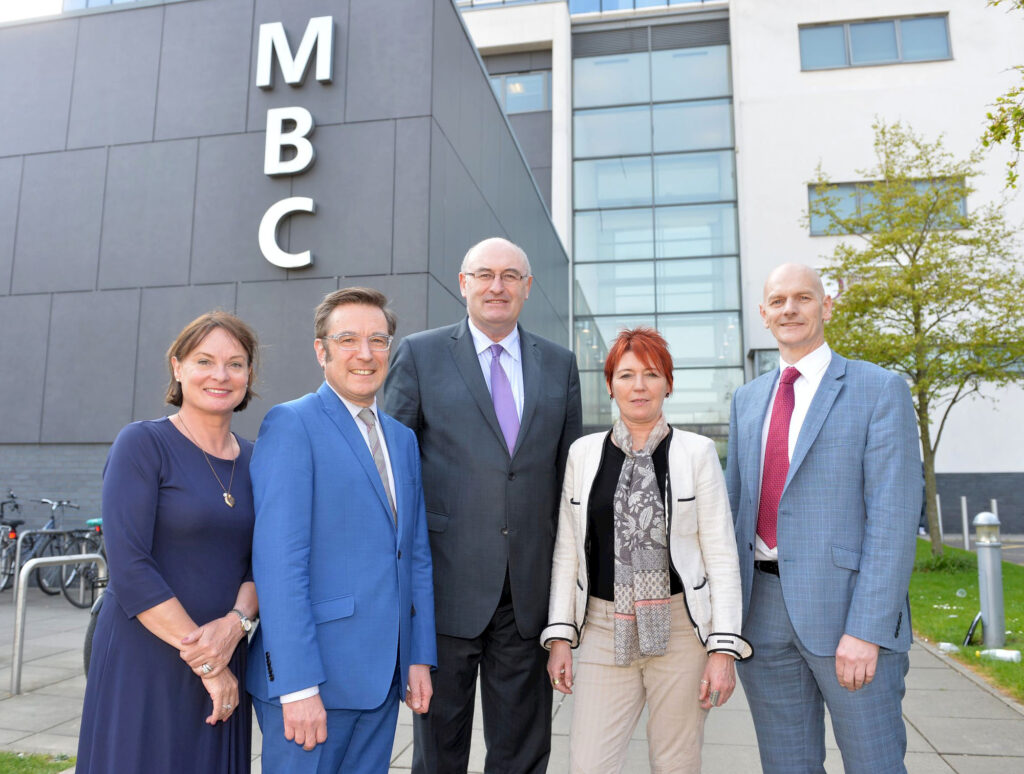
Pictured above: L-R: Ms Colette FitzGerald, Head of Office, European Commission Office in NI; Prof George Hutchinson, Director of the Gibson Institute at Queen’s University; Mr Phil Hogan, EU Commissioner for Agriculture and Rural Development; Dr Judith Stephens, School of Biological Sciences at Queen’s University; Prof Chris Elliott, Pro-Vice-Chancellor of the Faculty of Engineering and Physical Sciences at Queen’s University.