


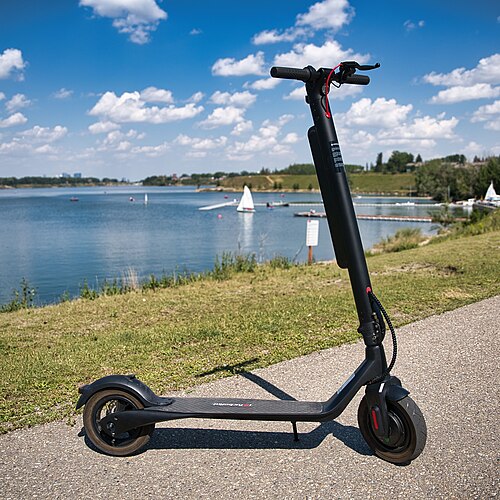
E-scooters are becoming increasingly used among children and young people in Northern Ireland, yet there is considerable confusion about the rules governing their use. This blog, prepared by Dr Chloe Hanna from the Centre for Evidence Based Youth Services, provides an accessible overview of the current legal position, focusing on what the law means in practice for young people and their parents and guardians. The blog forms part of the Centre for Evidence Based Youth Services’ wider work with community partners exploring problematic e-scooter use among young people.
E-scooters (electric scooters) have become an increasingly common sight on the streets of Northern Ireland, especially being used by children and young people. You have probably seen someone riding one to school, to work, to meet friends, or simply getting around their local area.
But there is a problem: Seeing e-scooters increasingly used on our roads and pavements does not mean they are legal to use there.
With their growing popularity comes confusion about what is and isn’t allowed… Can you ride your
e-scooter on the road? What about in your local park? Can you ride it to school or a youth club? Can the police stop you from riding one? And what happens if they do?
It can be difficult to know exactly what the rules and consequences are, particularly when you see other people riding e-scooters every day or come across different information online.
This quick guide from the Centre for Evidence Based Youth Services (CEBYS) looks at the current law around e-scooter use in Northern Ireland and what young people and their parents and guardians need to know.
Can Young People Legally Own an E-Scooter in Northern Ireland?
The short answer is yes – you can legally own, buy or sell an e-scooter in Northern Ireland. There is no specific rule making this unlawful.
However, there is an important difference between being allowed to own an e-scooter and the rules around where you can, and cannot, use them.
Under the current law, ordinary e-scooters cannot generally be used on public roads or other public areas in Northern Ireland. This includes streets, footpaths, pavements and cycle lanes. Instead, they are restricted to private land, with the landowner’s permission.
So, if owning an e-scooter does not mean you can simply ride it wherever you want, what does that mean for young people who own an e-scooter?
They could be breaking the law if they use an e-scooter to:
- Travel to school, work or a youth club
- Ride along the road to a friend’s house
- Ride around a public park
- Travel along a public cycle lane
- Ride around their local street with friends
Just because you see other people doing these things does not make it legal.
Why Can’t E-Scooters Be Used in Public?
This is largely because of how the law classifies e-scooters.
Northern Ireland road-traffic law treats e-scooters as motor vehicles. Although they may look very different from a car, van, or motorbike, e-scooters and their riders are still subject to the same road-traffic rules as other motor vehicles under The Road Traffic (Northern Ireland) Order 1995.
To be used lawfully on a public road, e-scooters would need to meet requirements such as:
- Insurance
- Registration and a number plate
- Vehicle tax
- Appropriate safety measures, including indicators, lights and reflectors
- A valid driving licence for the person operating the e-scooter
The problem is that ordinary e-scooters do not generally meet these requirements for lawful road use in Northern Ireland. Standard road insurance is also not currently available for e-scooters. Similarly, many young people who own and use them may not hold the required driving licence.
Therefore, e-scooters cannot currently be used on public roads in Northern Ireland. The law also prohibits motor vehicles, including e-scooters, from being used on footpaths and other public areas.
The bottom line is that unless you have access and permission to use private land, there is nowhere in Northern Ireland that young people can legally ride an e-scooter.
Can the Police Stop a Young Person Riding an E-Scooter? What Happens if they Do?
There is not a single, specific criminal offence called ‘illegal e-scooter use’ in Northern Ireland. Instead, because e-scooters are regarded as motor vehicles, the Police Service of Northern Ireland (PSNI) can enforce existing road-traffic law against e-scooter riders.
The PSNI can stop someone riding an e-scooter in public and take appropriate legal action where they suspect that a road-traffic offence has been committed. Depending on the circumstances, this can result in serious legal consequences for young people, for example:
- No insurance: £200 fine and 6 penalty points
- No valid driving licence: £1,000 fine and 3 to 6 points
- Using a mobile phone while riding: £200 fine and 6 points
- Riding while under the influence of drugs or alcohol: up to £5,000 fine, a potential driving ban and, in the most serious cases, imprisonment
Under The Criminal Justice (Northern Ireland) Order 2008, PSNI officers also have authority to seize e-scooters being used unlawfully or in a manner causing alarm, distress or annoyance, and subsequently destroy them.
Young people who do not yet have their driving licence might think that driving offences and penalty points are something they do not need to worry about. That is not necessarily the case; penalties can be recorded before they pass their driving test, meaning a road-traffic offence involving an e-scooter could potentially affect their future driving.
What About Parents and Guardians?
Parents and guardians should be aware that, depending on the circumstances, they may also face legal consequences.
Under ‘cause and permit’ road-traffic offences, a person can be held responsible for causing or allowing another person to use a motor vehicle unlawfully.
This means that if a parent or guardian buys an e-scooter for a young person and allows them to use it in public, they could potentially face consequences for permitting its unlawful use, including fines and penalty points on their own driving licence.
Parents and guardians should also consider their wider safeguarding responsibilities, particularly where inappropriate e-scooter use could place a young person at significant risk of harm.
Before buying an e-scooter for a young person, it is therefore important that parents and guardians consider where and how it will be used, as well as the potential consequences and risks involved if an e-scooter is used illegally.
What About the Rules in Other Places?
If you have searched online for information about e-scooters, you may have found that they are legal to use in other places.
For example, e-scooters have been allowed on public roads in the Republic of Ireland since 2024, with new regulations this year raising the minimum rider age to 18 and requiring riders to always wear a helmet and high-visibility clothing. In some areas of England, there are also pilot programmes allowing rental e-scooters to be used on roads and in cycle lanes under specific rules. However, privately owned e-scooters remain illegal to use in public in England, just as they are in Northern Ireland.
This means young people may see videos online of people legally riding e-scooters elsewhere and assume the same rules apply here. But they don’t; the law depends on where you are, and the fact that e-scooters are legal under certain conditions elsewhere in the UK and Ireland does not mean those rules apply in Northern Ireland.
Why Do the Rules Matter?
Facing legal consequences for using e-scooters in public is only one part of the picture; there are also important safety risks associated with their use.
E-scooters can travel at considerable speeds, while riders often have relatively little protection if they fall or collide with another road user. Collisions can involve cars, pedestrians, cyclists or other e-scooter users. Potholes, uneven surfaces and opening car doors can also create dangerous hazards.
Children and young people can be particularly vulnerable to serious injury. Belfast Health and Social Care Trust have reported treating more than 120 children for E-Scooter or E-Bike injuries over the last two years.
Wearing a helmet and protective equipment may reduce the severity of some injuries, but it cannot prevent a collision from happening in the first place.
For young people, knowing the law around e-scooters in Northern Ireland is about more than avoiding legal penalties. It is also about understanding that those rules are in place to protect riders and other road users, and how to make informed choices about where and how they will use e-scooters.
Will the Law Change?
The increasing use of e-scooters in Northern Ireland is prompting debate about whether our law needs to change.
E-scooters can provide a convenient way to make short journeys and may play a role in future transport systems. At the same time, they raise questions about road safety, insurance, enforcement and the protection of pedestrians and other road users.
While other places have taken different approaches to e-scooter rules, Northern Ireland’s recent political discussion has instead focused on enforcing existing law and strengthening PSNI’s powers to seize and destroy e-scooters used unlawfully or causing nuisance.
The law around e-scooters may change over time as Northern Ireland considers how best to respond to their increasing use. Until it does, the current rules still apply, and young people need to follow them.
So, What Should Young People Remember?
E-scooters are becoming increasingly common in Northern Ireland, but popularity and what young people see others doing, including online, do not necessarily reflect the rules around e-scooter use in Northern Ireland.
In September 2026, PSNI carried out a proactive operation targeting illegal e-scooter use, seizing 65 vehicles over one weekend, with the youngest rider encountered just six years old. Those involved are expected to face a range of criminal justice outcomes, including those discussed in this blog. The operation is a reminder that the law around e-scooters is being actively enforced in Northern Ireland – including where young people are involved.
If you are a young person thinking about using an e-scooter in Northern Ireland, or are a parent or guardian thinking about buying one for a young person, here are the key things to remember:
- You can legally buy and own an e-scooter.
- You cannot ride one wherever you want in Northern Ireland; e-scooters can generally only be used on private land with permission.
- Breaking road-traffic law can have serious legal consequences, including fines and penalty points, for both young people and/or their parents and guardians.
- The PSNI can stop someone from using an e-scooter illegally and may seize and destroy the e-scooter.
- What you see online or elsewhere may not apply in Northern Ireland.
- Knowing the law is only one part of staying safe.
So, before buying or using an e-scooter, make sure you understand where you can legally use it, the potential consequences, and how to stay safe.
About the Author
Dr Chloe Hanna is a Research Fellow at the Centre for Evidence Based Youth Services (CEBYS) at Queen’s University Belfast. Drawing on her background in law and socio-legal research, her work focuses on strengthening evidence-informed practice and supporting the development and recognition of high-quality youth services in Northern Ireland.
The featured image is licensed under the Creative Commons Attribution-Share Alike 4.0 International license