Tips on what to do with your assessment feedback – by Lydia Millar
Receiving feedback on your law assessments can be a daunting experience, especially when it feels like there’s a lot to improve upon. However, feedback is a valuable tool that can guide your academic growth, refine your legal skills, and boost your confidence. Whether it’s a detailed critique on your essay structure, an observation on your analysis, or comments on your referencing style, understanding and addressing feedback is essential to your development as a law student. In this post, we’ll explore practical tips on how to make the most of your feedback, turn it into actionable insights, and use it to elevate your performance in future assessments.
1. What is feedback?
Feedback is much more than a score or mark. Whilst markers differ in approach, feedback will normally take the form of several sentences or comments, picking up on what you did well in your answer and what you can improve upon. You may receive criticism but don’t panic! This will be constructive, meaning that you can build on it in the future. Remember that university marking is different – even if your answer is exceptional, it is rare to achieve a perfect score or a score that you may have been used to at A Level or school exams.
Feedback can be found on Canvas in the location where your assignment was uploaded:
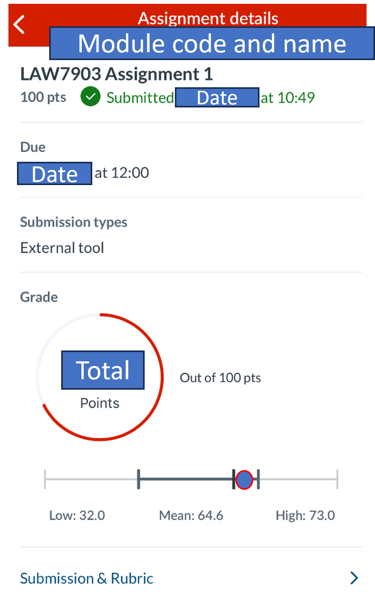
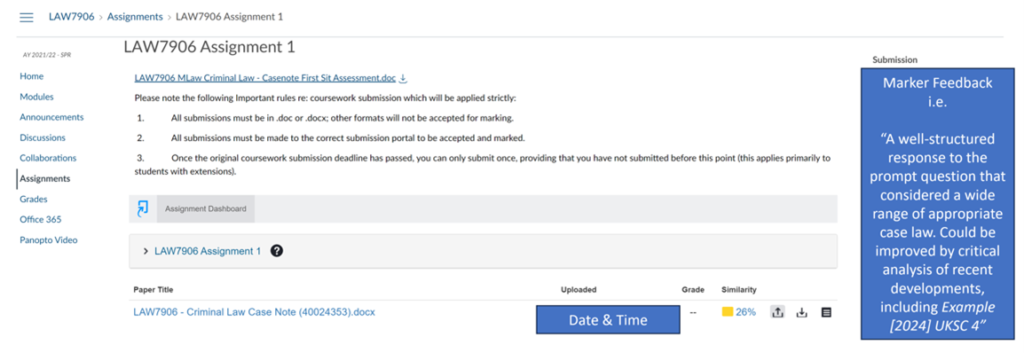
Assignment comments are located within your assignment on Canvas. These comments provide a general overview of what the assignment does well, where the assignment is less successful and points for future assignments. The grade out of 100, which relates to the conceptual equivalent scale, is also included in this section of Canvas.
If a transcript annotation is included, it is located on your assignment transcript on Canvas. Transcript annotation allows markers to highlight, underline or insert comments directly on a transcript to evaluate specific sections or points. If submitting on TurnItIn, it is possible to download the assignment transcript with marker annotation to keep for future reference.
2. Tips for Understanding Feedback on Academic Assignments
Receiving feedback on an assignment can feel like the much-anticipated end-point of a long research process. However, equipped with the right skills and an improvement-oriented mindset, every student can use feedback comments to reflect upon and improve their academic performance.
The University uses a conceptual equivalents scale for the assessment of student work. The use of the conceptual equivalents scale is mandatory for assignments that do not have clearly defined right and wrong answers. These types of assignments, such as essays, are often used to assess modules in AHSS.
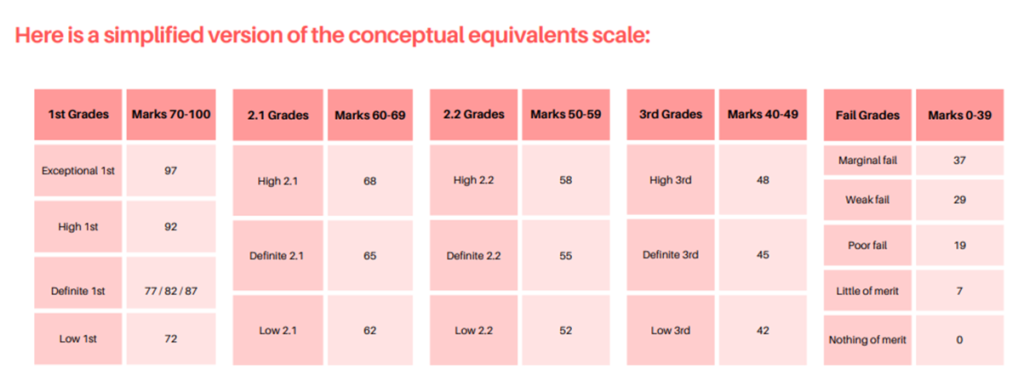
3. Feedback Comment Examples
Assignment feedback often includes specific feedback related to the subject topic, alongside commentary on a student’s proficiency in various academic skills related to the assignment. These academic skills can include the use of secondary criticism, writing style and argument development, or assignment formatting.
Below is a table of common positive and constructive feedback comment examples relating to these areas of academic skill:
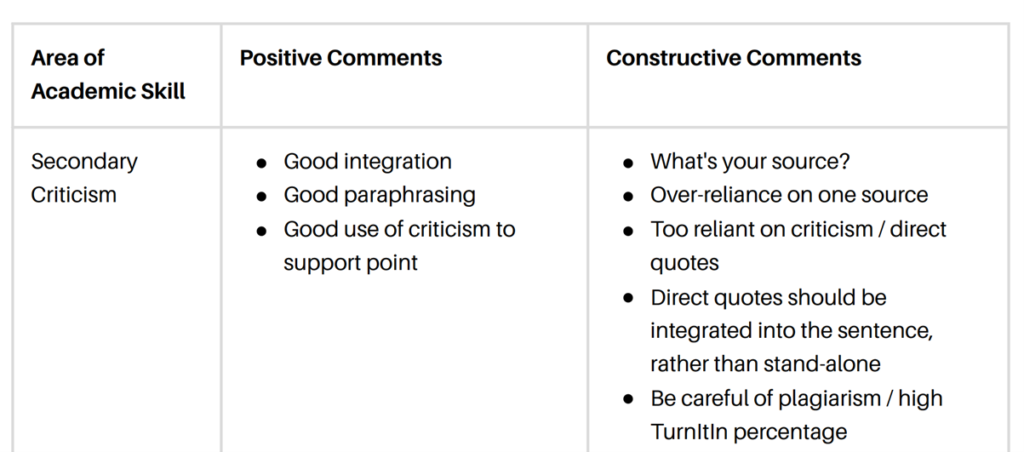
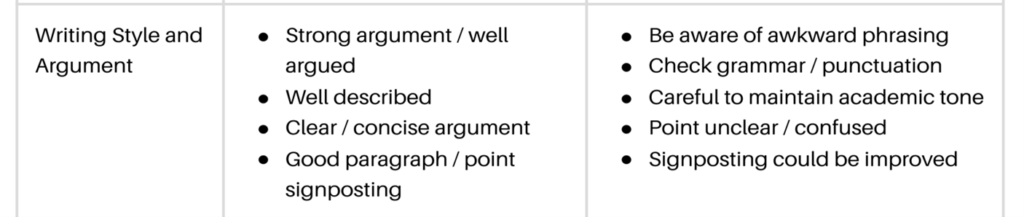
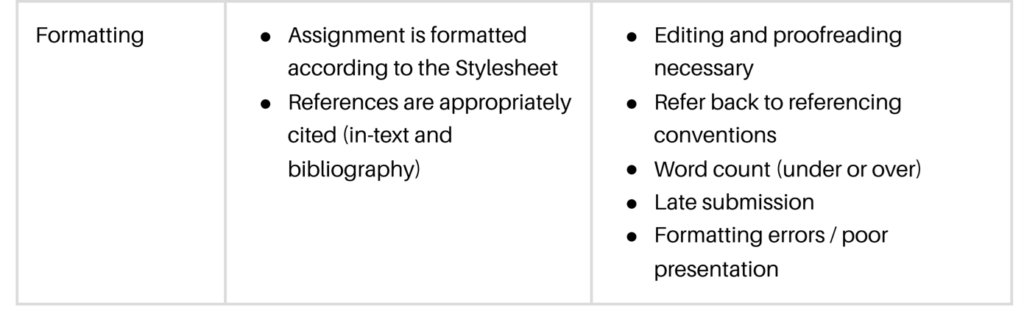
Let’s break down one of the skills in the table: secondary criticism. You can see that the marker has commented on the student’s good ‘integration.’ When considering whether your essay had good integration it is worth asking the following questions: does the essay contain unnecessary detail? Is the relevance of the issue clearly set out? Does it relate appropriately to the structure of the essay?
Another skill commented upon was to do with sources. It is best practice to cite law reports or academic articles in a reputable journal, i.e. Criminal Law Review. Don’t refer to websites like LawTeacher. The textbook is a great guide and will have citation for case law or good journal articles. However, be careful not to cite the textbook more than once or twice as it only summarises the material that you will want to interrogate. It is always a good tip to go the source of the information, whether it be from a case or an article, for your essays.
More generally, it is important to use the appropriate tone in essays and problem questions and make sure that you are always linking back to the core argument or essay question.
4. Tips for First year Students
It is okay to be disappointed! And remember, you are not the only student who will be disappointed with your mark. Give yourself some time to go over feedback and move on.
Look over your assessment feedback before starting a new assignment to remind yourself of what you need to work on.
Try to adopt a ‘glass half full’ attitude. Your markers are only trying to help you become the best student you can be.
For some, this might be your first Law School piece of feedback. Just remember that you have 3 years to improve and do better. Law School is a marathon not a sprint!
A lower mark does not mean that you shouldn’t be here, this is part of the learning process.
ESSENTIAL PIECE OF ADVICE: Do NOT compare your grades or yourself with others. It will only make you miserable. It is not anyone’s business what you got in your assignments and you are not obliged to share your score. Remember: ‘comparison is the thief of all joy.’
5. General Advice
- If you have concerns about feedback or assessment, contact the Module Convenor – their details will be on the module handbook or on canvas.
- If you want to chat in general about academic queries, please reach out to your Personal Tutor – their details are on QSIS.
- If you have non-academic queries related to illness/ extensions etc. reach out to your Advisor of Studies or Judith Paxton the Student Support Officer in the Law School.
- Referencing skills improve with practice, the OSCOLA guides have examples to refer back to and check your citations against.
- Structuring and planning your response helps with many areas of assessment, particularly word count and the flow of an argument.
- Make sure you’re familiar with the module handbook and specific assessment criteria.
- You can book one-to-one sessions with SSAs, a group workshop, or request a topic.
Studentskills-law@qub.ac.uk