
Many students are frightened of essay questions. This blog will help you to instead view essay questions as an opportunity to demonstrate your writing skills and legal knowledge! Remember that your Student Skills Assistants are available to help you with skills-based queries and can be contacted via studentskills-law@qub.ac.uk
Essays…
▪Enable you to shape your thoughts on a given topic
▪Develop and broaden your knowledge and understanding of a subject
▪Explore and research more deeply and engage in critical debate
▪Improve research and writing skills
You may also find that writing essays for set assignments can spark ideas for further work, e.g. a dissertation.
- Understand the Question
It is essential to plan your answer to an essay question.
The first step is to read the question thoroughly and establish what is being asked of you. A common mistake is to answer the question you’d liked to be asked rather than the question that is actually being asked. Crucial to avoiding this is to understand the meaning of the following question words:
Analyse: Find the main ideas, how they are related and why they are important.
Assess: Weigh up to what extent something is true.
Compare: Identify similarities and differences between two objects, concepts or ideas. Include what similarities and differences are more important than others.
Contrast: Identify dissimilarities, differences, unique or distinguishing characteristics.
Critically evaluate/ evaluate: Provide an opinion about whether a statement is true and whether you agree with it. Include evidence that agrees and disagrees with the statement and conclude by listing the most important factors and justify why you agree/disagree.
Discuss: Make a case for or against an argument and reach a conclusion. Point out the advantages and disadvantages.
Explore: Adopt a questioning approach and consider a variety of different viewpoints.
2. Research

•Begin by determining what reading material is relevant to the assignment.
•Refer to your notes to refresh yourself with the main points from the readings.
Ask yourself before you begin reading:
• What do I want to find out?
• What do I need to read to get the information I need?
• What is my point of view? Why do I think this?
Key point: Make use of the McClay library’s resources and access research databases including LexisNexis, HeinOnline and Westlaw online. Contact your subject librarian for help if needed!
3. Plan, Plan, Plan!
• Set yourself a timeframe: When do you want to achieve what? (e.g. reading = 1 week, writing = 1 week, editing/proof reading = 1 week)
• Structure:
– What are the key points/arguments you need to include
– Use sections and headings to make a plan
– Decide on the order of your sections/paragraphs
– Make links between each section
– Establish your conclusion
3A Signpost!
Often, it can be useful to write your introduction after completing your essay. This is because an introduction should signpost the direction that the main body of your essay will take: for example, “To answer this question, I will consider A and B, before moving on to an exploration of C in subsequent paragraphs.”
Don’t leave your ultimate conclusion a mystery either! Even though you may be exploring both sides of an issue in your answer, establish your ultimate conclusion early on and give a spoiler to readers!
3B Paragraph structure

-Write a list of your main points in the order you want them to appear
-New paragraph for each new point.
-Around 10% of word limit for introduction and 10% for conclusion
(a)Topic sentence – expresses your main point
(b)Supporting sentences – developing the main point, give back-up points, examples/quotes, refs
(c)Concluding sentence – gather together the content and leads onto the next paragraph
4. Edit
Leave a bit of time in between writing and editing
• Put yourself into the position of the reader: (Don’t assume prior knowledge)
-Has everything been defined?
-Can the reader follow your thinking?
-Can you summarise the key point of each paragraph and why it is relevant to your essay title?
-Is your language confident?
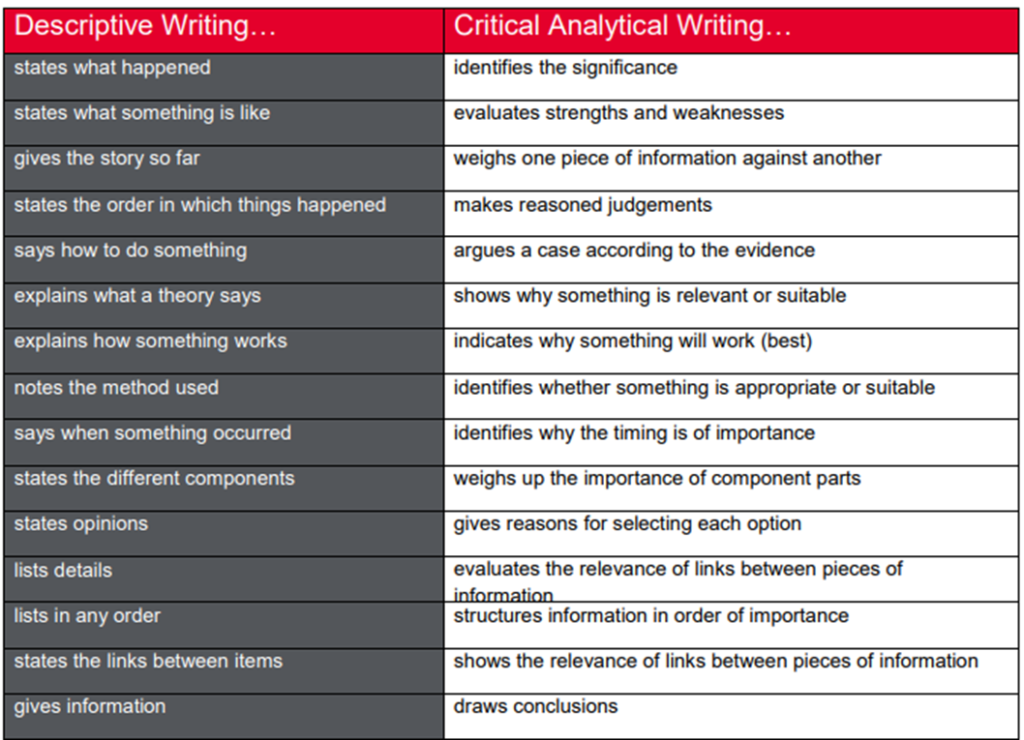
DOUBLE CHECK: Have I employed critical, analytical writing?
5. Proofread
▪What are you looking for?
– Spelling
– Grammar
– Missing words
– Spacing
– Words used inappropriately or in the wrong context (use dictionary to double-check meanings)
• Print it out to proofread your assignment
Is your referencing correct?
Following these steps and leaving lots of time for editing and proofreading is the best way to guarantee success in an essay question. Often, the research phase will take longer than the writing phase and the editing process can take just as long. Don’t be disheartened if you feel that your first draft isn’t your best work – it’s the same for everyone! Practice – and editing – makes perfect.