What is critical analysis and why do we do it?
From our early childhood, we have perfected the art of thinking critically; it is an everyday skill we employ in our daily interactions. Here is an example:
Read more: How to: Critically Read and AnalyseWe’re having a conversation and I tell you my favourite season is Autumn, I love the cosiness of warm jumpers and putting on my wellingtons for walks in the rain. You disagree, you hate the dark nights, instead, you prefer the summer because you love sunny hikes and there are more bank holidays to look forward to – whilst valid, you have listened to the evidence I presented to reason that Autumn is my favourite season, and you formulated your own evidence to disagree, favouring for Summer. You have applied critical thinking and presented an argument.
In academia, these critical analysis skills are employed more stylistically – and are recognised in two ways: critical thinking and critical writing.
As simply put by Glasgow Caledonian University, critical analysis in academia ‘involves reading and thinking widely about an issue in order to develop a deep understanding and a point of view in relation to the issue’.
However, it is important not to confuse critical thought with criticism. As explained by McMillan (2013: 4) critical thought is not about finding fault (as often associated with the term ‘criticism’), instead, the aim is ‘to arrive at (and discuss) a balanced view of a topic rather than create a one-sided treatment of the topic’.
Critical analysis means we are not taking things at face value – instead, we investigate the claims made by academic authors to form our own argument. This can be broken up into a three-part process: before, during and after. For example:
Before I begin my analysis, I ask myself ‘what is my point of view and why do I think this?’
During my research, reading academic sources, I ask myself ‘is the author’s argument effectively evidenced?’
After I read the source, I ask myself, ‘what part of the author’s argument do I want to use in my essay?’
Moreover, McMillan (2013: 4) describes critical thinking as:
- Incisive, seeing through complexity and obscurity
- Logical, deploying evidence towards a clear position
- Deep, involving higher level skills of analysis, synthesis and judgement.
Critical writing, then means, that based on your critical thinking, you write in a manner that persuades the readers of your point of view on a topic. This should be adapted in three ways:
- Description – What? When? Who? Where?
- Analysis – Why? How? What if? So what?
- Evaluation – What next? Why is this significant? How does this answer the question?
The Queen’s University Belfast Learning Development Service has formulated an Essay Writing Overview to support undergraduate students with their critical thinking and writing skills. Which we will take you through in the section below.
How do we critically read and analyse?
The practice of critically reading and analysing is a skill that can only be learned through practice. However, to understand what you should specifically seek from your readings, these guidelines can help you structure what you need to know.
- Identify what is being discussed in the paper, and how it contributes to your argument
- What is the topic discussed in this paper? What is the methodology used to present the argument?
- Judge the credibility of the sources
- Where is the paper being written from? What other work has the author published? Who funded the work, and how can that impact what the author is writing about? Does this limit what the paper can contribute to your argument?
- Evaluate and synthesise the evidence
- How can you place this author’s argument in the context of other authors you have read? Does the argument presented in this literature present a different view from other scholarly literature you have looked at? What are issues that have not been considered in the research?
- Draw and present your conclusions
- Now, place all the information into your argument; how does this author’s work support your argument? What does it not take into consideration?
Take your time in following these steps so you can thoroughly understand what the work is arguing and how it can be applied for your argument. Critical reading, writing, and analysis are all skills that need to be constantly learned when you’re a student – so don’t worry if it seems daunting at first!
EXAMPLE:
The question we’ve been given for an assignment is
“Discuss the impact of social media on students at Queen’s University Belfast.”
Let’s critically read and analyse the abstract for this paper by Gulati et al., (2020) below in applying it to our assignment question.
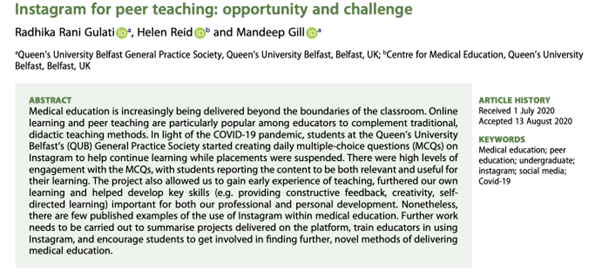
Now let’s see how we can critically analyse this abstract.
Identify what is being discussed in this paper
This paper is discussing how Instagram was used by Queen’s University students during the COVID-19 pandemic as a means to encourage learning whilst placement was suspended. The abstract does not discuss what methodology was used to collect data.
Judge the credibility of sources
As it says in the abstract, this paper is one of the first on peer teaching on Instagram in medical education, and more research needs to be completed to see how reliable the argument is in this abstract. Similarly, those who wrote the paper are based in Queen’s – there could potentially be a bias here in that they may not accurately show how Instagram negatively affected how student’s studied at Queen’s during the pandemic.
Evaluate and synthesise evidence
This paper presents the argument that social media improved the educational experience of students at Queen’s during the COVID-19 pandemic. However, can we compare that the online MCQs used during the pandemic were the same educational experience as being on placement? Are the two comparable? What does other research say about how students were educationally impacted during the pandemic whilst studying at Queen’s?
Draw and present your conclusions
Overall, this paper demonstrates how Instagram positively impacted the educational experience for students at Queen’s University Belfast during the pandemic by encouraging peer-to-peer learning through MCQs. However, can we say that this was the same educational experience provided to medical students who were not able to complete their placement due to the pandemic?
Bibliography:
Glasgow Caledonian University. Glasgow School for Business and Society: Critical Analysis. https://www.gcu.ac.uk/aboutgcu/academicschools/gsbs/study/ldc/academicwriting/criticalanalysis (accessed 24th November 2022).
McMillan, K. (2013) How to Improve your Critical Thinking & Reflective Skills, United Kingdom: Pearson Education UK.
Learning Development Service. (2022) Essay Writing Overview. Belfast: Queen’s University Belfast.
Written by:

Seanín Little
To contact Seanín for a one-to-one or group appointment on critical reading and analysis, contact studentskills-law@qub.ac.uk