
Written by Dr Siobhán McAlister and Dr Gail Neill. Posted on 25 March 2026
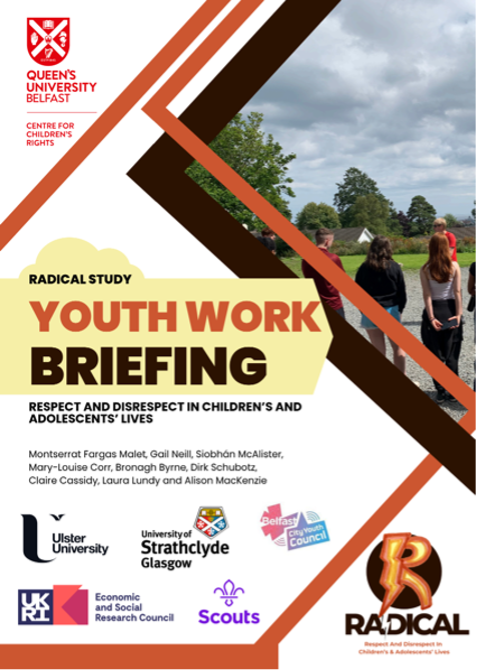
Dr Siobhán McAlister and Dr Gail Neill respond to a post by young person, Rebecca Deane McCann (found here). In doing so, they highlight the relationship between children’s rights and youth work. They argue that funding cuts, short-term funding cycles, and policy delays not only put youth work at jeopardy but also threaten children’s rights. They showcase the findings of the recent RADICAL research project led by the Centre of Children’s Rights, Queen’s University Belfast as evidence of the need for, and value of, youth services.
Youth services in Northern Ireland have always faced a degree of uncertainty, but the sense of precarity is especially heightened at the moment. A combination of funding cuts to the voluntary sector and to the education budget, short-term funding cycles and policy delays are all putting youth work at jeopardy. The Education Minister’s decision to no longer ring fence funding for youth services is particularly concerning. Cuts, delays, and uncertainty around youth services have direct implications for children’s rights under the United Nations Convention on the Rights of the Child (UNCRC). Youth work isn’t just a service; it is one of the practical ways through which many of the rights of children and young people are delivered.
Recent research led by Centre for Children’s Rights at Queen’s University Belfast explored children and young people’s understandings and experiences of respect and disrespect. What the research found is stark. Many children and young people reported feeling dismissed, unheard and undervalued because of their age, and 78% of 16-year-olds said young people are less respected than adults. Some groups, including children and young people with disabilities, same-sex attracted young people, young women and those from less affluent backgrounds, reported even greater experiences of disrespect. The research also found a correlation between experiences of respect/disrespect and mental well-being (Adams et al., 2026). In this context, the finding that youth provision stood out as a place where young people feel respected should make policymakers stop and think.
Engaging with more than 5,300 children and young people across Northern Ireland, the research found youth clubs/programmes to be one of the most consistently reported places in which children and young people feel respected. In surveys, 73% of 10-year-olds and 79% of 16-year-olds identified youth clubs/centres as places in which children/young people are always or mostly respected. In individual and group interviews, youth clubs/programmes were described as fun and ‘safe’ spaces, where children and young people make friends, ‘where you can express yourself’ and ‘not feel any judgement’, where people ‘treat you with kindness’ and where young people feel supported emotionally (Fargas-Malet et al., 2026). Many reported feeling listened to and encouraged in a way different to their experiences in schools. In short, children and young people of various ages and backgrounds report feeling safe, included and recognised for who and what they are, without competition, pressure or prejudice. While this highlights the value of universal youth services, those who were marginalised or had been excluded elsewhere, spoke of the difference youth provision had made to their confidence, well-being and their educational outcomes. Some, for instance, spoke of gaining qualifications that they would never have gained in school: ‘… the amount of qualifications I’ve got from being in [youth programme] and being in different youth clubs is probably close to the same as the amount that I’d have got in school …’ (Fargas-Malet et al., 2026).
This is why the current funding picture is so troubling. Even where some funding exists, instability undermines continuity, planning and relationships. And in youth work, relationships are key. If young people experience these settings as one of the main places in which they are respected and supported, then insecure funding places that protective and empowering resource at risk.
Children have the right to rest, play and leisure and the State has a responsibility to respect, protect and fulfil this right (UNCRC, Art 31). Youth programmes are often the main providers of these opportunities, and the evidence from our research demonstrates that through them, an array of other rights are met. The current ‘funding cliff-edge’ puts children’s rights at risk. Youth services support children’s development (UNCRC, Art.6), protection (UNCRC, Art.19), and participation rights (UNCRC, Art.12). They often provide early and informal mental health support (UNCRC, Art 24), are spaces where children and young people learn to express their views (UNCRC, Art. 12) and are provided with a range of information to make informed decisions about their lives (UNCRC, Art 13). Cuts to youth provision will inevitably reduce (equal) access (UNCRC, Art 2) to safe spaces and personal development opportunities. While all will be affected, the impact will be greatest for those whom youth provision is their ‘sanctuary’ (Tickle, 2016) or their main means of education (UNCRC, Art 28 & 29). Indeed, ‘education’ will inevitably be narrower and less inclusive with cuts to youth provision.
The case for sustained investment in youth services in Northern Ireland is not only an ethical and practical one, but a rights-based one. Uncertainty in funding risks compromising the progressive realisation of children’s rights and questions the States commitment to prioritise the best interests of the child (UNCRC, Art. 3). A genuine commitment to children’s rights requires sustained, secure investment in youth work. Services that support young people to feel heard, safe, included and respected should be embedded as core elements of education provision and must not be deprioritised in budget decisions.
Funding statement: The RADICAL project was funded by the ESRC, grant number ES/X007588/1.
About the Authors

Dr Siobhán McAlister is a Reader in Criminology and a member of the Centre for Children’s Rights at QUB. She is project lead for the Centre’s ESRC-funded project examining Respect And Disrepect in Children’s and Adolescents’ Lives (RADICAL)

Dr Gail Neill is a Lecturer in Community Youth Work and lead of the Centre for Youth Research and Dialogue at Ulster University. She was responsible for carrying out and analysing narrative interviews as part of the RADICAL project.