In this post, young people Ellie May and Isla discuss their experience of being deaf and why the Sign Language Act (Northern Ireland) 2026 is important. They argue that the Act “gives us hope for the future” as it “sends a powerful message that deaf people are capable and deserve equal opportunities”. Going forward, they emphasise the importance of free sign language classes and encouraging schools to provide better support.
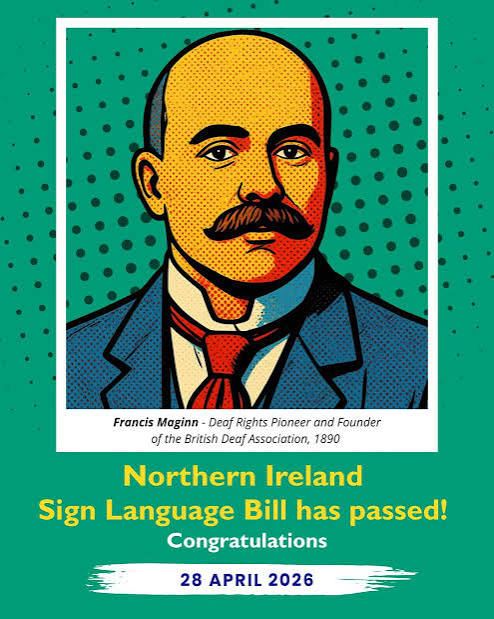
Earlier this year, we went to see a play about the life of Francis Maginn, a deaf man from Belfast who worked hard to improve the lives of deaf people over 100 years ago. We learned about the challenges deaf people faced in the past, and honestly, we were shocked. It made us think about our own experiences as deaf young people today and how much still needs to change.
The play about Francis Maginn taught us a lot. We learned about the 1880 Milan Conference, where sign language was banned from many schools around the world. Deaf people were often made to feel as though there was something wrong with them.
Francis Maginn fought against these attitudes and worked to protect sign language and deaf culture. Looking back at history shows us how far we have come, but it also reminds us why protecting sign language is so important today.
Being the Only Deaf Student
We both attend mainstream schools where most students and teachers can hear. Sometimes, being the only deaf person in school can feel lonely.
There are lots of communication barriers. It can be difficult to join conversations, especially when people speak quickly or forget to face you when talking. Making friends can also be challenging because some people focus on what makes you different instead of getting to know you.
By the end of the school day, we are often exhausted. Listening and concentrating all day takes a huge amount of energy. Many parents of deaf children notice how tired their children are when they come home from school. After a whole week of listening, we can feel completely worn out.
Learning Should Be Accessible
Deaf students need the right support to learn. Sometimes it can be difficult to get a classroom assistant who knows sign language. Teachers may talk while writing on the board, which means we can miss important information because we cannot watch both and lipread and write at the same time.
Many deaf young people spend a lot of time explaining their needs to new teachers. It can feel like we are responsible for raising awareness all the time.
Schools need to think more about inclusion. Having quiet time to rest from listening would help many deaf students. If sign language was used more in schools, learning would still require concentration, but it would be less exhausting. We would have more opportunities to communicate in the way that feels most natural to us.
Communication Beyond School
Communication barriers do not only exist in school. Everyday places such as shops, hospitals, and other public services can also be difficult for deaf children and young people to navigate.
Something as simple as asking a question, making an appointment, or understanding important information can become stressful when there is no accessible communication available.
A Day We Will Never Forget
One of the most exciting experiences we have ever had was attending the Northern Ireland Assembly when the Sign Language Bill was passed. This is important because the new law recognises sign language as a real and official language and it will help ensure deaf children and young people have access to interpreters and support when they need it.
Before going into the Assembly, we felt nervous and wondered whether it would really happen. Sitting in the public gallery and watching the debate was amazing. It felt overwhelming, but in a good way.
Afterwards, there were celebrations and speeches. It was inspiring to hear people talking about the future of sign language. We were especially proud when the Minister recognised our work in helping to make free sign language classes part of the new law.
We realised that we were witnessing an important moment for deaf people across Northern Ireland.
Free Sign Language Classes
We believe free sign language classes are incredibly important.
They give deaf young people the chance to learn sign language, build confidence, and meet other deaf people. They also help hearing family members learn how to communicate more easily with their deaf relatives.
Sometimes deaf children do not have opportunities to learn sign language or connect with the deaf community. Free classes can help change that. Even learning some basic signs can make a big difference.
Technology Helps, But It Doesn’t Change Who We Are
Technology such as hearing aids, cochlear implants, and BAHAs (bone anchored hearing aids) can be very useful and help many deaf people access sound.
However, wearing hearing technology does not make someone a hearing person. Deaf people have different levels of hearing loss and different experiences. There is no “one size fits all” solution.
That is why many deaf people dislike terms such as “hearing impaired” because they can give the impression that deafness is something that needs to be fixed. Being deaf is part of who we are.
Looking Ahead
The passing of the Sign Language Bill gives us hope for the future. We hope this law encourages schools and organisations to improve what they do for deaf people. It sends a powerful message that deaf people are capable and deserve equal opportunities.
We hope to see better support in schools, more accessible services, and more opportunities for deaf young people to come together, learn, and make friends.
Francis Maginn fought for deaf people’s rights more than a century ago. Thanks to people like him, and thanks to the work still happening today, we can continue building a future where deaf young people feel included, valued, and proud of who they are.
Discover more from The Children's Rights Blog
Subscribe to get the latest posts sent to your email.