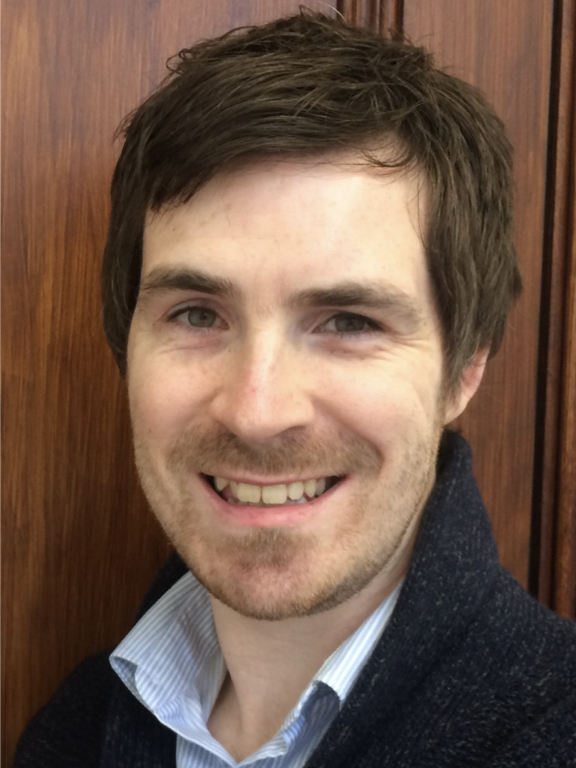
Dermot is (full/chaired) Professor of Theoretical Physics and Chemistry. He directs a research group at Queen’s University Belfast, which is & has been funded by the European Research Council [Consolidator Grant “ANTIMATTER” 2025-2030; Starting Grant “ANTI-ATOM” 2019-2024] and EPSRC [Fellowship in Theoretical Physics, 2015-2019]. See below for a brief CV.
Contact
Office 01.007 Old Physics (Lanyon Building)
Centre for Light-Matter Interactions
School of Mathematics and Physics
Queen’s University Belfast
Belfast BT7 1NN, Northern Ireland, United Kingdom
d.green [AT] qub.ac.uk
Office Telephone:
UK: 028 90 97 1928
Intl: +44 28 90 97 1928
Brief CV
Born August 1985. Obtained PhD 15 December 2011.
2025 — present (Full/Chaired) Professor of Theoretical Physics and Chemistry, Queen’s University Belfast, Northern Ireland, United Kingdom.
2018 — 2025 Reader in Applied Mathematics and Theoretical Physics, Queen’s University Belfast.
2025 — 2030 European Research Council Consolidator Grant “ANTIMATTER” (€2M). Principal investigator and research group director.
2019 — 2024 European Research Council Starting Grant “ANTI-ATOM” (€1.32). Principal investigator and research group director.
2015 — 2019 EPSRC Fellow in Theoretical Physics, Queen’s University Belfast, Northern Ireland, United Kingdom.
2013 — 2015 Research associate in the ultracold theory group of Jeremy Hutson FRS and (the first) Junior Research Fellow in the Sciences of Hatfield College, Durham University, United Kingdom.
2012 — 2013 Research Fellow, Centre for Plasma Physics, Queen’s University Belfast, Belfast, Northern Ireland, United Kingdom.
2010 Visiting Fellow, Harvard University Physics Department, based at the Institute of Theoretical Atomic, Molecular and Optical Physics (ITAMP), Harvard-Smithsonian Centre for Astrophysics, Cambridge, MA, USA.
2008 — 2011 PhD, Theoretical Atomic Physics, Queen’s University Belfast, Belfast, Northern Ireland, United Kingdom.
2004 — 2008 1st class MPhys University of Oxford, as Theobald Scholar of Balliol College, Oxford, United Kingdom, and a first-generation university student.
1997 — 2004 Belfast Royal Academy Grammar School, Belfast, Northern Ireland, United Kingdom. (Non-fee-paying voluntary grammar school, the oldest in Belfast city).
Selected prizes, awards and research funding
2025 The International CMOA (Centre de Mécanique Ondulatoire Appliquée) Promising Scientist Prize (for those under 40 yrs), awarded by at The Sénat (French Parliament), Paris, France during the 27th QSCP (Quantum Systems in Chemistry, Physics and Biology) by Profs. Rodney Bartlett and Jean Maruani. Citation: “For scientific and human endeavours.”
2024 European Research Council Consolidator Grant (EUR 2M).
2019 Institute of Physics Sir David Bates prize for outstanding contributions to quantum, atomic, molecular and plasma physics.
2018 Queen’s University Belfast Vice-Chancellor’s Research Prize.
2018 European Research Council Starting Grant (EUR 1.32M).
2018 EPSRC UK Early-Career Fellowship (~£900k, declined).
2017 “ICPEAC Sheldon Datz Prize”, for outstanding young scientist in atomic physics (selected by the international committee of the International Conference on Photonic, Electronic and Atomic Collisions), awarded in Sheldon Datz plenary session at ICPEAC XXX, Cairns, Australia
2015 EPSRC UK Postdoctoral Fellowship in Theoretical Physics (£260k).
2015 Leverhulme Trust Early-Career Fellowship (declined).
2013 — 2015 (The first) Junior Research Fellowship in the Sciences, Hatfield College, Durham University, Durham, United Kingdom.
2010 Institute of Physics Rosse medal for graduate research communication.
2010 Visiting Fellowship, Harvard University, USA, based at ITAMP, Harvard-Smithsonian Centre for Astrophysics, Cambridge, MA, USA.
2005 — 2008 Theobald Scholarship, Balliol College, University of Oxford (elected by the Fellows, for academic excellence in Physics)
High-performance computing grants
2025 Access to ARCHER2 (UK National Supercomputer), 185,000 CU hours (notional cost = £37,000)
2022 eCSE EPSRC award (with Dr Martin Plummer and Dr Alin Elena, Daresbury Laboratory).
2021 Access to ARCHER2 (UK National Supercomputer), 60,000 CU hours (notional cost £12,000)
Other positions of international and national leadership in science and society & other commissions of trust
Currently:
- Chair of the Northern Ireland Department of Education Curriculum Taskforce Science Group, leading design of the new Northern Ireland science curriculum for 5-13 year olds (2025-2026).
- Member of the Institute of Physics UK Council of Trustees (2024-2026).
- Chair of the Board of Directors, Institute of Physics of Ireland.
- Vice-Chair of the Institute of Physics Ireland Committee (2024-2025) (previously Chair 2022-2024).
- Member (outgoing Chair) of the International Scientific Advisory Committee for the International Workshop on Positron and Positronium Physics and Co Chair of POSMOL (2021-present).
- Member of the international General Committee for the International Conference on Photonic, Electronic, Atomic Collisions (ICPEAC) (2023-2027).
- Board member/Trustee of the Northern Ireland Science Festival (from end of 2025).
- Member of the CCEA (Council for the Curriculum, Examinations and Assessment) Northern Ireland Subject (Physics) advisory group.
- Specialist Editor (Atomic, Molecular and Optical Physics), Computer Physics Communications.
- Fellow of the Young Academy of Europe.
- Member (one of the first cohort of 40) Young Academy of Ireland (2023-2027).
- Member of the CCP9 (UK Collaborative Computational Project in Electronic Structure Theory) Working Group.
- Member of the EPSRC Peer Review College: reviewer for EPSRC and STFC UK, including Early-Career, Future-Leaders and Stephen Hawking Fellowship schemes, and other European funding agency grants.
- Member of the UKRI Talent Peer Review College (UKRI PRC).
- Regular reviewer for Physical Review Letters, Physical Review journals, EPJD, J. Phys. Chem., Phys. Chem. Chem. Phys., RSC Advances, etc
- Member of the Institute of Physics (MInstP).
Previously
- Chair of the Institute of Physics Ireland Committee (2022-2024).
- Chair of the International Scientific Advisory Committee for the International Workshop on Positron and Positronium Physics and Co Chair of POSMOL (2023-2025).
- Secretary of the Institute of Physics Atomic and Molecular Interactions Group (AMIG, 2020-2023).
- Treasurer, Institute of Physics Ireland (2018-2022), and before then ordinary committee member (2016-2018).
- External examiner (PhD): UNSW, Australia; University of Helsinki; University of Manchester/CERN; Curtin University, Perth, Australia; Open University, UK.
- Member of the CCPQ steering group (Collaborative Computational Project Q – Quantum dynamics in Atomic, Molecular and Optical Physics).
- Member of the College Council, Hatfield College, Durham University, Durham, United Kingdom (2013 — 2015).
- Committee member, Institute of Physics North East branch (2014 — 2015).
Selected talks at international conferences and academic institutions
- [CMOA prize talk] QSCP XX-VII (27th International Workshop on Quantum Systems in Chemistry, Physics and Biology), Sorbonne Université, Paris 2025.
- [Invited] ECAMP 15 (15th European Conference on Atoms, Molecules and Photons), Innsbruck, Austria, July 2025.
- [Invited] WATOC (13th Triennial Congress of the World Association of Theoretical and Computational Chemists), Oslo, Norway, June, 2025.
- [Plenary] PPC2024 (International Conference on Positron and Positronium Chemistry), Kanazawa, Japan (October 2024).
- [Invited] Jagiellonian Symposium on Advances in Particle Physics and Medicine (Krakow, Poland, July 2024)]
- [Invited] ESCMQC (European Seminar on Computational Methods in Quantum Chemistry), aka the Strasbourg Seminars, Denmark 2024 (June 2024).
- [Invited] DAMOP, USA 2024 (June 2024).
- [Invited] CCP9 (Collaborative Computational Project in Electronic Structure), Chester, UK, March 2024.
- [Plenary] The International Workshop on Positron and Positronium Physics (POSMOL 2023), Notre Dame, USA, flagship biennial). (EPJD sponsored Plenary talk)
- [Invited] The International Conference on Photonic, Atomic and Electronic Collisions (ICPEAC 2023, flagship biennial).
- [Plenary] The 2022 International Conference on Positron Annihilation (Helsinki/virtual), flagship triennial, plenary talk.
- DAMOP 2022, American Physical Society’s 53rd meeting of the Division of Atomic, Molecular and Optical Physics community (international conference, talk in the memorial session for Richard Drachman).
- [Invited] GEC 2021: the 74th International Gaseous Electronics Conference (invited talk).
- [Invited] DAMOP 2021, American Physical Society’s 52nd meeting of the Division of Atomic, Molecular and Optical Physics community (international conference, invited talk).
- [Invited; The Institute of Physics UK Sir David Bates Prize talk] International Conference in Quantum, Atomic and Molecular Physics (QuAMP 2019), Birmingham, United Kingdom.
- [Invited] The XX International Workshop on Low-Energy Positron and Positronium Physics (POSMOL 2019), Belgrade, Serbia (Invited talk).
- The International Conference on Atomic and Molecular Data and Their Applications (ICAMDATA 2018), Harvard Smithsonian Astrophysical Observatory, Harvard University, USA, Nov. 2018.
- [Invited] The (triennial) International Conference on Positron Annihilation (ICPA 2018), Orlando Florida, USA, Aug. 2018 (Invited talk).
- [Invited] The International Conference on Photonic, Electronic and Atomic Collisions (ICPEAC XXX), Cairns, Queensland, Australia, Jul. 2017 (Invited ‘Special Report’)
- EGAS 2017 (49th conference of the European Group on Atomic Systems), Durham University, Durham, United Kingdom, Jul 2017.
- [Invited] International workshop on Quantum Systems in Chemistry, Physics, and Biology (QSCP-XXI), University of British Columbia, Vancouver, Canada, Jul. 2016 (Invited talk).
- [Invited] International Conference on Positron Annihilation (ICPA-17), Wuhan, China, Sep. 2015 (Invited Talk).
- [Invited] Dept. of Physics, Swansea University, United Kingdom, Apr. 2015 (Invited Talk).
- [Invited] Dept. of Chemistry, Cambridge University, United Kingdom, Oct. 2014 (Invited Talk).
- QuAMP 2013, Swansea University, United Kingdom Sep. 2013.
- Institute of Physics Atomic Molecular interactions Group (AMIG) meeting, NUI Maynooth 2013.
- [Invited] United Kingdom Positron Physics workshop, Queen’s University Belfast, Mar. 2013 (Invited Talk).
- Inaugural International workshop of Positrons in Astrophysics, Murren, Switzerland, 2012.
- EGAS 2011, (43rd Congress of the European Group on Atomic Systems), Fribourg, Switzerland, 2011.
- [Invited] PSPA 10 (39th Polish Seminar on Positron Annihilation), Kasimierz Dolny, Poland, Jun. 2010 (Invited).
Directing research group/PhD supervision
Current group members:
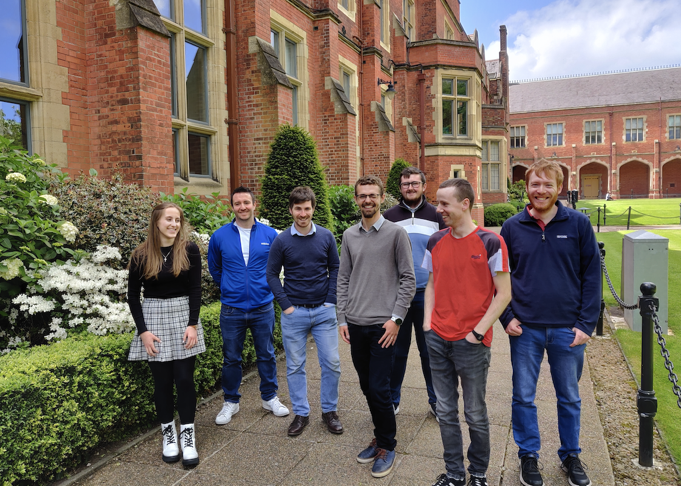
1. Dr Andrew Swann; Senior Research Fellow 2025-present; previously a Research Fellow (2021-2022) and 2022-2024 a Mathematics teacher;
2. Dr Sarah Gregg 2025-present; Research Fellow.
3. Dr Brian Cunningham; Research Software Engineer at Northern Ireland High-Performance Computing, with us at 20% full-time equivalent; 2025-present. Previously 04/2019-06/2024 Research Fellow; awarded QUB Postdoctoral Research Prize 2023;
4. Dr Steven Cousens; Research Software Engineer at Northern Ireland High-Performance Computing, with us at 20% full-time equivalent;
5. Tiarnan Smyth (PhD student 2024-present)
6. Taylor Scott (PhD student, starting Oct 2025)
Alumni; Postdoctoral Research Fellows:
- Dr Charlie Rawlins 2019-2021, subsequently a 4-year Research Fellow in QUB Mathematics.
Alumni; PhD students:
Dermot has supervised the following PhD students to graduation:
- Dr Sarah Gregg 2021-2025.
- Dr Jack Cassidy, 2020-2024, now staff at NISRA (Northern Ireland Statistics Research Agency).
- Dr Jaroslav Hofierka, 2019-2023; recipient of the prestigious biennial Milan-Odenhal award of the Czech Physical Society for his PhD thesis work. Subsequently Postdoctoral Research Associate at Heidelberg University with Prof Lorenz Cederbaum).
- Dr David Waide, graduated PhD QUB 2023 (co-supervised with Gleb Gribakin); subsequently Postdoctoral Research Associate at Trinity College Dublin.
- Dr Chris Emerson (second supervisor; primary supervisor Prof J. Coulter, QUB Pharmacy); subsequently Celerion Clinical Trials – Data programmer
Dermot has also supervised MSci, MMath and BSc undergraduate research project students, yearly since 2015.
Other governance and academic duties
I hold a Postgraduate Certificate in Higher Education Teaching and am a Fellow of the UK Higher Education Academy. In 2020 I was awarded a 2021 QUB Teaching award for the development of innovative technologies and an effective connected learning environment.
- 2025-present: Fellowship Academy Representative on the QUB Research and Innovation Committee.
- 2021-present: Member of QUB Academic Council (part of the University governance structure).
- 2022-present: Erasmus and Study-abroad coordinator for Mathematics, School of Mathematics and Physics, QUB.
- 2020-present: PhD Coordinator, Centre for Theoretical Atomic, Molecular and Optical Physics, QUB (administrative and pastoral role).
- 2020-present: Seminar coordinator, Centre for Theoretical Atomic, Molecular and Optical Physics, QUB.
Lecturing: QUB Applied Mathematics and Theoretical Physics
Most recently I lecture ~200 undergraduates in mathematics/applied mathematics and theoretical physics, including mathematical methods e.g., introduction to calculus in 3D: see Lightboard Lectures on my YouTube channel, advanced quantum theory etc.
I also supervise multiple undergraduate MSci and BSc projects in applied mathematics and theoretical physics yearly, and take small group tutorials in mathematics, and am Adviser of Studies for a number of international students.
Previously I’ve lectured 3rd and 4th year undergraduate masters students on Tensor field theory (tensor algebra, special relativity and covariant electromagnetism. Lectures on my YouTube channel); Advanced quantum theory; and Advanced numerical analysis.